

Data center lighting design isn’t just about visibility-it’s about operational efficiency, equipment protection, and cost control. Poor lighting choices lead to higher energy bills, equipment failures, and maintenance headaches.
At PacLights, we’ve seen firsthand how the right lighting strategy transforms data center performance. This guide covers the standards, technologies, and practical steps you need to implement lighting that actually works.
What Lighting Levels Do Data Centers Actually Need
Data center lighting design isn’t just about visibility-it’s about operational efficiency, equipment protection, and cost control. Server rooms operate under strict illumination requirements that differ dramatically from standard commercial buildings. These specifications come directly from NFPA 101, OSHA 1910.37/38, UL 924, and TIA-942, standards that govern critical facility operations.
Illumination Targets Vary by Zone
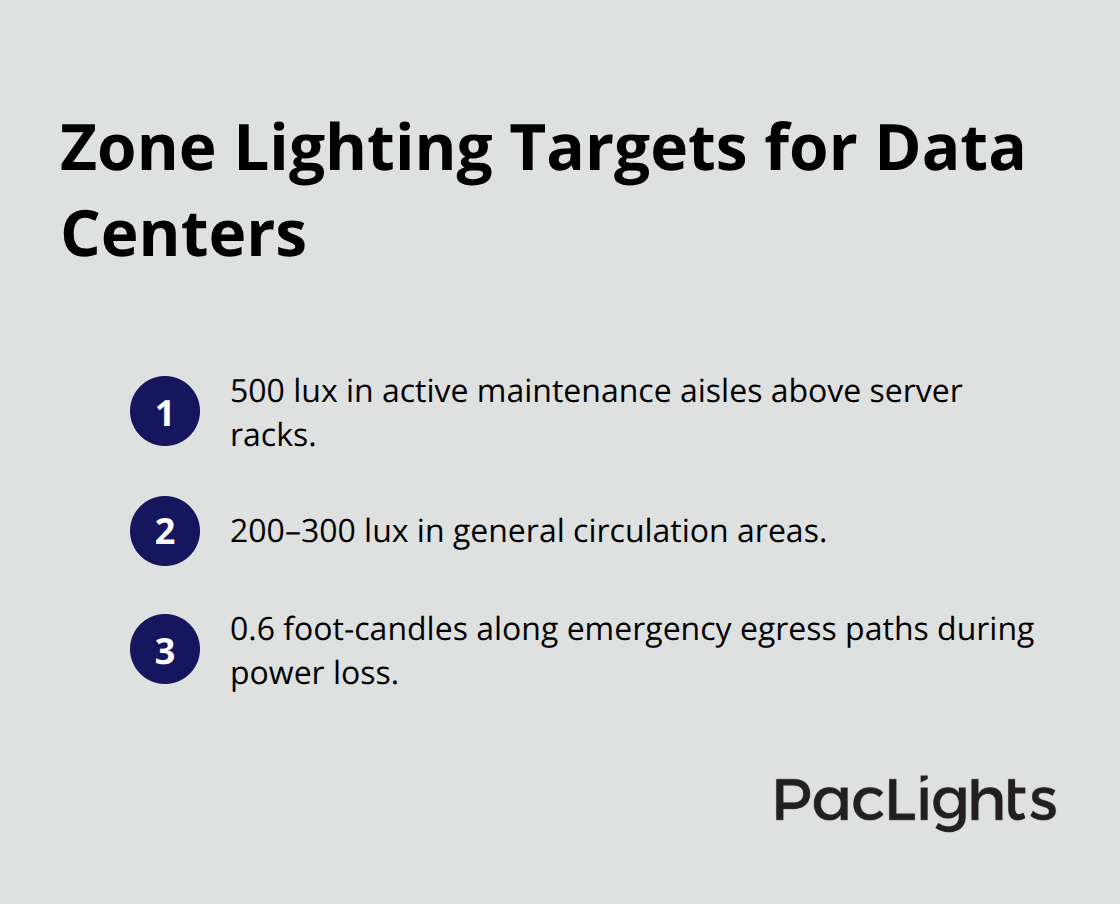
Server rooms demand 500 lux in active maintenance aisles where technicians work on equipment, while general circulation areas require only 200 to 300 lux. Emergency egress paths must maintain a minimum of 0.6 foot-candles during power loss, far below normal operating levels.
The mistake most operators make is over-lighting entire data halls uniformly, which wastes energy on areas where people rarely work. Instead, precision lighting concentrates brightness where technicians actually need it-directly above server racks and in maintenance corridors. This targeted approach cuts lighting energy consumption by 30 to 40 percent compared to warehouse-style fixture designs that flood every square foot equally.
Color Temperature and CRI Drive Accuracy
Cool white lighting at 4000K to 5000K isn’t optional for data centers-it’s a performance requirement. This color range directly boosts technician alertness and reduces eye strain during long maintenance shifts, which translates to fewer equipment misreadings and operational errors. Poor color temperature forces workers to squint at equipment labels and status indicators, introducing mistakes that cost far more than the lighting upgrade itself. TIA-942 specifically recommends this range because data center work demands precision; a technician who misidentifies a cable or switch can trigger cascading failures across entire infrastructure.
Beyond color temperature, CRI (Color Rendering Index) of 90 or higher ensures that equipment colors display accurately. Red warning lights appear genuinely red, green status indicators remain clearly green, and technicians spot physical damage or corrosion on hardware instantly. The three-level lighting protocol used by major operators implements Level 1 dimming during vacant periods for surveillance, Level 2 normal brightness when staff are present, and Level 3 maximum output during intensive maintenance work. This dynamic approach keeps energy costs down while maintaining safety and operational visibility at every phase.
Emergency Lighting Systems Prevent Catastrophic Failures
Compliance with NFPA 101, OSHA, UL 924, and TIA-942 isn’t bureaucratic overhead-it’s insurance against liability and operational failure. Data centers that ignore these standards face fines, insurance complications, and most critically, safety risks during emergencies. When power outages occur, emergency lighting must activate instantly and maintain minimum illumination levels without relying on the primary power system. Centrally located inverter-backed systems and unit-level emergency lights work together to ensure no area goes dark.
Facilities that skip proper emergency lighting design often discover during actual outages that critical egress routes become treacherous, which forces evacuation delays. TIA-942 compliance also addresses lighting placement within ceiling grids aligned with server aisles; misaligned fixtures create shadows inside cabinets where technicians need visibility most. The standard explicitly warns against relying on standard drop ceilings, which block illumination from reaching equipment. Pendant luminaires suspended directly above aisles deliver light precisely where it matters.
Audit Your Current Setup Against Standards
Organizations upgrading existing data centers should conduct lighting audits against TIA-942 requirements before retrofit planning begins. These audits identify gaps in lux levels, emergency coverage, and placement efficiency. A comprehensive assessment reveals whether your current fixtures meet color temperature specifications, whether emergency systems activate properly during simulated outages, and whether ceiling placement actually aligns with your server rack layout. This information becomes the foundation for your retrofit strategy and helps you prioritize which zones need immediate attention. With proper planning and the right lighting solutions in place, you can move forward to address the energy efficiency opportunities that directly impact your operational costs.
How LED Lighting Transforms Data Center Economics
The Energy and Thermal Advantage of LED Systems
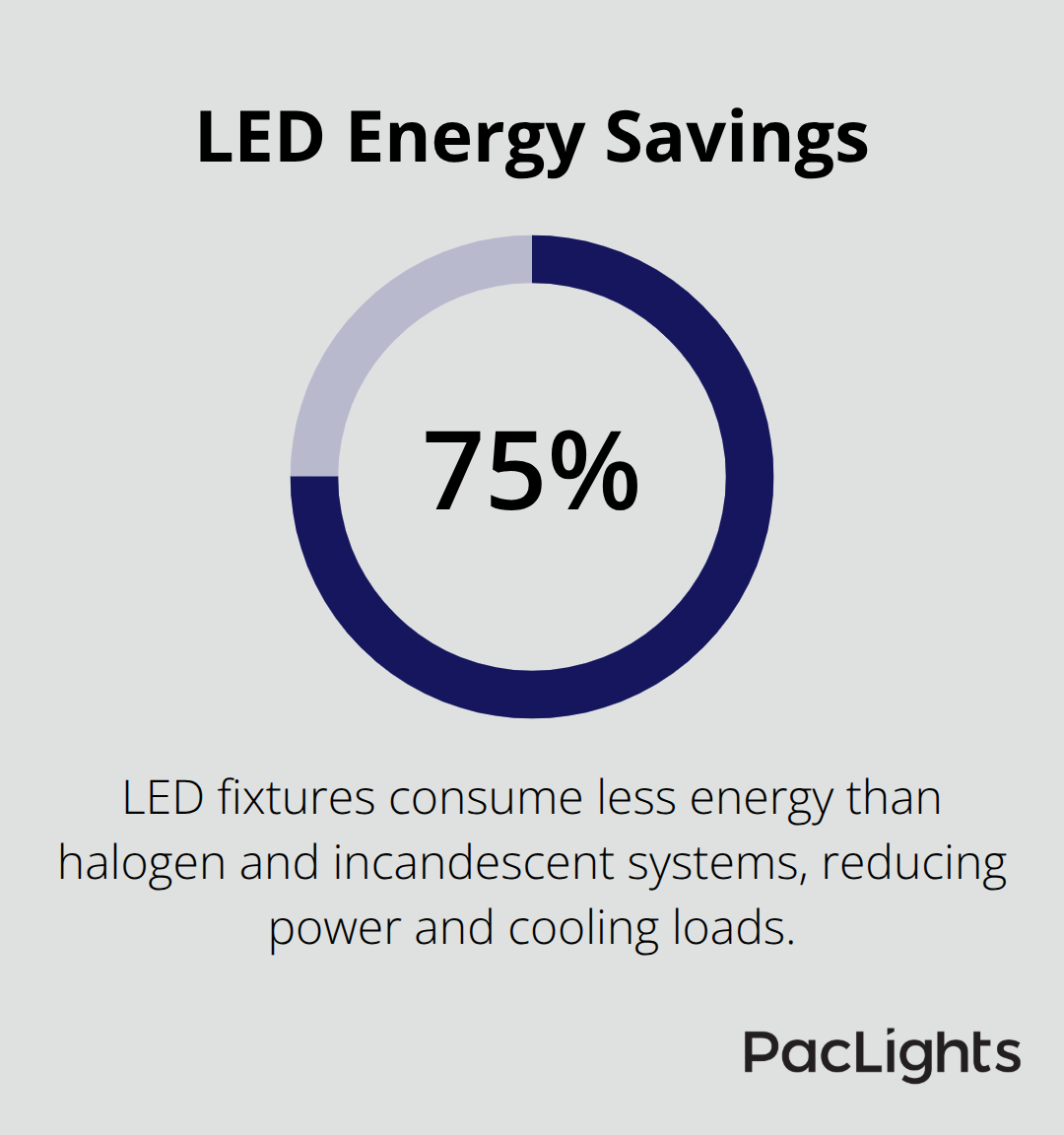
LED fixtures consume 75 percent less energy than traditional halogen and incandescent systems, directly cutting your monthly power bills and cooling loads simultaneously. Data centers account for roughly 1 percent of global energy consumption, and lighting represents 3 to 5 percent of total facility power draw.
That seemingly small percentage translates to substantial operational expense when you operate continuously across 8,760 hours annually. The real leverage comes from heat reduction: LEDs generate minimal thermal output compared to legacy fixtures, which means your cooling systems work less aggressively to maintain optimal server temperatures. In facilities operating near thermal limits, this cooling load reduction often exceeds the lighting energy savings itself.
An independent study by Inglett & Stubbs demonstrated that switching to low-voltage LED systems in a 40,000-square-foot hyperscale data center produced measurable thermal benefits alongside the energy cuts. Beyond the immediate power savings, LED longevity fundamentally changes maintenance economics. LEDs last approximately 30 times longer than incandescent bulbs and 5 times longer than CFLs, eliminating the constant replacement cycles that drain labor budgets and create service disruptions. Most LED fixtures installed today will outlast your current server hardware, turning what was historically a consumable expense into a durable infrastructure investment.
Smart Controls Eliminate Wasteful Lighting Patterns
Smart controls and occupancy sensors amplify these savings by preventing the wasteful practice of lighting unoccupied zones at full brightness. A three-level dimming protocol cuts energy consumption during vacant periods when only surveillance lighting is needed, maintains normal brightness during active maintenance, and delivers maximum output only during intensive equipment work. Occupancy sensors paired with scheduling controls automatically dim or extinguish lights in areas without staff presence, eliminating the human error factor entirely.
These systems integrate with your building management infrastructure to track real-time energy consumption and adjust lighting output based on actual facility activity. Facilities that implement occupancy-based controls report energy reductions of 30 to 40 percent in circulation areas and storage zones where staff presence remains sporadic. The automation removes the burden from operators to manually manage lighting zones, which historically resulted in lights remaining on during unoccupied periods.
Calculate Your Specific ROI and Implementation Timeline
The payback calculation for LED upgrades typically falls between 2 and 4 years depending on your facility size and current fixture age, after which you operate with minimal lighting costs for the next 15 to 20 years. Organizations that postpone these upgrades continue subsidizing inefficient lighting through higher electricity bills and accelerated cooling system wear, making delay the most expensive decision you can make. PacLights offers free lighting layout designs and ROI assessments that quantify these savings specifically for your data center configuration, accounting for your existing equipment density, maintenance patterns, and climate control setup. These assessments provide the financial justification needed to secure budget approval and establish realistic timelines for phased implementation across your facility.
With energy costs and thermal management addressed, the next critical consideration involves ensuring your lighting infrastructure remains operational when failures occur-a reliability requirement that separates well-designed data centers from those vulnerable to cascading outages.
Reliability and Backup Systems Keep Data Centers Operational During Outages
Emergency Lighting Prevents Catastrophic Failures During Power Loss
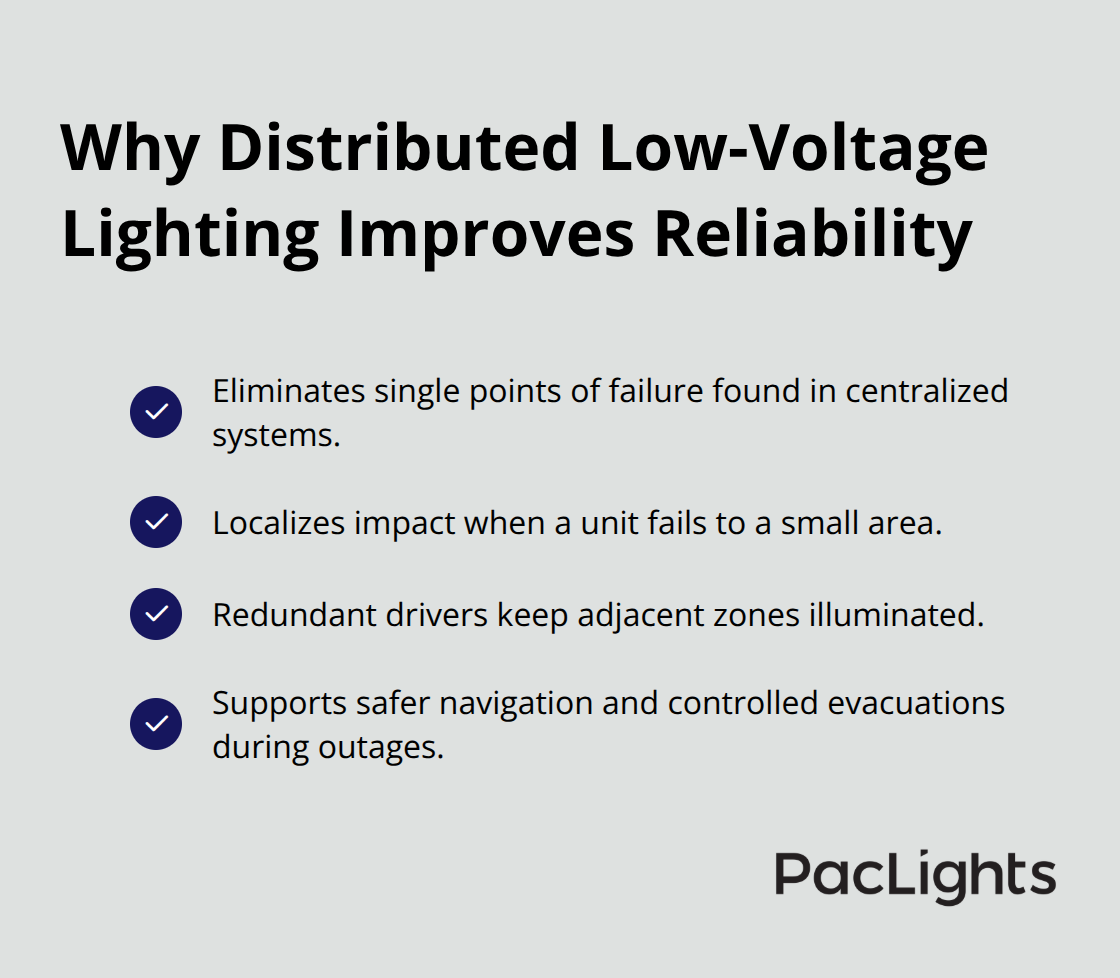
Backup lighting systems aren’t optional infrastructure-they’re the difference between a controlled evacuation and a catastrophic failure during power loss. NFPA 101 and OSHA 1910.37/38 mandate that emergency lighting maintain a minimum of 0.6 foot-candles along all egress paths the moment primary power disappears, with centrally located inverter systems and unit-level emergency lights working in tandem to guarantee coverage. Most data centers fail this requirement because they treat emergency lighting as an afterthought bolted onto existing designs rather than integrating it from the start. When a power outage hits, technicians navigating dark server aisles become liabilities to themselves and your operation. A distributed low-voltage lighting architecture with remote driver units eliminates single points of failure that plague centralized systems. If one inverter fails in a traditional setup, entire zones go dark; with distributed drivers positioned strategically throughout your facility, one unit’s failure affects only its immediate area while redundant systems keep adjacent zones illuminated.
Distributed Low-Voltage Systems Extend Equipment Life
An independent study by Inglett & Stubbs found that distributed low-voltage LED systems in hyperscale facilities extended fixture life by 25 to 40 percent compared to integrated-driver designs, because remote drivers stay outside hot zones where thermal stress degrades components rapidly. This longevity translates directly to fewer maintenance emergencies and more predictable lighting availability when you need it most. Remote drivers positioned away from server exhaust streams experience lower temperatures, which reduces component wear and failure rates substantially. The distributed approach also simplifies troubleshooting-technicians can isolate problems to specific zones rather than investigating facility-wide outages caused by centralized inverter failures.
Thermal Management Protects Your Cooling Infrastructure
Thermal management in high-density environments demands that you treat lighting as a heat source that compounds your cooling challenges rather than a minor utility load. LED fixtures generate minimal thermal output, but placement matters enormously-positioning lights above hot aisles where servers exhaust heat creates thermal interference that forces cooling systems to work harder, defeating the energy savings from LED adoption itself. Pendant luminaires suspended directly above cold aisles deliver light where technicians work while keeping heat away from server exhaust streams. This strategic placement prevents lighting from becoming an unexpected thermal burden that undermines your overall facility efficiency.
Phased Retrofits Maintain Operational Capacity
Installation and retrofit work requires planning that minimizes operational disruption, which means staging lighting upgrades zone by zone rather than attempting facility-wide changes simultaneously. Retrofitting a 40,000-square-foot data center section-by-section keeps your facility operational throughout the transition, though it extends the overall project timeline. Low-voltage systems simplify installation safety by eliminating high-voltage shock risks that plague traditional fixture upgrades, reducing both installation time and labor costs significantly. Modular, scalable lighting architecture accommodates future density increases without requiring wholesale replacement-your next generation of equipment will demand different illumination patterns, and flexible systems adapt without forced obsolescence.
Final Thoughts
Data center lighting design fundamentally shapes how your facility operates, costs money, and responds to emergencies. The standards we covered-NFPA 101, OSHA, UL 924, and TIA-942-exist because poor lighting choices create real operational failures, not minor inconveniences. Precision illumination at 500 lux in maintenance aisles, cool white 4000K to 5000K color temperature, and properly positioned emergency systems form the foundation of safe, efficient data center operations.
The financial case for upgrading to LED systems with smart controls proves straightforward. Your facility spends 3 to 5 percent of total power on lighting, and switching to LEDs cuts that consumption by 75 percent while reducing thermal load on your cooling infrastructure simultaneously. Distributed low-voltage architectures with remote drivers extend fixture life by 25 to 40 percent compared to traditional designs, which eliminates the constant maintenance cycles that drain labor budgets.
Start by auditing your current setup against TIA-942 requirements to identify gaps in lux levels, emergency coverage, and placement efficiency. We at PacLights provide free lighting layout designs and ROI assessments that quantify savings specifically for your data center configuration, accounting for your equipment density, maintenance patterns, and climate setup. Schedule that assessment today and move forward with precision lighting that transforms both your operational performance and your bottom line.
Disclaimer: PacLights is not responsible for any actions taken based on the suggestions and information provided in this article, and readers should consult local building and electrical codes for proper guidance.