

The color of light in your commercial space shapes how customers perceive products, how employees focus on work, and ultimately how your business performs. At PacLights, we’ve seen firsthand how commercial downlights color rendering directly influences everything from retail sales to office productivity.
Most business owners overlook this detail, treating all white light as identical. The truth is far more nuanced, and understanding color rendering can transform your space.
What is Color Rendering Index and Why It Matters
The Color Rendering Index, or CRI, measures how accurately a light source renders colors on a scale from 0 to 100, where 100 represents perfect daylight. This metric matters because it directly affects how colors appear in your space. A downlight with CRI 95 will make a red fabric look vibrant and true-to-life, while the same fabric under CRI 80 lighting appears noticeably duller. The International Commission on Illumination developed CRI using eight standard color samples to assess this accuracy. When manufacturers test fixtures, they compare how these eight colors appear under the test light versus a reference light source. This methodology has been the industry standard for decades, though it has limitations we’ll address later. Higher CRI means colors look more natural and vivid in your space.
How CRI Directly Impacts Your Bottom Line
Commercial spaces live or die by color perception. In retail, a CRI upgrade from 80 to 95 costs roughly 15 to 20 percent more upfront, but returns arrive fast through improved product appearance and customer confidence. Produce under high-CRI lighting looks fresher and more appetizing, directly influencing purchasing decisions. Fashion retailers see fewer returns when fabrics render accurately. In offices, CRI 90 or higher reduces eye strain during color-critical tasks like design work or quality control. Hospitality venues benefit similarly-food looks more appetizing under CRI 90 lighting, influencing dining satisfaction and perceived value. Healthcare settings require CRI 90 or above to accurately assess skin tones for diagnosis and patient evaluation. Most commercial spaces should try for CRI 80 as a minimum; environments handling color-critical work demand CRI 90 or higher. Anything below CRI 75 creates visible color distortion that damages both aesthetics and function.
The Red Rendering Problem Standard CRI Misses
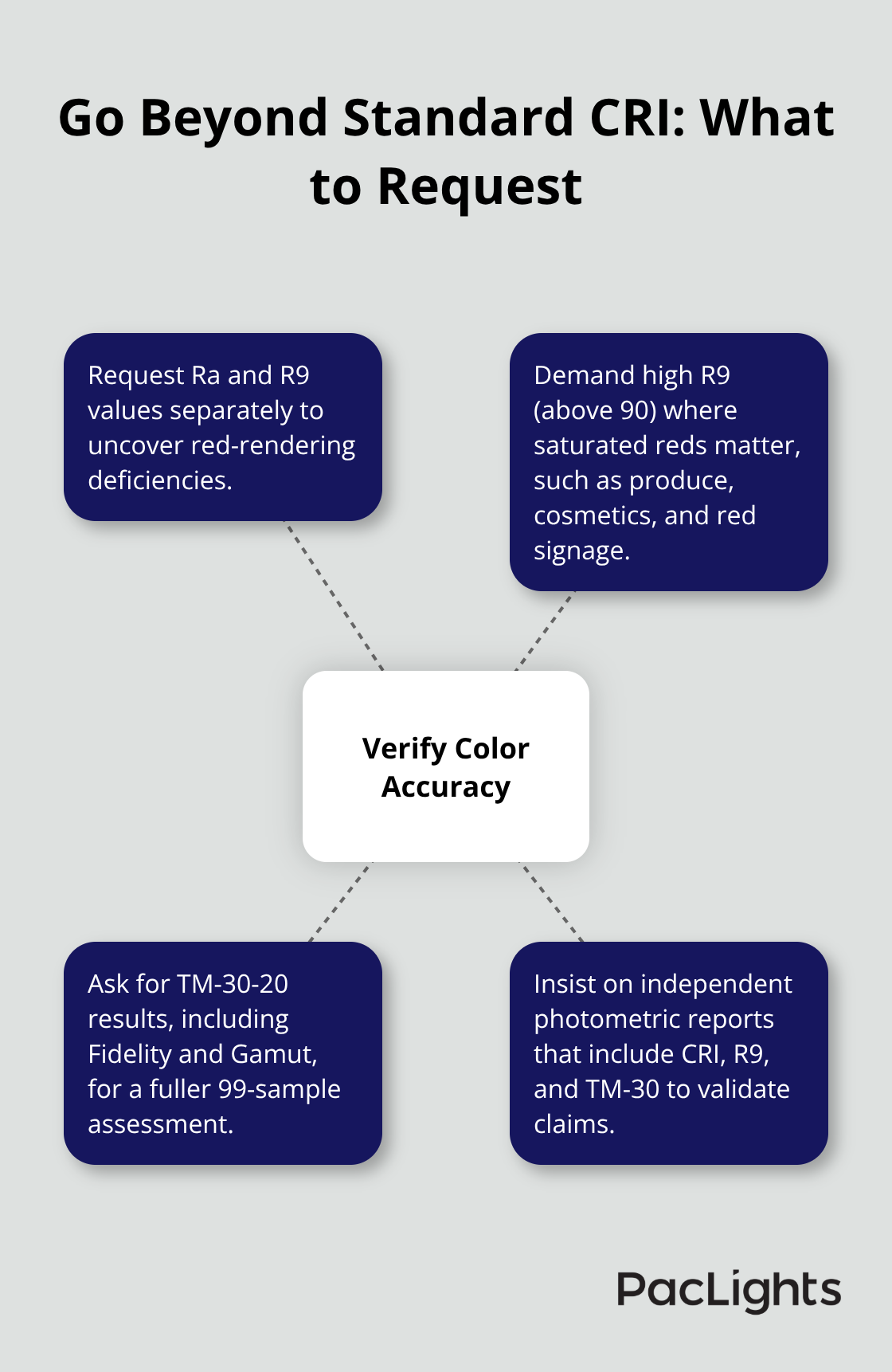
Standard CRI has a critical blind spot: it masks poor red rendering. The Ra value averages eight color samples, but R9, which measures saturated red, isn’t included in that average. A fixture can score CRI 90 while delivering terrible red rendering-a problem especially serious in grocery stores, cosmetics retail, and signage. Always request both Ra and R9 values separately from manufacturers. For spaces with strong reds, demand fixtures with R9 scores above 90. The IES TM-30-20 standard provides a fuller picture, evaluating 99 color samples and reporting both Fidelity and Gamut indices. If you’re serious about color accuracy, insist on independent photometric reports that include CRI, R9, and ideally TM-30 data.
Regulatory Requirements Shape Your Choices
Title 24 in California and similar energy codes increasingly require CRI 90 or higher for many commercial interiors, making compliance verification essential before purchase. These regulations reflect a broader shift toward recognizing that color rendering affects both occupant wellbeing and operational performance. Understanding these standards now positions your facility ahead of compliance timelines and protects your investment in lighting infrastructure. With the right CRI specifications in hand, you’re ready to evaluate how different commercial environments demand different color rendering approaches.
How Color Rendering Impacts Different Commercial Spaces
Retail: Where Color Accuracy Drives Sales
Retail environments demand the highest color rendering standards because every product depends on accurate color perception to drive sales. In grocery stores, produce under CRI 80 lighting appears noticeably less fresh than the same items under CRI 95 lighting, directly affecting purchase intent. Fashion retailers report fewer returns when fabrics render accurately under high-CRI downlights, since customers see true colors in-store rather than discovering mismatches at home. Cosmetics counters require CRI 90 minimum because poor red rendering makes skin tones appear unnatural, undermining customer confidence in foundation matches and lip colors.
The financial case for upgrading proves compelling. Moving from CRI 80 to CRI 95 costs roughly 15 to 20 percent more upfront, but returns arrive fast through improved perceived product quality and reduced color-related returns. Try CRI 95 in fashion and cosmetics retail; CRI 90 works adequately for general merchandise if your space doesn’t emphasize reds or saturated colors. Test red rendering specifically by requesting R9 values above 90 from manufacturers, since standard color rendering can mask weak red performance that damages produce appeal or signage impact.
Offices: Balancing Productivity and Comfort
Office environments present a different challenge: color rendering affects both productivity and employee wellbeing during long work hours. Design studios and quality control departments handling color-critical tasks require CRI 90 or higher to reduce eye strain and improve task accuracy. Standard office work functions adequately at CRI 80, but upgrading to CRI 90 noticeably reduces fatigue during extended screen work combined with ambient lighting tasks.
Hospitality and Healthcare: Non-Negotiable Standards
Hospitality spaces benefit significantly from high-CRI downlights because food presentation influences perceived dining value and satisfaction. Restaurants using CRI 90 lighting report higher perceived food quality compared to identical dishes under CRI 80 lighting, potentially justifying menu prices and improving customer satisfaction ratings. Hotel lobbies and dining areas using CRI 95 create warmer, more welcoming atmospheres that influence guest perception and repeat visits.
Healthcare facilities demand CRI 90 minimum to accurately assess skin tones for diagnosis and patient evaluation, making this non-negotiable rather than optional. These settings cannot compromise on color accuracy without risking patient safety and care quality.
Verifying Performance Before Purchase
Across all three environments, demand independent photometric reports showing CRI, R9, and ideally TM-30 data before purchase. Verify color stability across your full dimming range from 10 to 100 percent brightness, since some fixtures shift color when dimmed. This verification step protects your investment and confirms that the lighting you select will perform consistently throughout its operational life, setting the stage for selecting fixtures that match both your color rendering needs and energy efficiency goals.
Choosing the Right CRI for Your Commercial Downlights
Map Your Space’s Function First
Start by identifying which zones in your facility handle color-critical work and which don’t. A warehouse receiving area where workers verify product labels demands CRI 90 minimum to distinguish colors accurately and reduce errors, while a storage zone behind the scenes functions adequately at CRI 80. Retail showrooms displaying fashion or cosmetics require CRI 95, but a back-of-house stockroom wastes money at that level. This functional breakdown prevents you from paying premium prices where they deliver no measurable return.
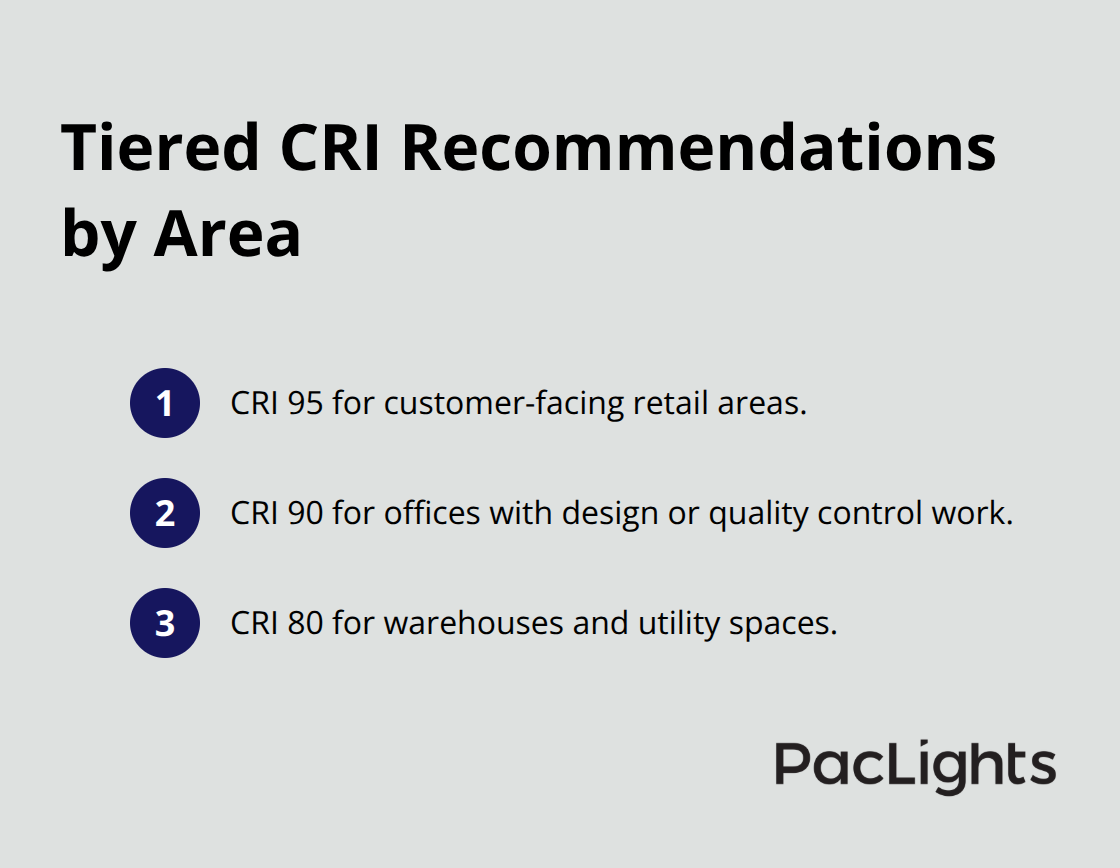
Document which areas demand high color accuracy and which don’t, then specify CRI accordingly. Most commercial facilities benefit from a tiered approach: CRI 95 in customer-facing retail areas, CRI 90 in offices with design or quality control work, CRI 80 in warehouses and utility spaces. This strategy cuts costs without sacrificing performance where it matters.
Energy Efficiency and Color Rendering Work Together
Energy efficiency and color rendering support each other rather than compete, contrary to what some lighting vendors suggest. Modern LED downlights deliver 80 to 120 lumens per watt while achieving CRI 90 or higher, making them roughly three times more efficient than older fluorescent fixtures that typically managed 60 to 70 lumens per watt. The real cost comparison isn’t CRI 80 versus CRI 95 in isolation-it’s the total energy and maintenance expense over the fixture’s 25,000 to 50,000 hour lifespan.
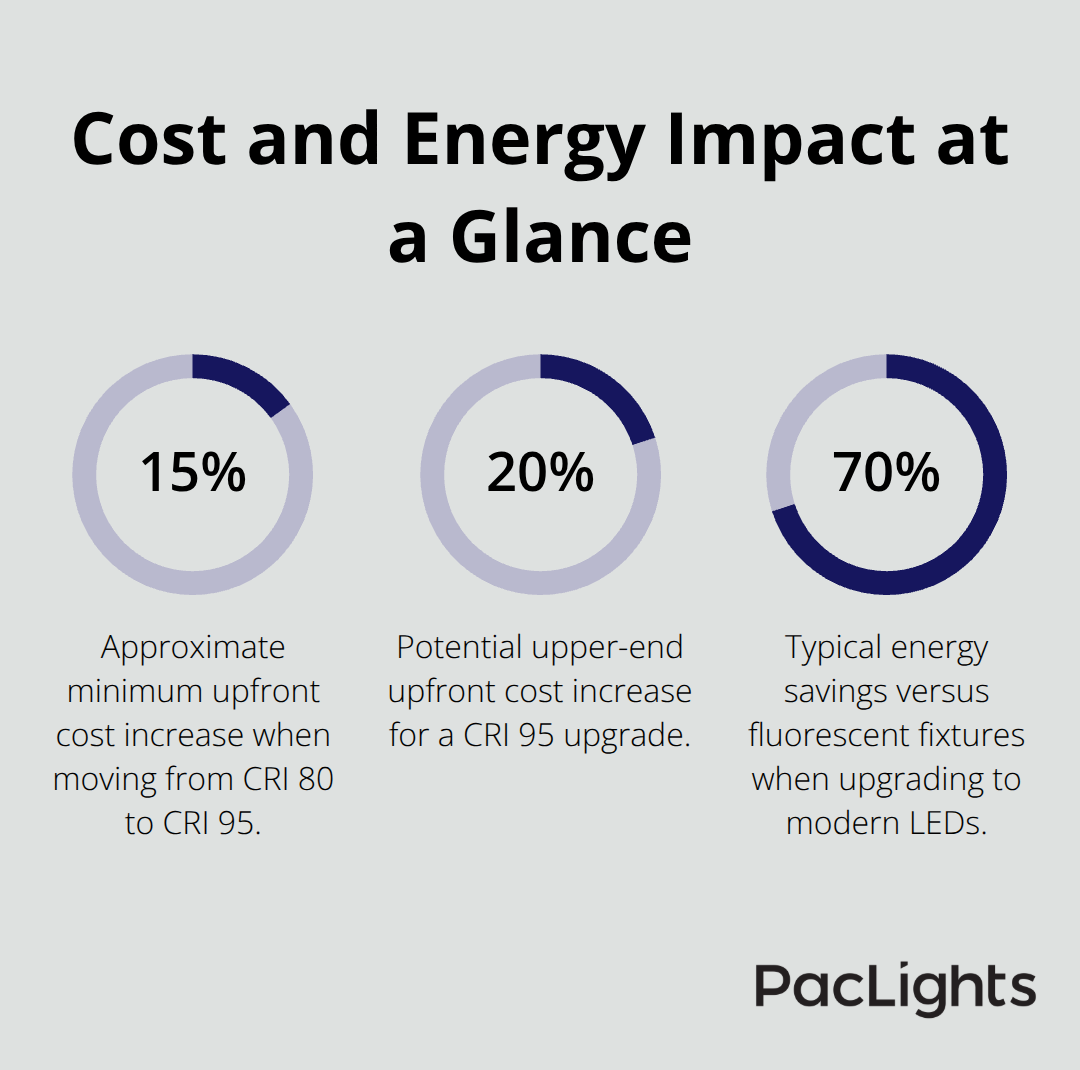
Upgrading from CRI 80 to CRI 95 costs approximately 15 to 20 percent more upfront, but the 70 percent energy savings versus fluorescents typically recovers that investment within three to five years while delivering superior color accuracy throughout. This calculation shifts the conversation from “Can we afford high CRI?” to “Can we afford not to upgrade?”
Request Independent Photometric Data
Request independent LM-79 photometric reports from manufacturers before purchase, specifying that reports include CRI, R9 values separately, and ideally TM-30-20 Fidelity and Gamut data. Verify color stability across your dimming range from 10 to 100 percent brightness-some fixtures shift color noticeably when dimmed, which creates inconsistent appearance as lighting levels change throughout the day.
Test beam angles against your ceiling height: roughly 24 to 36 degrees for eight-foot ceilings, 60 degrees or wider for high-ceiling spaces. This verification prevents costly mistakes and confirms the fixture will perform consistently throughout its operational life.
Final Thoughts
Color rendering in commercial downlights directly shapes how your customers perceive products, how your employees perform their work, and ultimately how your business operates. Upgrading from CRI 80 to CRI 95 costs 15 to 20 percent more upfront but returns that investment within three to five years through improved sales, reduced returns, and lower energy consumption. Modern LED fixtures deliver this performance at 80 to 120 lumens per watt, making them three times more efficient than older fluorescent systems.
Map your facility by function and specify CRI accordingly: CRI 95 for customer-facing retail areas where color accuracy drives purchasing decisions, CRI 90 for offices with design or quality control work, CRI 80 for utility spaces where color precision matters less. Demand independent photometric reports that include CRI, R9 values, and ideally TM-30-20 data before committing to any purchase. Verify color stability across your full dimming range and confirm beam angles match your ceiling heights to prevent costly installation mistakes.
We at PacLights understand that commercial downlights color rendering affects both your bottom line and your facility’s performance. Our energy-efficient LED retrofit solutions and customizable downlight options match your specific color rendering needs, backed by free lighting layout designs and ROI assessments. Contact PacLights today to find the fixtures and expertise that deliver the color accuracy your space requires while maximizing energy savings.
Disclaimer: PacLights is not responsible for any actions taken based on the suggestions and information provided in this article, and readers should consult local building and electrical codes for proper guidance.