

Your warehouse lighting retrofit is one of the fastest ways to cut operating costs. Energy expenses eat up 10-20% of most warehouse budgets, and outdated fixtures waste thousands annually.
At PacLights, we’ve seen LED upgrades reduce energy consumption by 50-75% while boosting worker safety and productivity at the same time. This guide walks you through planning and executing a retrofit that actually pays for itself.
The Real Cost of Outdated Warehouse Lighting
Warehouse lighting expenses extend far beyond the electricity bill. When your facility runs lights 10 to 24 hours daily, small inefficiencies compound into massive waste. A warehouse consuming 100,000 kWh annually for lighting at $0.12 per kilowatt-hour spends $12,000 yearly on outdated fixtures. That money vanishes through flickering fluorescent tubes and aging metal halide systems that lose efficiency over time. The problem worsens because old fixtures don’t just consume more power-they generate excess heat, forcing your HVAC system to work harder in summer months. This hidden cooling cost often represents 15-25% of the total lighting expense burden. LED retrofits eliminate this problem entirely. Modern LEDs convert most energy into light rather than heat, reducing your cooling load while cutting lighting energy use by 50-75% simultaneously. For a mid-sized warehouse, this translates to $6,000-$9,000 in annual savings from lighting alone, not counting HVAC relief.
Why Payback Happens Fast
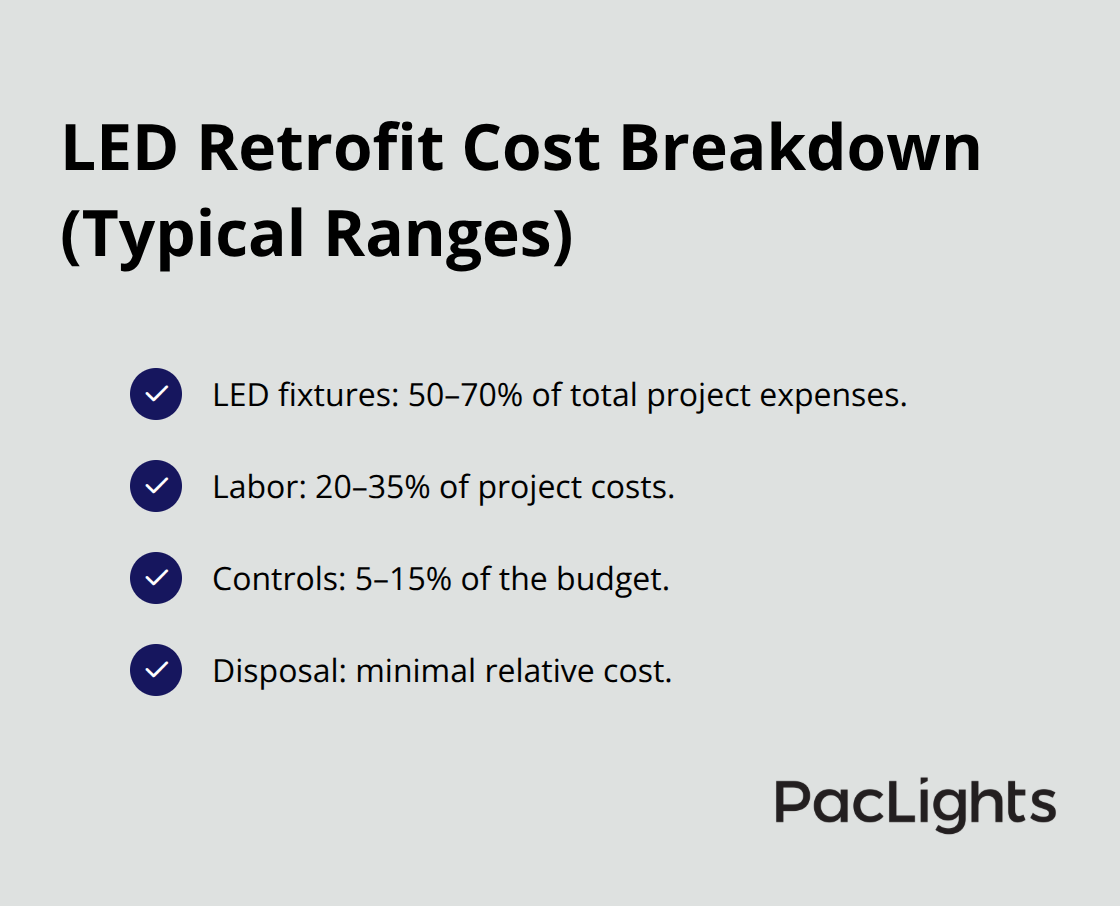
Retrofit costs typically range from $3 to $8 per square foot depending on fixture type and complexity. A 50,000 square foot warehouse spending $4 per square foot invests $200,000 in the upgrade. With $7,500 in annual savings from a 50% energy reduction, payback arrives in roughly 26 months. Many facilities achieve faster returns because utility rebates and incentive programs cover 20-50% of project costs in most regions. The cost breakdown matters: LED fixtures account for 50-70% of expenses, labor takes 20-35%, controls represent 5-15%, and disposal costs remain minimal. This structure means larger facilities reach lower per-square-foot pricing through bulk purchasing, accelerating ROI further.
Facilities operating lights around the clock see payback in 12-18 months since energy savings compound continuously.
Safety and Productivity Gains Beyond Cost Savings
Improved warehouse lighting directly reduces workplace accidents. Better illumination eliminates dark corners and shadows in aisles, loading docks, and storage areas where forklifts operate. Workers make fewer inventory picking errors when visibility improves-mispick rates drop significantly under consistent, flicker-free LED lighting. Older fluorescent systems flicker as they age, causing eye strain and fatigue that reduce productivity by 5-10% per worker. LED fixtures provide instant-on illumination with no warm-up period and zero flicker, immediately improving worker comfort and accuracy. A warehouse with 50 employees working 10-hour shifts experiences measurable productivity gains when lighting quality improves (often offsetting retrofit costs through better output alone). These improvements position your facility to move forward with implementation planning.
How to Plan Your Warehouse LED Retrofit
Start by documenting exactly what you have. Walk through your warehouse with a camera and notepad, recording ceiling height, current fixture types, mounting locations, and spacing between fixtures. Measure the distance from fixtures to the work surface below. This matters because a fixture mounted at 20 feet delivers light differently than one at 30 feet, and most warehouses have varying heights across different zones. Note which areas feel dark or create shadows during peak operational hours. Check your electricity bills for the past 12 months to establish your baseline consumption and cost per kilowatt-hour. Warehouses operating 16-24 hours daily see the biggest energy savings, so document your actual operating schedule. Many facilities discover they light unoccupied spaces during off-peak hours, which smart controls can address later. Photograph aging fixtures, flickering tubes, or discolored lenses to document current conditions. This documentation becomes your reference point for calculating ROI and selecting replacement fixtures.
Calculate Your Actual Payback Period
ROI calculations require three numbers: total retrofit cost, annual energy savings, and utility rebates available in your region. Retrofit costs genuinely range from $3 to $8 per square foot, but this varies dramatically based on fixture type and complexity. High-bay fixtures for tall spaces cost more than linear strips for aisles, and adding motion sensors or daylight harvesting increases upfront investment by 5-15%. Contact your utility company or visit their website to identify rebate programs specific to your state or territory. Many utilities offer 20-50% cost reductions for LED warehouse upgrades, but programs differ significantly by region and facility size. Calculate energy savings by multiplying your current kWh consumption for lighting by 0.50 to 0.75 (representing the 50-75% reduction LEDs deliver), then multiply by your cost per kWh. A 50,000 square foot warehouse consuming 100,000 kWh annually for lighting at $0.12 per kWh saves $6,000 to $9,000 yearly. Subtract this annual savings from your total retrofit cost to find payback months. A $200,000 retrofit with $8,000 annual savings and a $60,000 rebate reduces net cost to $140,000, yielding 21-month payback. Facilities operating lights continuously often see payback in 12-18 months because energy savings compound daily. Include maintenance cost reductions in your calculation: LED fixtures lasting 50,000-100,000 hours eliminate frequent relamping, reducing labor and material expenses by roughly $1,500-$3,000 annually depending on your current maintenance frequency.
Select Fixtures Matched to Your Space
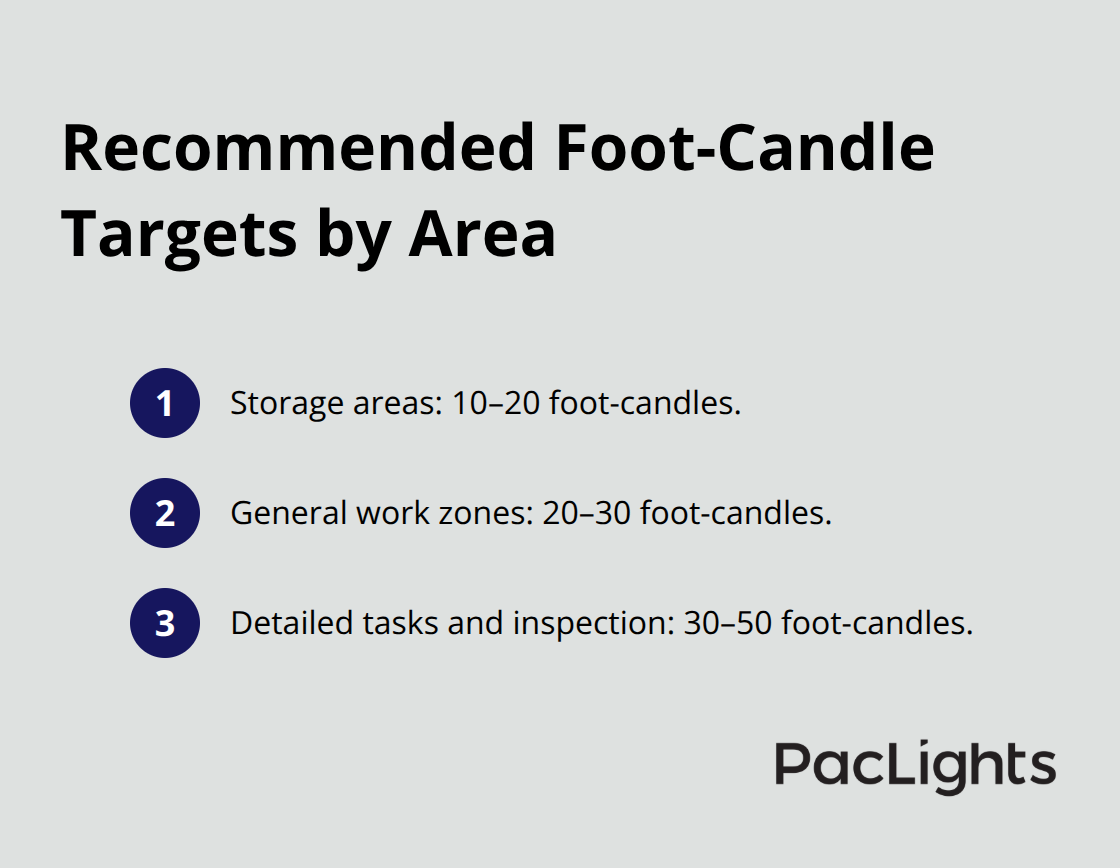
High-bay fixtures suit open warehouse floors with ceilings above 25 feet, delivering concentrated light over large areas without requiring excessive fixture density. Linear high-bay lights work better for aisles, shelving rows, and narrow spaces where you need uniform coverage along a path rather than broad area illumination. Troffer lights fit drop ceilings in office areas within warehouses, providing comfortable illumination for administrative zones without the industrial appearance of high bays. The mistake most facilities make is treating the entire warehouse as one lighting zone. Your storage area genuinely requires less illumination than your picking line or inspection station. Foot-candle targets vary: storage areas need 10-20 foot-candles, general work zones need 20-30 foot-candles, and detailed tasks like quality inspection need 30-50 foot-candles.
Design your retrofit around actual task requirements, not uniform brightness everywhere. A photometric plan from your retrofit partner shows exactly where fixtures mount, how many you need, and the resulting light distribution across your floor. This plan prevents over-lighting, which wastes energy and creates glare that reduces visibility. Request this plan before committing to any retrofit purchase.
Validate Your Design Before Purchase
A photometric plan transforms your retrofit from guesswork into precision. This technical document maps fixture locations, calculates light levels at floor level, and identifies any dark spots or over-lit zones before installation begins. Your retrofit partner should provide this plan at no cost or minimal expense. The plan accounts for your specific ceiling height, mounting positions, and task requirements across different warehouse zones. Without this validation, you risk purchasing too many fixtures (wasting money) or too few (leaving dark areas that compromise safety). Photometric plans also help you apply for utility rebates, since many programs require documentation that your retrofit meets specific efficiency standards. This documentation proves your installation delivers the promised energy savings and lighting quality. Request the plan in writing and review it carefully before your retrofit partner orders materials. A well-designed retrofit specification matches your actual operational needs and delivers the visibility improvements that justify the investment.
Implementation and Optimization Strategies
Phased Retrofit Execution Minimizes Operational Disruption
Retrofitting your entire warehouse at once creates operational chaos. Your team needs lighting to work safely, and a complete shutdown isn’t realistic for most operations. A phased approach retrofits your warehouse zone by zone, keeping critical areas lit and operational throughout the project. Start with your lowest-priority storage areas or zones that operate during off-peak hours. This lets your retrofit partner test installation methods, validate the photometric plan against real conditions, and work out coordination issues before tackling high-traffic zones.
Phase one typically covers 20-30% of your facility and takes 2-4 weeks depending on size. This timeline lets you document actual energy savings before proceeding to phase two, which provides hard numbers to justify continued investment to management. Phase two should target your picking lines, packing areas, or other high-activity zones where lighting quality directly impacts productivity. Schedule phase two work during your lowest-traffic periods-early mornings, late nights, or your slowest season-to minimize workflow disruption.
Most warehouses complete a full retrofit across three phases over 8-12 weeks, which spreads costs across multiple budget periods and reduces cash flow strain. Coordinate closely with your retrofit partner on installation timing. They should schedule work in specific zones, complete installation and testing within defined windows, then move to the next zone. This compartmentalized approach prevents your entire facility from operating under temporary lighting conditions.
Your operations team needs a clear communication plan: which zones get retrofitted when, which areas will have temporary lighting during work, and when full normal lighting returns. Document this schedule and share it with all staff who depend on warehouse visibility for their daily work.
Motion Sensors Eliminate Lighting Waste in Low-Traffic Areas
Once your LED fixtures are installed and operational, motion sensors reduce energy use by an additional 30-50% beyond base LED efficiency. These sensors eliminate unnecessary lighting in unoccupied areas like storage racks, loading docks during slow periods, or conference rooms within warehouse office spaces. Install motion sensors in low-traffic zones and areas with irregular occupancy patterns.
Your picking lines and active work zones should remain on full brightness continuously, but perimeter areas, hallways, and secondary storage genuinely benefit from occupancy-based control. Motion sensors cost roughly $200-400 per unit installed, and a typical facility might deploy 8-15 sensors across appropriate zones, representing a modest investment that pays back within 18-24 months through energy savings alone.
Daylight Harvesting Optimizes Natural Light Integration
Daylight harvesting sensors automatically adjust artificial lighting levels based on available natural light from windows or skylights, maintaining consistent illumination while reducing energy consumption during bright daylight hours. A warehouse with significant window exposure can cut lighting energy use an additional 15-25% through daylight harvesting alone.
These sensors cost roughly $200-400 per unit installed. A typical facility might deploy 8-15 sensors across naturally lit zones, representing a modest investment that pays back within 18-24 months through energy savings alone.
Networked Controls Provide Real-Time Performance Visibility
Networked lighting controls integrate all your fixtures and sensors into a centralized system accessible from your office or mobile device. This technology lets you monitor real-time energy consumption, adjust brightness levels remotely, schedule lighting patterns around your actual operational schedule, and receive alerts if fixtures malfunction. A networked system costs more upfront-typically adding 5-15% to your retrofit budget-but provides visibility into your facility’s lighting performance that manual systems cannot match.
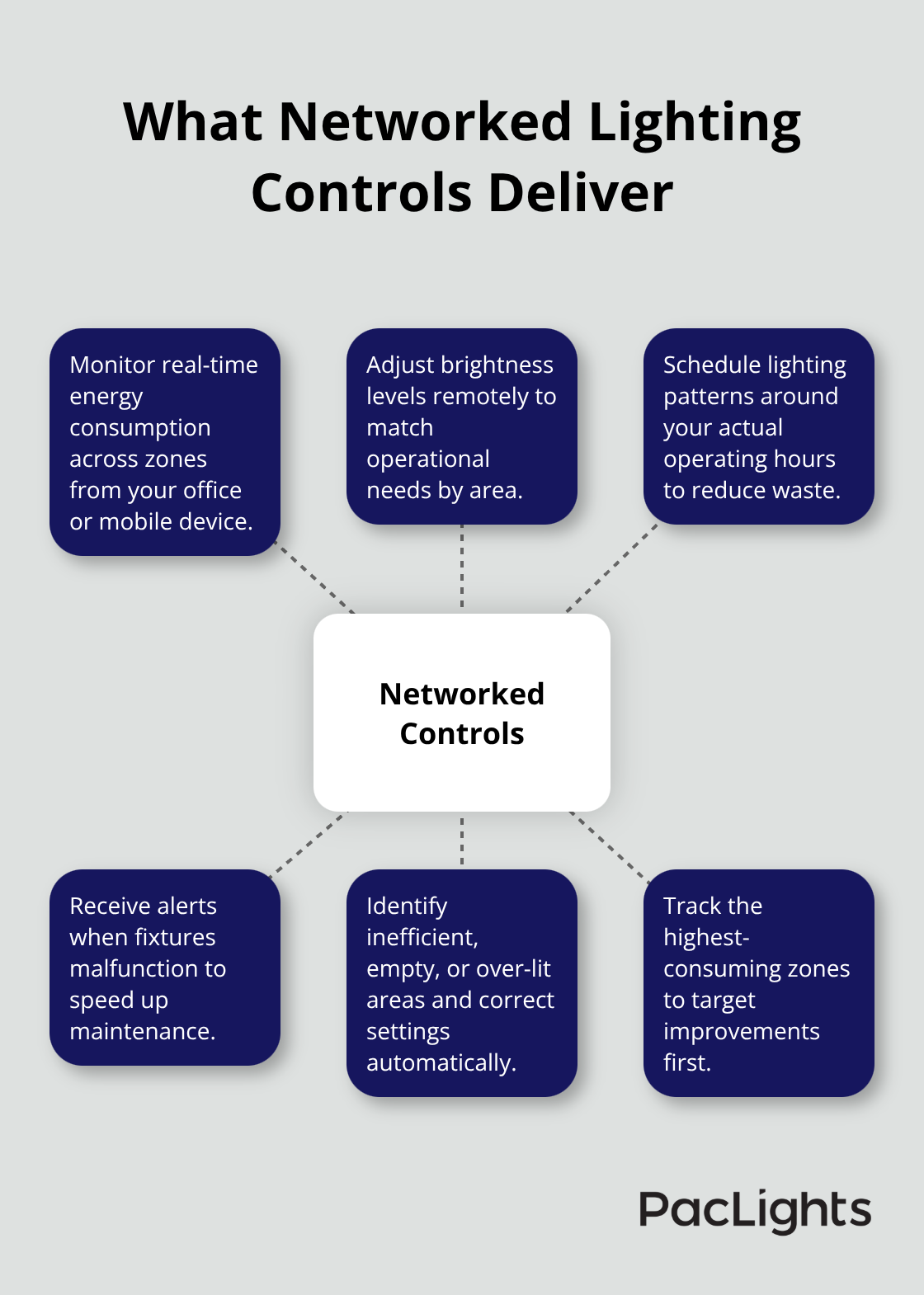
You can dim lights in storage areas during off-peak hours, increase brightness during peak picking periods, and track which zones consume the most energy. This data-driven approach identifies inefficiencies you never knew existed. Many facilities discover they were lighting completely empty zones during night shifts, or running full brightness in areas that only need 50% illumination. Networked controls eliminate this waste automatically.
We at PacLights offer advanced lighting controls as optional features on retrofit solutions, letting you add them during initial installation or upgrade existing retrofits later as your operational needs evolve. These controls transform your retrofit into a continuously optimizing system that delivers far greater savings than fixtures alone.
Final Thoughts
Your warehouse lighting retrofit delivers measurable financial returns alongside genuine safety improvements that compound over time. The 50-75% energy reduction translates directly to lower operating costs, faster payback periods, and improved worker visibility that reduces accidents and picking errors. Motion sensors and daylight harvesting add 30-50% additional energy savings beyond base LED efficiency, while networked lighting controls provide real-time visibility into your facility’s energy consumption and let you adjust brightness remotely based on actual operations.
We at PacLights offer free lighting layout designs and ROI assessments that map your specific facility, calculate your actual payback period, and identify which fixture types and control options deliver the best results for your space. This assessment removes guesswork from your retrofit planning and provides documentation you need for utility rebate applications. Schedule your free lighting assessment to begin planning the warehouse lighting retrofit that transforms your facility’s efficiency and safety profile.
Disclaimer: PacLights is not responsible for any actions taken based on the suggestions and information provided in this article, and readers should consult local building and electrical codes for proper guidance.