

Data centers consume roughly 1–2% of global electricity, with lighting accounting for 17–25% of that total energy use. At PacLights, we’ve seen firsthand how switching to sustainable lighting practices cuts both carbon emissions and operational costs dramatically.
The right lighting strategy transforms data center efficiency. This guide walks you through proven approaches that reduce environmental impact while improving your bottom line.
The True Cost of Data Center Lighting Today
Energy Waste in Traditional Lighting Systems
Data centers consume 1–2% of global electricity, according to the International Energy Agency, but lighting represents a disproportionate share of that burden. Within a typical data center, lighting accounts for 17–25% of total energy consumption-a figure that seems manageable until you calculate the actual dollars and emissions involved. A mid-sized data center running 24/7 spends $200,000 to $400,000 annually on lighting alone, with traditional fluorescent and high-intensity discharge fixtures driving those costs upward. Most data centers were built decades ago with lighting systems designed for human-centric spaces, not optimized for the specific demands of server halls and infrastructure rooms. Traditional metal halide and fluorescent systems waste enormous amounts of energy as heat, requiring additional cooling capacity that multiplies the environmental damage.

The Hidden Cooling Connection
Lighting energy use directly feeds into cooling loads-when fixtures generate excess heat, your HVAC systems must work harder and consume even more electricity. This creates a vicious cycle where outdated lighting generates heat that demands extra cooling, inflating both your carbon footprint and operating expenses simultaneously. The inefficiency compounds because facility managers often overlook this connection, treating lighting and cooling as separate problems rather than interconnected systems.
Carbon Emissions from Data Center Lighting
Global data centers and transmission networks produce approximately 330 million metric tons of CO2 equivalent annually, representing about 0.9% of energy-related greenhouse gas emissions according to the International Energy Agency. If lighting represents 17–25% of a data center’s energy use, lighting alone contributes roughly 50–80 million metric tons of CO2e globally-equivalent to the annual emissions from millions of vehicles. A 10,000 square foot data center with traditional lighting running continuously emits around 200–300 metric tons of CO2 annually from lighting alone.
The Financial Case for Upgrading
Switching to LED technology with advanced controls eliminates 60–80% of that carbon burden immediately. LED systems with motion sensors and occupancy controls reduce lighting energy consumption by 70–85%, translating to $140,000–$340,000 in annual savings for a mid-sized facility. The payback period for a complete LED retrofit with controls typically falls between 2–4 years, after which you operate with virtually free lighting. Reduced cooling demands from lower heat generation cut another 5–15% off total facility energy costs, making the environmental and economic arguments inseparable.
Why Lighting Upgrades Matter Most
Upgrading lighting stands as the fastest, most cost-effective lever available for data centers pursuing carbon neutrality. The combination of immediate energy savings, reduced cooling requirements, and rapid payback makes lighting optimization the logical starting point for any sustainability initiative. Understanding these costs and benefits sets the stage for exploring the specific technologies that deliver these results.
LED Technology Cuts Data Center Lighting Energy
LED fixtures consume 75–80% less energy than traditional metal halide and fluorescent systems, a difference that translates directly to lower electricity bills and reduced cooling demands. The physics is straightforward: LEDs convert electrical energy into light with minimal wasted heat, whereas incandescent and discharge-based systems squander enormous amounts of energy as thermal radiation that your cooling systems must then remove. A data center retrofit replacing 1,000 traditional 400-watt metal halide fixtures with 100-watt LED equivalents eliminates 300,000 watts of continuous load-roughly equivalent to removing 300 homes from the electrical grid. That reduction in heat generation means your HVAC systems run less frequently and at lower capacity, cutting cooling energy by 5–15% across the entire facility. The payback arrives fast: a mid-sized facility typically recovers its LED retrofit investment within 2–4 years through energy savings alone, after which the lighting operates at near-zero marginal cost.

Controls That Match Reality, Not Guesswork
Motion sensors and occupancy-based dimming reduce lighting energy consumption by an additional 40–60% in areas that don’t require constant illumination-administrative spaces, conference rooms, and corridors typically run at full brightness despite remaining empty for hours daily. Network-connected lighting controls enable facility managers to adjust brightness, schedules, and occupancy thresholds from a single dashboard. Data center infrastructure management systems integrate lighting data alongside power and cooling metrics, revealing patterns that manual observation misses. Many data centers discover that backup generator testing and maintenance procedures trigger unnecessary lighting schedules that run for days after the actual work concludes. Automated controls eliminate these oversights and reduce energy waste by another 10–20%.
The Financial Reality of LED Conversion
A 10,000 square foot data center with 50 fixtures running traditional 400-watt systems continuously costs approximately $35,000–$45,000 annually in lighting electricity alone. Converting to 100-watt LED fixtures with motion sensors reduces that to $7,000–$10,000 per year, freeing up $25,000–$35,000 in annual operating budget. Equipment costs for a complete retrofit (including LEDs, sensors, and controls) typically run $40,000–$70,000 depending on facility complexity and control sophistication. That produces a payback period of 1.5–2.5 years for most facilities, with 15–20 additional years of operational savings afterward. Reduced cooling requirements add another 5–10% savings to total facility energy costs beyond the direct lighting reduction, making the actual financial benefit substantially larger than lighting costs alone suggest.
Why Heat Reduction Matters Beyond Lighting
A data center that invests $60,000 in a comprehensive LED and controls retrofit often realizes $30,000–$40,000 in annual savings across lighting and cooling combined. Lower heat output from efficient fixtures means your cooling infrastructure operates at reduced capacity, extending equipment lifespan and deferring expensive replacements. This interconnection between lighting and thermal management reveals why lighting upgrades deliver outsized returns-you’re solving two problems simultaneously. The next chapter explores how to design lighting systems that work with your facility’s natural conditions and occupancy patterns, maximizing these efficiency gains even further.
How to Design Data Center Lighting for Maximum Efficiency
Natural Light Transforms Administrative Spaces
Natural light integration rarely applies to data center server halls, but it transforms administrative and support spaces where staff spend significant time. Facility managers often overlook these peripheral areas when calculating lighting ROI, yet they represent 30–40% of total data center floor space. Offices, conference rooms, and corridors running full-brightness lighting 24/7 waste enormous energy because occupancy fluctuates dramatically throughout the day and night. Positioning workstations near windows and installing daylight sensors that automatically dim artificial lighting when sufficient natural light arrives cuts energy consumption in these spaces by 20–40%. Data centers in northern climates with limited daylight hours see smaller gains, while facilities in southern regions achieve 40–50% reductions in administrative lighting energy. A typical data center spends $8,000–$15,000 annually on administrative and support space lighting; daylight harvesting plus occupancy controls reduce this to $3,500–$7,000 per year. Installation costs for daylight sensors and networked controls in these spaces run $8,000–$15,000, producing payback within 1–2 years while improving working conditions for staff.
Motion Sensors Eliminate Wasted Hours
Server halls and infrastructure rooms run at full brightness regardless of whether technicians are present, representing the core inefficiency in data center operations. A typical data center server hall occupied by maintenance staff perhaps 10–15 hours weekly still consumes lighting energy 168 hours weekly. Installing motion sensors with 10–15 minute auto-shutoff timers eliminates 75–85% of unnecessary lighting in these spaces. Network-connected lighting controls enable facility managers to view occupancy patterns and adjust sensor sensitivity across multiple areas from a single interface, revealing unexpected usage patterns that manual observation misses.
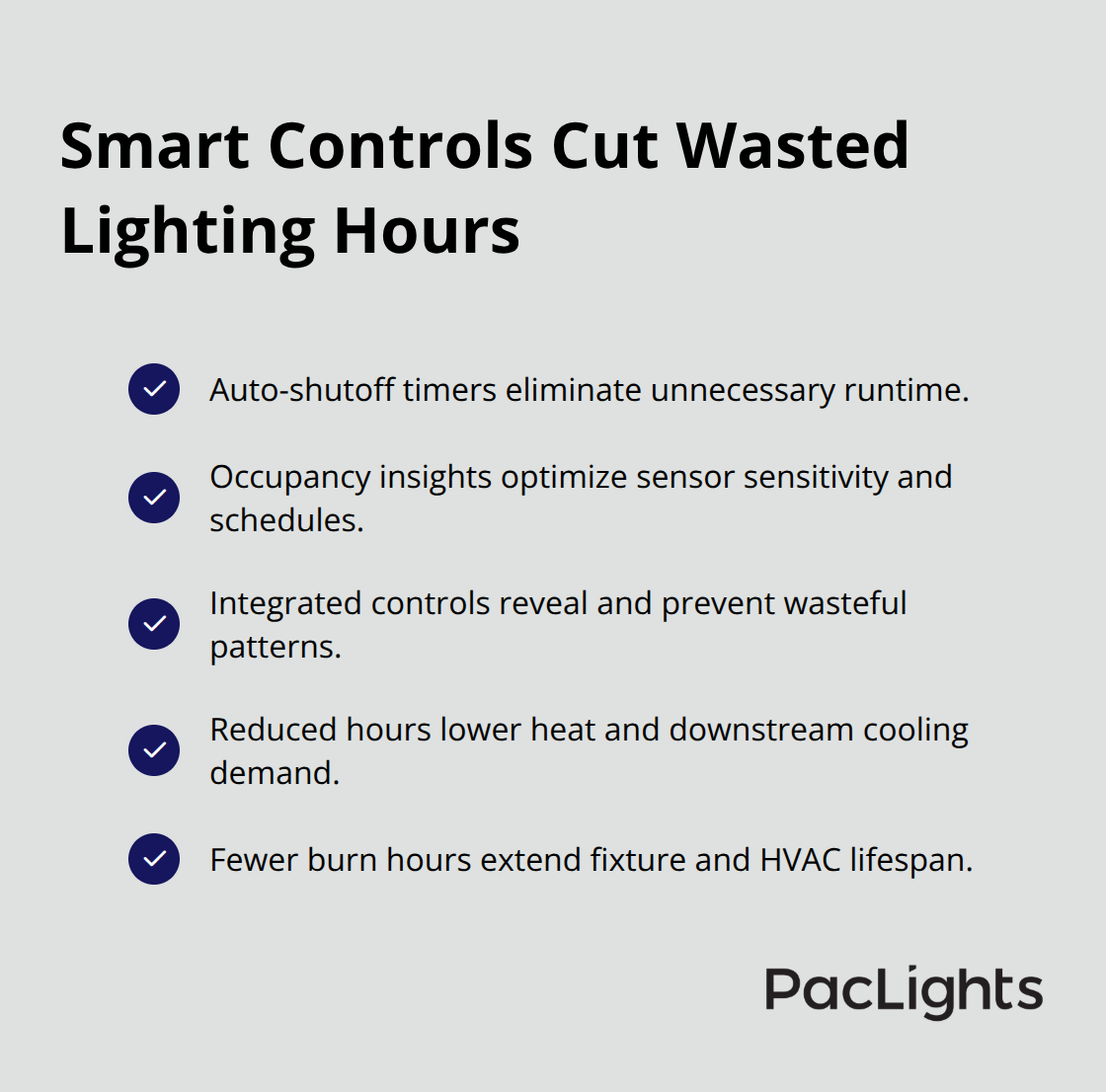
Many data centers discover that backup generator testing procedures trigger automated lighting schedules that run continuously for days after work concludes, wasting thousands in energy annually. These controls integrate with data center infrastructure management systems, creating visibility into how lighting decisions ripple through cooling demands.
Heat Reduction Compounds Your Savings
Every watt of lighting energy that converts to heat instead of light demands additional cooling capacity. A data center with 50 traditional 400-watt fixtures generates approximately 20,000 watts of continuous heat that cooling systems must remove; switching to LED fixtures reduces this to 5,000 watts. That 15,000-watt reduction in heat output allows HVAC systems to run at lower capacity, cutting cooling energy consumption by 8–12% facility-wide. The interconnection between lighting efficiency and thermal management means that lighting upgrades deliver compounding benefits across multiple systems rather than isolated savings in a single category. Networked lighting controls integrated with data center infrastructure management systems enable facility managers to optimize both systems simultaneously rather than treating them as separate problems requiring separate solutions. Lower heat output from efficient fixtures also extends equipment lifespan and defers expensive replacements, multiplying the financial advantage beyond direct energy reductions.
Final Thoughts
Sustainable lighting practices deliver measurable environmental and financial benefits that extend far beyond the lighting system itself. A mid-sized data center switching to LED fixtures with motion sensors and occupancy controls reduces annual lighting energy consumption by 70–85%, eliminating 150–250 metric tons of CO2 emissions yearly while cutting lighting costs by $140,000–$340,000 annually. The reduced heat output from efficient fixtures compounds these savings by cutting cooling energy by 5–15% facility-wide, making the total environmental impact substantially larger than lighting upgrades alone suggest.
Data centers pursuing carbon neutrality by 2030 cannot ignore sustainable lighting as a lever for change. The International Energy Agency projects that data center energy demand will continue rising with AI and digital workload growth, making efficiency gains in every system essential for meeting climate targets. Lighting represents one of the fastest, most cost-effective opportunities available because the technology is proven, payback arrives quickly, and the environmental benefits are immediate and measurable.
We at PacLights offer free lighting layout designs and ROI assessments that reveal exactly how much energy and money you can save through LED retrofit solutions tailored to your specific data center configuration. Our energy-efficient lighting fixtures include optional daylight and motion control, plus advanced networked lighting controls that integrate with your data center infrastructure management systems. Contact PacLights today to discover how customizable LED retrofit solutions reduce costs and carbon footprints while maintaining the reliability your operations demand.
Disclaimer: PacLights is not responsible for any actions taken based on the suggestions and information provided in this article, and readers should consult local building and electrical codes for proper guidance.