

Industrial facilities face constant battles with moisture, corrosion, and equipment failure. A vapor tight high bay lighting system stops these problems before they start, protecting your investment while keeping operations running smoothly.
At PacLights, we’ve seen firsthand how the right lighting fixture transforms facility performance. This guide walks you through why these fixtures matter, how they save money, and what to look for when upgrading your space.
Why Vapor Tight High Bays Outperform Standard Fixtures in Harsh Environments
Sealed Construction Stops Moisture Before It Damages Equipment
Vapor tight high bays use gasket-sealed enclosures with IP65 or higher ratings to block moisture, dust, and debris from reaching internal components. This matters because moisture, dust, and chemical vapors corrode standard lighting fixtures from the inside out. In warehouses with humidity above 60 percent, standard fixtures fail within 18 to 24 months. Vapor tight designs extend that lifespan to 50,000 hours or more by preventing water intrusion at the source. The sealed housing also resists corrosive environments like car washes, cold storage facilities, and food processing plants where salt spray, cleaning chemicals, and temperature swings would otherwise degrade wiring and LED boards within months.
Impact Resistance and Vibration Tolerance Keep Operations Running
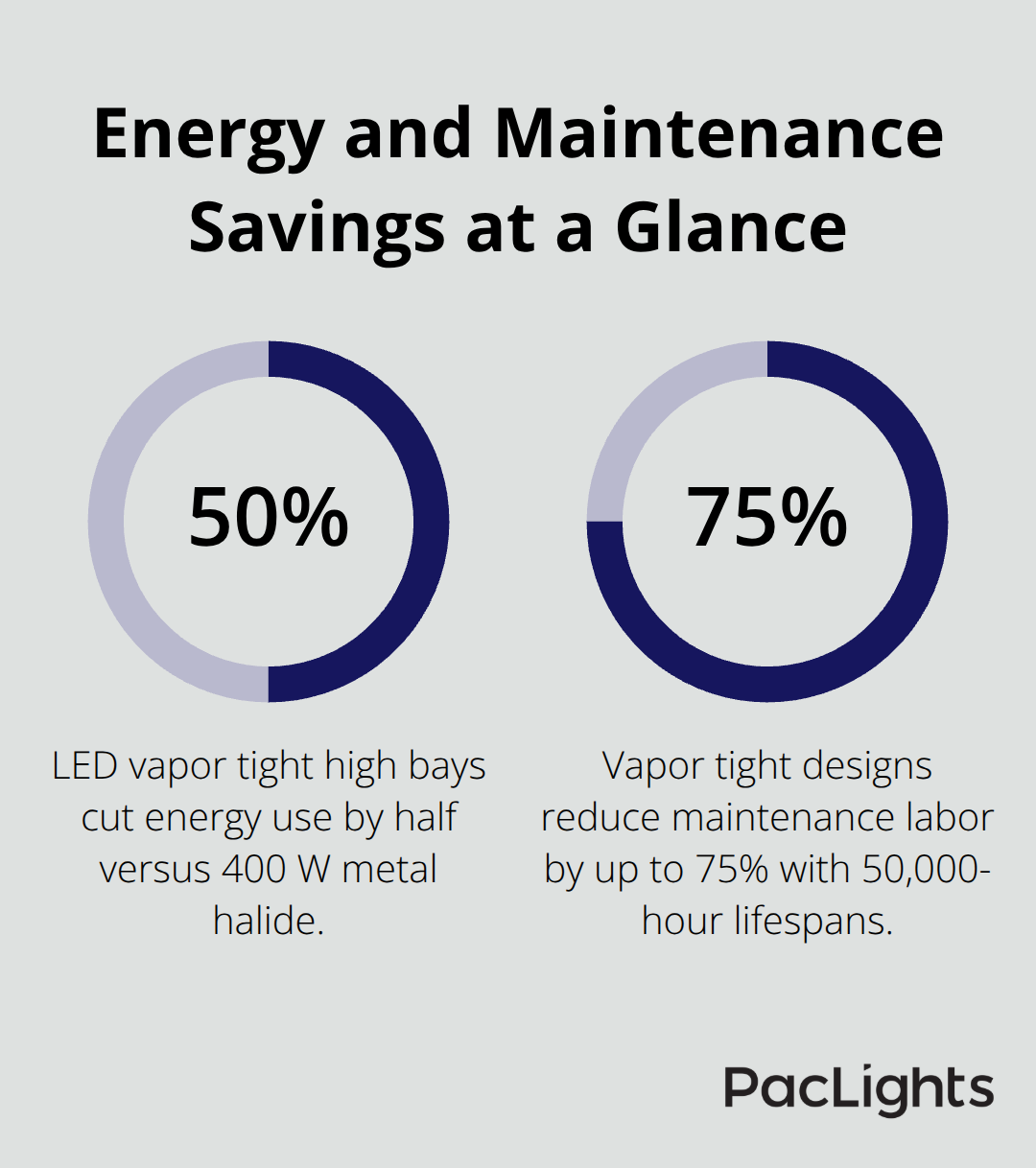
Industrial spaces demand fixtures that survive mechanical stress. Vapor tight high bays carry IK10 impact ratings and NEMA 4X variants, meaning they withstand accidental bumps from forklifts, equipment movement, and vibration from machinery without failure. A standard fixture struck by a pallet jack shatters; a vapor tight high bay absorbs the impact and keeps operating. This durability directly reduces downtime. When a fixture fails in a 40-foot-high warehouse, replacement requires equipment rental, scheduling, and labor costs that quickly exceed $2,000 per fixture. Vapor tight designs with 50,000-hour lifespans eliminate frequent replacements, cutting maintenance labor by up to 75 percent compared to traditional metal halide or fluorescent systems that need re-lamping every 6 to 12 months.
Compliance Happens Automatically with Certified Designs
Vapor tight high bays meeting UL 1598 and UL 8750 safety standards come pre-certified for industrial environments. NSF-certified vapor tight options exist for food processing and storage, removing the compliance burden from your facility. This matters because non-compliant lighting creates liability during health inspections or safety audits. DLC certification on modern vapor tight high bays also qualifies fixtures for utility rebates that cover 50 to 99 percent of project costs. Trinity Lutheran School paid roughly $1 per fixture after rebates when upgrading 140 vapor tight lights, demonstrating how certification unlocks substantial savings. Rather than navigating complex regulations yourself, specified vapor tight fixtures arrive inspection-ready and position your facility to qualify for energy incentives that offset the initial investment.
How Vapor Tight High Bays Cut Energy Costs and Pay for Themselves
LED Technology Cuts Energy Consumption in Half
LED vapor tight high bays consume dramatically less power than the metal halide and fluorescent systems they replace. A 200-watt LED vapor tight fixture delivers the same light output as a 400-watt metal halide unit, cutting energy consumption in half. For a warehouse running 60 high bay fixtures for 16 hours daily at $0.12 per kilowatt-hour, this 50-percent reduction saves $6,912 annually in electricity costs alone.
The U.S. Department of Energy confirms that LED lighting cuts overall lighting energy use significantly in the right application, with payback timelines affected by fixture count, wattage reduction, runtime hours, labor costs, maintenance access, and local electricity rates.
Real Savings Scale Across Facility Size
In facilities operating 24/7, the energy savings accelerate dramatically. A distribution center with 100 vapor tight high bays running continuously saves over $17,000 per year compared to traditional lighting. These aren’t theoretical numbers-real-world deployments consistently report energy reductions between 60 and 75 percent when upgrading from older technologies. Smaller facilities see proportional savings; even a 30-fixture operation cuts annual electricity costs by thousands of dollars.
Maintenance Costs Drop When Fixtures Last Longer
LED vapor tight high bays maintain 50,000 hours or more of lifespan, compared to 6,000 to 15,000 hours for metal halide or fluorescent alternatives. This means your facility replaces fixtures once every eight to ten years instead of every one to two years. Eliminating frequent re-lamping removes the labor costs, equipment rental for lifts, scheduling complexity, and facility downtime that accompany maintenance cycles. For a 40-foot ceiling, each fixture replacement costs $2,000 or more in labor and equipment alone. Upgrading 100 fixtures saves approximately $200,000 in maintenance labor over a decade.
Total Cost of Ownership Justifies the Initial Investment
Add the electricity savings to the maintenance reductions, and total cost of ownership drops by 40 to 50 percent despite the higher upfront price tag. Return on investment typically arrives within 12 to 24 months, meaning the fixtures pay for themselves through operational savings. The financial case extends far beyond simple math-vapor tight high bays transform how facilities manage their lighting budgets and operational efficiency.
When you’re ready to calculate exactly how much your facility will save, understanding which fixtures match your space becomes the next critical step.
Matching Fixtures to Your Facility’s Actual Requirements
Selecting the wrong vapor tight high bay wastes money on excess lumens you don’t need or forces you to install additional fixtures because you underestimated output. Start by measuring your ceiling height and calculating the required light levels for your specific work. A warehouse storing inventory needs around 500 lux on the floor, while manufacturing floors performing detailed assembly work require 800 lux or higher. Food processing areas demand similar brightness levels to ensure product quality and worker safety.
Calculate Exact Fixture Counts Using Lux Requirements
Once you know your target lux level, use this formula: multiply your floor area by the required lux, then divide by the fixture’s lumens and account for a 0.8 maintenance factor as dust accumulates over time. For a 10,000-square-foot warehouse needing 500 lux, you calculate 10,000 × 500 ÷ 0.8 = 6,250,000 lumens total needed. If each fixture delivers 20,000 lumens, you need roughly 313 fixtures. This math prevents both oversizing and undersizing.
Ceiling height directly determines lumen requirements. Spaces with 15-foot ceilings typically need 10,000 to 15,000 lumens per fixture, while 25 to 35-foot ceilings demand 33,000 lumens or higher. PacLights provides free lighting layout designs that handle this calculation for you, eliminating guesswork and showing exactly how many fixtures your space needs before you spend a dollar.
Prioritize IP Rating, Efficacy, and Beam Angle
IP65 ratings represent the minimum acceptable standard for vapor tight high bays in most industrial environments, but IP67 fixtures provide superior protection in washdown areas, cold storage, or food processing plants where water and cleaning chemicals directly contact equipment. Higher IP ratings cost slightly more upfront but eliminate premature failures in the harshest conditions.
Efficacy matters equally-look for fixtures delivering 150 lumens per watt or higher, as this efficiency directly translates to lower operating costs over the fixture’s 50,000-hour lifespan. A fixture with 140 lm/W versus 160 lm/W might seem minor, but across 100 fixtures running 16 hours daily, that 20 lm/W difference costs approximately $2,000 annually in excess electricity.
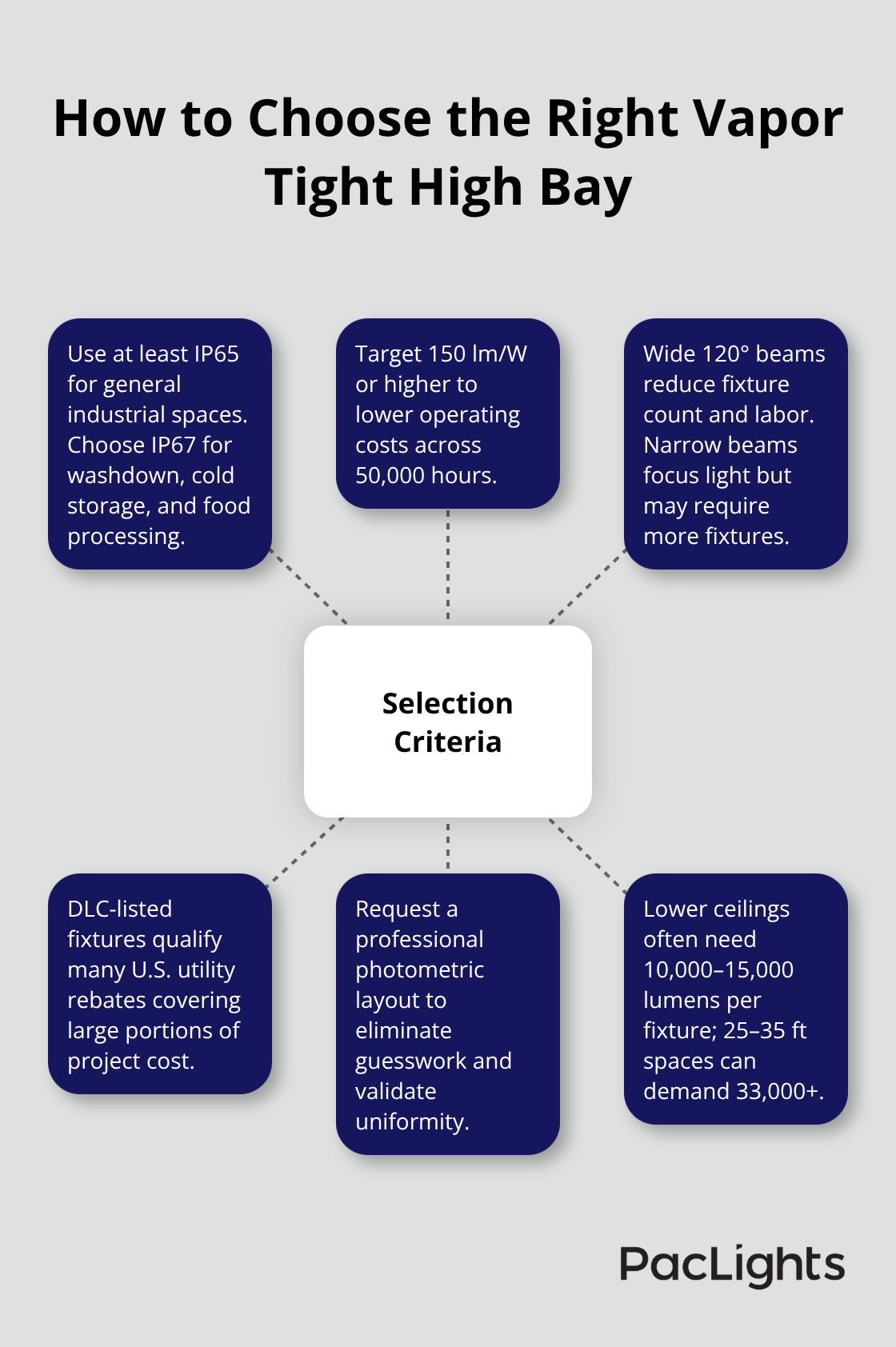
Beam angle determines how many fixtures you actually need. Wide beam angles of 120 degrees or greater reduce fixture count and installation labor, while narrow angles concentrate light in specific zones but require more fixtures for uniform coverage. For open warehouse floors, wide beam angles almost always deliver better economics.
Verify DLC Certification for Rebate Eligibility
DLC certification appears on quality vapor tight high bays and qualifies your project for utility rebates covering 50 to 99 percent of costs, making certification status a non-negotiable selection criterion rather than a nice-to-have feature. This certification transforms the financial equation and directly impacts your return on investment timeline.
Obtain Professional Layout Design Before Purchasing
Facility managers frequently purchase vapor tight high bays based on competitor specifications without understanding how those fixtures perform in their actual space. Photometric studies and professional layout designs eliminate this risk entirely. A proper layout accounts for reflectance of your walls, ceiling, and floor; existing obstructions like beams or equipment; and how light distributes across your specific floor plan.
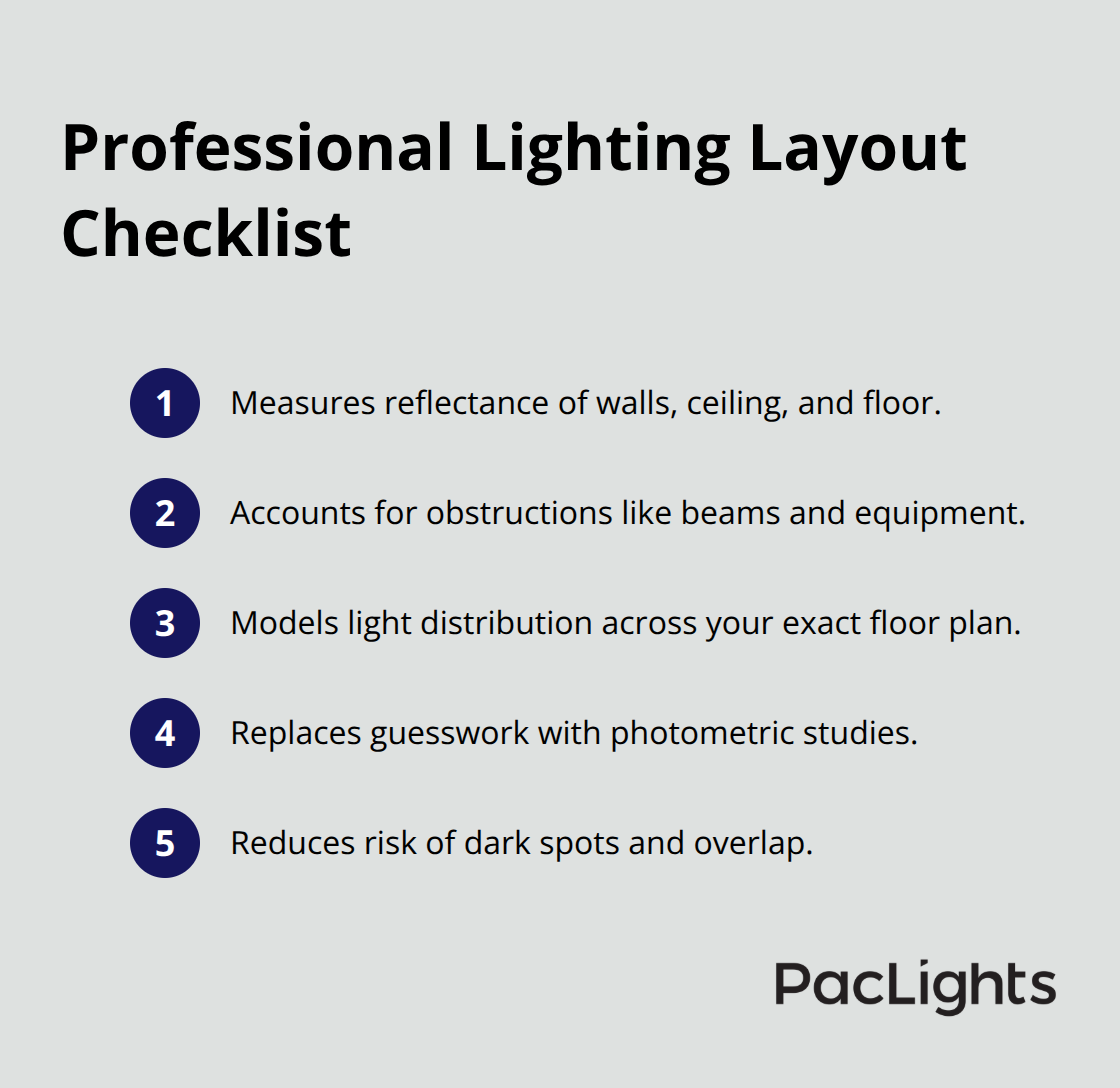
Cheap layouts produced by inexperienced designers often result in dark spots near walls or excessive overlap in center aisles, forcing you to add fixtures later or live with poor visibility. PacLights offers free lighting layout designs and ROI assessments showing exactly what you’ll save with specific fixture selections in your facility, transforming abstract specifications into concrete performance projections and cost comparisons. This removes installation risk and gives you confidence that your investment will deliver the promised results.
Final Thoughts
Vapor tight high bays deliver straightforward financial returns that industrial facilities cannot ignore. Lower energy bills, reduced maintenance cycles, extended fixture lifespans, and automatic compliance with safety standards combine to produce payback within 12 to 24 months. Real warehouses, distribution centers, and manufacturing floors report energy reductions between 60 and 75 percent when upgrading from older technologies, and your facility will experience the same results.
The real challenge lies in selecting the right fixtures for your specific space rather than navigating technical complexity or financial risk. Installing incorrect fixtures wastes money on excess capacity or forces costly additions later. We at PacLights provide free lighting layout designs and ROI assessments that show exactly what your facility will save with specific vapor tight high bay selections before you commit to anything.
Our team handles the photometric calculations, accounts for your ceiling height and floor reflectance, and delivers concrete numbers showing your return on investment timeline. Start with a free layout assessment and see what’s possible for your operation.
Disclaimer: PacLights is not responsible for any actions taken based on the suggestions and information provided in this article, and readers should consult local building and electrical codes for proper guidance.