

Your commercial downlight retrofit ideas might be costing you thousands in wasted energy and maintenance every year. Outdated lighting systems drain budgets while delivering poor light quality that impacts how your team works.
At PacLights, we’ve helped businesses transform their spaces with LED retrofits that cut energy costs and boost productivity. This guide shows you exactly how to modernize your lighting and what returns to expect.
Why Your Current Downlights Are Draining Money
Halogen and fluorescent downlights consume far more energy than most facility managers realize. A single 50-watt halogen downlight running 8 hours daily uses roughly 150 kilowatt-hours annually, while an LED alternative at 10 watts uses just 30 kilowatt-hours for identical brightness. For a 50-fixture office, that difference amounts to 6,000 kilowatt-hours per year-translating to approximately $1,800 in unnecessary electricity costs based on typical commercial utility rates.
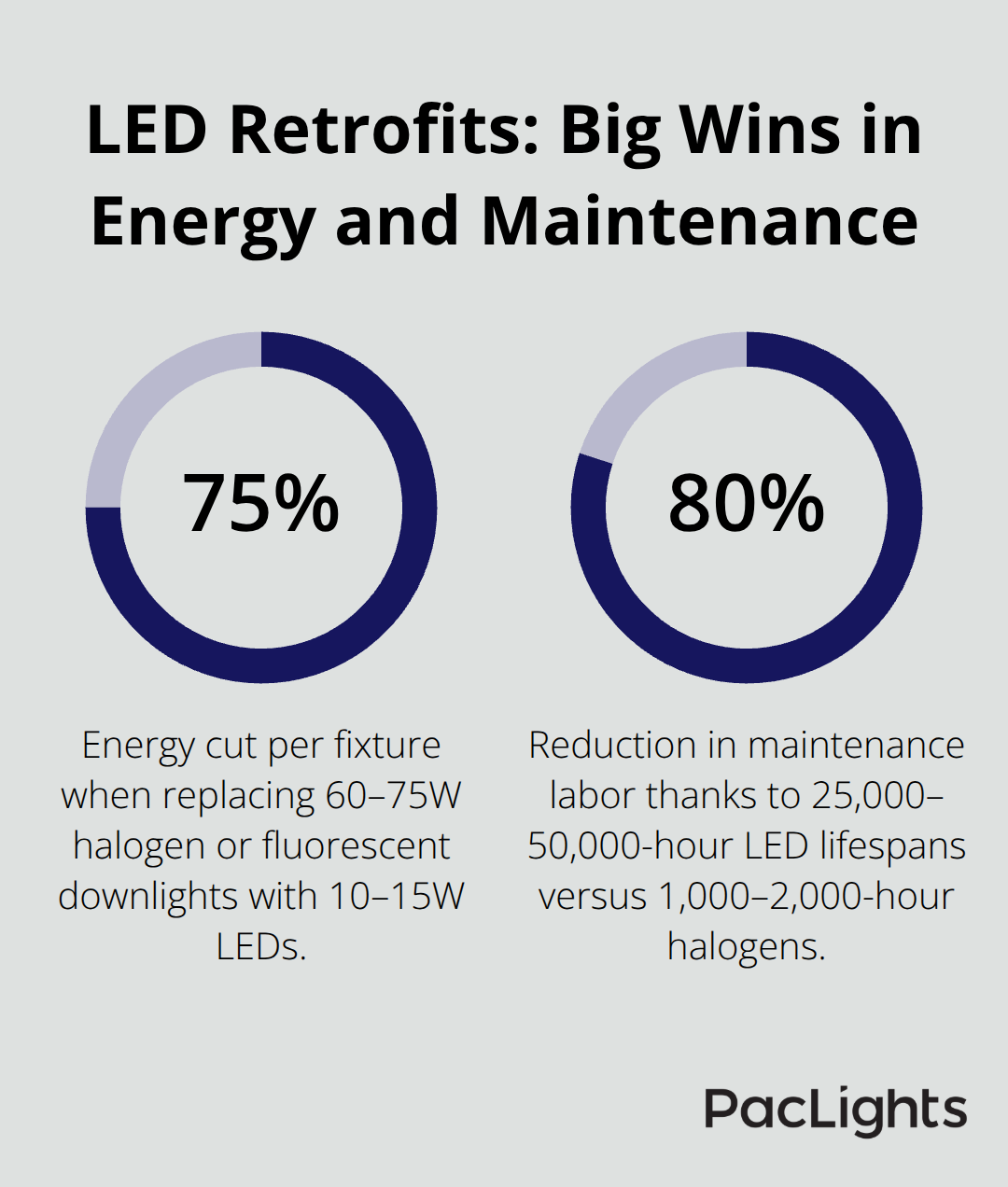
According to DOE standards, replacing 60–75 watt halogen or fluorescent downlights with 10–15 watt LEDs cuts energy consumption by up to 75 percent per fixture. Over a decade, a single retrofit project in an Atlanta commercial facility avoided roughly $18,000 in electricity costs. The financial drain extends beyond energy bills. Halogen downlights fail after just 1,000–2,000 hours of operation, forcing frequent replacements that disrupt workflows and strain maintenance budgets. LED downlights last 25,000–50,000 hours, reducing maintenance labor by up to 80 percent compared to traditional lamps. This means fewer ceiling access calls, less inventory management, and minimal operational downtime.
The Hidden Productivity Cost
Poor light quality from aging downlights directly impacts how your team performs. Halogen and older fluorescent fixtures often produce flickering light and uneven illumination, causing eye strain and fatigue. LED downlights with 90+ CRI improve color rendering significantly, reducing eye strain and enhancing worker performance. Research consistently shows that higher-quality lighting improves focus, reduces errors, and supports better decision-making in office environments.
Halogen fixtures also generate excessive heat-200–300 degrees Celsius-creating uncomfortable workspaces and unnecessary cooling demands. LEDs run substantially cooler, improving comfort while reducing HVAC strain during warm months. Additionally, outdated systems often lack dimming capabilities or occupancy controls, forcing fixed brightness levels regardless of actual need.
Smart Controls Transform Energy Waste into Savings
Modern LED retrofits support motion sensors and daylight harvesting, which deliver 20–30 percent additional energy savings beyond baseline LED improvements. In high-traffic areas like hallways and break rooms, occupancy-based controls achieve 60–70 percent annual energy reductions, making them particularly effective for commercial spaces. These controls adapt lighting to actual occupancy and natural light availability, eliminating waste during low-demand periods.
Advanced lighting controls (such as networked lighting controls) further optimize energy use across your entire facility. This inflexibility in older systems wastes energy during low-occupancy periods and fails to adapt lighting to different tasks. Upgrading to LED retrofits with smart controls positions your facility to recover thousands in annual savings while improving the work environment your team experiences daily.
How to Choose and Install the Right LED Retrofit System
Match Fixtures to Your Space’s Real Requirements
The most effective retrofit strategy starts with matching your fixture type to your space’s actual requirements. Standard 6-inch recessed downlights work well for general office illumination, delivering 800–1,200 lumens at 10–15 watts, but troffer retrofits serve different ceiling types and lumen demands. A 50-fixture office upgrading from halogen to LED typically needs fixtures spaced 8–10 feet apart above workstations, delivering 2,500–3,500 lumens per fixture at 4000K color temperature for clear visibility without eye strain.
Before purchasing retrofit kits, measure your existing housings carefully and verify compatibility with current dimmers and control protocols to avoid flicker or control issues. Installation takes 15–30 minutes per fixture, meaning a 50-fixture office completes an upgrade in one to two days with minimal operational disruption. A free lighting layout assessment verifies target lumen levels, identifies dark zones or glare, and optimizes fixture counts before you commit to purchase, which eliminates costly oversizing or undersizing mistakes.
Add Motion Sensors and Daylight Harvesting
Occupancy sensors and daylight harvesting transform LED retrofits from simple energy savers into intelligent systems that adapt to real-world usage patterns. Motion sensors work exceptionally well in hallways and break rooms, where occupancy-based dimming and automated shutoff achieve 60–70 percent annual energy reductions compared to continuously lit spaces. Daylight harvesting sensors reduce artificial lighting during peak daylight hours, adding 20–30 percent extra energy savings beyond baseline LED improvements in perimeter offices and spaces with windows.
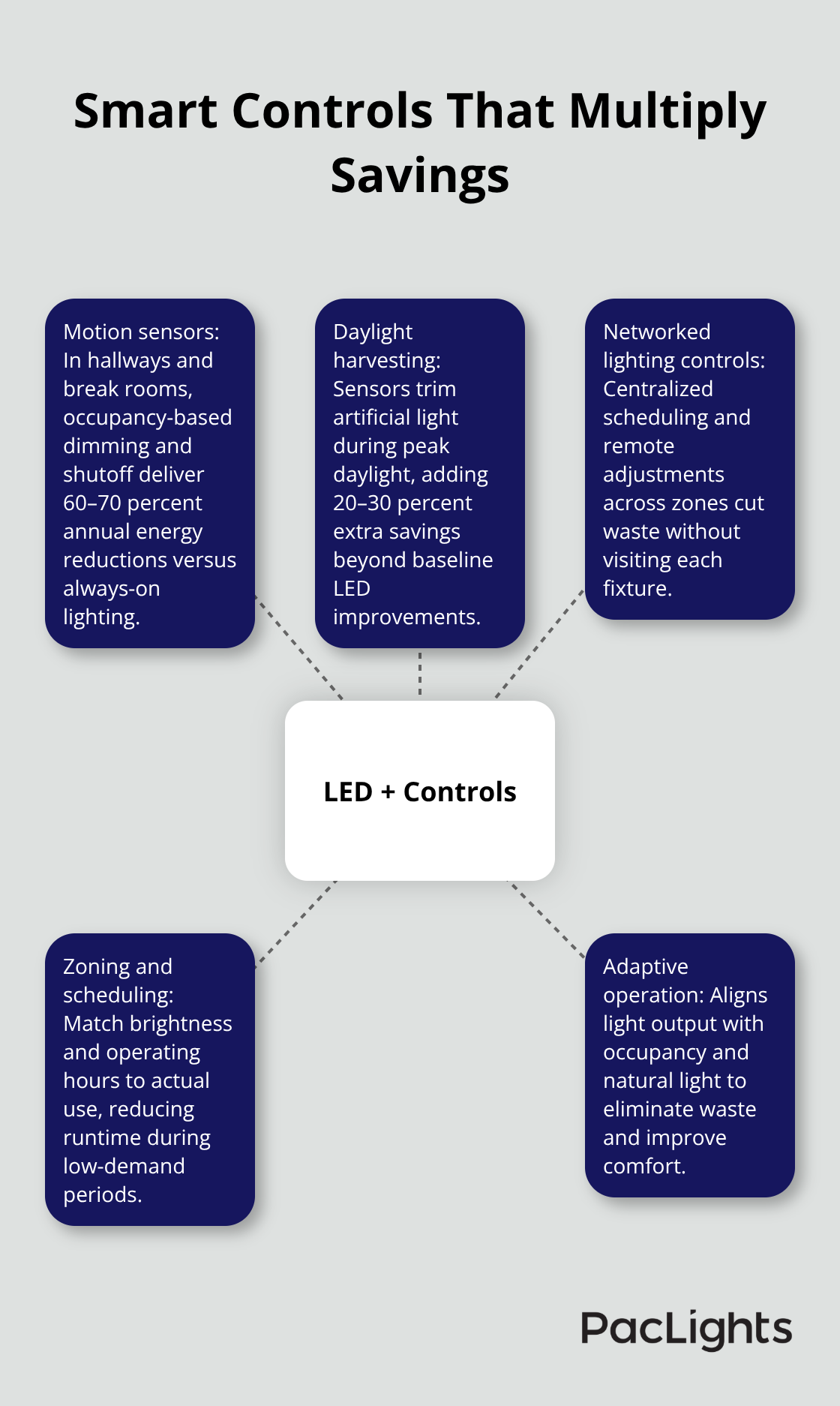
Advanced networked lighting controls enable remote management and scheduling across multiple zones, allowing facility managers to adjust brightness, color temperature, and operating hours from a central dashboard without visiting each fixture. Atlanta commercial facilities implementing these controls alongside LED retrofits report payback periods of 18–24 months after accounting for rebates like those offered through Georgia Power, with post-incentive costs running approximately $15–$40 per fixture.
Calculate Your True Financial Return
The financial case strengthens further when you factor in reduced maintenance labor. LED fixtures lasting 25,000–50,000 hours versus halogen’s 1,000–2,000 hours means your maintenance team spends far less time on ceiling access calls and inventory management, directly lowering operational overhead. These savings compound over time, making the retrofit investment increasingly valuable as years pass and maintenance demands shrink.
Understanding your facility’s specific lighting needs and control requirements positions you to select retrofit solutions that deliver maximum returns. The next step involves evaluating which retrofit products and control systems align with your budget and performance goals.
What Your Retrofit Investment Actually Returns
Energy Savings That Pay Back in Months, Not Years
Your retrofit payback arrives faster than most facility managers expect. A 50-fixture office replacing halogen downlights with LEDs saves approximately $1,800 annually in electricity costs alone, which translates to $18,000 over a decade based on observed Atlanta commercial facility data.
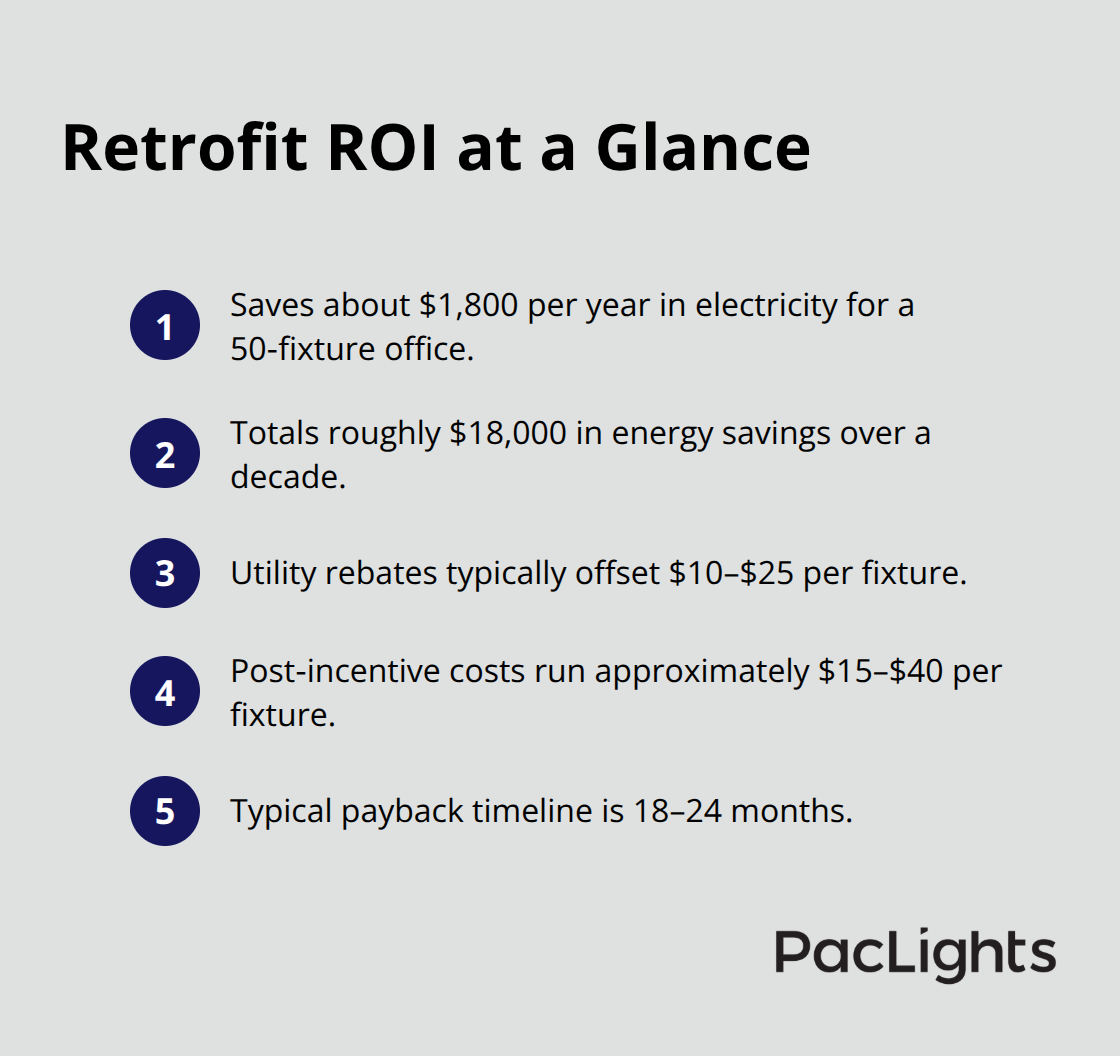
After accounting for Georgia Power rebates that typically offset $10–$25 per fixture, your post-incentive costs drop to roughly $15–$40 per fixture, pushing typical payback timelines to 18–24 months. Within two years, your retrofit investment pays for itself entirely through energy savings, then generates pure profit for the remaining 8–10 years of LED lifespan.
Maintenance Labor Savings Accelerate Your Returns
The calculation becomes even more attractive when you factor maintenance labor savings. LED downlights last 25,000–50,000 hours compared to halogen’s 1,000–2,000 hours, so your maintenance team performs up to 80 percent fewer ceiling access calls and bulb replacements. For commercial facilities with 50+ fixtures, this translates to hundreds of hours annually freed from routine maintenance, allowing your team to focus on higher-value work. Combining energy savings with reduced maintenance labor often accelerates payback to 12–18 months, particularly in facilities operating extended hours.
Smart Controls Multiply Your Financial Advantage
Advanced controls amplify these returns significantly. Motion sensors and daylight harvesting add 20–30 percent extra energy savings beyond baseline LED improvements, pushing annual savings to $2,200–$2,300 for a typical 50-fixture office. In high-traffic corridors and break rooms where occupancy-based controls achieve 60–70 percent annual energy reductions, payback periods compress further. Networked lighting controls enable remote management across multiple zones, allowing facility managers to adjust brightness and operating hours without visiting each fixture.
Environmental and Tax Benefits Strengthen the Case
Your carbon footprint shrinks proportionally with energy consumption, reducing emissions by roughly 75 percent per fixture compared to halogen systems. This environmental improvement directly supports corporate sustainability commitments and increasingly influences purchasing decisions among clients and partners. Tax incentives vary by location and facility type, but many commercial properties qualify for accelerated depreciation on LED retrofit investments under Section 179 deductions, further improving financial returns.
Get Your Specific Numbers Before You Commit
Request a free lighting layout and ROI assessment before committing to any retrofit project. This analysis reveals your specific payback period by tracking actual energy consumption and comparing it against pre-retrofit baseline data, identifies dark zones or oversizing mistakes, and quantifies total cost of ownership using your actual utility rates and local rebate programs. PacLights offers free lighting layout designs and ROI assessments to help you understand your exact financial returns and make informed decisions about your retrofit investment.
Final Thoughts
Commercial downlight retrofit ideas transform your facility’s energy consumption and maintenance costs in ways that compound over time. A 50-fixture office saves approximately $1,800 annually in electricity costs, translating to $18,000 over a decade, while reduced maintenance labor and rebate programs compress payback timelines to 18–24 months. Motion sensors and daylight harvesting multiply these returns by adding 20–30 percent extra energy savings beyond baseline LED improvements, and networked lighting controls enable remote management across your entire facility without visiting individual fixtures.
Your carbon footprint shrinks proportionally with energy consumption, supporting corporate sustainability goals while improving your competitive position with environmentally conscious clients and partners. The long-term value compounds as LED technology continues advancing and your maintenance team spends far less time on ceiling access calls and bulb replacements. Understanding your specific facility needs and financial picture positions you to make informed decisions about your retrofit investment.
We at PacLights offer free lighting layout designs and ROI assessments that reveal your exact payback period, identify optimization opportunities, and quantify total cost of ownership using your actual utility rates and local rebates. This analysis eliminates guesswork and helps you understand how commercial downlight retrofit solutions can transform your space while delivering substantial financial returns. Contact us today to schedule your free assessment.
Disclaimer: PacLights is not responsible for any actions taken based on the suggestions and information provided in this article, and readers should consult local building and electrical codes for proper guidance.