

Moisture and chemicals destroy electrical equipment faster than most people realize. At PacLights, we know that vapor tight fixture selection makes the difference between equipment that lasts decades and systems that fail within months.
The right enclosure protects your investment and keeps operations running smoothly in harsh environments.
What Vapor Tight Fixtures Actually Protect Against
Vapor tight fixtures are sealed luminaires that keep moisture, dust, and airborne contaminants out of the electrical compartment. Unlike standard fixtures with open housings, vapor tight enclosures use structural seals, gaskets, and corrosion-resistant materials to create a barrier against environmental hazards. The electrical components-LED drivers, ballasts, and wiring-sit inside a protected chamber that prevents water wicking, condensation, and chemical penetration. Unprotected fixtures in wet environments fail within 6 to 18 months because moisture corrodes the driver and ballast connections. Standard fixtures offer no defense against this; they’re designed for dry, controlled indoor spaces. Vapor tight fixtures, by contrast, are rated using IP codes (International Protection ratings) that specify exactly what they can withstand.
Understanding IP Ratings and What They Mean
IP65 means dust-tight protection and resistance to water jets from any direction. IP67 adds temporary immersion protection up to 3 feet for 30 minutes, which matters in washdown areas. IP68 allows permanent submersion, required in continuous washdown cycles like food processing plants. The structural difference is significant: vapor tight housings use die-cast aluminum or reinforced polymer to maintain seal integrity under pressure, while standard fixtures use basic sheet metal that offers no environmental defense.
Critical Applications Where Vapor Tight Protection Becomes Non-Negotiable
Food processing plants, car washes, cold storage facilities, and parking garages depend on vapor tight fixtures because their environments create constant moisture exposure. Food processing plants with 80 psi washdowns require IP67 or IP68 ratings to survive daily cleaning cycles. Car wash facilities demand IP66 or IP69K minimum because standard IP65 fixtures cannot handle high-pressure jets and harsh detergents. Cold storage and freezer operations create condensation even without direct water contact, so sealed enclosures prevent electrical failures from temperature swings. Manufacturing facilities with chemical splash or salt-air exposure (coastal areas) need corrosion-resistant housings paired with appropriate IP ratings.
Regulatory Requirements and Cost Implications
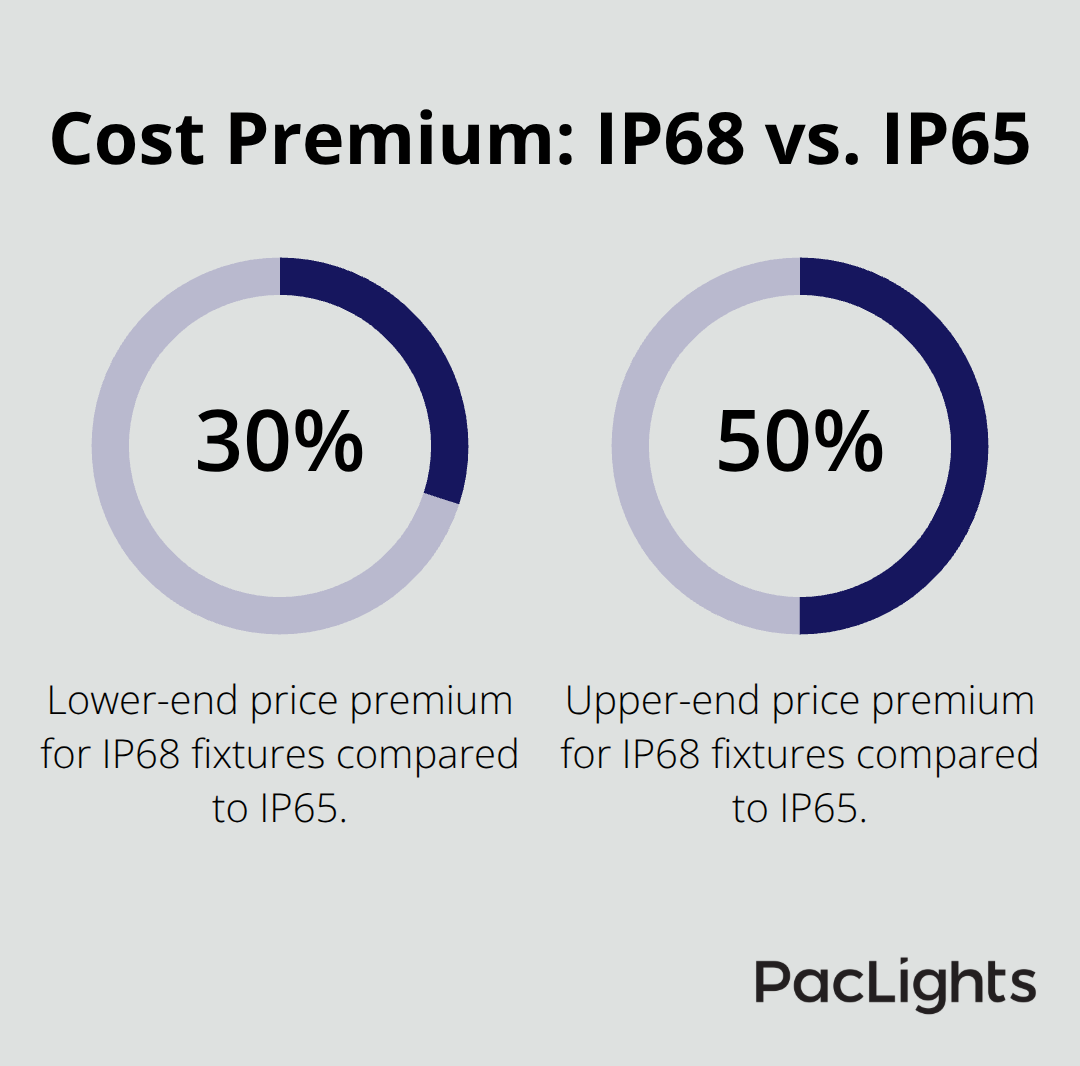
NEC Article 410 mandates that wet and damp locations use fixtures with proper IP or NEMA ratings; failure to comply creates liability and code violations. The cost difference is real-IP68 fixtures can cost 30 to 50 percent more than IP65 alternatives-but the math is straightforward. Replacing a failed standard fixture in a food plant costs labor, downtime, and potential contamination risk. Vapor tight fixtures eliminate that risk entirely.
The next step involves assessing your specific environment to determine which IP rating and enclosure type will protect your equipment and operations most effectively.
Matching Enclosures to Your Exact Environment
Start by documenting three site conditions before selecting any fixture: frequency of moisture contact, type of exposure (spray, splash, or immersion), and chemical or salt-air presence. A dry climate warehouse with occasional dust needs only IP65 protection, but a food processing plant with daily 80 psi washdowns demands IP67 or IP68. The difference matters financially-oversizing protection unnecessarily costs 30 to 50 percent more and wastes budget that could fund other improvements.
Temperature and Condensation Challenges
Temperature extremes complicate fixture selection significantly. Condensation in freezers creates internal moisture even without direct water contact, and coastal environments require corrosion-resistant materials alongside appropriate water ratings. Cold storage facilities experience constant temperature swings that generate internal moisture; standard IP65 fixtures fail because condensation reaches the driver connections. When you select fixtures for freezer environments, confirm cold-start performance and low-temperature operation of electronics and drivers to ensure the battery and electronics perform reliably at your project minimum temperatures.
Material Selection and Housing Design
Polycarbonate lenses offer the highest impact resistance but can yellow or degrade with certain chemicals, while acrylic resists yellowing and chemical exposure but typically provides lower impact protection. Die-cast aluminum housings provide structural rigidity and act as a heat sink for the LED driver, improving durability significantly in harsh environments. When you evaluate fixtures, demand certification documentation and verify that labels match the actual product-beware marketing claims of waterproof without third-party certification. Request actual performance data: measured lumens per watt, real-world lifespans in similar installations, and warranty terms covering sealed components. Rely on certified data from UL or ETL rather than estimates.
IP and IK Ratings for Industrial Zones
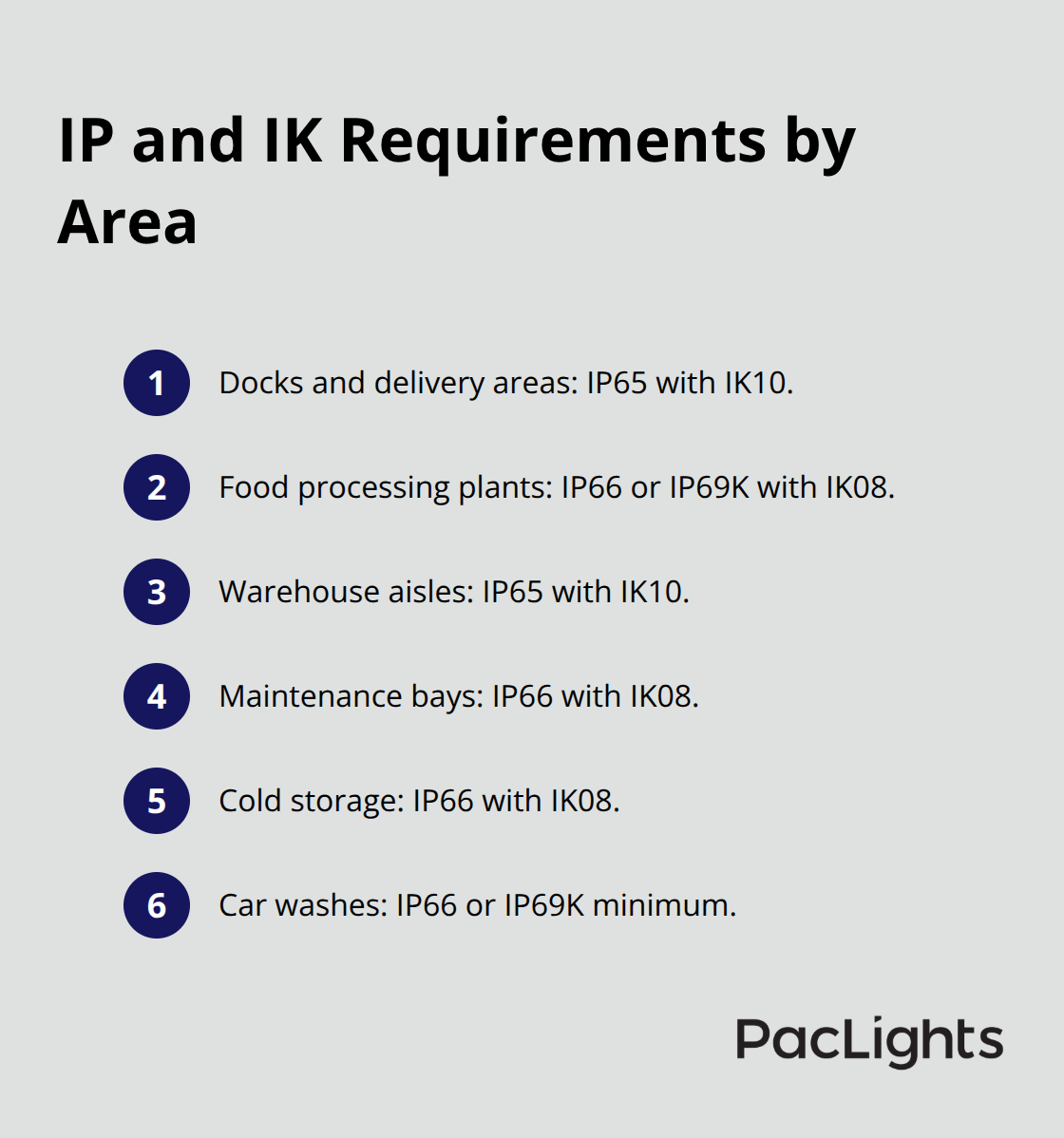
Docks and delivery areas typically require IP65 plus IK10 impact resistance; food processing plants need IP66 or IP69K combined with IK08; warehouse aisles operate safely with IP65 and IK10; maintenance bays function well at IP66 plus IK08; cold storage demands IP66 with IK08. Car wash environments demand special attention-standard IP65 fixtures cannot handle high-pressure jets and harsh detergents. Specify IP66 or IP69K minimum for these applications.
NSF certification may be required in food processing industries; always check local codes and regulatory requirements before selecting fixtures. For coastal and corrosive environments, pair your IP rating with stainless-steel hardware and specialized coatings to prevent material degradation beyond what moisture protection alone provides.
Documentation and Total Cost of Ownership
Documentation matters as much as the luminaire itself. Insist on a complete standards dossier and third-party test certificates from accredited laboratories like Intertek or TUV. Request stamped reports, not just PDFs. When you calculate a five-year total cost of ownership, include energy use, maintenance labor, and replacement parts, then confirm warranty coverage-typical ranges span 3 to 5 years for fixtures. This financial picture reveals whether a higher IP rating pays for itself through reduced downtime and maintenance labor. The next step involves understanding how proper installation and maintenance practices protect your investment and extend fixture life in these demanding environments.
Installation and Maintenance: Protecting Your Investment
Torque Specifications and Gasket Compression
Gasket compression is where most vapor tight installations fail, and the fix is simple: follow the manufacturer’s torque specification exactly. Over-tightening crushes the gasket and creates gaps; under-tightening leaves room for water wicking. A torque wrench costs under $50 and takes seconds to use, yet most installers skip this step entirely.
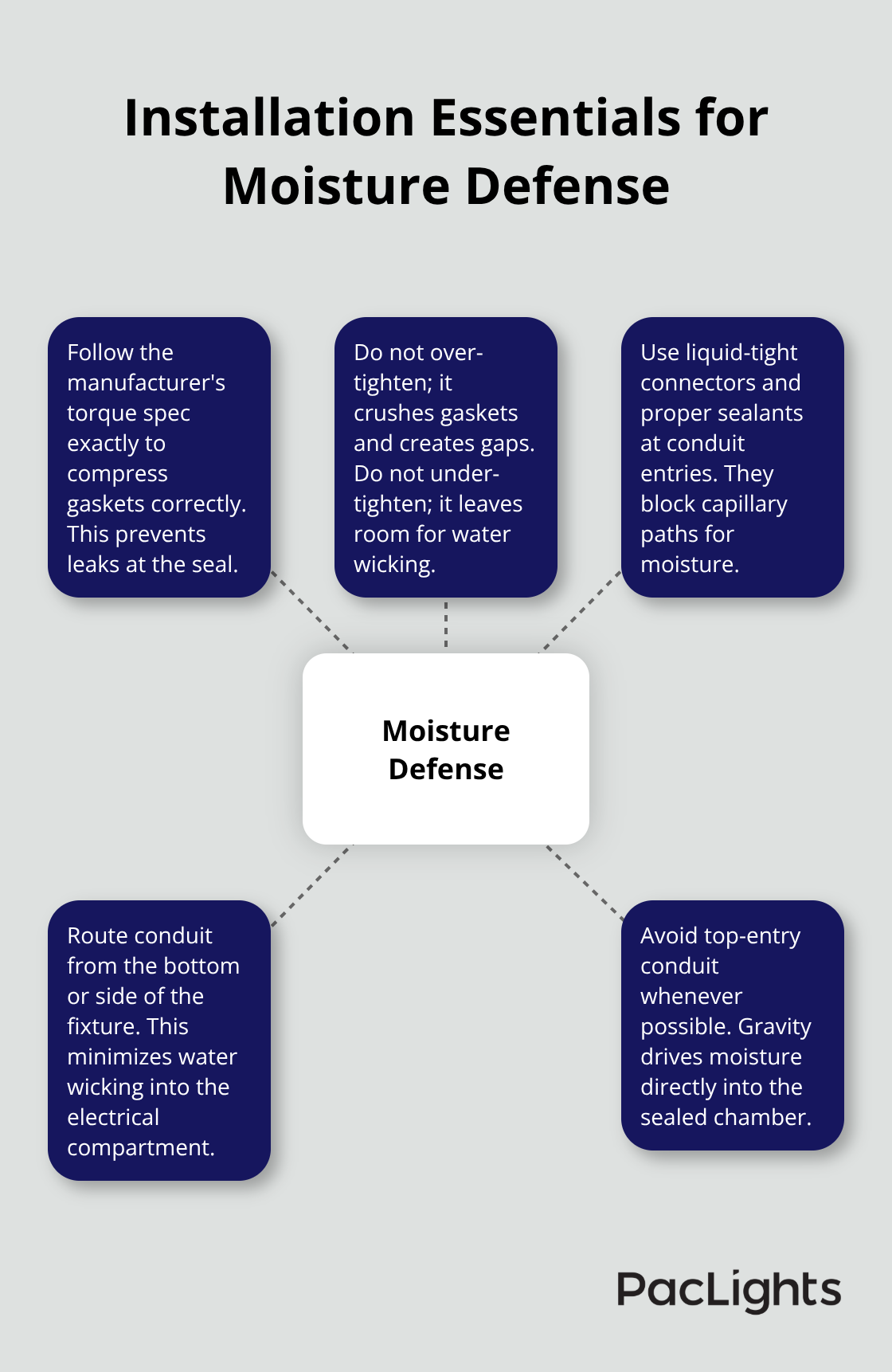
Conduit entry design matters equally-use liquid-tight connectors and proper sealants, then route the conduit from the bottom or side of the fixture to minimize water wicking upward into the electrical compartment. If conduit enters from the top, gravity works against you and moisture travels directly into the sealed chamber.
Thermal Clearance and Performance in Hot Environments
Thermal clearance is non-negotiable in sealed IP66 fixtures: maintain at least 12 inches between the fixture and ceiling obstructions to allow convective cooling. Without this space, the LED driver experiences thermal foldback at ambient temperatures above 40°C, reducing lumen output by 5 to 8 percent. In hot industrial zones, select fixtures rated to operate reliably up to 50°C to prevent performance loss. Facilities with mechanical vibration from cranes or stamping presses need vibration-rated anchors to prevent seal fatigue and premature gasket failure. For IK10 impact zones, add a stainless steel safety cable to prevent a dropped fixture from becoming a falling hazard after extreme impact events. Installation mock-ups early in the project reveal spacing conflicts and glare issues before fixtures ship; this single step prevents costly field modifications and rework.
Inspection Schedules and Preventive Maintenance
Inspection schedules prevent small problems from becoming expensive failures. Check gaskets and seals quarterly in food processing and car wash environments, semi-annually in moderate moisture zones, and annually in dry climates. Clean lenses every three months in dusty or chemical-heavy facilities to maintain light output; polycarbonate lenses need gentle cleaners because harsh chemicals cause yellowing and brittleness. Monitor for flicker or dimming, which signals driver stress or moisture intrusion. If condensation appears inside the lens, the seal has failed and the fixture requires replacement immediately; waiting increases the risk of electrical failure.
Documentation and Verification Protocols
Request a complete standards dossier and third-party test certificates from the manufacturer at installation, then file them for warranty claims and regulatory audits. When troubleshooting failures, start with the gasket: remove the fixture, inspect for cracks, debris, or compression marks, then reinstall with correct torque. Most field failures stem from installation errors, not manufacturing defects. Demand robust third-party certifications such as UL or ETL via the UL Solutions Product iQ database, and confirm that the exact model tested matches what arrives on your loading dock. Counterfeit or mislabeled fixtures circulate in the market, so verify serial numbers and inspection marks before installation begins.
Final Thoughts
Vapor tight fixture selection requires you to match your IP rating to actual environmental conditions, select materials that resist your specific hazards, and install fixtures correctly from the start. A food processing plant with daily washdowns needs IP67 or IP68, not IP65, while a coastal warehouse requires corrosion-resistant housings alongside appropriate water protection. A freezer demands cold-rated electronics and gasket materials that perform at sub-zero temperatures, and skipping any of these steps leaves you with equipment that fails within months.
Converting from standard fixtures to vapor tight LED alternatives typically pays back within 1.5 to 4 years through energy savings alone, depending on your run hours and local electricity rates. Add reduced maintenance labor and eliminated emergency replacements, and the payback accelerates further. Third-party certifications from UL or ETL matter far more than marketing claims, so demand full test reports from accredited laboratories like Intertek or TUV and verify that the exact model on your loading dock matches the certified product.
Installation errors cause most field failures, so use a torque wrench on gaskets, maintain thermal clearance around sealed fixtures, and route conduit from the bottom to prevent water wicking. We at PacLights understand that vapor tight fixture selection requires balancing protection, cost, and performance, and our team offers free lighting layout designs and ROI assessments to help you choose the right fixtures for your specific environment. Contact PacLights to discuss your vapor tight lighting needs and get a customized solution that protects your operations and your budget.
Disclaimer: PacLights is not responsible for any actions taken based on the suggestions and information provided in this article, and readers should consult local building and electrical codes for proper guidance.