

Data center lighting isn’t just about visibility-it directly impacts your operating costs and energy consumption. At PacLights, we’ve seen how a poorly planned data center lighting layout can waste thousands in unnecessary expenses while compromising equipment safety.
The right lighting strategy reduces energy consumption, improves cooling efficiency, and extends equipment lifespan. This guide walks you through the essential design principles that deliver measurable results.
Why Lighting Costs Matter More Than You Think
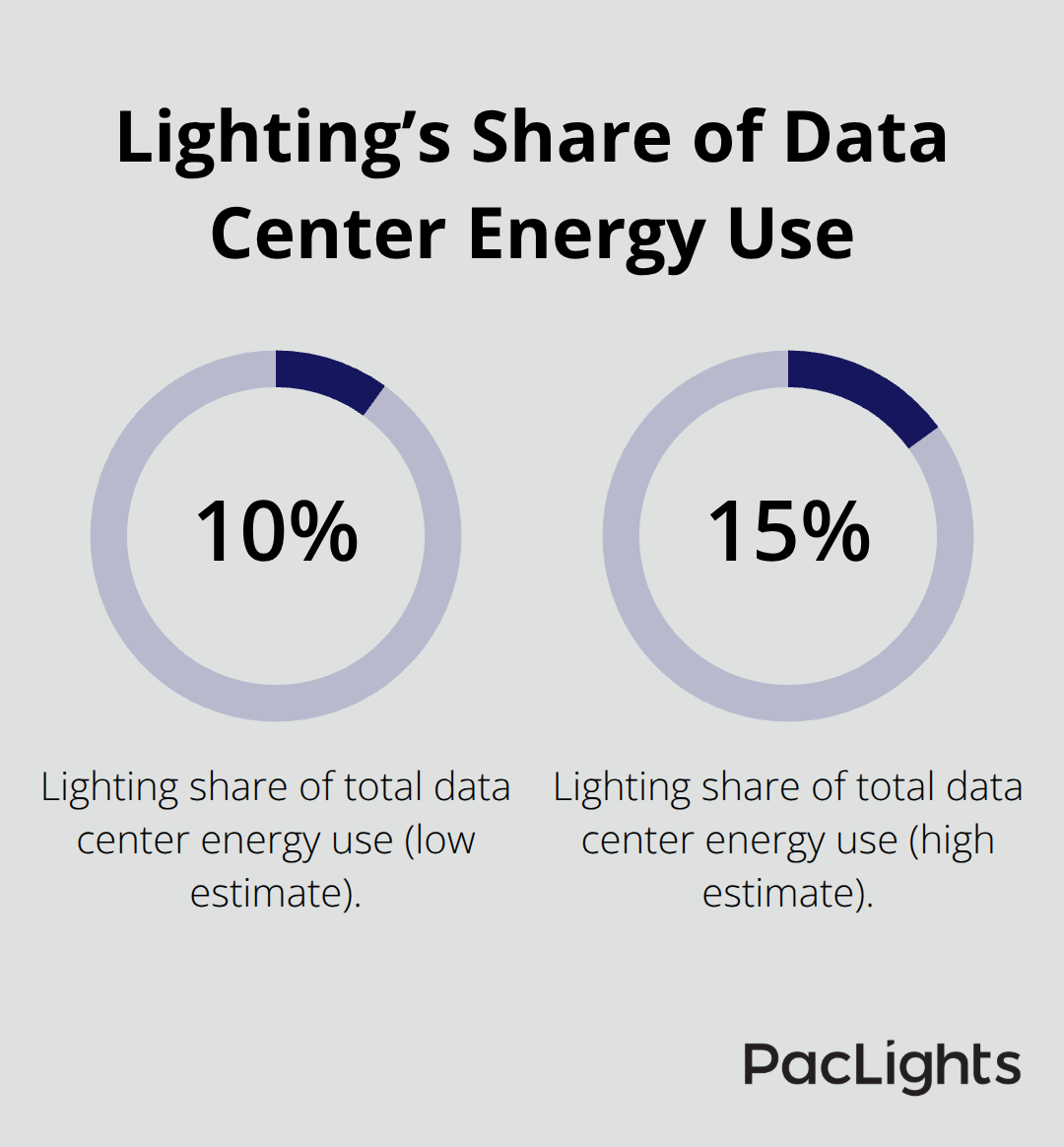
Data center operators typically allocate 20-40% of their operating budget to energy consumption, and lighting represents a far larger slice of that pie than most realize. According to Energy Innovation, lighting accounts for roughly 10-15% of total data center energy use, which translates to substantial annual expenses even in moderately sized facilities.
A 10,000 square foot data center running standard fluorescent or inefficient LED fixtures consumes 50,000-100,000 kWh annually just for lighting. At average commercial electricity rates of $0.12 per kWh, that amounts to $6,000-$12,000 spent yearly on illumination alone.
Poor Lighting Design Amplifies Hidden Costs
Inefficient fixtures force cooling systems to work harder, driving up HVAC costs by an additional 2-3% across the entire facility. When you combine direct lighting expenses with the hidden cooling overhead, the total impact on your bottom line becomes impossible to ignore. Strategic lighting design flips this equation entirely. LED fixtures consume roughly 90% less energy than incandescent alternatives according to Energy.gov, which means switching from a 500-watt fluorescent system consuming about 4,380 kWh annually to an equivalent LED setup using 440 kWh annually saves approximately $527 per year. Over a typical LED lifespan of 50,000 hours or more, these savings compound dramatically while reducing your carbon footprint by tons of CO2 annually.
Heat Generation Directly Impacts Cooling Efficiency
Traditional lighting fixtures generate significant waste heat that your cooling infrastructure must actively remove, forcing compressors and chillers to run longer and harder. LED fixtures produce substantially less heat than older technologies, which means your cooling load decreases immediately upon installation. This reduction in lighting-related heat output typically cuts overall cooling energy consumption by 2-3%, a meaningful reduction when cooling often represents 40-50% of total data center operating costs.
Poorly positioned lighting compounds this problem because fixtures placed haphazardly throughout the facility create hot spots that disrupt airflow patterns in hot and cold aisles, forcing your containment strategy to work inefficiently. Strategic placement directly above aisles at consistent spacing eliminates these disruptions and maintains uniform temperature distribution, allowing your HVAC system to operate at peak efficiency.
Calculate Your Payback Timeline
Payback periods for LED upgrades typically fall within 2-4 years, after which your lighting operates as pure operational savings. A $15,000 investment in proper LED fixtures and controls pays for itself within 36 months, then generates continuous cost reductions for the next 15-20 years. Free layout assessments help you identify the exact fixtures, placement strategies, and control systems that maximize savings for your specific facility layout and operational patterns. Understanding these numbers transforms lighting from a cost center into a strategic investment that directly strengthens your competitive position.
Designing Layouts That Protect Your Equipment and Cut Costs
Align Fixtures to Your Aisle Layout
Aisle alignment determines whether your lighting strategy succeeds or fails. Your fixtures must sit directly above the centerline of hot and cold aisles, spaced approximately 8–10 feet apart at mounting heights between 8–12 feet. This positioning delivers uniform illumination across cable connections and equipment faces without spilling light behind racks where it wastes energy and generates unnecessary heat.
Grid-aligned fixtures eliminate shadows between rows and reduce fixture count by 20–30% compared to warehouse-style overhead coverage. This approach also maintains the thermal separation that hot and cold aisle containment requires. When your ceiling grid doesn’t align with equipment layout, narrow pendant or linear fixtures solve the problem without expensive structural modifications.
Match Illumination Levels to Actual Tasks
Typical server-room maintenance requires about 500 lux of illumination, enough for technicians to read cable labels and spot connection issues without eye strain. Most facilities over-illuminate by 50–100%, wasting energy while creating glare that actually impairs visibility.
Color temperature matters more than most operators realize: 4000K–5000K lighting enhances focus and reduces errors during cable terminations and troubleshooting. Flicker-free LED drivers prevent camera interference and eye fatigue during extended shifts. Position fixtures to maintain at least seven feet of vertical clearance below them, avoiding head-strike hazards and preventing obstruction of cable trays that run perpendicular to aisles.
Build Redundancy and Meet Emergency Standards
Redundancy and emergency compliance aren’t optional-they’re mandatory. Split your lighting across at least two independent circuits covering different zones so that a single circuit failure still leaves partial visibility for safe navigation and basic operations.
Emergency lighting must comply with NFPA 101 standards, using battery-backed LED fixtures that maintain brightness during power outages and clearly mark all exit routes with illuminated signage. This dual-circuit approach protects both your operations and your staff.
Implement Three-Level Control with Motion Sensors
Motion sensors and occupancy-based controls deliver the largest energy reductions in real-world deployments. A zone rarely visited by staff might operate 8,760 hours annually under manual control but only 2,000 hours with sensors, cutting that area’s lighting consumption by 77% without compromising safety.
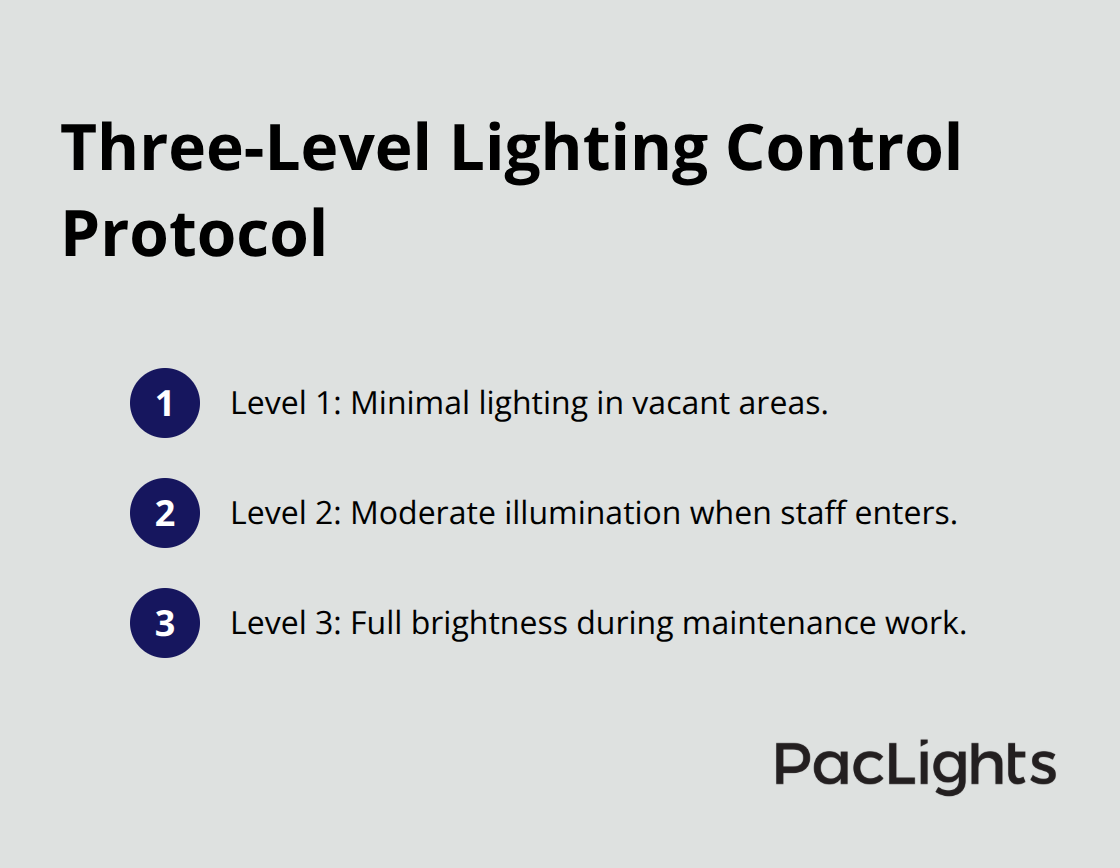
Implement a three-level protocol where Level 1 provides minimal lighting in vacant areas, Level 2 activates moderate illumination when staff enters, and Level 3 delivers full brightness during maintenance work. Each tier triggers through occupancy sensors or scheduled timing.
Daylight harvesting works in data centers with perimeter windows or outdoor spaces, automatically dimming fixtures when sufficient natural light is available and ramping brightness back up as daylight fades.
Centralize Control and Track Performance
Network-connected controls enable precise management of all three levels from a centralized dashboard. These systems track energy consumption by zone and generate performance reports that identify high-usage areas for continuous optimization.
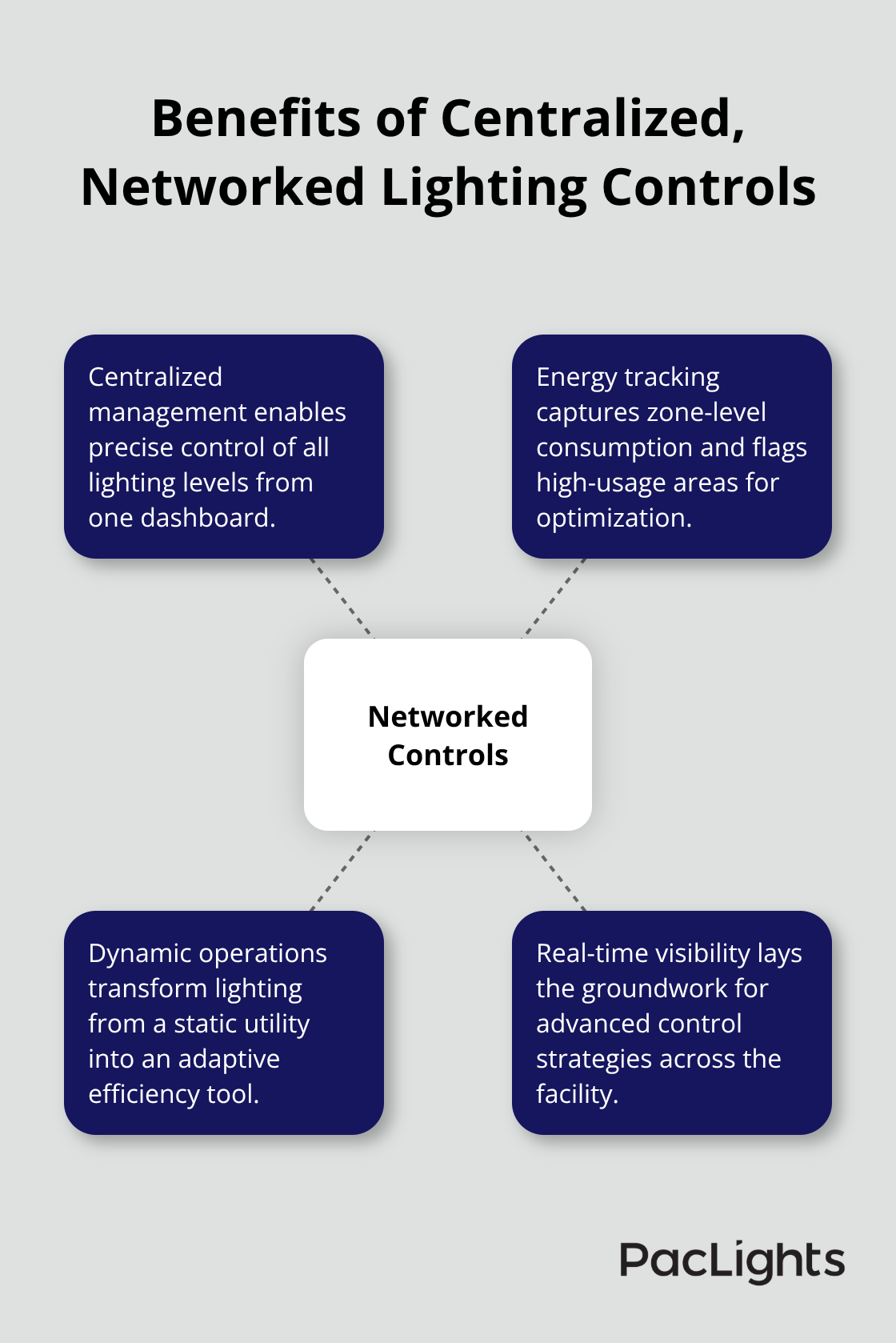
Your lighting transforms from a static utility into a dynamic efficiency tool that adapts to actual facility operations rather than guessing at occupancy patterns. This real-time visibility into fixture performance and energy use sets the foundation for the advanced control strategies that modern data centers demand.
Smart Controls Transform Data Center Lighting Into an Efficiency Engine
Real-Time Adjustments Replace Static Fixture Operations
Networked lighting controls fundamentally change how data centers manage energy. Rather than static fixtures operating on fixed schedules, connected systems adjust brightness in real time based on actual occupancy, equipment load, and available daylight. Energy reductions of 40–60% compared to uncontrolled LED installations represent the standard performance across facilities ranging from 5,000 to 50,000 square feet. A facility running three-level occupancy-based controls can reduce annual lighting energy consumption from 440 kWh to roughly 220 kWh, cutting that $527 annual savings figure in half again.
Integration Creates Unified Facility Intelligence
Integration with your building management system means lighting controls talk directly to HVAC systems, security cameras, and access points, creating a unified facility intelligence layer. When motion sensors detect technicians entering a maintenance aisle, the system simultaneously activates lighting, logs access for security, and notifies cooling systems to adjust airflow patterns. This coordination eliminates the energy waste that occurs when lighting runs independently from other building systems.
Real-time dashboards show energy consumption by zone, fixture performance metrics, and maintenance alerts, giving operators visibility into exactly which areas consume the most power and which fixtures approach end-of-life. This data transforms abstract energy efficiency into concrete, actionable intelligence that drives continuous optimization decisions. The control system itself pays back within 18–24 months through energy reductions alone, then delivers pure operational savings for the next 10–15 years.
Retrofit Solutions Eliminate Infrastructure Barriers
LED retrofit solutions remove the barrier that legacy infrastructure creates. Upgrading existing fluorescent or older LED systems does not require replacing wiring, ceiling structures, or control circuits-modern retrofit fixtures drop directly into existing sockets and mounting hardware. A data center with 200 fluorescent troffers can transition to networked LED controls without structural modifications, electrical rewiring, or operational downtime during business hours.
Retrofit projects typically complete in 2–3 weeks, compared to 8–12 weeks for full infrastructure replacements. The energy savings begin immediately: a 500-watt fluorescent system replaced with equivalent LED retrofit fixtures reduces consumption to roughly 50 watts per fixture, cutting total lighting energy by 90%.
Dimming and Daylight Harvesting Multiply Savings
Dimming capabilities in retrofit LED systems automatically reduce brightness during low-activity periods-overnight hours, weekends, or areas with minimal staff presence-without requiring motion sensors or complex scheduling. A simple daylight harvesting retrofit in a facility with perimeter windows can reduce daytime lighting energy consumption by 30–40% as sensors detect available natural light and dim fixtures proportionally.
These retrofit solutions deliver measurable ROI without the capital expense or operational disruption of full system replacement, making them the practical choice for facilities operating under tight budget constraints or unable to tolerate extended downtime. PacLights offers LED retrofit solutions to upgrade existing systems with optional daylight and motion control, plus advanced networked lighting controls to further optimize energy use across your facility.
Final Thoughts
Data center lighting layout decisions ripple through your entire operation, affecting energy bills, equipment reliability, and staff safety for years to come. Switching to LED fixtures with networked controls cuts lighting energy consumption by 40–60% compared to uncontrolled systems, while reducing cooling overhead by an additional 2–3%. A typical facility saves $527 annually just from LED efficiency, with payback periods of 2–4 years before entering pure profit territory.
Optimized lighting directly protects your equipment and extends facility lifespan by eliminating hot spots that disrupt airflow and maintaining the thermal separation your containment strategy requires. Battery-backed emergency lighting ensures safe navigation during power outages, meeting NFPA 101 compliance while protecting your team. Redundant circuits split across independent zones guarantee partial visibility even if one circuit fails, preventing the operational blind spots that lead to costly mistakes.
Retrofit solutions remove the infrastructure barriers that once made upgrades prohibitively expensive-existing fluorescent systems transition to networked LED controls without rewiring, structural modifications, or extended downtime. The energy savings begin immediately, with 90% reductions in lighting consumption compared to older technologies. Contact PacLights to transform your data center lighting layout from a cost center into a strategic efficiency advantage.
Disclaimer: PacLights is not responsible for any actions taken based on the suggestions and information provided in this article, and readers should consult local building and electrical codes for proper guidance.