

Warehouse area lighting is one of the most overlooked factors in facility operations, yet it directly impacts worker safety, productivity, and your bottom line. Poor visibility leads to accidents, slower work rates, and higher energy bills that compound over time.
At PacLights, we’ve seen firsthand how the right lighting strategy transforms warehouse performance. This guide walks you through proven solutions that maximize visibility while cutting costs.
Why Poor Lighting Costs You More Than You Realize
Inadequate warehouse lighting creates a cascade of problems that drain profitability faster than most facility managers recognize. When workers operate in dim conditions, picking errors spike dramatically. Studies show that poor visibility increases error rates by 20–30% in picking and packing operations, directly inflating labor costs and customer returns. Beyond errors, workers move slower in low-light environments, reducing throughput by 15–25% depending on task complexity.
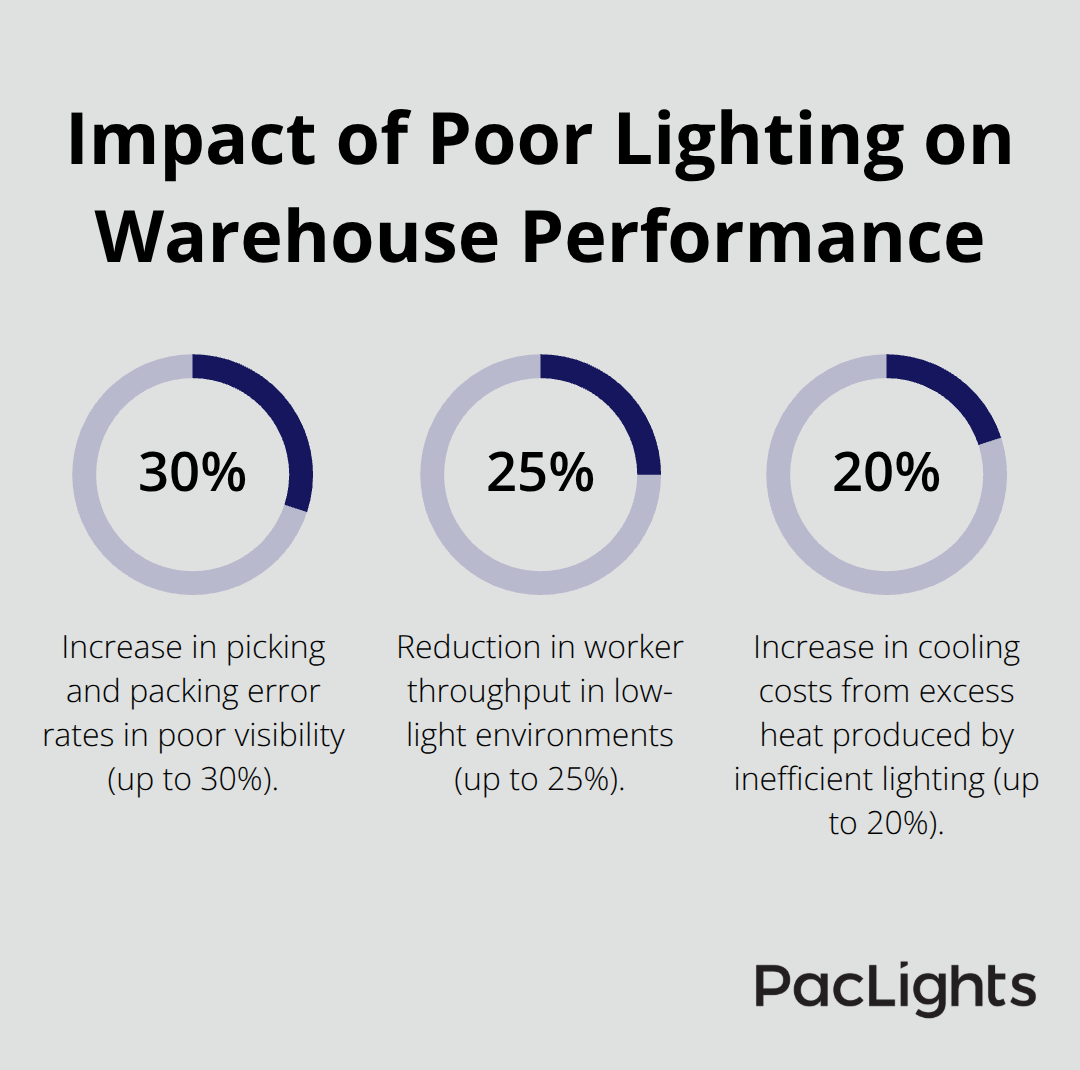
Safety incidents also climb sharply-forklift accidents, trips, and falls happen more frequently when sight lines are poor, leading to workers’ compensation claims, lost productivity, and potential OSHA violations. A single serious warehouse accident costs $40,000 to $100,000 in direct and indirect expenses, making lighting investment a safety issue, not a luxury upgrade.
Energy Waste From Outdated Systems
Fluorescent and HID lighting systems still powering many warehouses consume 50–75% more energy than modern LED alternatives. A 50,000 sq ft warehouse running on old fluorescent high bays spends $15,000–$25,000 annually on lighting alone, with much of that energy wasted as heat rather than useful light. LED systems cut that bill dramatically while delivering superior light quality and directional control. The payback on LED retrofits typically occurs within 3–5 years, after which facilities enjoy decade-long savings. Inefficient systems also generate excess heat, forcing HVAC systems to work harder and increasing cooling costs by 10–20% in summer months. Vapor tight fluorescent fixtures in harsh environments consume up to 160 watts per fixture compared to 12–55 watts for LED equivalents, making the energy gap even wider in challenging conditions.
Compliance Standards Drive Specific Requirements
Warehouse lighting must meet ASHRAE 90.1 energy codes and OSHA safety guidelines, which set minimum illumination levels based on task type and facility layout. General warehouse areas require 100–150 lux, while picking and staging zones demand 300+ lux for accuracy and safety. Forklift aisles need at least 150 lux to prevent accidents, and dock areas typically require 200–300 lux for efficient receiving and shipping.
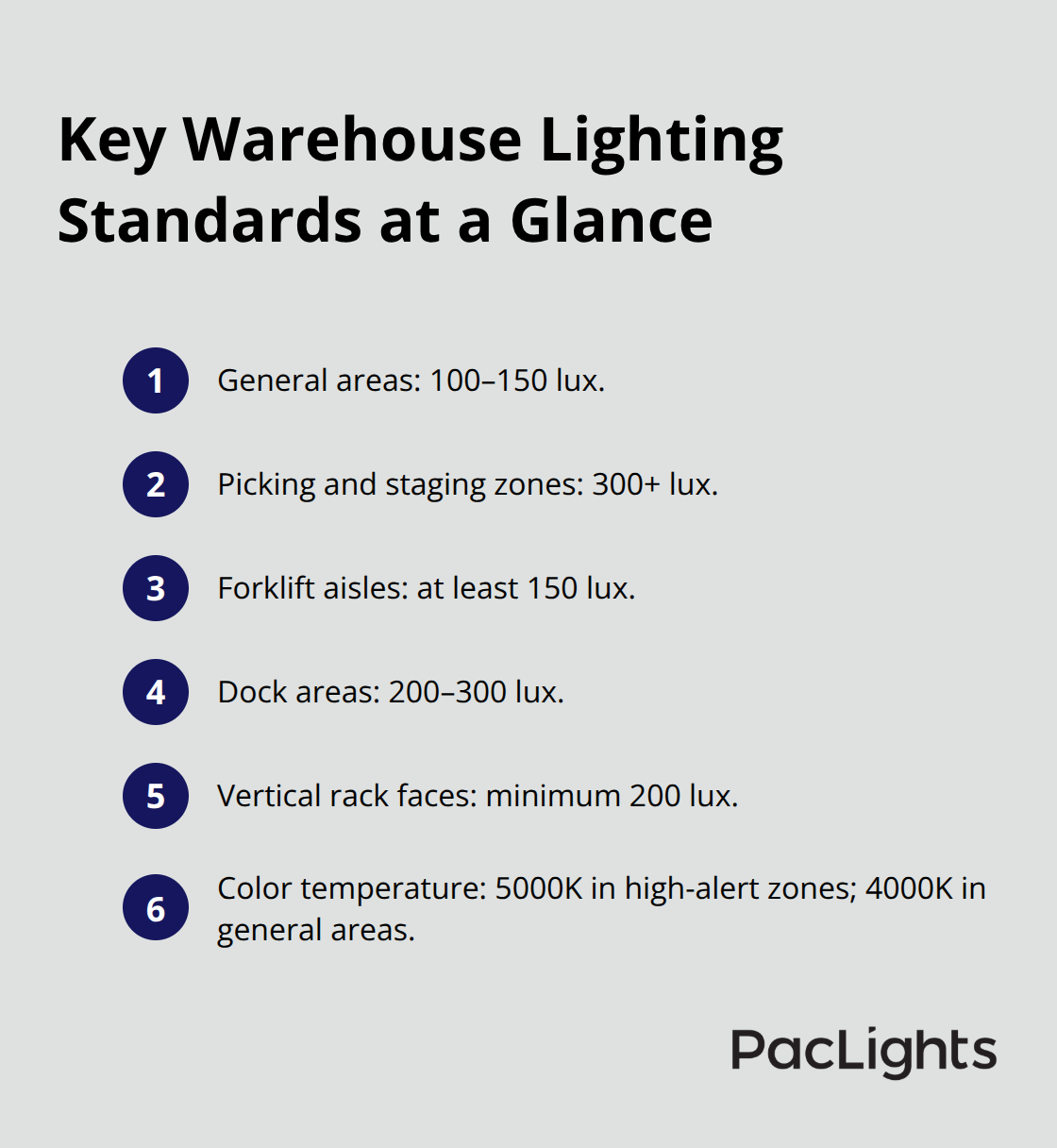
Standards like EN12464-1 and ISO/CIE 8995 specify that vertical illumination on storage rack faces must not fall below 200 lux to ensure workers read labels and identify inventory correctly. Color temperature matters too-5000K lighting in high-alert zones and 4000K in general areas supports worker alertness and reduces errors. Failing to meet these standards exposes facilities to regulatory fines, liability claims, and operational shutdowns.
Moving Forward With Your Lighting Strategy
The financial and safety case for upgrading warehouse lighting is clear. Poor visibility drains money through errors, accidents, and wasted energy, while compliance gaps create legal exposure. The next section explores the specific lighting solutions that address these challenges-from high bay fixtures for tall ceilings to advanced controls that optimize energy use without sacrificing visibility.
Choosing the Right Fixture Type for Your Warehouse Height and Layout
High Bay Fixtures for Tall Ceilings
High bay fixtures dominate warehouse lighting because they address the specific challenge of tall ceilings. At 20 feet and above, standard fixtures waste energy throwing light upward instead of down where workers need it. LED high bays deliver concentrated beams that reach the floor efficiently, with wattage ranging from 100–105W for 15–25 foot ceilings up to 320W for ceilings around 50 feet. The key is matching fixture wattage to ceiling height and spacing. At 25 feet with 20-foot fixture spacing, you’ll need roughly 39,000 total lumens to hit 100 lux across a general warehouse area.
Narrow-beam optics between 60–120 degrees work best in racked environments because they prevent light from being blocked by shelving, while wide-beam fixtures work for open floor areas. For tall aisles where vertical illumination matters most, asymmetric lenses outperform symmetric ones by focusing light on pallet faces and shelves rather than wasting output on ceiling reflectors. The difference is measurable: a well-designed asymmetric distribution can illuminate the same area with 15–20 percent fewer fixtures than a symmetric setup, directly cutting both installation and energy costs.
Linear and Flat Panel Solutions
Linear high bays with aisle-optimized optics excel in distribution centers where throughput demands uniform floor coverage and consistent light at picking heights. Flat panel lights work best in areas with lower ceilings or drop-ceiling configurations, delivering even light across wider zones with minimal glare. The critical mistake most facilities make is treating all picking areas the same as general storage. Picking and staging zones need 30–50 foot-candles of illumination, while bulk storage only requires 10–20 foot-candles. Using high-intensity fixtures throughout wastes 40–50 percent of energy on over-lit areas.
Outdoor Perimeter and Dock Lighting
Outdoor warehouse perimeters and dock areas present another challenge entirely. Area lighting and flood lights must cover large surfaces while minimizing glare that causes safety issues and worker fatigue. Dock areas typically require 200–300 lux on average, with fixtures positioned to avoid creating shadows near loading bays. Vapor tight fixtures rated for harsh conditions consume far less power than their fluorescent predecessors: LED vapor tight fixtures use 12–55 watts compared to 160 watts for traditional fluorescent equivalents, making them ideal for outdoor perimeters where weather exposure demands sealed, durable construction.
Matching Fixtures to Your Facility’s Needs
Vertical illumination in racked zones matters more than most facility managers realize. Match wattage precisely to ceiling height and spacing, and differentiate lighting intensity by task rather than lighting everything uniformly. PacLights offers a range of high bays, linear strip lights, flat panel lights, and area lighting fixtures tailored to these specific requirements, along with free lighting layout designs to help you optimize your facility’s configuration. The next section explores how advanced controls transform these fixtures into an intelligent system that adapts to your operations and cuts energy waste without sacrificing visibility.
Advanced Controls Transform Fixtures Into Intelligent Systems
Smart controls separate warehouses that waste energy from those that operate at peak efficiency. Motion sensors and daylight harvesting cut lighting energy use by 20–40% in zones with variable occupancy, while networked controls let facility managers monitor and adjust lighting across entire floors from a single interface. The real advantage isn’t the technology itself-it’s the precision.
How Occupancy Sensors Cut Energy Waste
A 50,000 sq ft warehouse running high bays 16 hours daily without controls consumes roughly 800–1,200 kWh monthly just for lighting. Adding occupancy sensors to low-traffic aisles and bulk storage areas cuts that consumption by 200–300 kWh monthly, saving $2,400–$3,600 annually depending on local electricity rates. Motion sensors work best in areas with intermittent activity-storage aisles, maintenance zones, and perimeter areas.
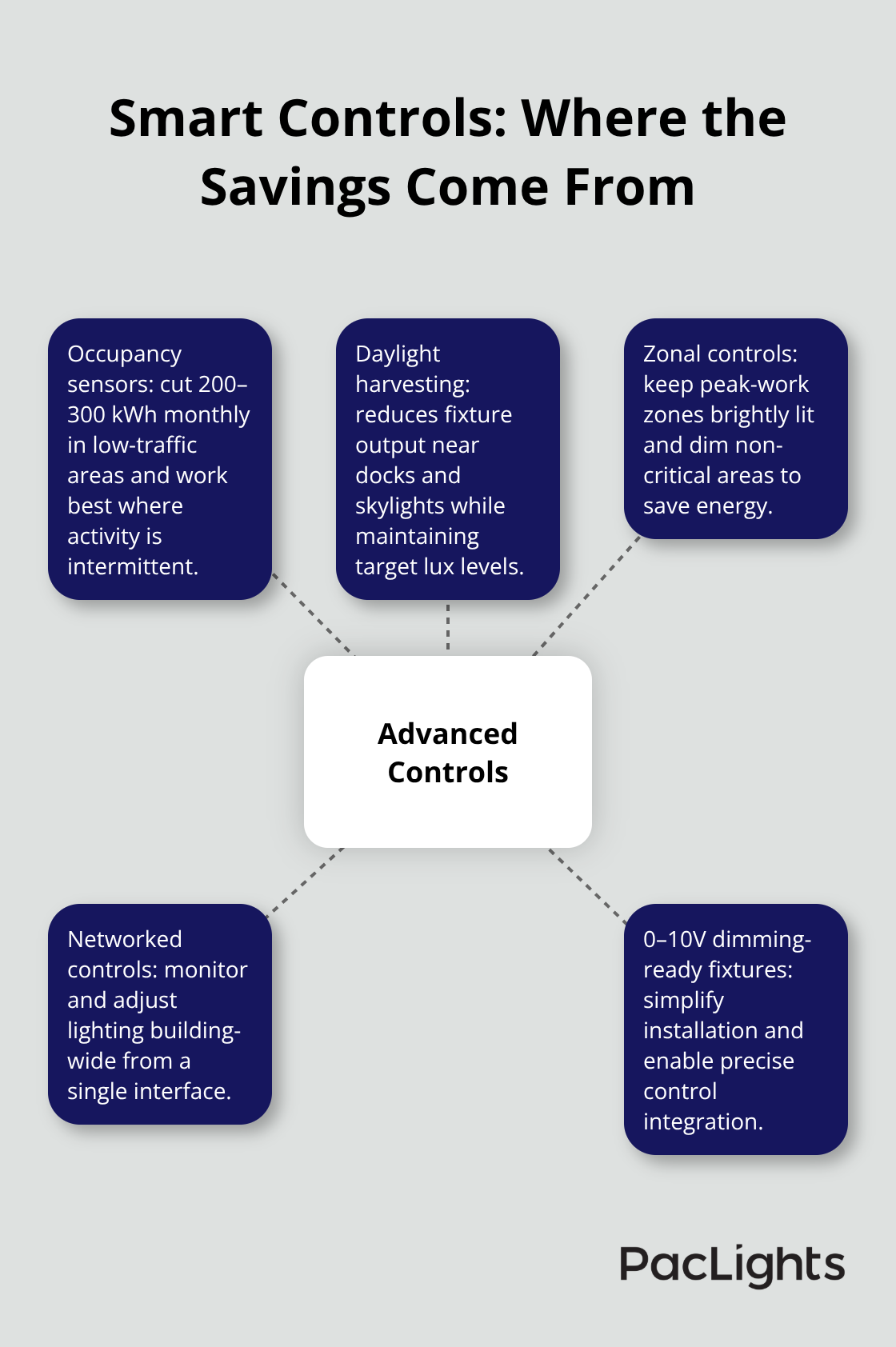
These sensors detect worker presence and activate fixtures only when needed, eliminating the waste of running full lighting in empty zones.
Zonal Controls for Distribution and Fulfillment Centers
In distribution centers where throughput demands consistent visibility, zonal controls aligned with workflow zones maintain target lux levels during peak hours while dimming non-critical areas during slower periods. Fulfillment centers benefit most from networked, fine-grained controls integrated with building management systems because they allow constant-output systems that maintain visibility even as layout changes occur. The payback on adding controls to an LED retrofit typically happens within 2–3 years, after which savings accumulate for the remaining 15+ year lifespan of the LED fixtures.
Daylight Harvesting and Natural Light Integration
Daylight harvesting near dock doors and skylights reduces fixture output when natural light is sufficient, preventing the common mistake of running full lighting during daylight hours. This strategy works particularly well in facilities with large windows or skylights that provide variable natural illumination throughout the day. Sensors automatically adjust LED output to maintain consistent lux levels without wasting energy when daylight contributes to visibility.
Selecting Fixtures That Support Advanced Controls
The critical decision is fixture selection: not all LED high bays support dimming or sensor integration equally. Fixtures with 0–10V dimming capability and pre-wired sensor ports install faster and cost less than retrofitting controls onto fixtures that lack these features. Advanced control systems using DALI or wireless protocols give facility managers real-time visibility into energy consumption by zone, making it simple to identify over-lit areas and adjust settings without manual visits to individual fixtures. Many warehouses discover that their actual lighting needs are 20–30% lower than their current output once they install controls and run data for 30–60 days. LED retrofit solutions accelerate this efficiency gain because LEDs respond instantly to dimming commands without the flickering or color shift that older fluorescent and HID systems exhibited.
Final Thoughts
Warehouse area lighting directly shapes your facility’s safety record, operational speed, and bottom line. Upgrading from fluorescent or HID systems to LED high bays and linear fixtures cuts lighting energy costs by 50–75% while eliminating the picking errors and safety incidents that drain profitability. A 50,000 sq ft warehouse spending $15,000–$25,000 annually on outdated lighting recoupes a retrofit investment within 3–5 years, then enjoys decade-long savings that compound to hundreds of thousands of dollars over the fixture lifespan.
The financial case extends beyond energy bills. Reducing picking errors by 20–30% through better visibility lowers labor costs and customer returns directly. Preventing forklift accidents and falls through proper illumination avoids the $40,000–$100,000 expense of a single serious incident, while occupancy sensors and zonal controls cut consumption by another 200–300 kWh monthly and accelerate payback timelines. Facilities that implement daylight harvesting near docks reduce fixture output by 20–30% during daylight hours without sacrificing safety or compliance with ASHRAE 90.1 and OSHA standards.
Assess your current lighting conditions, identify task areas that demand higher illumination, and evaluate fixture options matched to your ceiling heights and layout. We at PacLights provide free lighting layout designs and ROI assessments to help you understand exactly what your facility needs and what savings you can expect. Our range of high bays, linear strip lights, flat panel lights, and area lighting fixtures, combined with optional motion sensors and networked controls, gives you the precision to optimize every zone.
Disclaimer: PacLights is not responsible for any actions taken based on the suggestions and information provided in this article, and readers should consult local building and electrical codes for proper guidance.