

Data center operators face a hard truth: lighting consumes 20-30% of total energy costs, yet most facilities still rely on outdated systems that waste power through inefficient heat generation. At PacLights, we’ve seen firsthand how datacenter power saving lighting transforms operational budgets.
LED technology cuts energy consumption by up to 75% compared to traditional fixtures, and when paired with smart controls, the savings accelerate even further. The payback period typically spans just 3-5 years, after which every dollar saved flows directly to your bottom line.
Where Data Center Energy Really Goes
The Scale of Data Center Energy Consumption
US data centers consumed 183 TWh in 2024, representing roughly 4% of total US electricity, according to the International Energy Agency. Within those facilities, lighting typically accounts for 20-30% of energy costs, yet this figure masks a deeper problem: most data centers operate significantly over-lit. Many facilities maintain 400-500 lux when 200-300 lux meets safety and maintenance requirements, meaning they waste roughly 30% of lighting energy immediately through unnecessary brightness.
How Lighting Heat Drives Cooling Costs
Traditional fluorescent and incandescent systems compound this waste through substantial heat generation, forcing cooling systems to work harder. Cooling itself represents 30-50% of total facility energy, so every watt of heat from lighting directly increases your cooling burden. A 100,000 square foot facility running outdated T8 fluorescent lamps at 32W per fixture generates far more thermal load than necessary, and that heat ripples through your entire operational cost structure.
LED Efficiency Delivers Real Savings
LED technology cuts through this inefficiency decisively. Switching from T8 fluorescent to LED tubes reduces lighting energy by 50-70%, dropping consumption from 32W to roughly 10W per fixture. A financial services data center with 50,000 square feet reduced lighting energy from 180 kW to 55 kW, cutting total facility energy use by 40% and saved approximately $180,000 annually. That result demonstrates the power of addressing the root cause rather than tolerating waste.

The Multiplier Effect on Infrastructure
LED fixtures emit significantly less heat, which means your cooling compressors run fewer cycles, your generators operate more efficiently, and you free up capacity for growth without major infrastructure upgrades. The payback period for LED retrofits ranges from 18-36 months depending on local electricity rates, meaning the investment pays for itself through operational savings alone, before considering the extended lifespan that reduces maintenance disruptions. Understanding your facility’s specific waste profile becomes the next critical step toward maximizing these gains.
Turning Off Lights That Nobody Uses
Motion Sensors Deliver Fast Payback
Motion sensors and occupancy detection represent the fastest payback in any data center lighting retrofit. A motion sensor costs roughly $50–150 per unit installed, yet cuts lighting energy by 20–35% in typical facilities by automatically dimming or switching off lights when aisles sit empty. For a mid-sized data center running 24/7, that translates to thousands of dollars annually in avoided waste. The key is sensor placement: install them with an unobstructed view of the aisles to prevent false triggers that waste energy cycling lights on and off. Daylight harvesting delivers additional savings in facilities with skylights or large windows, reducing daytime artificial lighting energy use by 30–50% depending on climate and window exposure.
Real-World Results from Integrated Controls
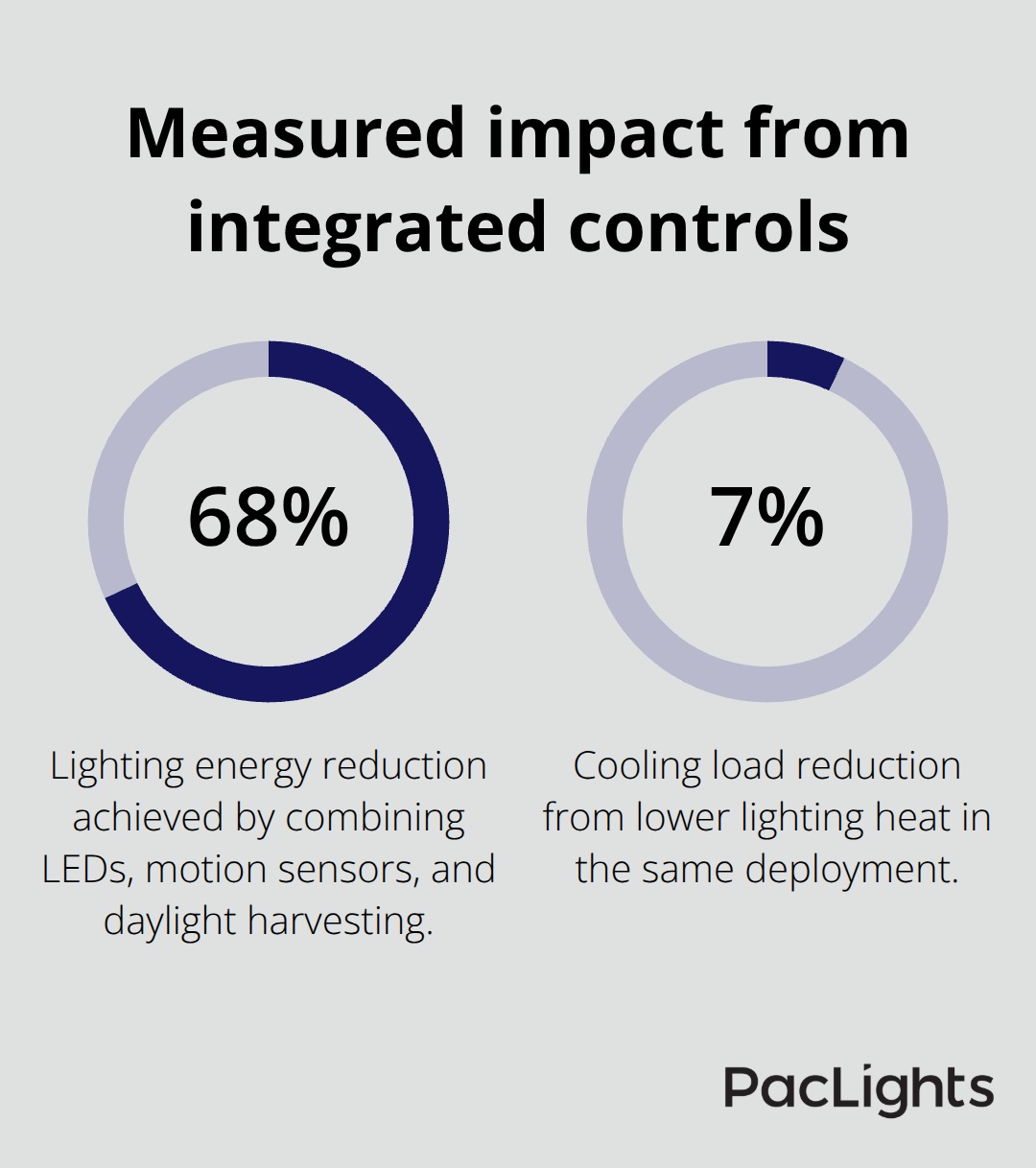
A hyperscale facility in Southeast Asia combined LED fixtures with motion sensors and daylight harvesting, achieving a 68% reduction in lighting energy and a 7% drop in cooling load-payback came in at roughly 20 months with annual savings around $220,000. Networked lighting controls tie these systems together, coordinating motion sensors, daylight sensors, and manual overrides while integrating with your building management system to sync lighting with HVAC for overall facility optimization. Installation costs for networked controls in a mid-sized data center typically run $8,000–$20,000, with payback periods of 2–3 years once energy savings accumulate.
Three-Tier Lighting Strategy Cuts Waste Further
A three-level lighting protocol optimizes energy use without compromising safety or maintenance capability. Level 1 applies minimal lighting during vacant periods, relying on surveillance cameras for monitoring. Level 2 provides adequate brightness for navigation and task performance when staff occupy the space. Level 3 delivers maximum illumination during equipment maintenance and repairs. This approach works because most data center downtime occurs during off-hours when full lighting serves no operational purpose.
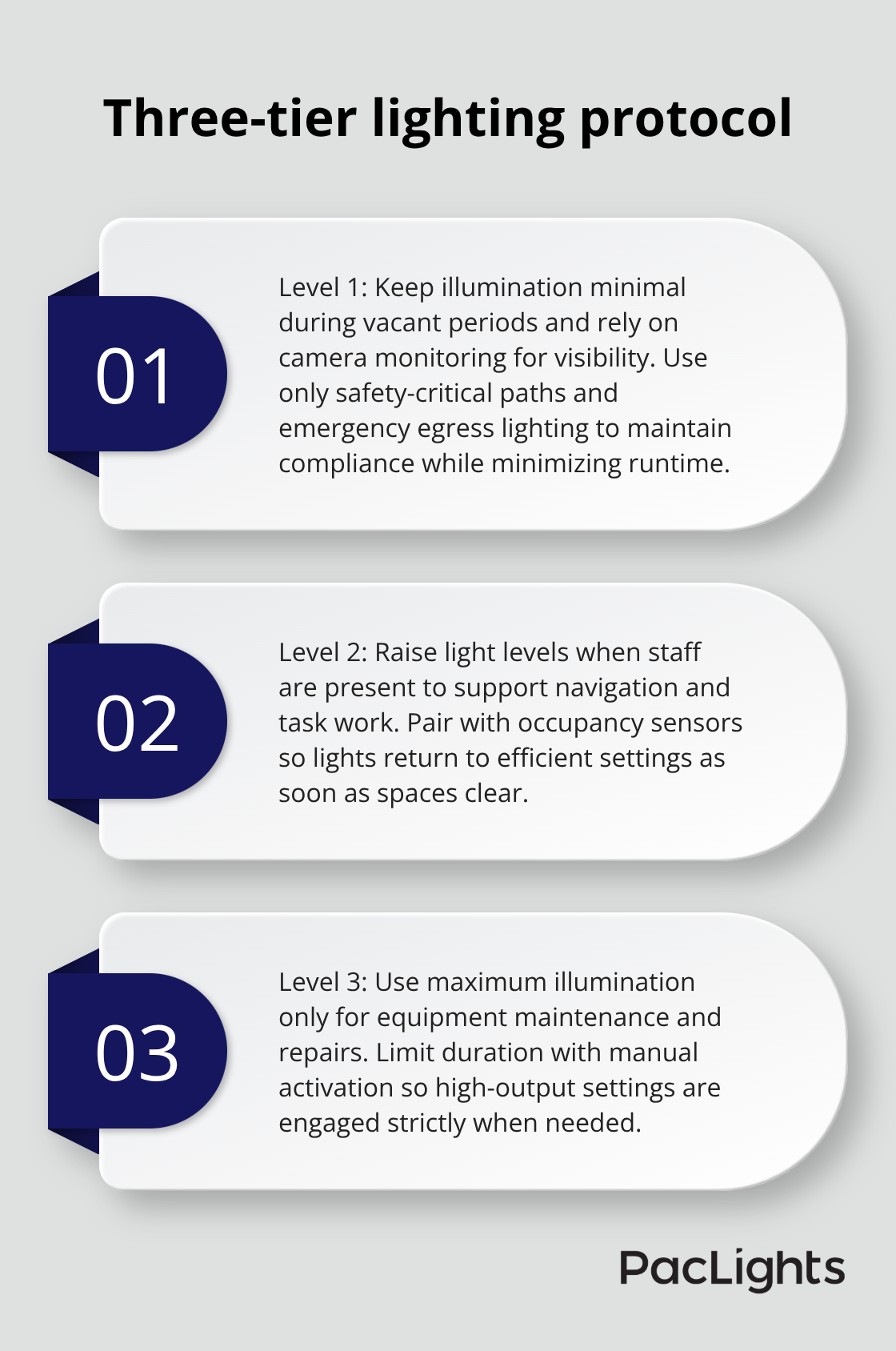
Motion sensors trigger the transition from Level 1 to Level 2 automatically, while maintenance staff manually activate Level 3 when needed. Scheduling controls further enhance savings by dimming lights during daylight hours in facilities with windows or reducing brightness during periods when staffing patterns are predictable. Automated dimming also reduces thermal stress on LED fixtures, extending their lifespan and cutting premature failures.
Cumulative Energy Reductions Transform Operations
The cumulative effect-LEDs plus motion sensors plus daylight harvesting plus scheduling-can exceed 40% total energy reduction when properly configured, with some facilities achieving even higher gains depending on occupancy patterns and climate conditions. These layered controls work because each system addresses a different source of waste: LEDs eliminate heat generation, motion sensors eliminate unnecessary runtime, daylight harvesting eliminates redundant artificial light, and scheduling eliminates peak-hour overconsumption. The real power emerges when you combine all four approaches, creating a lighting system that responds dynamically to actual facility conditions rather than running at fixed brightness regardless of need. Understanding your specific occupancy patterns and climate exposure becomes essential to selecting which controls deliver the highest return for your operation.
The Real Cost of Waiting on LED Upgrades
Energy Savings Arrive Faster Than Expected
The financial case for LED retrofits rests on a single fact: energy savings arrive faster than most facility managers anticipate. A mid-sized data center spending $50,000 annually on lighting recovers $20,000 to $30,000 in the first year alone through LED conversion, compressing what appears to be a multi-year payback into months of actual operational gains. The 18-36 month payback window cited across the industry masks a more aggressive reality: facilities with higher electricity rates and older lighting systems often hit full cost recovery in under two years. Once that threshold passes, every subsequent year delivers pure margin improvement.
Real Payback Timelines from Actual Facilities
A financial services facility with 50,000 square feet achieved roughly $180,000 in annual savings after switching from fluorescent to LED, translating to approximately 22 months to recoup the retrofit investment. The hyperscale operation in Southeast Asia hit payback in 20 months with $220,000 in annual savings, demonstrating that larger facilities often see faster returns due to higher absolute energy consumption. These numbers matter because they shift the conversation from whether retrofits make financial sense to how quickly you can move forward without leaving money on the table.
Maintenance and Cooling Savings Multiply Your Returns
LED fixtures last approximately 30 times longer than incandescent bulbs and five times longer than CFLs, with most retaining at least 70% of initial brightness after 50,000 hours of operation. This extended lifespan directly reduces maintenance labor, emergency replacement calls, and inventory management overhead. Cooling cost reductions provide the third financial lever, often underestimated in quick ROI calculations. Since cooling typically represents 30-50% of total facility energy consumption, and lighting heat drives a measurable portion of that load, reducing lighting-generated thermal output creates a cascading efficiency gain.
A facility that cuts lighting energy by 40-50% through LED conversion and controls often sees cooling load drop by 5-10%, translating to $8,000 to $15,000 in additional annual savings for mid-sized operations. Networked lighting controls add $8,000 to $20,000 to the initial retrofit cost but compress payback to 2-3 years through cumulative energy reductions and reduced manual maintenance interventions.
Why Immediate Action Outperforms Waiting
The combination of lower utility costs, reduced maintenance disruptions, extended fixture lifespan, and improved cooling efficiency creates a financial outcome that justifies immediate action rather than incremental upgrades. Delaying a retrofit means accepting higher energy bills, more frequent maintenance calls, and greater cooling strain on aging infrastructure. Each month of postponement costs real dollars in wasted energy and accelerated equipment wear. Facilities that move forward with LED retrofits today capture savings that compound year after year, while those that wait continue funding inefficiency through their operating budgets.
Final Thoughts
The financial case for datacenter power saving lighting extends far beyond the first year of savings. Your facility faces a choice: continue funding inefficiency through inflated energy bills and frequent maintenance calls, or invest in LED systems and controls that pay for themselves within 18–36 months while delivering compounding returns for decades. Facilities that retrofit to LED technology reduce lighting energy by 40–68%, lower cooling loads by 5–10%, and recover their investment through operational savings alone.
LED fixtures last 30 times longer than incandescent bulbs, eliminating the disruption and expense of frequent replacements. Networked controls reduce manual maintenance interventions by detecting equipment failures 20–30 days earlier than traditional inspections, while motion sensors and daylight harvesting systems work continuously to eliminate waste without requiring staff intervention. Data centers account for roughly 1% of global energy consumption, making lighting efficiency a high-impact lever for reducing carbon footprint and lowering operating costs simultaneously.
We at PacLights offer free lighting layout designs and ROI assessments that map your facility’s energy waste by zone and project specific savings timelines tailored to your electricity rates and occupancy patterns. This assessment identifies which fixtures and controls deliver the highest return for your operation, eliminating guesswork from the retrofit decision. Schedule your assessment with PacLights to start capturing the savings your facility is currently leaving on the table.
Disclaimer: PacLights is not responsible for any actions taken based on the suggestions and information provided in this article, and readers should consult local building and electrical codes for proper guidance.