

The quality of your commercial downlights directly shapes how customers perceive products and how employees experience their workspace. Color rendering in commercial downlights isn’t just a technical specification-it’s the difference between a space that feels inviting and one that feels off.
At PacLights, we’ve seen firsthand how the right lighting transforms retail displays, offices, and industrial facilities. This guide walks you through what matters when selecting downlights that deliver both visual quality and lasting performance.
Understanding Color Rendering Index (CRI) in Commercial Downlights
What CRI Actually Means for Your Commercial Space
Color Rendering Index measures how accurately a light source reveals colors compared to natural daylight on a scale of 0 to 100. The International Commission on Illumination established CRI as a standardized way to compare lighting quality across different fixtures and sources. A CRI of 100 matches daylight perfectly, while lower scores indicate increasingly inaccurate color representation. Most commercial LED downlights deliver CRI values between 80 and 95, though some premium options reach 98 or higher.
The Ra value manufacturers report represents the average of eight standard color samples used in testing, but this average masks a critical weakness: R9, the saturated red sample, often performs poorly in LEDs yet isn’t included in the Ra calculation. This matters because red rendering directly affects how skin tones, produce, fabrics, and cosmetics appear under your lights. If you select downlights for retail, hospitality, or any color-sensitive environment, request both the Ra and R9 values separately. A downlight claiming CRI 90 might have an R9 of only 40, meaning reds will look dull and lifeless regardless of the overall score.
Why CRI Alone Falls Short in Real Spaces
The Illuminating Engineering Society developed TM-30-20 specifically because CRI has significant limitations for LED lighting. TM-30 evaluates 99 color samples instead of eight, reporting two separate metrics: Fidelity (Rf) shows how accurately colors match a reference light, while Gamut (Rg) reveals whether colors appear more or less saturated than expected. An LED downlight with excellent CRI but poor Rg might make reds pop artificially while skin tones look washed out.
For retail environments, high CRI combined with strong R9 performance and positive Gamut drives customer perception and purchase intent. In office spaces, CRI above 85 reduces eye strain and improves visibility, but jumping from 85 to 95 delivers diminishing returns unless color-critical tasks dominate the work. Healthcare facilities need CRI 90 minimum because accurate skin tone assessment supports diagnostics, while museums and galleries should try CRI 95 or higher to preserve artists’ intended colors.
Real Performance in Commercial Applications
Retail spaces see measurable differences in how products appeal to customers under different CRI levels. Clothing stores using CRI 80 downlights report that fabrics appear less vibrant and true to color compared to CRI 95 fixtures, directly affecting customer confidence in purchase decisions. Grocery stores with poor red rendering struggle to make produce look fresh and appetizing, even when the fruit is high quality.
Hospitality venues using CRI 90 or higher enhance food presentation and create warmer, more welcoming atmospheres that influence dining satisfaction. When you evaluate downlights for your commercial space, ask suppliers for independent LM-79 photometric reports that include CRI, R9, and ideally TM-30 data. Verify that color rendering remains stable across dimming levels, since some fixtures degrade significantly when dimmed.
Selecting Downlights Based on Complete Performance Data
The investment in higher CRI and better color metrics typically adds 10 to 20 percent to downlight costs but delivers tangible returns through improved product presentation, reduced customer complaints, and enhanced employee comfort in workspaces. Demand complete photometric documentation so you can make informed decisions backed by real performance data rather than marketing claims. Your next step involves understanding how color temperature and control features work alongside CRI to shape the overall quality of your commercial lighting system.
Beyond CRI: Building Lighting That Works for Your Space
Color Temperature as a Strategic Tool
Color temperature shapes how people feel in a space far more than most facility managers realize. A retail environment lit at 4000K appears professional and energetic, making customers linger longer and browse more deliberately, while 3000K creates warmth that encourages relaxation in hospitality settings. Most commercial spaces treat color temperature as a fixed choice rather than a strategic tool. Modern LED downlights let you shift between 2700K for evening dining and 5000K for daytime retail without replacing fixtures, yet most installations lock in one temperature and never adjust.
If your space hosts different activities throughout the day, dimming controls that preserve color quality matter more than the fixture itself. Research on circadian lighting shows that bright, cooler light in morning hours boosts alertness and productivity, while warmer, dimmer light in afternoon and evening prevents energy crashes and supports natural sleep cycles. For offices, this means specifying downlights that maintain consistent color rendering as you dim them, since many cheaper LEDs shift toward yellow or blue when dimmed, creating an unprofessional appearance. Request dimming compatibility data from suppliers and test fixtures at 50 percent brightness to verify the color stays true.
Smart Controls and Energy Savings
Energy efficiency paired with smart controls transforms how downlights perform without sacrificing visual quality. Modern LED downlights deliver 80 to 120 lumens per watt, roughly triple the output of older fluorescent fixtures, so you can achieve the same brightness with far fewer watts. The real savings come from daylight harvesting and occupancy sensing, which automatically reduce brightness when natural light floods a space or when a room sits empty.
A retail environment with south-facing windows can cut artificial lighting energy use by 30 to 50 percent when you pair high-CRI downlights with daylight sensors that dim fixtures throughout the day. Industrial facilities benefit similarly, with motion sensors reducing lighting in storage areas and low-traffic zones. The critical specification nobody checks is whether dimming preserves color rendering, since some downlights with poor driver quality shift color as brightness changes, making product displays look inconsistent.
Verifying Color Stability Across Dimming Ranges
Request independent photometric reports that show color stability across the full dimming range, from 10 percent to 100 percent brightness. Lifecycle cost analysis consistently shows that investing in quality downlights with advanced controls pays back within three to five years through energy savings alone, before accounting for reduced maintenance and extended fixture life from lower operating temperatures. The next critical factor involves understanding how fixture specifications and application requirements align to ensure your downlights deliver performance where it matters most.
Matching Downlight Specs to What Your Space Actually Needs
CRI Requirements Across Different Commercial Spaces
Retail facilities demand CRI 90 minimum, preferably 95 or higher, because product visibility directly drives sales. Clothing retailers operating with CRI 80 downlights lose customer confidence when fabrics appear dull or colors shift between the store and daylight. Grocery stores with poor red rendering struggle to make produce look fresh, cutting perceived quality regardless of actual fruit condition. The investment in CRI 95 downlights typically costs 15 to 20 percent more than CRI 80 alternatives, but retail environments recoup this premium within two years through improved conversion rates and reduced color-related returns.
Office environments sit lower on the priority scale. CRI 85 suffices for general administrative work, reducing eye strain and improving visibility without the premium cost of CRI 95 fixtures. However, if your office includes design studios, architectural firms, or color-matching tasks, specify CRI 90 minimum and verify R9 performance separately. Industrial facilities represent the opposite extreme. Manufacturing floors, warehouses, and mechanical spaces rarely justify CRI above 85 because color accuracy matters less than visibility and cost control. However, quality control areas where inspectors assess product finish or defects need CRI 90 minimum to prevent missed flaws.
Most facility managers make a critical mistake: they specify identical CRI across entire buildings rather than matching requirements to actual space function. This approach wastes money on unnecessary premium fixtures in low-priority zones while potentially under-specifying color rendering where it directly impacts operations or revenue.
Energy Codes and Color Rendering Standards
Compliance with energy codes like California Title 24 and similar regulations increasingly mandate not just efficiency but also color rendering quality in commercial installations. Title 24 requires CRI 90 or higher for most interior spaces and specifies minimum lumens per watt for downlights, forcing choices between older, inefficient fixtures and modern LEDs that deliver both efficiency and color quality simultaneously. This regulatory shift eliminates the false choice between saving money and maintaining lighting quality.
Modern LED downlights from reputable manufacturers deliver 80 to 120 lumens per watt while maintaining CRI 90 or higher, making compliance straightforward if you source from suppliers providing independent LM-79 photometric reports. Demand TM-30 data alongside CRI, since this metric reveals whether your downlights maintain consistent color rendering across dimming levels and different color temperatures. Many cheaper downlights claim CRI 90 but fail to maintain that performance when dimmed below 50 percent brightness, shifting toward yellow and creating an unprofessional appearance.
Request photometric reports showing color stability across your intended dimming range before committing to any fixture. This documentation protects your investment and confirms that fixtures perform as advertised in real-world conditions.
Beam Angle and Lumen Output Matching
Application-specific selection requires matching beam angle, lumen output, and color metrics to actual space dimensions and task requirements. A retail boutique with eight-foot ceilings needs narrow beam angles around 24 to 36 degrees to create focused product lighting, while a warehouse with 20-foot ceilings demands wider beams at 60 degrees or higher to achieve even coverage. Selecting downlights with excessive beam width for tight spaces wastes energy and creates hot spots, while too-narrow beams in high ceilings leave dark gaps between fixtures.
Pair this geometric matching with color rendering specifications tied to actual activities occurring in each zone, and you eliminate the guesswork that plagues most commercial lighting projects. The combination of proper beam angle, appropriate lumen output, and matched CRI ensures that every fixture contributes to both visual quality and operational efficiency.
Final Thoughts
The path forward for your commercial lighting strategy starts with matching downlight specifications to actual space requirements rather than applying generic solutions across your entire facility. Commercial downlights color rendering quality directly influences how customers perceive products, how employees perform their work, and ultimately how much you spend on energy and maintenance. A retail environment with CRI 95 downlights outperforms one with CRI 80 fixtures by measurable margins in customer satisfaction and sales, while an industrial warehouse wastes money on premium color rendering it doesn’t need.
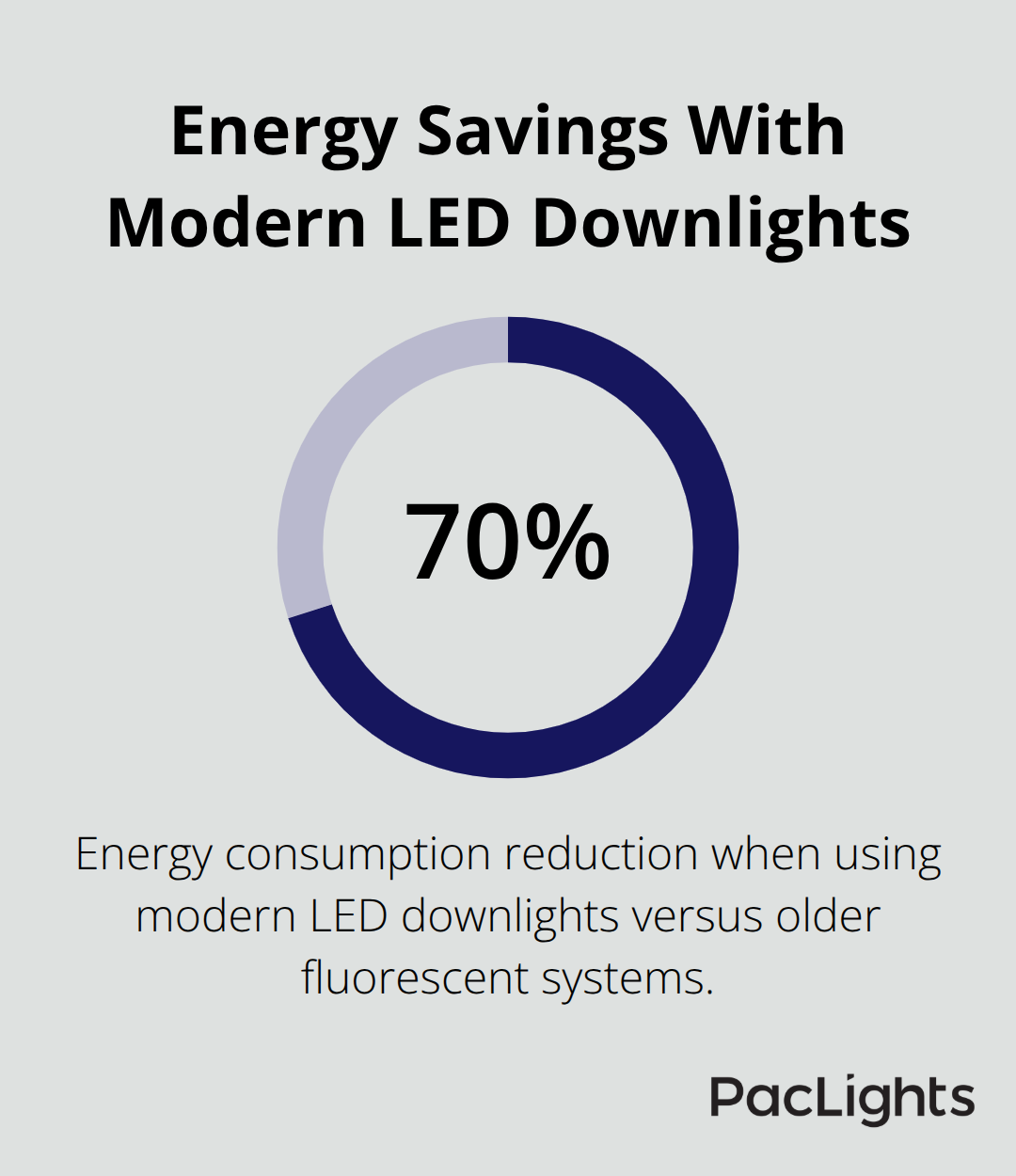
Quality downlights deliver long-term value through multiple channels simultaneously. Modern LED downlights operating at 80 to 120 lumens per watt cut energy consumption by roughly 70 percent compared to older fluorescent systems, translating to thousands of dollars in annual savings for mid-sized commercial facilities. Extended fixture lifespans of 25,000 to 50,000 hours reduce replacement frequency and labor costs, while smart controls with daylight harvesting and occupancy sensing push energy savings even higher.
Request independent photometric reports from suppliers that document CRI, R9, and ideally TM-30 data across your intended dimming range. We at PacLights provide free lighting layout designs and ROI assessments to help you evaluate downlight options backed by actual performance data rather than marketing claims. This documentation protects your investment and confirms that every fixture contributes to both visual quality and operational efficiency in your commercial space.
Disclaimer: PacLights is not responsible for any actions taken based on the suggestions and information provided in this article, and readers should consult local building and electrical codes for proper guidance.