

A single power outage can cost a datacenter thousands of dollars per minute in lost operations and revenue. When the lights go out, your facility becomes a liability-staff can’t work safely, security systems fail, and compliance violations pile up fast.
At PacLights, we’ve seen firsthand how backup lighting transforms datacenter resilience. The right backup lighting solution isn’t optional anymore; it’s the difference between staying operational and grinding to a halt.
Why Backup Lighting Matters for Datacenters
Downtime costs datacenters over $1 million per hour, according to industry analysis of outage impacts. When utility power fails, your facility loses far more than light-it loses the ability to operate safely and maintain compliance. Server rooms require illumination for technicians to respond to hardware failures, evacuation routes must remain visible for staff safety, and security systems depend on powered lighting to function. Without backup lighting, a routine power fluctuation becomes a full operational shutdown that exposes your facility to massive financial and reputational damage.
The Financial Reality of Going Dark
A datacenter that experiences a four-hour outage without proper backup lighting faces compounding losses. Staff cannot access critical infrastructure to perform manual failover procedures or diagnose problems. Cooling systems malfunction in darkness, risking equipment overheating. Security monitoring becomes impossible, creating vulnerability to unauthorized access. The Uptime Institute’s Tier Classification System shows that Tier 4 facilities maintain 99.995% uptime through redundant systems (including emergency lighting), while facilities without backup lighting rarely exceed 99% uptime.

That difference translates to roughly 4 hours versus 52 hours of annual downtime. For a facility processing millions in transactions, those extra 48 hours of potential outage represent staggering revenue loss and contract penalties.
Safety and Compliance Cannot Be Ignored
OSHA and local fire codes mandate that evacuation routes remain illuminated during emergencies. Datacenters operating without compliant backup lighting face citations, fines, and increased insurance premiums. Beyond regulation, your facility’s liability exposure grows dramatically when staff or emergency responders navigate dark corridors during a crisis. Battery-backed exit signs and emergency luminaires with lithium-ion batteries provide extended runtime during extended outages, with some systems rated for 24–48 hours of full operation. Regular testing and maintenance of these systems (monthly visual inspections and annual performance verification) keeps compliance current while preventing the scenario where backup lighting fails precisely when needed. Insurance carriers actively reward facilities with documented, tested emergency lighting systems through lower premiums, offsetting the installation investment within 2–3 years for most datacenters.
What Backup Lighting Solutions Actually Deliver
The right backup lighting system addresses three operational needs simultaneously: it maintains safe egress during power loss, it supports technician access to critical infrastructure, and it satisfies regulatory requirements. Three-phase emergency lighting inverters keep essential and egress lighting powered during outages, supporting both safety and code compliance. Redundant power distribution (through multiple independent circuits and PDUs) prevents single points of failure that could leave sections of your facility dark. Real-time power monitoring systems detect anomalies early and alert your team before minor issues escalate into full outages. These solutions work together to transform your datacenter from a facility vulnerable to cascading failures into one that maintains operational continuity when the grid fails.
What Backup Lighting Solutions Work Best for Datacenters
Emergency LED Lighting Systems with Battery Backup
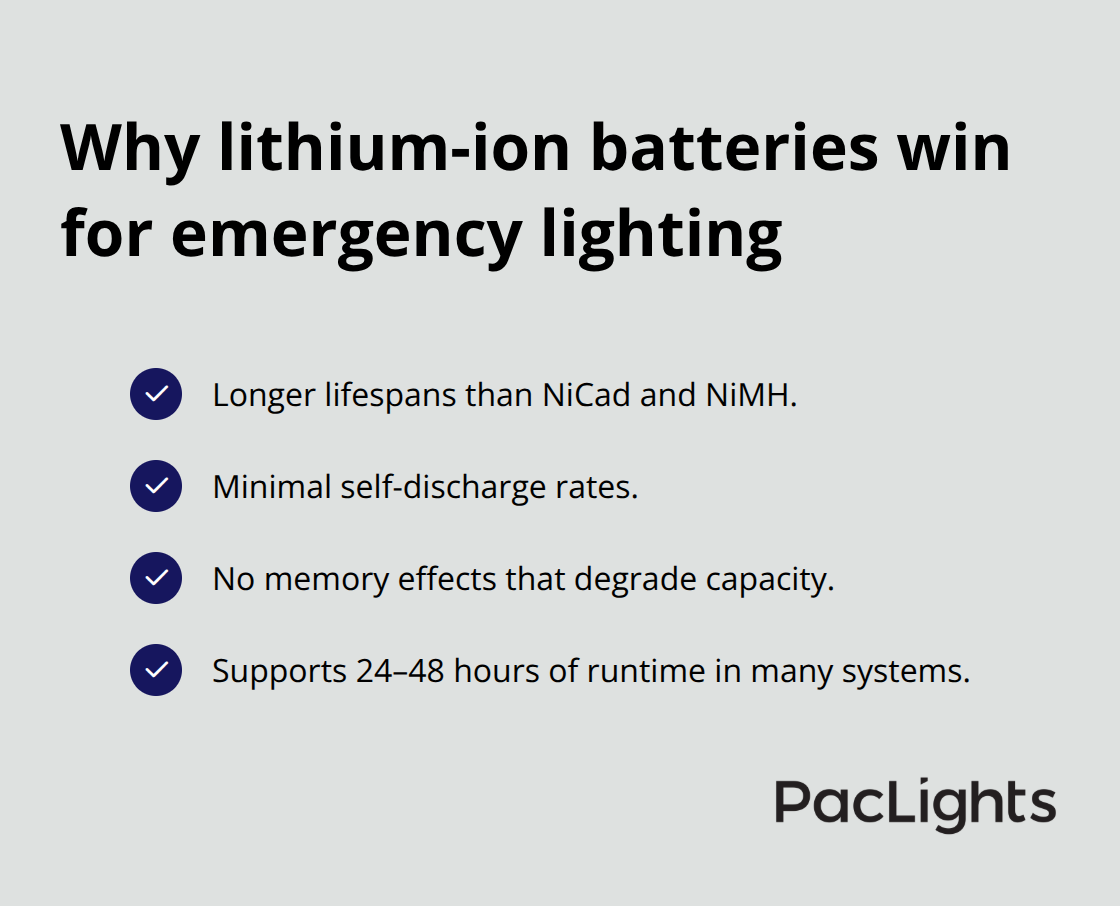
Emergency LED lighting systems form the backbone of any datacenter backup strategy, and they work differently than standard facility lighting. These systems use LED technology paired with integrated battery backup, typically lithium-ion chemistry, which keeps fixtures powered for 24–48 hours during extended outages. Lithium-ion batteries outperform older NiCad and NiMH chemistries because they offer longer lifespans, minimal self-discharge rates, and no memory effects that degrade capacity over time.
Exit signs with integrated battery backup satisfy compliance requirements, but the real operational value comes from emergency luminaires placed strategically in server room corridors, stairwells, and maintenance areas where technicians need visibility to respond to hardware failures or perform manual procedures. Monthly visual inspections and annual battery performance testing verify that backup systems function when needed, not after an outage has already cost you hundreds of thousands in downtime. Many datacenters skip this maintenance entirely, which means their backup lighting fails precisely when it matters most.
Three-Phase Emergency Lighting Inverters
Three-phase emergency lighting inverters represent a more sophisticated approach, connecting directly to your UPS system to keep essential and egress lighting powered seamlessly during utility failures. This configuration matters because it eliminates the lag time between power loss and battery activation, maintaining continuous illumination while your facility transfers to generator power. The inverter technology ensures that your lighting infrastructure responds instantly to power disturbances, preventing the dangerous gap where technicians lose visibility during the critical moments when manual intervention becomes necessary.
Generator-Powered Lighting Infrastructure
Generator-powered lighting infrastructure extends operational resilience beyond the 10–30 second window that UPS systems provide. A properly configured backup generator supports 24–48 hours of full-load operation, keeping all facility lighting active during extended grid failures. The critical detail most datacenters miss is that lighting circuits must be explicitly included in generator load calculations and automatic transfer switch configuration, otherwise your backup power system protects servers but leaves technicians working in darkness.
Real-time power monitoring systems with sequence of event recorders capture power disturbances with millisecond precision, helping your team identify which circuits failed and why, which directly informs whether lighting stayed powered as designed. Redundant power distribution through multiple independent PDUs and circuit breakers prevents single points of failure that could leave sections of your facility dark even when backup power operates correctly. This approach aligns with the Uptime Institute’s Tier 4 standard, which requires 2N redundancy for mission-critical infrastructure.
Redundancy and Power Distribution Design
Redundant power distribution creates multiple independent circuits that prevent single points of failure from leaving your facility dark. When you design lighting circuits with redundancy in mind, you ensure that a failure in one power path does not cascade into widespread darkness across critical areas. This design principle applies to both interior server room corridors and exterior security lighting, creating a comprehensive backup strategy that protects your entire facility.
Solar-Powered and Emerging Solutions
Solar-powered backup lights represent an emerging option for outdoor security and egress lighting, charging during normal operations and providing resilience for remote or grid-challenged datacenter sites. These systems work well as secondary solutions for perimeter security and parking areas, though they remain secondary to hardwired emergency systems for interior critical spaces where continuous, reliable illumination cannot depend on weather conditions or daylight availability.
The specific configuration of your backup lighting system depends on your facility’s power architecture, redundancy requirements, and operational priorities. Understanding how these solutions integrate with your UPS, generator, and power distribution infrastructure determines whether your facility maintains operational continuity or faces cascading failures when the grid fails.
Implementation Best Practices for Datacenter Backup Lighting
Conduct a Comprehensive Lighting Audit
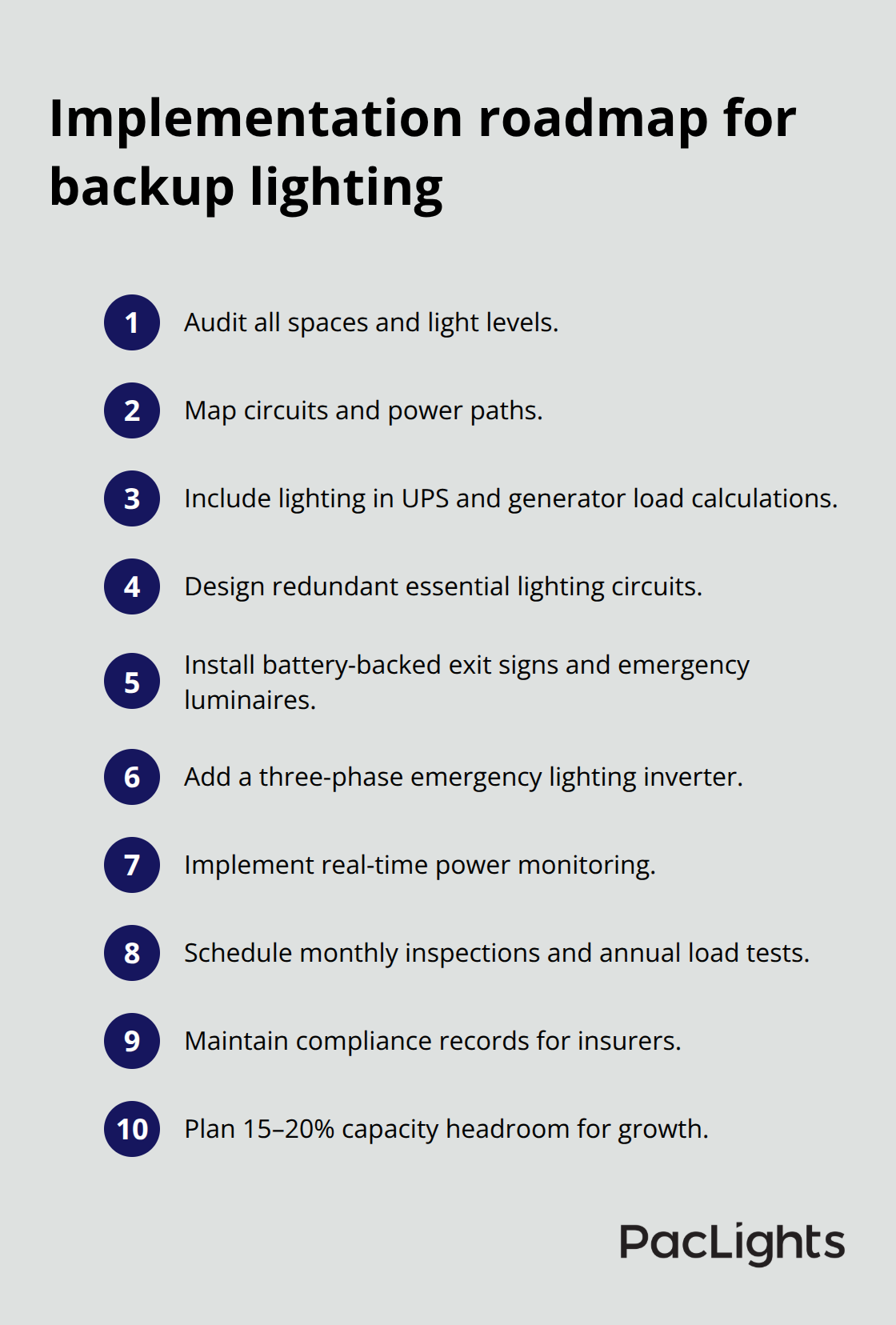
Start with a complete audit of your existing lighting infrastructure before you install a single backup system. Walk your datacenter with a flashlight during normal operations and identify every space where technicians need visibility during an outage: server room corridors, equipment racks, electrical rooms, mechanical spaces, stairwells, and emergency exits. Document the current light levels in foot-candles using a basic light meter; OSHA requires minimum 5 foot-candles in work areas and 1 foot-candle in corridors and exits. Most datacenters discover they have dark zones or inadequate coverage only after an outage forces technicians to work by phone flashlight.
Your audit should also map which circuits power which areas, revealing whether lighting depends on a single power path that could fail catastrophically. Check your current UPS capacity and generator load calculations to confirm that lighting circuits are explicitly included; many facilities discover their backup power system was designed to protect servers only, leaving lighting unpowered during the critical window when technicians need to respond to failures. This audit becomes your baseline for measuring improvements and identifying where redundancy gaps exist.
Design Redundant Lighting Circuits
Design your lighting circuits with explicit redundancy, not as an afterthought. Separate your essential lighting circuits from standard facility lighting, then route essential circuits through your UPS system with a dedicated three-phase emergency lighting inverter that activates instantly when utility power fails. Your server room corridors, emergency exits, and critical equipment areas should have redundant lighting systems powered through at least two independent power paths, so a single breaker failure or circuit issue does not leave those spaces dark.
Install battery-backed exit signs rated for 24–48 hours of operation using lithium-ion chemistry, which maintains capacity far better than older NiCad batteries over multi-year lifecycles. Real-time power monitoring systems with sequence of event recorders track when power disturbances occur and which circuits respond correctly, giving you data to verify that your redundant design actually functions as intended.
Establish Regular Testing and Maintenance Schedules
Monthly visual inspections of emergency fixtures and annual load testing of backup batteries prevent the scenario where systems fail precisely when needed. Many datacenters skip this maintenance entirely because backup systems rarely activate, but that invisibility creates dangerous complacency. Document your testing results and maintain them as proof of compliance for insurance carriers and regulatory audits; facilities with verified maintenance records often negotiate lower premiums that offset the testing costs within two to three years.
Your design should also account for future growth, sizing backup power capacity and lighting circuits for 15–20% additional load so you can expand without redesigning your entire electrical infrastructure.
Final Thoughts
Backup lighting for datacenters is no longer optional-it determines whether your facility survives a power outage or collapses into cascading failures. Downtime costs exceed $1 million per hour, and without proper backup lighting systems, technicians cannot respond to hardware failures, staff cannot evacuate safely, and your facility violates OSHA and fire code requirements. The financial and operational stakes demand that you treat backup lighting as infrastructure, not as an afterthought.
Start with a comprehensive audit to identify dark zones and single points of failure in your current lighting setup. Design redundant circuits that route essential lighting through your UPS system with dedicated three-phase emergency lighting inverters, ensuring instant activation when utility power fails, then install battery-backed exit signs and emergency luminaires rated for 24–48 hours of operation using lithium-ion chemistry. Establish monthly visual inspections and annual load testing to verify that backup systems function when needed, not after an outage has already cost you hundreds of thousands in downtime.
Insurance carriers reward facilities with documented, tested emergency lighting systems through lower premiums that offset installation costs within two to three years. We at PacLights offer energy-efficient lighting solutions with advanced controls and free lighting layout designs to optimize your backup lighting strategy for your specific facility requirements. Contact us for a comprehensive ROI assessment tailored to your datacenter’s power architecture and operational priorities.
Disclaimer: PacLights is not responsible for any actions taken based on the suggestions and information provided in this article, and readers should consult local building and electrical codes for proper guidance.