

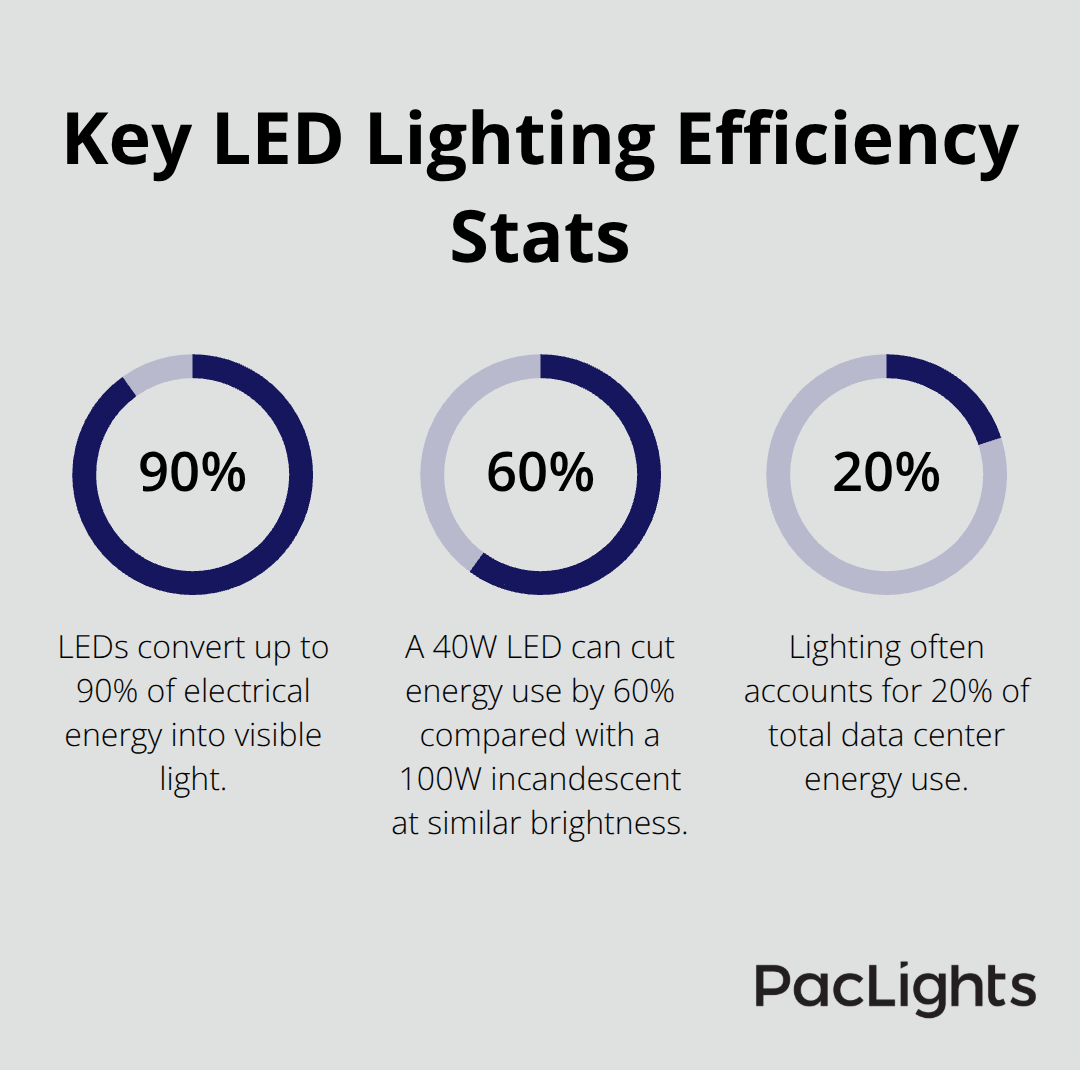
Data centers consume massive amounts of electricity, with lighting often accounting for 20% of total energy use. We at PacLights know that switching to LED technology is one of the fastest ways to cut those costs significantly.
This guide covers practical datacenter LED efficiency tips you can implement immediately, from smart controls to maintenance schedules. You’ll also learn exactly how much money LED upgrades can save your facility.
How LEDs Cut Data Center Power Consumption
LEDs convert up to 90% of electrical energy into visible light, while incandescent bulbs waste roughly 90% as heat. That fundamental difference means a 40W LED delivers brightness comparable to a 100W incandescent, cutting energy use by 60% immediately. In data centers running 24/7, this compounds fast.
A facility with 500 fixtures switching from incandescent to LED technology saves approximately 30,000W of continuous power consumption. Over a year, that’s 262,800 kilowatt-hours of reduced demand.
Traditional fluorescent lighting performs better than incandescent but still lags LED efficiency by roughly 50%. More importantly, LED heat output drops dramatically, which reduces cooling load. Since cooling often accounts for 30–50% of non-IT energy in data centers, eliminating unnecessary lighting heat cuts cooling costs by an estimated 5–10%. This matters for your Power Usage Effectiveness (PUE) metric tracked by The Green Grid.
How LED Efficiency Improves Your PUE
If a data center runs at PUE 1.5 with 100MW of IT equipment energy, reducing lighting heat and power could lower PUE to 1.4, saving approximately 10MW of total facility energy annually. LED fixtures emit almost no heat, so your air conditioning systems work less hard. This dual benefit-lower lighting power plus reduced cooling demand-stacks to create measurable facility-wide savings that show up directly in your PUE calculations.
LED Lifespan Eliminates Constant Maintenance Cycles
LED fixtures exceed 50,000 hours of operation, meaning a single fixture in 24/7 service lasts roughly 5–6 years before replacement. Incandescent bulbs typically last 1,000 hours, requiring replacement every month or two in continuous operation. Fluorescent fixtures last around 20,000 hours, demanding changes every 2–3 years. This lifespan difference eliminates constant maintenance cycles, reduces downtime, and cuts labor costs substantially. Technicians stop climbing ladders to swap failing bulbs. Instead, LED fixtures remain stable and flicker-free, reducing technician fatigue and errors during critical equipment work.
Brightness and Color Standards for Accurate Work
Color rendering index (CRI) near 90 and color temperature around 4000K help technicians distinguish cables, indicators, and components accurately, speeding troubleshooting and reducing mistakes. Try brightness around 500–600 lumens per fixture in aisles and 1000 lumens in technician work areas to balance visibility with efficiency. Fixtures rated for NSF certification signal adherence to safety and quality standards, offering confidence in harsh or damp data center environments. With proper brightness levels and color standards in place, your team works faster and makes fewer errors-which directly impacts uptime and operational costs.
Smart Controls and Proper Placement Transform Data Center Lighting
Three-Level Lighting Cuts Energy Costs in Half
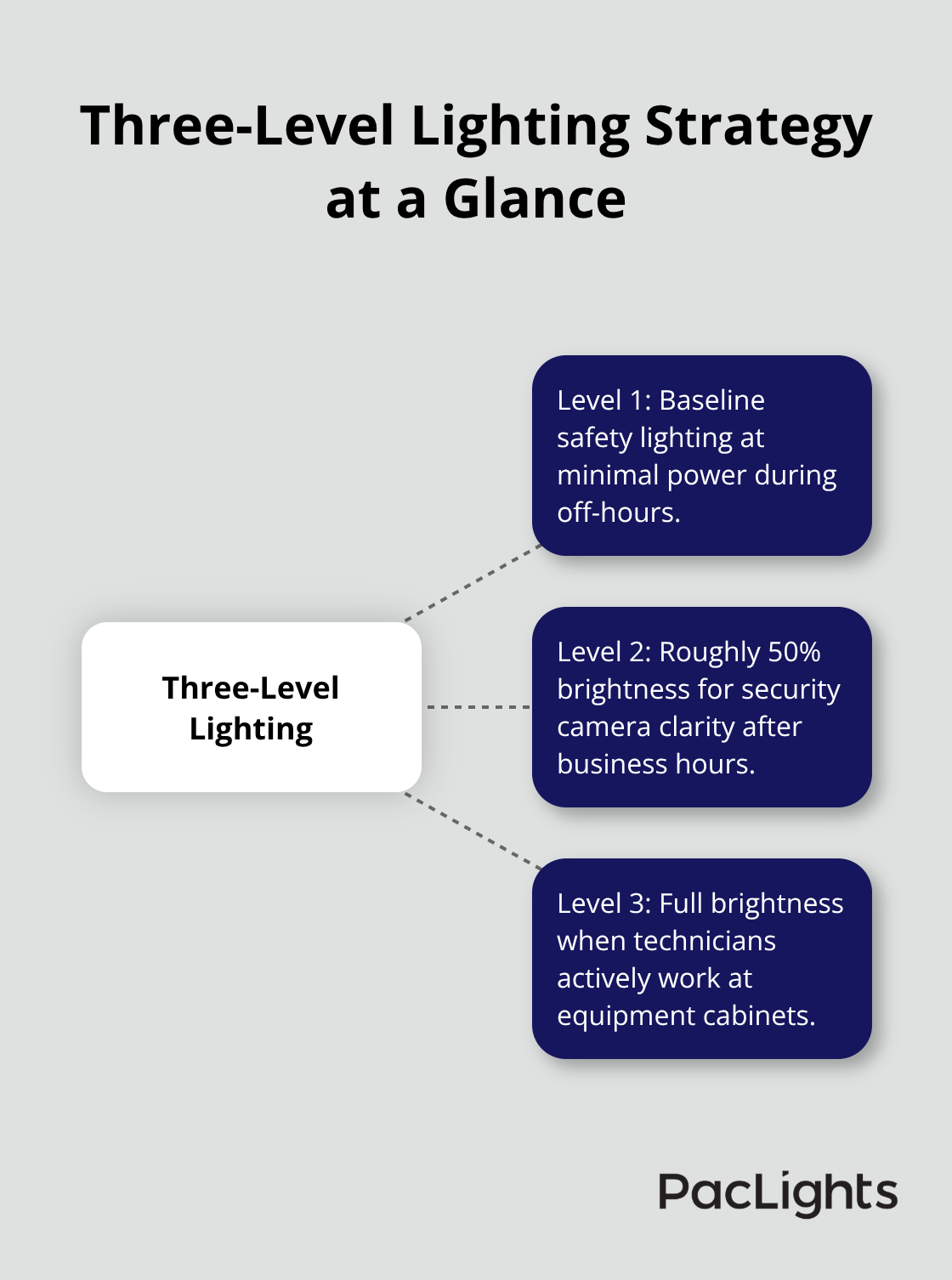
Motion sensors and occupancy controls deliver real energy savings when you install them in corridors, loading docks, and ancillary spaces where technicians don’t work constantly. These controls cut lighting energy in those zones by 40–60%. A data center corridor lit all day with nobody in it wastes money for no reason. Pair occupancy sensors with a three-level lighting strategy: Level 1 provides baseline safety lighting at minimal power during off-hours, Level 2 delivers roughly 50% brightness for security camera clarity after business hours, and Level 3 offers full brightness when technicians actively work at equipment cabinets. This approach cuts electricity costs roughly in half compared with running full brightness 24/7.
Daylight Harvesting and Dimming Eliminate Wasted Energy
Daylight harvesting in office areas and adjacent spaces matters if your facility has windows. Photocell controls dim LED fixtures automatically when natural light is sufficient, eliminating wasted energy during daylight hours. Implement 0–10V dimming to fine-tune brightness by zone without sacrificing visibility. Use field-adjustable lumen output so you adapt brightness to different tasks without swapping fixtures entirely. These controls work together to match lighting output to actual demand rather than running at constant maximum power.
Strategic Fixture Placement Ensures Visibility and Efficiency
Lighting placement directly determines whether technicians can actually see what they’re working on. Place fixtures every 2–3 meters through corridors to maintain uniform brightness and eliminate dark spots that force slower work and mistakes. Install lights directly above or in front of cabinet faces, aiming at equipment panels and connector ports rather than spreading light everywhere. Try around 500–600 lumens per fixture in aisles and bump that to 1000 lumens in active technician work areas where detailed inspection happens.
Maintenance and Material Selection Preserve Performance
Keep all fixtures and lenses clean on a quarterly schedule because dust and dirt reduce light output over time, forcing you to run brighter fixtures or add more units to compensate. Vapor-tight or enclosure-rated LED fixtures hold up better in damp or dusty environments common in some data centers, and they maintain consistent output longer. NSF-certified luminaires signal adherence to recognized safety standards and offer confidence in critical environments.
Planning Prevents Inefficiency and Wasted Investment
A comprehensive lighting layout planned before installation prevents hot spots, dark corners, and the inefficiency of over-lighting some areas while under-lighting others. PacLights offers free lighting layout designs and ROI assessments to help you plan optimal fixture placement and calculate exact payback timelines. With proper planning in place, your retrofit investment delivers measurable results from day one, setting the stage for understanding the financial returns that LED upgrades actually produce.
How Much Will LED Upgrades Actually Cost You
LED retrofit costs vary widely depending on fixture count, control complexity, and installation labor, but the financial picture becomes clear when you calculate energy savings against upfront investment. A data center with 500 fixtures switching from fluorescent to LED typically spends between $25,000 and $50,000 on hardware and installation, depending on whether you add motion sensors and dimming controls. Energy savings from that same retrofit run approximately $8,000 to $12,000 annually when you factor in reduced lighting power plus lower cooling load. At $10,000 per year in savings, payback happens in roughly 3 to 5 years, after which the facility operates with nearly pure profit on lighting costs.
The math strengthens if your data center runs at high occupancy or operates in a climate requiring significant cooling; those conditions amplify cooling savings beyond the base lighting reduction. Utility rebates from programs like ENERGY STAR and DLC-listed fixtures often cover 20 to 40 percent of hardware costs, cutting your net investment substantially and accelerating payback to 2 to 3 years. Check with your local utility first because rebate programs vary by region and can shift your financial picture dramatically.
Calculate Your Actual Energy Savings
A 500-fixture data center currently using 40W fluorescent bulbs consumes 20,000W of continuous lighting power. Switching to 15W LED fixtures drops that to 7,500W, saving 12,500W or roughly 109,500 kilowatt-hours annually at 24/7 operation. At an average US commercial rate of $0.12 per kilowatt-hour, that translates to $13,140 in annual lighting energy savings alone.
Add cooling savings of 5 to 10 percent of your current cooling budget, and total annual savings frequently exceed $15,000 for a facility of that size. Maintenance labor drops dramatically because LED fixtures last 50,000 hours versus 20,000 for fluorescent, meaning technicians perform bulb changes roughly once per 5 to 6 years instead of every 2 to 3 years. In a data center with multiple technicians, that frees up hundreds of hours annually for higher-value work.
Understand Your 10-Year Financial Picture
Over a 10-year period, a typical retrofit investment of $35,000 generates $150,000 to $180,000 in combined energy and maintenance savings, delivering a return on investment between 400 and 500 percent. Those numbers assume no major equipment failures; LED reliability actually pushes savings higher because fewer fixture replacements mean fewer disruptions to operations. Most data centers see payback between 2 and 4 years, which justifies the retrofit investment immediately since LED fixtures carry 10 to 15-year warranties.
Build Your ROI Case with Specific Numbers
Calculate your specific payback period by gathering three pieces of data: current monthly lighting energy costs from your utility bill, current fixture count and wattage, and local utility rates for the next 10 years. Multiply your current wattage by 0.375 to estimate LED consumption at equivalent brightness, then multiply the difference by 8,760 hours and your local rate. That figure becomes your baseline annual lighting savings.
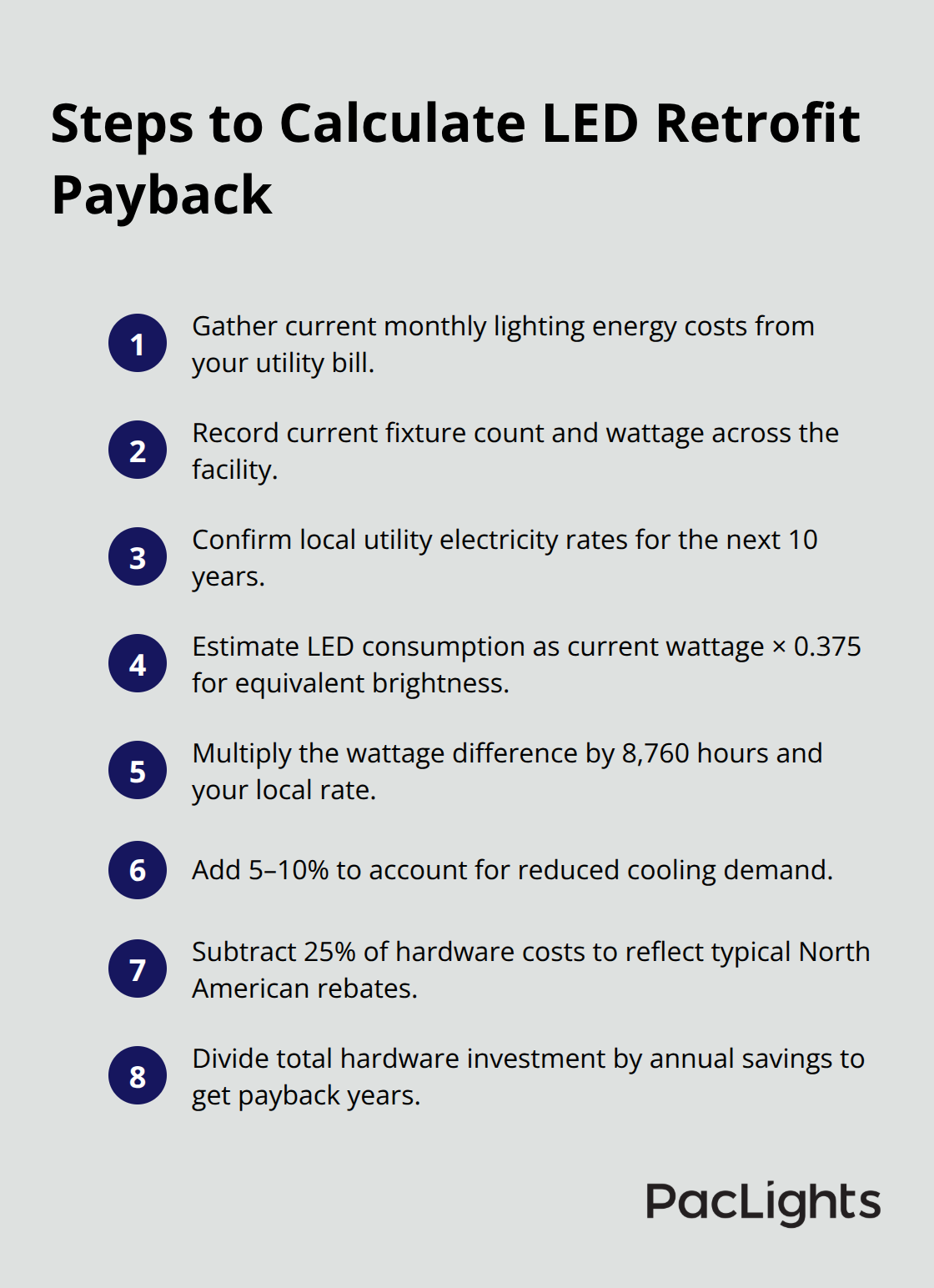
Add 5 to 10 percent to account for cooling reduction, then subtract 25 percent of hardware costs to reflect typical rebate programs in North America. Divide total hardware investment by annual savings to get payback years. Present this calculation to your finance team with specific numbers from your facility rather than industry averages; decision-makers respond to concrete numbers tied to your operation.
Get Professional Assessment and Move Forward
We at PacLights provide free ROI assessments and lighting layout designs that include these calculations tailored to your exact fixture placement and local utility rates, removing guesswork and helping you build a defensible business case for the retrofit investment. Professional assessment accelerates your decision-making process and ensures your retrofit targets the highest-impact areas first.
Final Thoughts
LED upgrades deliver measurable results across three critical areas: energy consumption, operational reliability, and financial returns. The datacenter LED efficiency tips covered throughout this guide-from three-level lighting strategies to strategic fixture placement and smart controls-work together to cut your facility’s power draw while maintaining the brightness technicians need for accurate, fast work. A 500-fixture retrofit typically saves $10,000 to $15,000 annually while eliminating constant maintenance cycles that drain labor resources.
Most data centers recover their retrofit investment within 2 to 4 years, then operate with substantially lower lighting and cooling costs for the next decade. Utility rebates accelerate payback further, often covering 20 to 40 percent of hardware costs depending on your region. Beyond the numbers, LED upgrades improve uptime by reducing maintenance disruptions and technician fatigue, which translates to fewer errors during critical equipment work.
Start with your current lighting inventory and energy costs, then request a professional assessment tailored to your facility. Contact PacLights to move from planning to implementation and begin capturing the substantial savings LED technology delivers.
Disclaimer: PacLights is not responsible for any actions taken based on the suggestions and information provided in this article, and readers should consult local building and electrical codes for proper guidance.