

Datacenter lighting standards aren’t optional-they’re the foundation of safe, efficient operations. Poor lighting compliance leads to equipment failures, safety hazards, and wasted energy costs that add up fast.
At PacLights, we’ve seen firsthand how the right lighting setup transforms datacenter performance. This guide walks you through the standards you need to meet and the practical steps to get there.
Datacenter Lighting Standards: A Fragmented Landscape Demands Strategic Planning
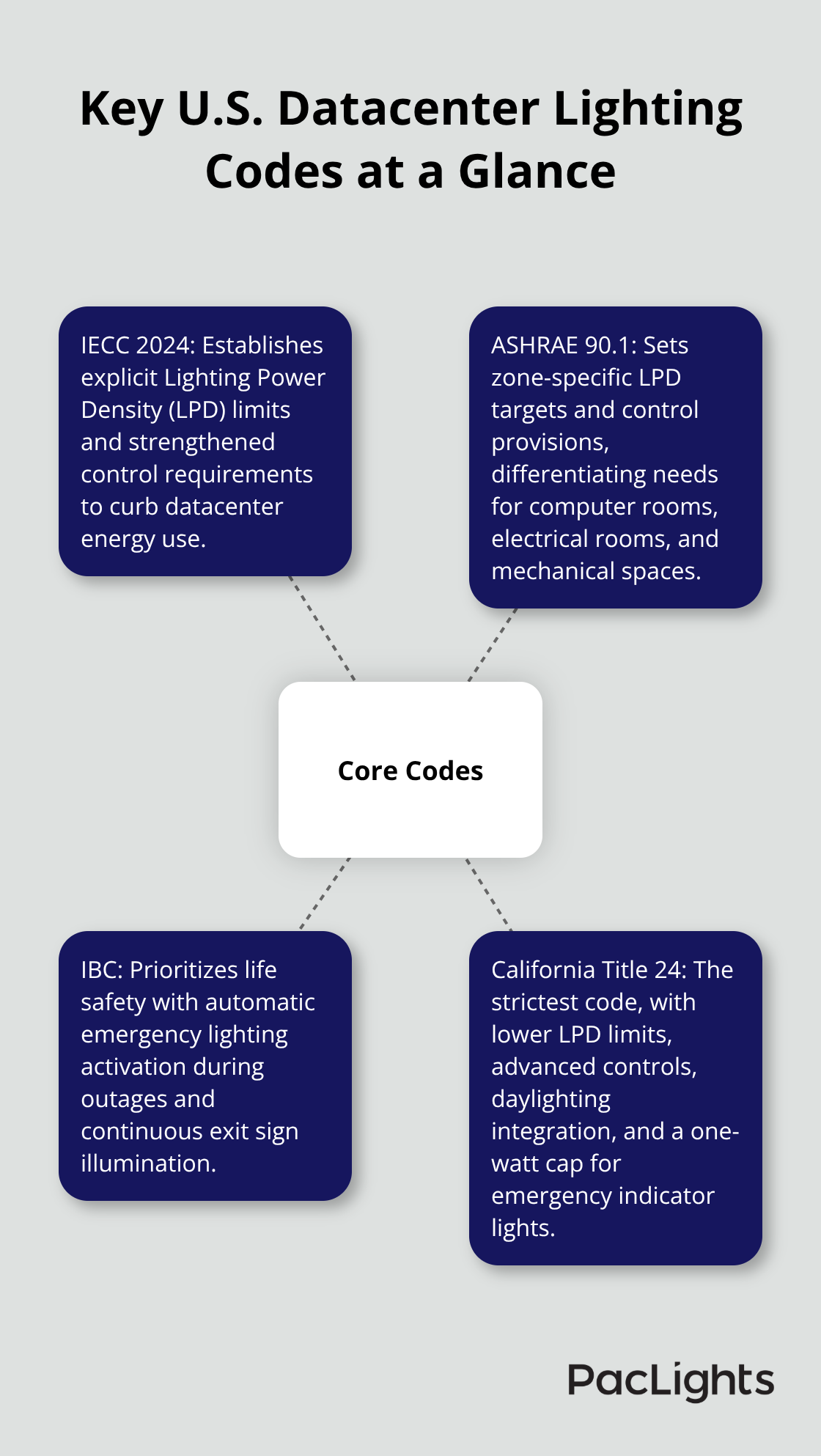
The regulatory landscape for datacenter lighting is fragmented, and that’s the first problem you need to solve. IECC 2024, ASHRAE 90.1, IBC, and California Title 24 all impose different requirements, and they overlap in ways that create compliance headaches if you don’t plan strategically. IECC 2024 introduced explicit Lighting Power Density limits and strengthened controls requirements specifically to curb datacenter energy use. ASHRAE 90.1 goes deeper with zone-specific LPD targets-computer rooms have different requirements than electrical rooms or mechanical spaces. IBC focuses on safety, mandating automatic emergency lighting activation during power outages and continuous illumination of exit signs. California Title 24 is the strictest of all, imposing lower LPD limits, requiring advanced controls and daylighting integration, and capping emergency indicator lights at one watt per fixture.
Most facilities treat these codes as separate compliance exercises when they should be treated as an integrated framework. Early coordination across all applicable codes prevents excessive enabling costs and design conflicts. Washington state datacenters face a June 1, 2026 deadline for Building Performance Standards compliance-roughly two years earlier than Oregon’s large-site deadline of June 1, 2028. That timeline matters because lighting upgrades take time to plan, procure, and install correctly.
LPD: The Central Compliance Metric
Lighting Power Density-measured in watts per square foot-is the central metric across all these codes. Lowering LPD in high-use datacenter zones yields meaningful energy and cost savings that directly impact your bottom line and compliance status. High-efficiency LED fixtures combined with zone-appropriate layouts help you meet zone-specific LPD targets while maintaining adequate illumination for safety and operations.
Advanced lighting controls are not optional add-ons; they’re required for IECC 2024 and ASHRAE 90.1 compliance. Occupancy sensors, daylight sensors, and automated dimming reduce lighting in underused spaces without compromising safety, and they integrate with DALI or 0-10V control systems. Section 179D tax incentives and utility rebates can offset capital costs for LED retrofits and advanced controls, so factor these into your project development from the start.
Why Non-Compliance Costs More Than You Think
Failing to meet lighting standards exposes you to penalties from local authorities, but the operational impact cuts deeper. Inadequate emergency lighting during power outages creates safety hazards and potential liability. Inefficient lighting drives unnecessary energy consumption that inflates operating costs and damages your sustainability reporting-increasingly important as Building Performance Standards roll out across 12+ jurisdictions.
Poor lighting design also hinders thermal management by adding unnecessary heat load to your cooling systems, forcing CRAC and CRAH units to work harder and consume more energy. Documentation failures compound these problems; California Title 24 requires robust compliance documentation, and audits often find gaps that create enforcement risk.
Moving From Compliance Analysis to Action
A comprehensive code analysis at the project outset determines the optimal combination of requirements for your specific facility and jurisdiction, preventing costly rework later. An energy audit identifies current inefficiencies and establishes a baseline for your retrofit strategy. From there, you develop a zoned LPD strategy with LED retrofits and automated controls that address your specific code requirements and performance goals. This approach transforms compliance from a checkbox exercise into a performance improvement initiative that pays for itself through reduced energy costs and operational efficiency.
What Performance Standards Actually Mean for Your Datacenter Lighting
Illumination Requirements Vary by Space Type
Illumination requirements in datacenters aren’t arbitrary. ASHRAE 90.1 specifies different lux levels depending on the space: computer rooms need 50 foot-candles for safe equipment maintenance, while administrative areas require 30 foot-candles for general tasks. Emergency lighting must deliver at least 1 foot-candle at floor level along exit paths during power loss, a non-negotiable safety requirement under IBC. Color temperature matters less in sealed server rooms where staff spend minimal time, but in control rooms and administrative spaces, 4000K to 5000K (neutral white) reduces eye strain during extended monitoring shifts. The practical takeaway: don’t over-light your datacenter. Excessive illumination wastes energy and generates unnecessary heat that your cooling systems must handle.
LED Technology and Control Systems Drive Real Savings
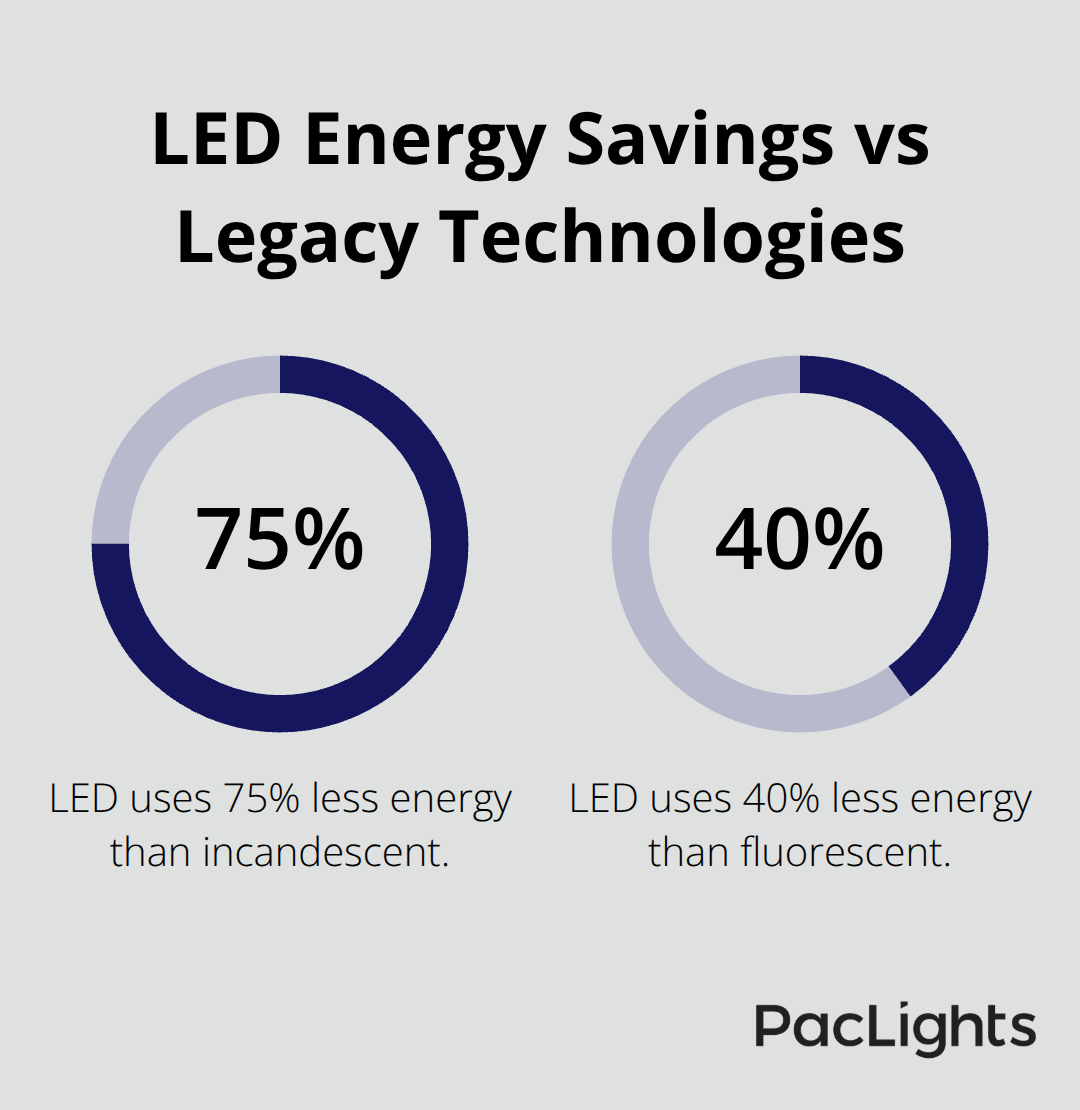
High-efficiency LED fixtures matched to zone-specific requirements deliver adequate visibility without the thermal penalty of older technologies. LED uses 75 percent less energy than incandescent and 40 percent less than fluorescent, but advanced controls drive the real savings. Occupancy sensors in intermittently used spaces like server rows reduce energy consumption by 30 to 50 percent without compromising safety.
Daylight harvesting in perimeter zones and automated dimming tied to actual workload demands prevent the waste that occurs when spaces run at full brightness 24/7.
Financial Incentives Offset Retrofit Costs
Section 179D tax deductions provide up to 1.80 dollars per square foot for qualified energy-efficient lighting retrofits, offsetting capital costs immediately. Utility rebates further reduce your capital burden when you plan them into your project development from the start. These financial tools transform lighting upgrades from a compliance burden into a cost-effective investment that pays back quickly through operational savings.
Thermal Impact on Cooling Systems
Heat generation from lighting directly impacts your cooling load. Reducing artificial lighting needs through efficient fixtures and smart controls lowers CRAC and CRAH runtime, cutting energy consumption across your entire thermal management system. This thermal benefit compounds your energy savings beyond the lighting system itself, making efficient lighting a lever for broader datacenter performance improvement.
Real-World Performance Gains
Real-world retrofit data from datacenters shows that combining high-efficiency LEDs with occupancy and daylight sensors reduces lighting energy consumption by 40 to 60 percent compared to legacy systems. This measurable improvement directly strengthens your Building Performance Standards compliance position and creates the foundation for selecting and installing the right lighting solutions that meet both your regulatory obligations and operational performance targets.
Choosing the Right LED Fixtures and Control Systems for Your Datacenter
Match Fixtures to Specific Space Demands
Selecting LED fixtures for datacenters requires matching technology to specific space demands rather than treating all areas identically. Server rooms demand different performance characteristics than administrative zones or mechanical rooms. High-bay fixtures in server areas should deliver 50 foot-candles with minimal heat generation, while admin spaces benefit from 4000K to 5000K color temperature to reduce eye strain during extended shifts. The critical decision point is fixture efficiency and thermal output. Modern LED fixtures operate at 90 to 95 percent efficiency compared to 15 to 20 percent for incandescent, meaning less wasted energy converts to heat that burdens your cooling systems. When you evaluate vendors, request photometric data that specifies lumens per watt and thermal output in BTUs.
Control Systems Drive Compliance and Savings
Control systems matter as much as fixtures themselves. IECC 2024 and ASHRAE 90.1 require advanced controls, not just efficient bulbs. Occupancy sensors in intermittently accessed spaces like cable corridors or backup generator rooms reduce energy consumption by 30 to 50 percent without safety compromises. Daylight harvesting in perimeter zones automatically dims artificial lighting when natural light provides sufficient illumination. DALI and 0-10V control protocols integrate with your building management system, enabling centralized monitoring and remote adjustments. Section 179D tax incentives cover up to 1.80 dollars per square foot for qualified LED retrofits with controls, so factor this into your capital planning immediately.
Integration With Building Management Systems
Integration with your existing building management system determines whether your lighting investment delivers ongoing optimization or becomes isolated hardware. Systems that report energy consumption in real time allow you to track performance against your Building Performance Standards compliance targets and identify underperforming zones quickly. Real-time visibility into lighting performance prevents the energy waste that occurs when spaces run at full brightness without adjustment to actual occupancy or available daylight.
Maintenance and Monitoring Strategy
LED fixtures last 50,000 to 100,000 hours, but control systems require regular calibration to maintain sensor accuracy. Schedule quarterly checks on occupancy sensor sensitivity and daylight sensor thresholds, especially after HVAC maintenance that may affect air handling and dust accumulation on sensors. Battery backup systems for emergency lighting need annual testing to confirm they activate during power loss; IBC requires continuous illumination of exit signs and at least 1 foot-candle at floor level along egress paths.
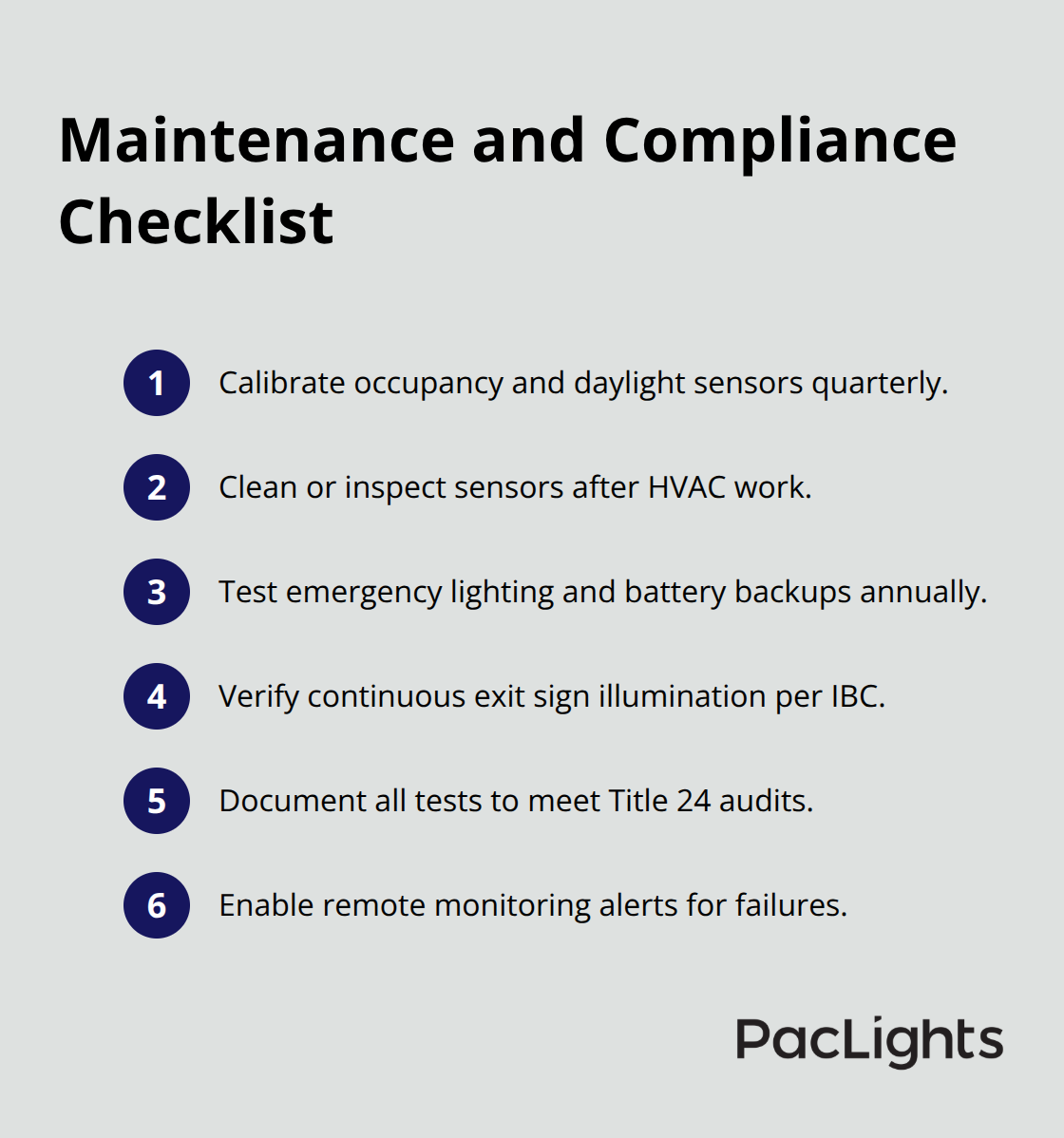
Document all compliance testing and maintenance activities to satisfy California Title 24 audit requirements and demonstrate good faith compliance efforts if enforcement questions arise. Remote monitoring capabilities reduce on-site maintenance visits and catch failures before they impact operations, lowering your total cost of ownership over the lighting system lifecycle.
Final Thoughts
Datacenter lighting standards form the backbone of compliant, efficient operations. Meeting IECC 2024, ASHRAE 90.1, IBC, and California Title 24 requirements reduces energy costs, improves thermal management, and strengthens your Building Performance Standards position. Facilities that implement high-efficiency LED fixtures with advanced occupancy and daylight controls achieve lighting energy reductions of 40 to 60 percent compared to legacy systems, translating directly to lower operating costs and measurable progress toward sustainability goals.
Proper datacenter lighting implementation reduces heat load on your cooling systems, lowering CRAC and CRAH runtime and compounding energy efficiency gains across your entire thermal management strategy. LED fixtures lasting 50,000 to 100,000 hours mean fewer maintenance cycles and lower replacement costs over the system lifecycle. Real-time monitoring and remote control capabilities prevent energy waste that occurs when spaces run at full brightness without adjustment to actual occupancy or available daylight.
Start with a comprehensive code analysis for your specific jurisdiction and facility type, then conduct an energy audit to establish your baseline. Factor Section 179D tax incentives and utility rebates into your capital planning from the start-these financial tools offset retrofit costs and accelerate payback timelines. At PacLights, we engineer energy-efficient LED fixtures, retrofit solutions, and advanced lighting controls designed to meet datacenter lighting standards while optimizing your energy performance, and our team provides free lighting layout designs and ROI assessments to help you make informed decisions.
Disclaimer: PacLights is not responsible for any actions taken based on the suggestions and information provided in this article, and readers should consult local building and electrical codes for proper guidance.