

Hazardous environments demand lighting solutions that go beyond standard fixtures. Vapor tight enclosure lighting protects your equipment and workforce while meeting strict industrial safety standards.
At PacLights, we’ve seen firsthand how the right lighting system reduces maintenance costs and prevents costly downtime. This guide walks you through everything you need to know about selecting, installing, and maintaining vapor tight fixtures in your facility.
Why Vapor Tight Lighting Protects Your Facility and Workforce
How Vapor Tight Fixtures Prevent Equipment Failure
Moisture, dust, and chemical vapors corrode standard lighting fixtures from the inside out. Vapor tight enclosure lighting uses gasket-sealed housings and corrosion-resistant materials to block these contaminants entirely, keeping electrical components safe and operational for years longer than conventional high bays. In food processing plants, car washes, cold storage facilities, and chemical storage areas, this protection isn’t optional-it’s the difference between equipment that lasts and equipment that fails. The sealed design prevents water ingress, dust accumulation, and corrosive fume damage, which means your fixtures maintain consistent light output and avoid the sudden failures that shut down production lines.
Meeting OSHA and NEC Requirements
Regulatory compliance adds another layer of urgency. OSHA 1926.56 establishes minimum illumination requirements for construction and industrial work-general construction areas require at least 5 foot-candles, while plant shops and active storage areas demand 10 foot-candles. Vapor tight fixtures rated IP65, IP66, or IP67 meet NEC Article 410 requirements for wet and damp locations, protecting your facility from liability and inspection failures.
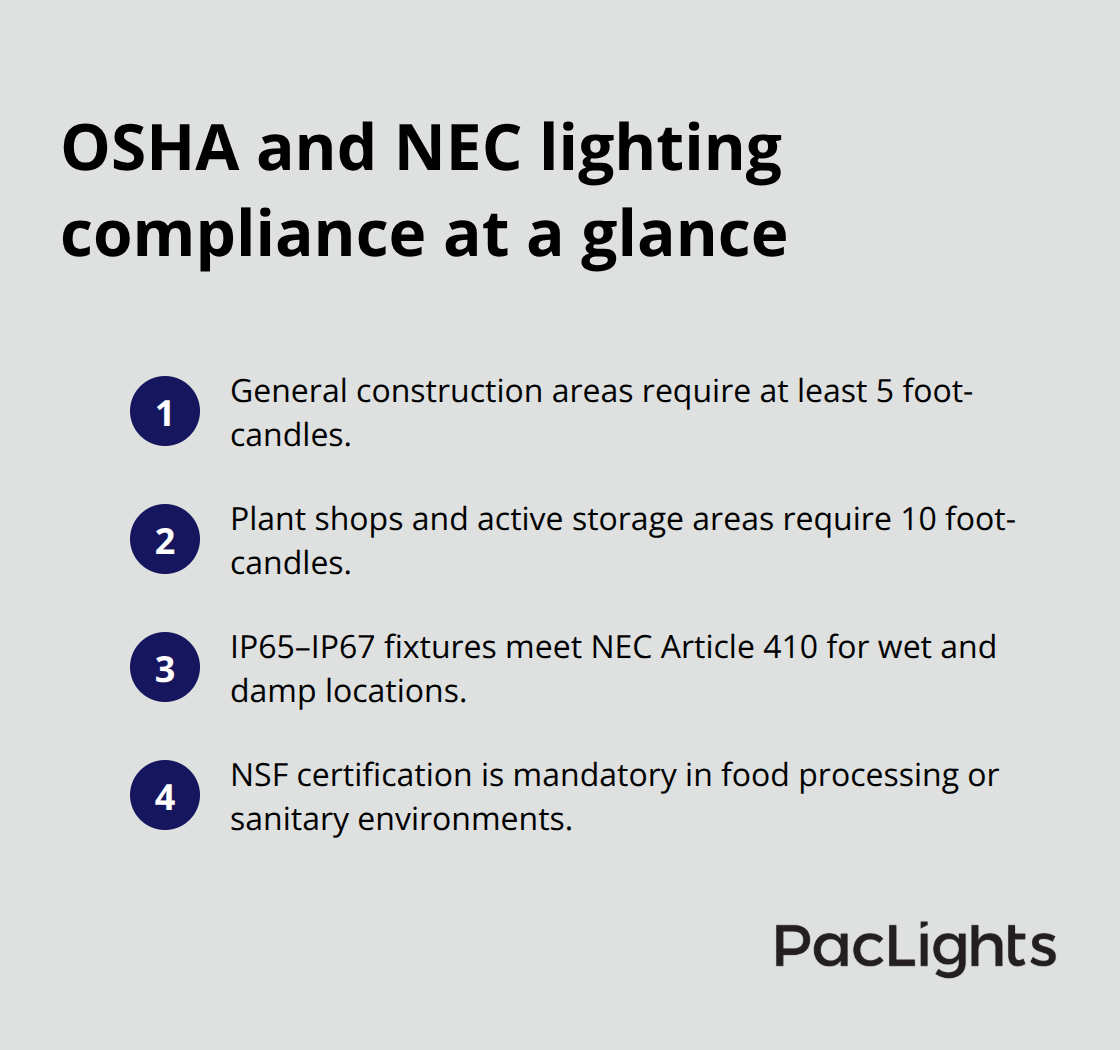
NSF certification becomes mandatory if your lighting operates in food processing or sanitary environments, and vapor tight fixtures with NSF ratings satisfy compliance without costly retrofits later.
Calculating Long-Term Energy and Maintenance Savings
LED vapor tight fixtures operate for 50,000 hours or more before replacement, compared to 10,000 to 20,000 hours for fluorescent or metal halide alternatives. This extended lifespan cuts replacement labor costs dramatically, especially in high-bay spaces where access proves difficult and time-consuming. Energy consumption also drops significantly-LED vapor tight systems consume 40 to 50 percent less power than older HID systems while delivering equal or superior lumen output. For a warehouse operating 24/7, this translates to thousands of dollars in annual energy savings. The sealed gasket design also reduces maintenance frequency because dirt and moisture cannot accumulate inside the fixture, keeping lenses cleaner and preserving light output without constant cleaning cycles. These financial benefits compound over time, making vapor tight fixtures a smart investment for facilities that operate in harsh conditions.
What to Look for When Choosing Vapor Tight Fixtures
Understanding IP Ratings for Your Environment
IP ratings determine how well a fixture resists dust and water intrusion. IP65 protects against dust and water spray, IP66 withstands powerful water jets, and IP67 tolerates temporary immersion. Food processing plants that run daily wash-down cycles require IP66 as a minimum standard. Cold storage facilities with condensation and occasional moisture can operate safely with IP65.
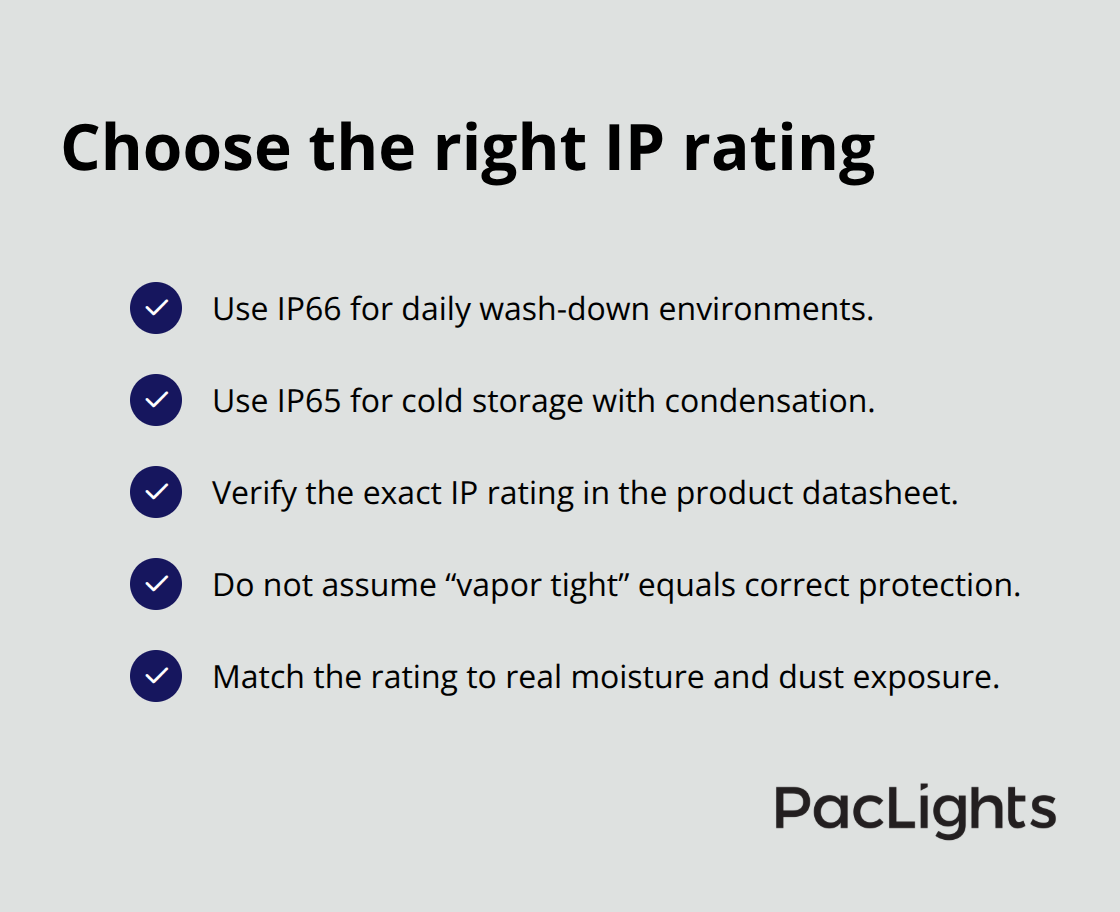
Never assume a fixture labeled vapor tight automatically carries the protection your facility needs-verify the specific IP rating in the product datasheet before purchase.
Housing Materials and Durability
The fixture’s housing material determines how long it survives in harsh conditions. Corrosion-resistant die-cast aluminum or copper-free composites outperform standard steel in damp environments, especially near chemical storage areas or marine facilities. These materials resist rust and degradation that would compromise electrical safety and light output over time. A quality housing protects internal components from moisture, dust, and chemical vapors that corrode standard fixtures from the inside out.
Lumen Output and Foot-Candle Requirements
Lumen output matters far more than wattage when comparing fixtures. A 4-foot vapor tight fixture delivering 21,600 lumens at 80 watts outperforms a competitor’s 60-watt model producing 14,000 lumens. Calculate the foot-candles your space requires using OSHA 1926.56 as your baseline-general warehouse areas need 5 foot-candles minimum, but task-specific zones like inspection stations demand 30 foot-candles or higher. This calculation prevents over-specification and ensures your investment covers actual needs.
Color Temperature and Certifications
Cooler light at 4000K to 5000K improves contrast and reduces errors in manufacturing environments, while 3500K works adequately for general storage. Selectable wattage and CCT options reduce your SKU inventory and simplify future upgrades without replacing entire fixtures. Certifications signal quality and eligibility for rebates-UL Listed and DLC Premium status confirm energy efficiency and often qualify your purchase for utility rebates that offset initial costs by 20 to 30 percent. NSF certification becomes mandatory if your fixture operates in food service or sanitary environments. Operating temperature range matters too (fixtures rated down to negative 40 degrees Fahrenheit suit cold storage, while units tolerating 122 degrees Fahrenheit handle hot industrial spaces). Most reputable manufacturers back vapor tight fixtures with 5-year warranties, indicating confidence in durability.
Installation and System Integration
A site assessment documents moisture levels, dust concentration, chemical exposure, and physical hazards before installation begins. This assessment informs your IP and NEMA enclosure selection and prevents costly mistakes. Mount fixtures according to manufacturer specifications, ensuring gaskets remain compressed and seals stay intact-improper mounting voids the vapor tight rating. Electrical wiring must comply with NEC standards, and you must seal all conduit entries and junction boxes to maintain vapor tight integrity. Suspension kits using chains or cables work for high-bay applications, while surface mounting suits lower installations.
Vapor tight fixtures typically operate on 120–277V, with some supporting 347–480V for larger industrial panels. If your facility runs older metal halide or fluorescent systems, the transition to LED vapor tight lighting requires minimal rewiring in most cases. Dimming control via 0–10V compatibility enables energy savings during low-demand periods and integrates with occupancy sensors or daylight harvesting systems. A lighting layout design confirms lumen distribution and foot-candle compliance across your entire space before you purchase fixtures. This approach prevents over-specification and ensures your investment covers actual needs rather than theoretical maximums. With the right fixtures selected and specifications confirmed, the next step involves understanding where these systems perform best in real industrial environments.
Where Vapor Tight Lighting Performs Best
Food Processing Plants and Sanitary Environments
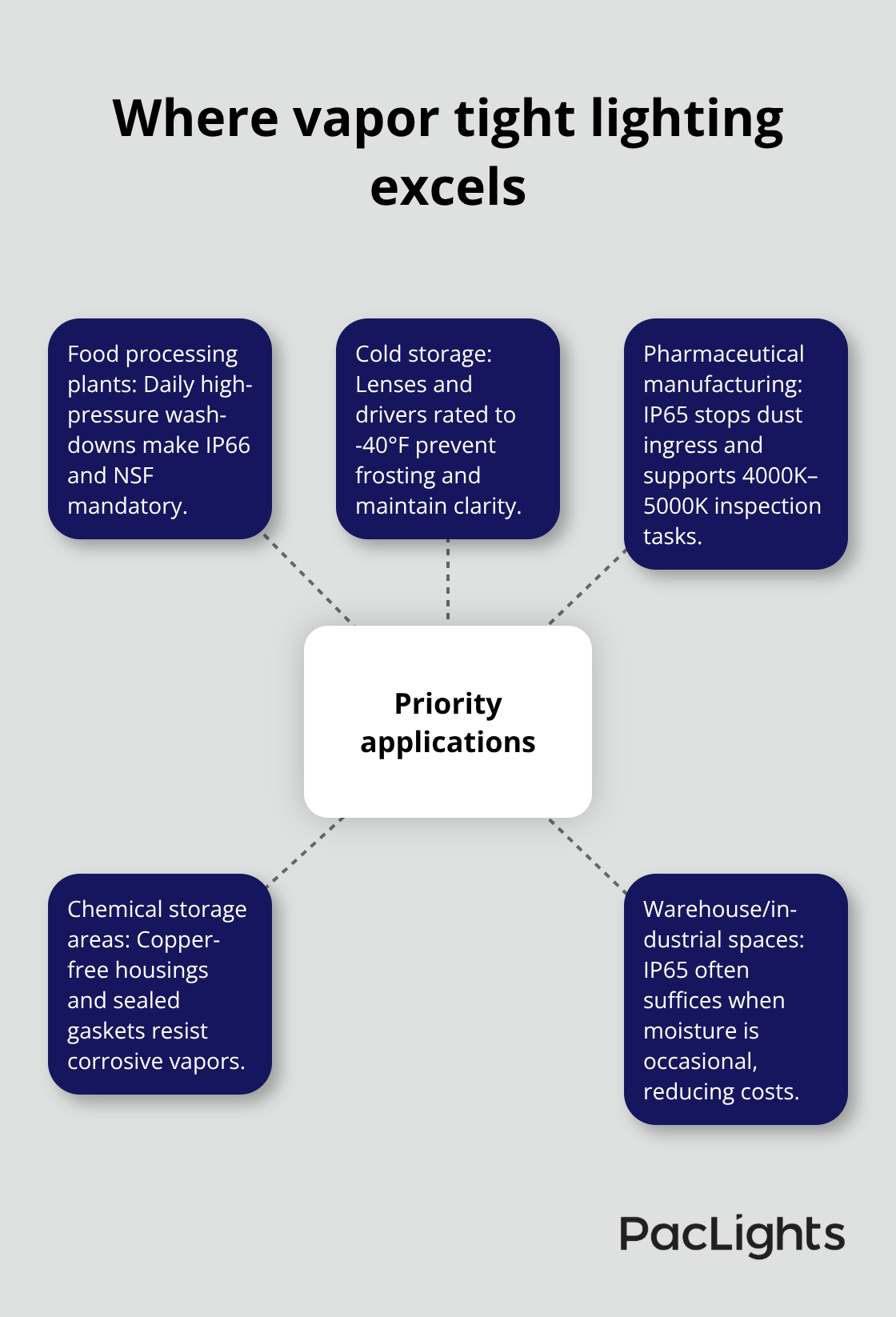
Food processing facilities face relentless moisture and wash-down cycles that destroy standard lighting within months. Daily sanitation protocols use high-pressure water jets that exceed IP65 requirements, making IP66-rated vapor tight fixtures mandatory rather than optional. NSF certification becomes non-negotiable because contamination risks demand fixtures that meet sanitary standards for food contact environments. A typical 50,000-square-foot food processing plant operating 16 hours daily requires 10 foot-candles minimum across production floors and 30 foot-candles at inspection stations where product quality checks occur. The sealed gasket design prevents moisture from corroding internal components, which means your fixtures maintain consistent lumen output throughout their 50,000-hour lifespan instead of degrading after 12 to 18 months of exposure.
Cold Storage and Refrigeration Facilities
Cold storage facilities present a different challenge: condensation forms constantly on fixture lenses at temperatures below 32 degrees Fahrenheit, and standard coatings fog or frost over time. Vapor tight fixtures with polycarbonate lenses rated to negative 40 degrees Fahrenheit resist this degradation and maintain clarity without requiring weekly cleaning cycles. The sealed design eliminates moisture accumulation that would otherwise reduce light output and force frequent maintenance interventions in hard-to-reach high-bay locations.
Pharmaceutical Manufacturing Plants
Pharmaceutical manufacturing plants operate under strict environmental controls where dust and particle contamination directly impact product integrity. IP65-rated vapor tight fixtures prevent dust ingress into the lighting system itself, eliminating a potential contamination source that regulatory inspectors specifically scrutinize. These facilities typically demand 4000K to 5000K color temperature to enhance visual contrast during quality inspections, and selectable wattage options allow you to optimize lumen output for different production zones without purchasing multiple fixture types.
Chemical Storage Areas
Chemical storage areas demand the highest protection level because corrosive vapors attack standard fixtures aggressively. Copper-free die-cast aluminum housings resist chemical degradation far better than steel, and the gasket-sealed design prevents vapors from reaching electrical connections where corrosion causes equipment failure. Many chemical storage facilities pair vapor tight fixtures with 0–10V dimming controls to reduce energy consumption during low-activity periods, cutting operating costs by 20 to 30 percent compared to non-dimmable systems.
Warehouse and General Industrial Spaces
Warehouse facilities with occasional moisture exposure can operate safely with IP65 fixtures, saving money compared to the heavier-duty IP67 models required for immersion environments. The decision hinges on your actual environmental conditions rather than worst-case scenarios. A detailed site assessment documents humidity levels, chemical exposure, temperature fluctuations, and water jet frequency before you select fixtures. This assessment prevents over-specification that wastes capital and under-specification that leads to premature failure. Real-world performance data shows that properly selected vapor tight fixtures in food processing plants reduce maintenance labor by 60 to 70 percent compared to standard high bays, and cold storage facilities see similar reductions in cleaning and replacement cycles. The upfront cost premium of 20 to 40 percent for vapor tight fixtures typically pays back within three to four years through reduced maintenance and extended equipment life, making the investment financially justified across virtually every industrial application where moisture, dust, or chemical exposure exists.
Final Thoughts
Vapor tight enclosure lighting solves a problem that standard fixtures cannot address: protecting your equipment and workforce in environments where moisture, dust, and chemical vapors are constant threats. The financial case is straightforward-your facility avoids the hidden costs of premature equipment failure, frequent maintenance cycles, and production downtime that plague standard lighting systems in harsh conditions. A 50,000-hour lifespan paired with 40 to 50 percent energy savings means your investment pays back within three to four years through reduced labor and electricity costs alone.
The regulatory landscape reinforces this decision. OSHA 1926.56 establishes minimum illumination standards, NEC Article 410 governs wet and damp locations, and NSF certification becomes mandatory in food processing environments. Vapor tight fixtures meeting IP65, IP66, or IP67 ratings satisfy these requirements without costly retrofits later, and your facility gains compliance confidence while eliminating liability exposure from inadequate lighting or equipment failures caused by moisture ingress.
Your next step involves a site assessment that documents moisture levels, dust concentration, chemical exposure, and temperature fluctuations specific to your facility. We at PacLights provide free lighting layout designs and ROI assessments to help you understand the exact financial impact of upgrading to vapor tight enclosure lighting for your space. Contact our team to begin your facility assessment and discover how the right lighting system protects your equipment, reduces costs, and keeps your workforce safe.
Disclaimer: PacLights is not responsible for any actions taken based on the suggestions and information provided in this article, and readers should consult local building and electrical codes for proper guidance.