

Surface mount downlight pricing often surprises retrofit project managers. The upfront cost is just one piece of the puzzle-energy savings, lifespan, and installation efficiency matter equally.
At PacLights, we’ve helped hundreds of facilities plan retrofits without breaking the budget. This guide walks you through real costs, practical savings strategies, and how to calculate what you’ll actually save over time.
Surface Mount Downlight Pricing: What You’ll Actually Pay
Breaking Down the Three Cost Components
Surface mount downlight pricing splits into three distinct parts: the fixture itself, installation labor, and supporting materials. The fixture typically costs between $20 and $90 per unit for standard models, though premium options with advanced controls reach $100 to $200 each.
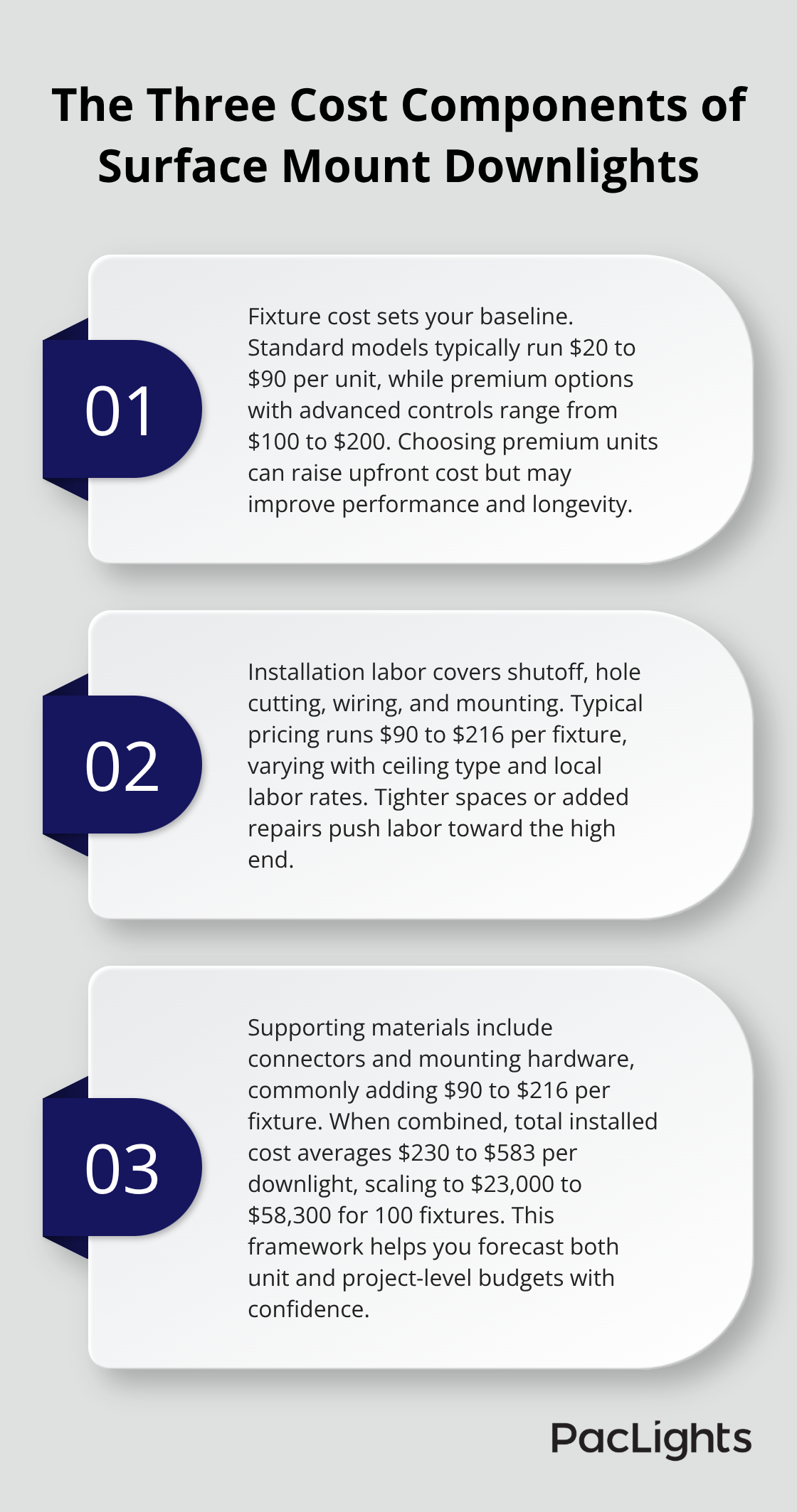
Installation labor runs $90 to $216 per fixture for basic work-shutoff, hole cutting, wiring, and mounting. Job supplies like connectors and mounting hardware add another $90 to $216 per fixture. According to Homewyse data from January 2026, total installed cost per downlight averages $230 to $583 when all three components combine. A 100-fixture retrofit therefore ranges from $23,000 to $58,300 depending on your facility’s conditions and local labor rates.
How Ceiling Type Affects Your Bottom Line
Tight ceilings favor wafer retrofit modules that require less than one inch of clearance and connect directly to existing wiring, reducing labor costs significantly. These modules work especially well in retrofit situations where you cannot easily modify ceiling structures. Standard recessed installations demand more labor and potential ceiling repairs, pushing costs higher. Surface-mounted options on solid ceilings eliminate framing work entirely, making them the fastest and most affordable path forward. Your ceiling type determines whether you save thousands or spend them on structural modifications.
Energy Savings That Offset Upfront Costs
The Department of Energy confirms that LED surface mounts consume 50 to 75 percent less energy than incandescent or halogen alternatives. A facility replacing 20 fixtures from 400-watt metal halide to 150-watt LED wafers at typical commercial rates of $0.125 per kilowatt-hour and 12 hours daily operation saves approximately $2,738 per year in energy alone.
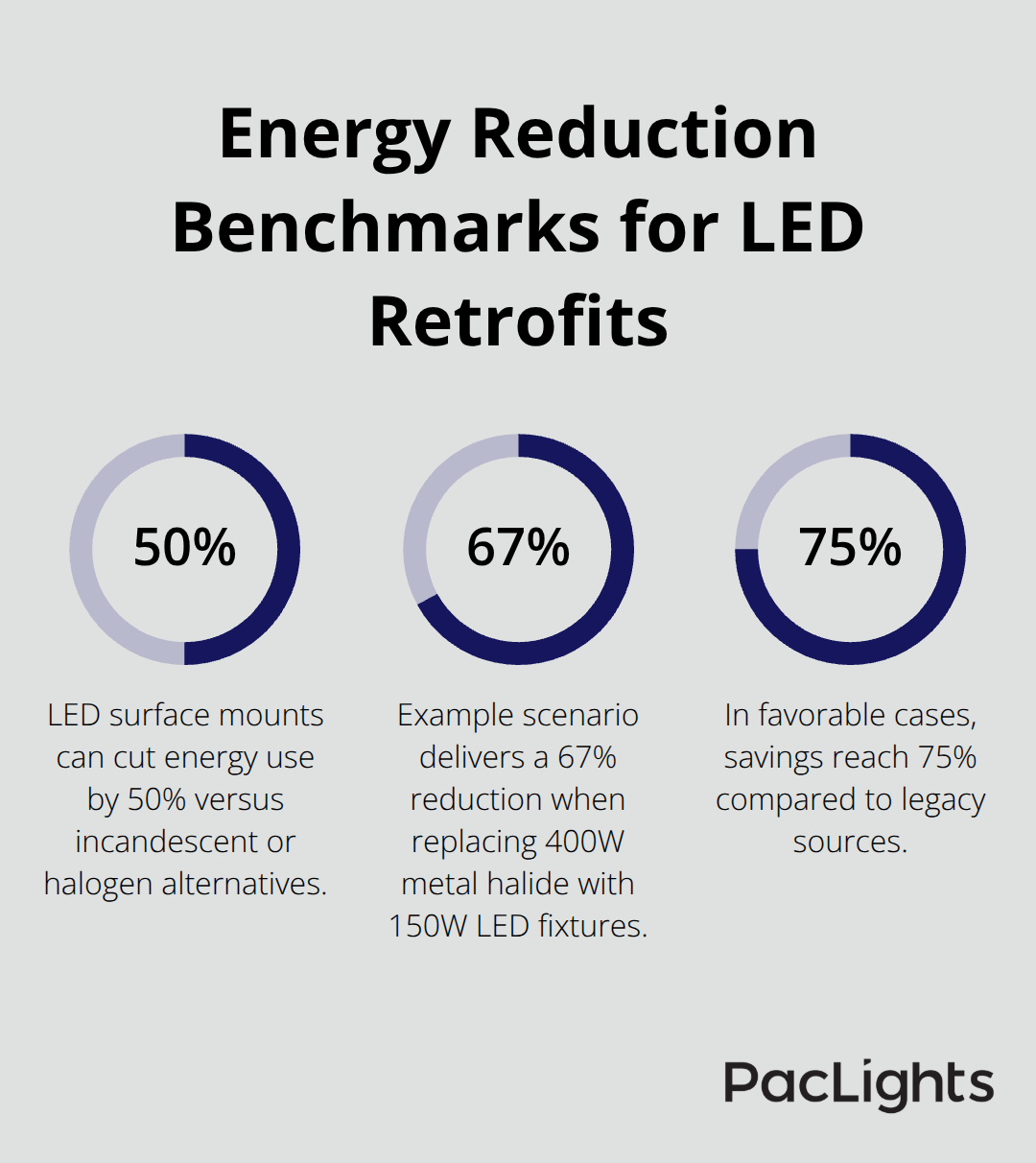
Maintenance costs drop dramatically as well: LED fixtures last 25,000 to 50,000 hours compared to 6,000 to 15,000 hours for metal halide, reducing replacement labor across those same 20 fixtures by roughly $13,000 over the LED lifespan. These savings compound year after year, making the initial investment recoup itself within months for many facilities.
Premium Fixtures vs. Budget Options
Choosing between budget and premium options requires understanding what drives price differences. Premium fixtures deliver higher color rendering index (CRI) ratings above 90, superior thermal management through better heat sinking, and certified performance data from LM-79 and LM-80 testing. Standard fixtures typically offer 80+ CRI, adequate for most applications, but premium models ensure consistent color appearance across your entire facility. Thermal management matters because LEDs dim as they heat up; premium housings with IC-rated designs maintain brightness and longevity in enclosed or insulated ceiling cavities. Budget options work perfectly for warehouses and industrial spaces where color consistency matters less, but retail environments and offices benefit from premium specifications.
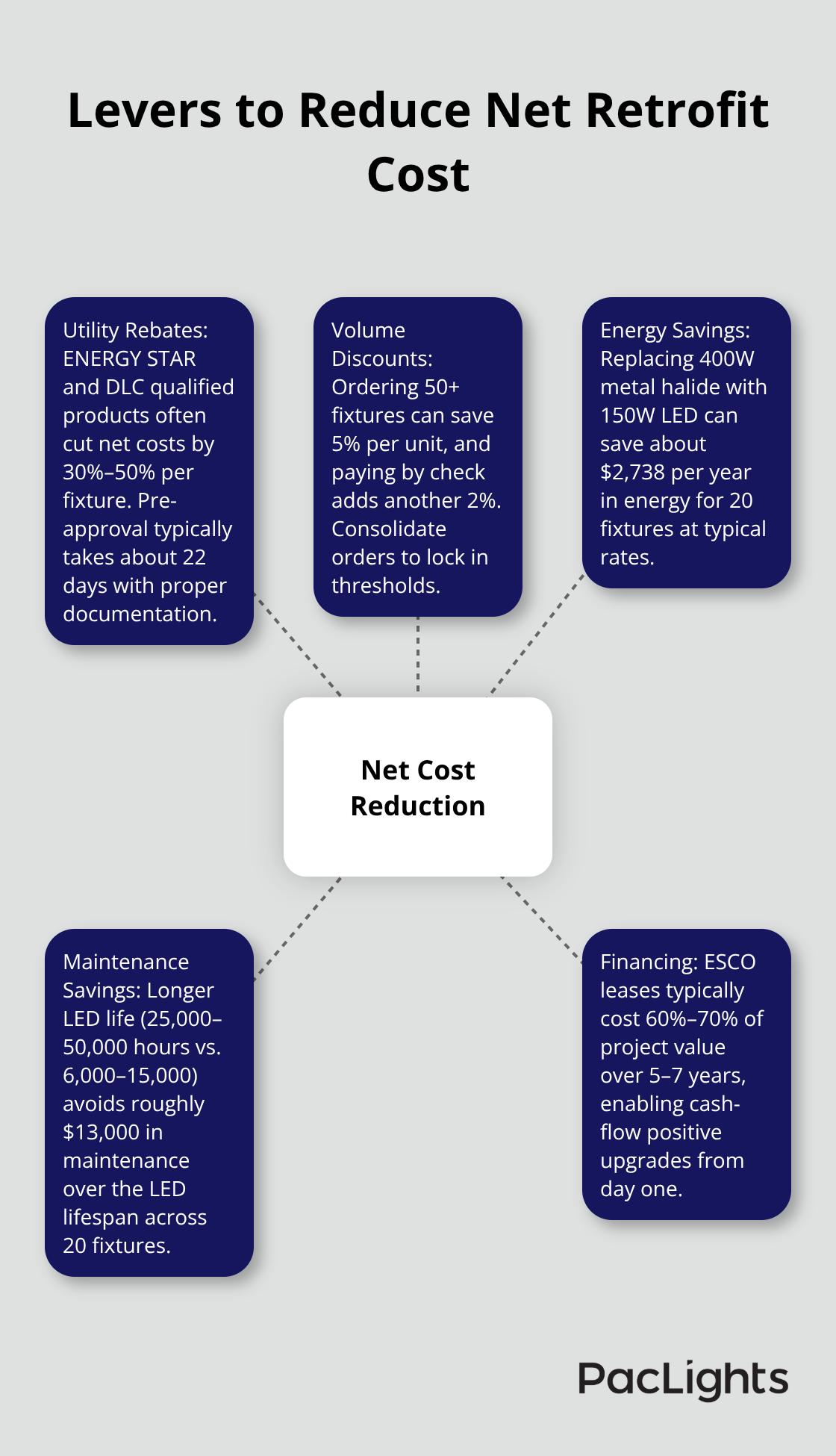
Lumen output ranges from 800 to 1,600 lumens per fixture depending on the model, with efficacy typically between 100 and 150 lumens per watt. Dimming compatibility varies significantly: most surface mounts support TRIAC, 0-10V, or DALI dimming, but verify compatibility with your existing dimmers before purchasing. ENERGY STAR and DLC qualified products qualify for utility rebates that commonly reduce net investment by 30 to 50 percent per fixture, making premium options more affordable than they appear upfront. A $3,000 fixture budget might yield 20 standard units or 15 premium units, but rebates could reduce the net cost to $1,500 to $2,100, closing the gap significantly.
Maximizing Discounts Through Volume Purchasing
Bulk ordering amplifies savings further: purchasing 50 or more fixtures through a shipping account can reduce per-unit costs by five percent, while check payments add another two percent discount. Planning your full retrofit scope upfront allows you to consolidate orders and negotiate better rates with suppliers. These volume discounts compound with rebate programs, creating substantial savings on larger projects. The key is determining your total fixture count before you begin purchasing, so you can lock in the best possible pricing across your entire retrofit.
How to Lock In Real Savings on Your Retrofit
Consolidate Your Orders for Maximum Volume Discounts
Consolidating your retrofit into a single purchase order unlocks the best pricing available. Ordering 50 or more fixtures through a shipping account reduces per-unit costs by five percent, while paying by check adds another two percent discount according to bulk purchasing data from commercial lighting suppliers. A 100-fixture retrofit at $60 per fixture costs $6,000 at standard pricing, but volume discounts bring that down to $5,700, saving $300 before rebates apply. Planning your complete fixture count upfront prevents the common mistake of purchasing in waves, where early orders lock you into higher prices while later purchases miss the volume threshold.
Capture Utility Rebates Before You Purchase
Utility rebate programs represent the single largest opportunity to reduce your net investment, yet most facilities leave money on the table by purchasing without pre-approval. ENERGY STAR and DLC qualified products typically qualify for rebates that cut net costs by 30 to 50 percent per fixture, transforming an $80 fixture into a $40 to $56 net cost after incentives. A 20,000-square-foot warehouse retrofit replacing 400-watt metal halide with 150-watt LED wafers generates approximately 134,904 kilowatt-hours in annual savings at typical commercial rates, but the real leverage comes from combining energy savings with utility rebates and federal tax credits under Section 179D. Pre-approval takes roughly 22 days and requires documentation including your account number, project details, product specifications, invoices, and recent electricity bills, but securing approval upfront guarantees you capture every dollar available.
Phase Your Retrofit Strategically Across Budget Cycles
Phasing your retrofit across multiple quarters or fiscal cycles spreads costs when upfront capital is tight, but only if you phase by zone rather than by fixture type. Installing all fixtures in your warehouse first, then moving to office spaces in the next phase, maintains consistent color temperature and CRI across each completed area while spreading labor and material costs across different budget cycles. The mistake is purchasing 50 fixtures in January, then another 50 in April at higher prices because you lost the volume discount threshold.
Verify Your Actual Savings Against Projections
Calculate your true payback period by tracking actual energy consumption for two weeks after installation and comparing it against pre-retrofit baseline data from your utility bills. If actual consumption deviates by more than ten percent from projections, adjust your occupancy sensor thresholds or daylight harvesting settings before finalizing your ROI calculations. A facility achieving 67 percent energy reduction across 20 fixtures realizes roughly $2,738 in annual energy savings plus approximately $13,000 in avoided maintenance costs over the LED lifespan, delivering payback in under nine months when rebates are included.
With your pricing locked in and savings verified, the next step involves selecting the right fixtures for your specific facility conditions and operational needs.
How to Build Your Retrofit Budget and Calculate Real Payback
Establish Your Baseline Energy Costs
Start with your utility bills from the past six to twelve months, not a single month. Seasonal variations and rate changes affect your actual savings significantly, and a single bill underestimates winter heating loads or summer cooling impacts. Extract your average kilowatt-hour consumption, peak demand charges if applicable, and your blended rate per kilowatt-hour. Next, calculate your baseline lighting energy use by identifying fixture wattages, operating hours, and quantity across each zone. For a 20,000-square-foot warehouse running 400-watt metal halide fixtures for 12 hours daily, that’s roughly 20 fixtures times 400 watts times 4,380 annual hours equals 35 megawatt-hours annually. Multiply that by your local rate to establish your current lighting cost.
Project Your LED Savings and Maintenance Benefits
Subtract the projected LED consumption from your baseline. A 150-watt LED fixture under the same conditions yields 10.5 megawatt-hours, delivering 67 percent energy reduction and approximately $2,738 in annual savings at $0.125 per kilowatt-hour. This calculation forms your foundation. Add maintenance savings next: LED fixtures lasting 25,000 to 50,000 hours versus 6,000 to 15,000 hours for metal halide means fewer replacement cycles, reducing labor costs by roughly $13,000 over the LED lifespan across 20 fixtures. These two savings streams compound your financial advantage significantly.
Calculate Your True Payback Period
Subtract your total project cost from your combined savings. A 20-fixture retrofit at $300 installed cost per fixture totals $6,000 before incentives. Apply your utility rebate-ENERGY STAR and DLC qualified fixtures typically reduce net investment by 30 to 50 percent, cutting your $6,000 to $3,000 to $4,200. Federal tax credits under Section 179D can reduce net investment further, but verify current eligibility with your accountant since rules change annually. Your true payback period is now $3,600 divided by ($2,738 plus maintenance savings) equaling approximately 0.9 years, or under nine months. This is the number that justifies your retrofit to finance teams and ownership.
Secure Financing and Rebate Pre-Approval
Financing options depend on your organization’s cash position and tax situation. Many facilities lease their retrofit through energy service companies, paying for improvements from utility savings rather than upfront capital. These arrangements typically cost 60 to 70 percent of your total project cost over five to seven years, allowing cash flow positive financing from day one. Alternatively, request pre-approval for utility rebates before purchasing-the Database of State Incentives for Renewables and Efficiency lists programs by state, and pre-approval takes roughly 22 days with proper documentation. Prepare your account number, project details, product specifications with LM-79 and LM-80 test data, itemized invoices, and recent electricity bills to avoid delays.
Track Performance and Verify Projections
Phase your retrofit across budget cycles only if you maintain consistent specifications and color temperature across zones, otherwise you fragment your volume discount advantage. A 100-fixture retrofit phased as 50 fixtures in Q1 and 50 in Q2 loses the five percent volume discount on the second batch unless you locked pricing upfront. Document everything: warranty details, installation dates, product specifications, and actual energy consumption within two weeks of operation to verify your projections versus reality. If actual consumption deviates by more than ten percent from projections, reassess your occupancy sensor thresholds or daylight harvesting settings before finalizing ROI calculations.
Final Thoughts
Surface mount downlight pricing reflects far more than the fixture cost alone. Your true investment encompasses installation labor, materials, energy savings, maintenance reductions, and the financial incentives available in your region. The facilities that succeed with retrofits treat pricing as a multi-year calculation rather than a single purchase decision.
Your baseline energy costs and actual operating hours determine your specific payback period, not industry averages. A warehouse running 12 hours daily generates vastly different savings than an office with occupancy sensors cutting runtime to six hours-calculate your payback using six to twelve months of utility data, apply realistic rebate amounts from your local utility, and factor in maintenance savings from longer LED lifespan. This approach transforms surface mount downlight pricing from an expense into a financial strategy that justifies your investment to finance teams and ownership.
We at PacLights support your retrofit planning with free lighting layout designs and ROI assessments tailored to your facility’s specific conditions. Contact PacLights to start your retrofit planning with confidence, knowing your investment will deliver measurable returns within months.
Disclaimer: PacLights is not responsible for any actions taken based on the suggestions and information provided in this article, and readers should consult local building and electrical codes for proper guidance.