

Industrial cylinder light fixtures serve a dual purpose that most facility managers overlook: they’re engineered to withstand punishing conditions while looking sharp doing it.
At PacLights, we’ve seen firsthand how the right lighting transforms both the functionality and appearance of industrial spaces. These fixtures deliver real durability without sacrificing modern design, which is why they’ve become the standard choice for warehouses, factories, and commercial buildings.
What Makes Industrial Cylinder Fixtures Withstand Decades of Punishment
Materials That Resist Time and Abuse
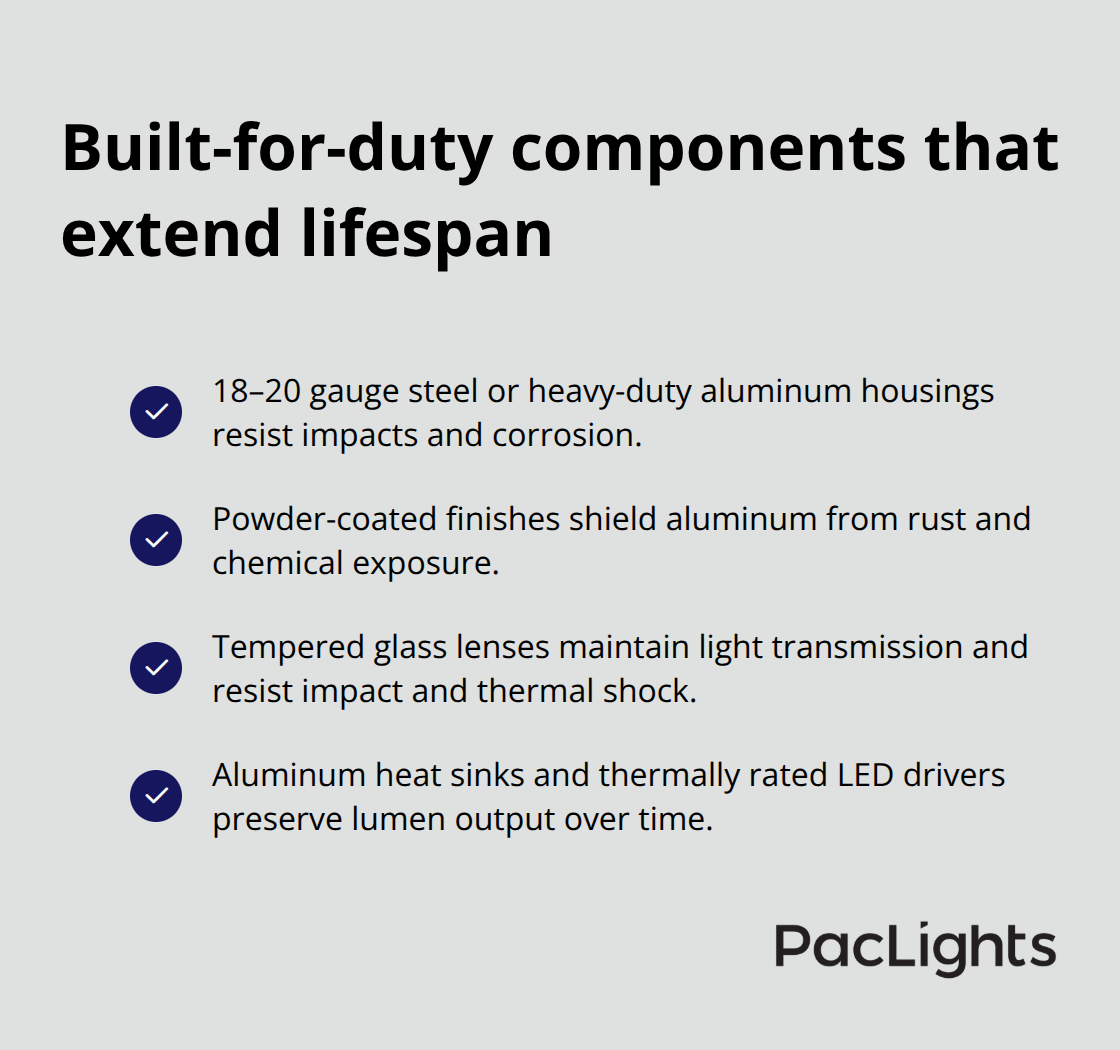
Industrial cylinder fixtures last 50,000+ hours because we build them with 18–20 gauge steel or heavy-duty aluminum housings rated for 10–15 years of continuous operation. This construction far outperforms cheaper fixtures that fail within 2–3 years. Stainless steel variants excel in aggressive washdown environments where standard housings corrode within months. Powder-coated finishes protect aluminum from rust and chemical exposure, while tempered glass lenses maintain light transmission without shattering under impact or thermal stress.
The housing gauge and coating thickness matter more than marketing claims. Demand specific specifications in microns and gauge measurements from your supplier, not vague durability promises. Aluminum heat sinks paired with thermally rated LED drivers preserve lumen output and prevent the premature dimming that plagues poorly designed fixtures.
The Real Cost of Fixture Failure
A single high-bay maintenance visit costs $500–$1,500 due to equipment rental and downtime. Fixtures that eliminate replacement cycles save facilities thousands annually. This financial reality makes material selection a business decision, not just a technical one.
Protection Ratings and Environmental Matching
IP65–IP66 protection ratings handle dust and moisture in typical indoor spaces, but manufacturing floors and washdown areas demand IP69K certification with FKM gaskets and chemical-resistant materials. Fixtures fail catastrophically when their materials aren’t matched to the environment-glycol-resistant enclosures break down under sodium hypochlorite cleaners, and standard gaskets degrade in humid food-processing plants.
For manufacturing floors, specify 4000–5000K color temperature with CRI above 80 to improve visibility and reduce eye strain during long shifts. Thermal management in LED cylinders is non-negotiable; fixtures without proper heat dissipation lose brightness faster and burn out sooner.
Illumination Planning and Installation Flexibility
The Illuminating Engineering Society recommends roughly 30 foot-candles for general industrial work, and cylinder fixtures’ optimized optics deliver this with fewer units and lower wattage than older designs. In a 100-foot by 200-foot warehouse with 30-foot ceilings, roughly 60–80 pendants spaced about 25 feet apart achieve target illumination without dead zones.
Mounting flexibility matters-adjustable suspensions for ceilings above 25 feet and modular drivers minimize installation complexity and future downtime when components need service or replacement. These design choices determine whether your facility runs smoothly or faces constant maintenance interruptions. The next section explores how these durable fixtures also deliver the energy savings that modern facility managers demand.
Design Flexibility and Aesthetic Appeal
Mounting Options That Fit Any Space
Industrial cylinder fixtures eliminate the one-size-fits-all design trap that constrains most facility managers. The cylindrical form factor provides mounting flexibility that rectangular or dome-shaped alternatives cannot match. You can suspend them from high ceilings on adjustable chains, mount them directly to beams, or position them on walls for task-specific lighting without structural modifications. This adaptability reduces retrofit project costs because you avoid redesigning entire ceiling systems to accommodate new fixtures. For spaces with ceiling heights above 25 feet, pendant configurations with adjustable suspensions let you fine-tune light distribution without expensive structural work. Spaces below 20 feet work equally well with flush-mount or short-pendant cylinders that maintain the same durability standards as their larger counterparts.
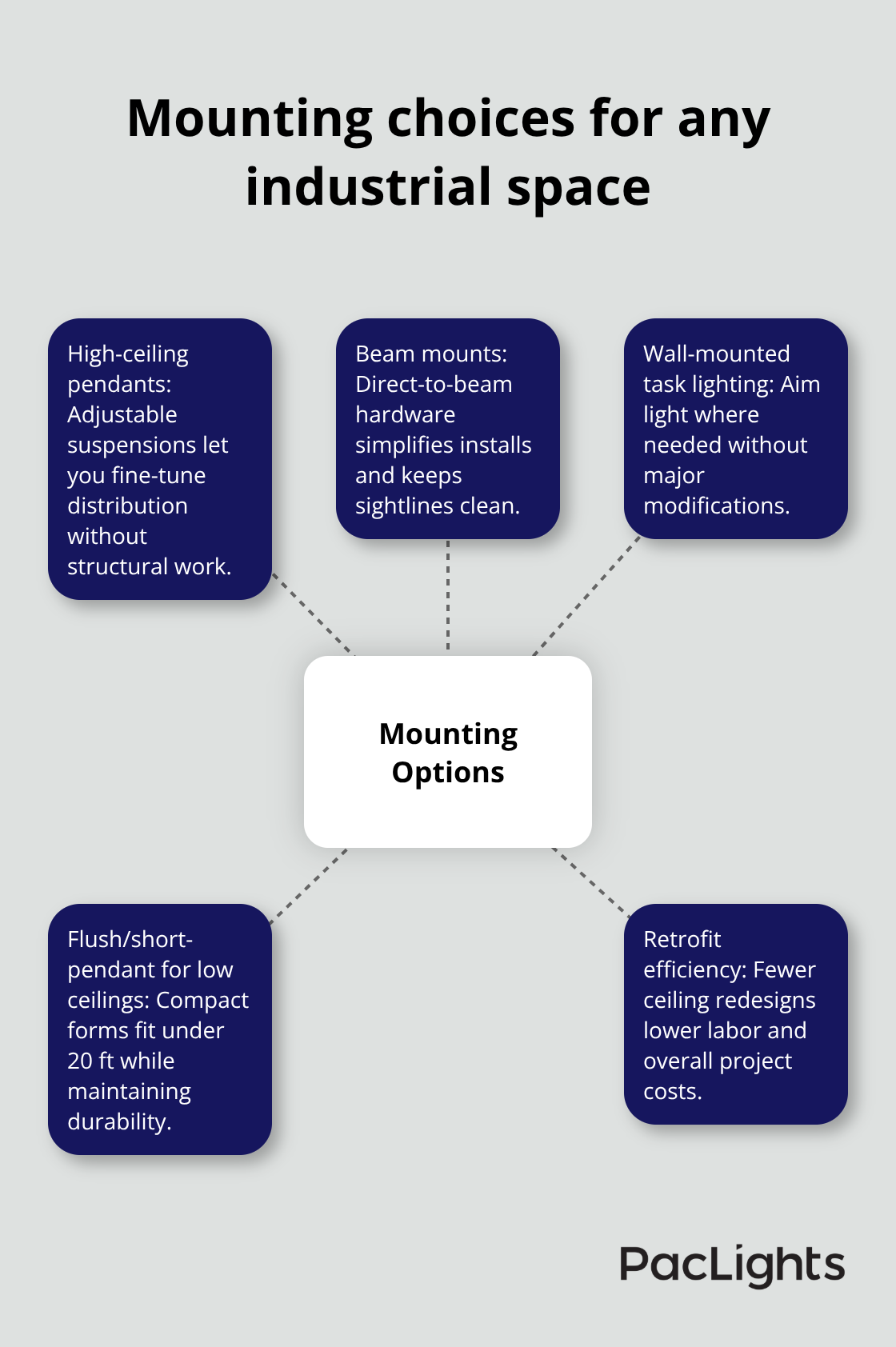
The real advantage emerges when you compare installation timelines and material counts. A 100,000-square-foot warehouse with older HID systems might require 200+ fixtures; switching to high-output LED cylinders often reduces that count to 60–80 units. This reduction directly lowers material costs and labor hours, making the upgrade financially attractive beyond energy savings alone.
Color Temperature and Visual Precision
You can specify 3000K, 4000K, or 5000K color temperatures depending on whether you prioritize warm ambient lighting in office areas or crisp, high-visibility lighting on assembly lines. CRI ratings above 80 ensure accurate color rendering for manufacturing environments where product inspection demands precision, while lower CRI fixtures work fine for storage corridors and non-visual tasks. This flexibility means a single facility type can accommodate multiple lighting strategies without installing incompatible systems.
Material Finishes and Spatial Integration
Powder-coated finishes come in neutral grays, whites, and blacks that blend seamlessly into modern industrial architecture without clashing with exposed beams and ductwork. Stainless steel variants suit food-processing facilities and chemical plants where corrosion resistance doubles as a design statement. The compact cylindrical housing occupies minimal ceiling space, preserving sightlines and making spaces feel less crowded than installations with bulky square or rectangular housings.
Smart Controls and Adaptive Lighting
Integration with networked lighting controls and smart dimming adds another layer of flexibility-you adjust brightness and color temperature by zone or time of day without rewiring. A single facility can operate task-specific lighting during production hours and shift to lower-energy ambient lighting during maintenance windows, all from a central control interface. This capability transforms how facilities balance operational demands with energy management, setting the stage for the substantial cost reductions that modern LED technology delivers.
Energy Efficiency and Cost Savings
The Real Numbers Behind LED Cylinder Upgrades
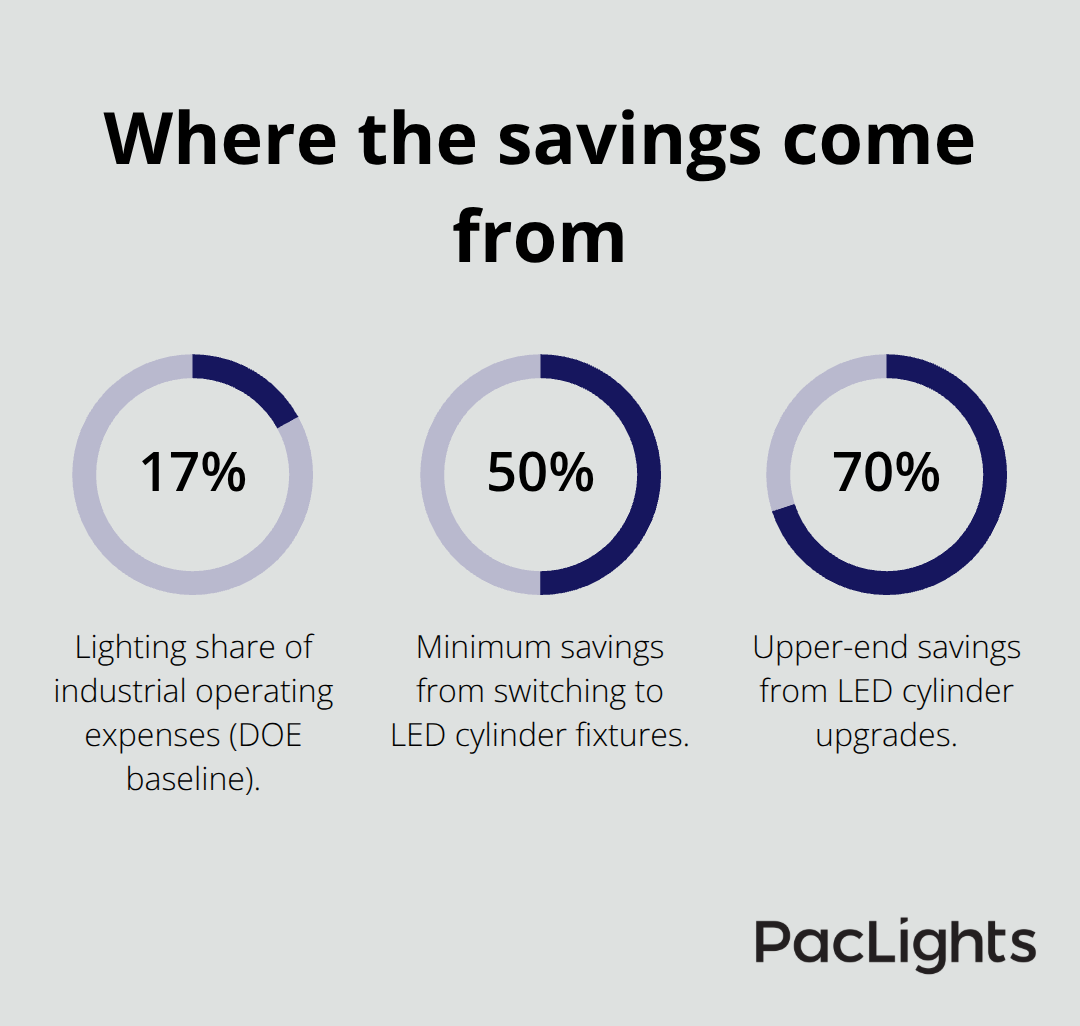
The financial case for upgrading to LED cylinder fixtures rests on three concrete realities: lower energy consumption, reduced maintenance labor, and extended fixture lifespans that eliminate replacement cycles. The U.S. Department of Energy reports that lighting typically accounts for 17–20% of industrial operating expenses, which means a 100,000-square-foot warehouse running older HID or fluorescent systems spends roughly $50,000–$80,000 annually on lighting alone. Switching to LED cylinder fixtures cuts that number by 50–70%, delivering immediate savings that hit the bottom line.
A typical 150W LED cylinder outputs around 15,000 lumens at over 100 lumens per watt, delivering the brightness of a 400W metal halide system while consuming a fraction of the power. For a facility operating 12–16 hours daily, energy savings typically pay back the entire upgrade cost in 2–4 years. Add motion sensors and daylight harvesting controls, and you boost those savings by an additional 20–60%.
Maintenance Costs That Compound Over Time
The maintenance cost advantage matters just as much as energy savings, though facility managers often overlook it. LED cylinders rated for 50,000+ hours eliminate replacement cycles that plague older fixtures, freeing your maintenance team from constant high-bay work and redirecting labor toward production priorities. In high-ceiling spaces, a single replacement visit costs $500–$1,500 due to equipment rental and downtime-costs that multiply when your facility replaces fixtures every 2–3 years.
Over a 5–10 year horizon, this durability advantage compounds into savings of $30,000–$60,000 annually for large facilities. The math becomes unavoidable: fewer fixture failures mean fewer emergency maintenance calls, less equipment rental expense, and more staff hours available for core operations.
Incentives and Environmental Benefits
Utility rebates and incentives frequently offset a portion of upfront capital costs, particularly in regions where energy conservation programs offer significant incentives for LED conversions. The environmental benefit matters too: reducing lighting energy consumption directly lowers your facility’s carbon footprint and positions you favorably against increasingly stringent environmental reporting requirements.
Quantifying Your Specific Savings
Start with a lighting audit to measure your space dimensions, operation hours, and current energy consumption. Suppliers offer free lighting layout designs and ROI assessments that quantify your exact savings based on your facility’s specific hours, local energy rates, and upgrade costs rather than industry averages. This approach transforms vague energy-savings claims into concrete numbers tied to your actual operations.
Final Thoughts
Industrial cylinder light fixtures deliver what most facility managers thought impossible: genuine durability paired with modern design that actually looks intentional in your space. We at PacLights have watched facilities transform their operations by choosing fixtures built to last 50,000+ hours while cutting energy costs by 50–70%. A 100,000-square-foot warehouse spending $50,000–$80,000 annually on older lighting systems recoups the entire upgrade cost in 2–4 years through energy savings alone, and the elimination of $500–$1,500 maintenance visits compounds those gains further.
The design flexibility of cylinder fixtures removes the constraints that plague most facility managers. You mount these fixtures on high ceilings with adjustable suspensions, directly to beams, or on walls without expensive structural modifications, and you specify your color temperature and CRI rating based on whether you need crisp visibility for assembly work or ambient lighting for storage areas. Powder-coated finishes and stainless steel variants integrate seamlessly into modern industrial architecture without clashing with exposed infrastructure.
Start with a lighting audit of your space dimensions and operation hours. We at PacLights offer free lighting layout designs and ROI assessments that quantify your exact savings based on your facility’s specific conditions rather than industry averages, transforming vague energy-savings claims into concrete numbers tied to your actual operations.
Disclaimer: PacLights is not responsible for any actions taken based on the suggestions and information provided in this article, and readers should consult local building and electrical codes for proper guidance.