

Industrial spaces demand lighting that works as hard as your operation. Harsh conditions, constant use, and safety requirements mean you can’t settle for standard fixtures.
At PacLights, we know that industrial cylinder wall lights are built for exactly this challenge. They deliver the durability, efficiency, and coverage your facility needs to stay productive and safe.
Why Industrial Cylinder Wall Lights Matter
Durability That Outlasts Harsh Conditions
Industrial cylinder wall lights stand out because they handle the conditions that break standard fixtures. Die-cast aluminum housings with powder-coated finishes resist corrosion, moisture, and temperature swings that occur in manufacturing floors, outdoor perimeters, and storage yards. In coastal or high-salt environments, upgrading to stainless steel 304 housings costs about 40% more upfront but eliminates the frequent replacements that cut into your operating budget.
LED cylinder fixtures last 25,000 to 50,000 hours, meaning a fixture running 12 hours daily won’t need replacement for 5 to 10 years. Industrial cylinder light fixtures reach their full potential through engineering that withstands punishing conditions, so you stop spending labor hours on maintenance cycles that interrupt production schedules.
Precise Light Distribution Without Waste
Light distribution from cylinder wall lights is precise and controllable in ways that broad fluorescent panels cannot match. Narrow beam angles of 15 to 24 degrees focus light exactly where you need it-on work surfaces, machinery, or entryways-without wasting energy on areas that don’t require illumination.
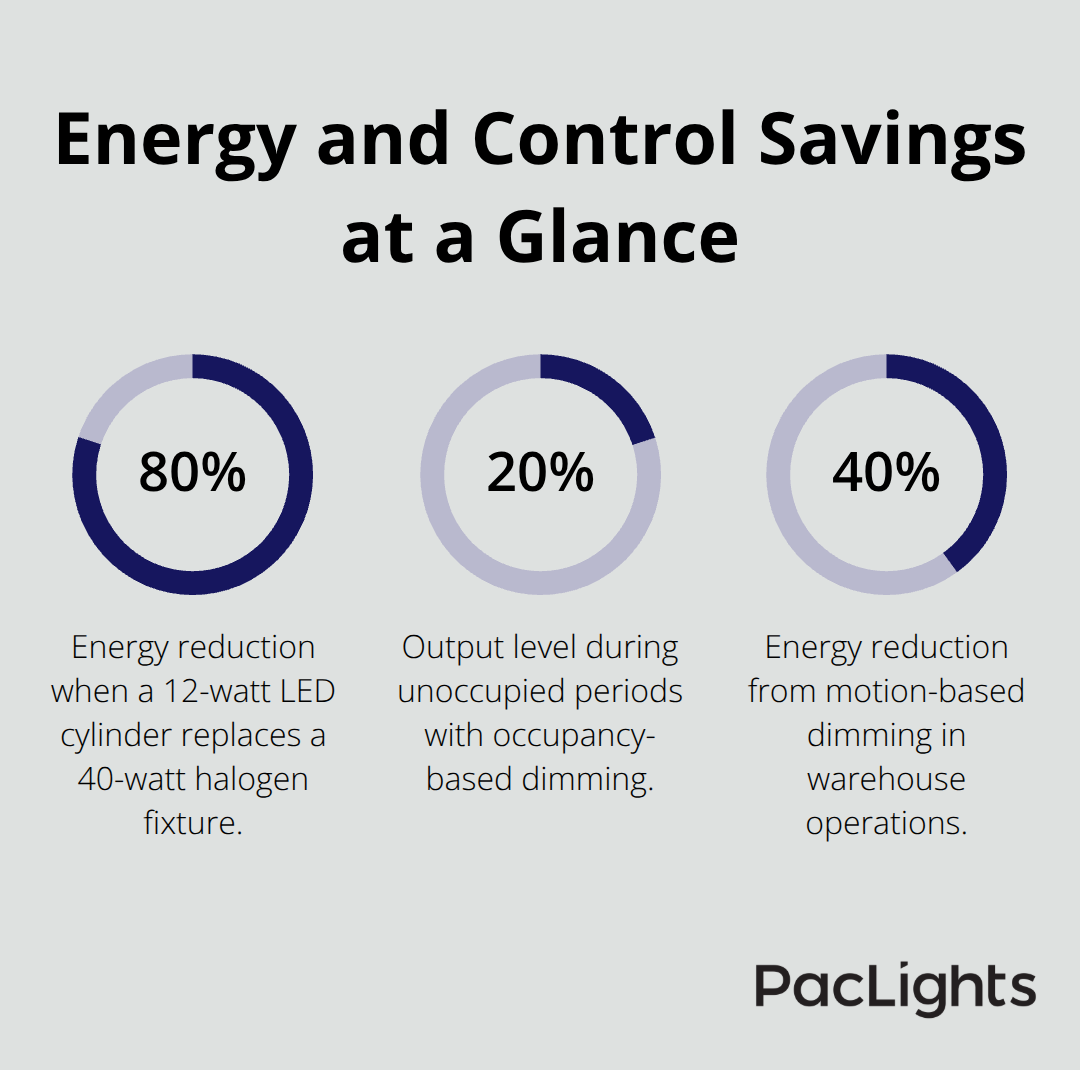
A 12-watt LED cylinder delivers output comparable to a 40-watt halogen fixture, cutting energy consumption by roughly 80 percent. Strategic placement reduces ambient light waste by concentrating illumination where it matters most, and this efficiency matters immediately on your utility bills and compounds over time.
Measurable Savings and Faster Payback
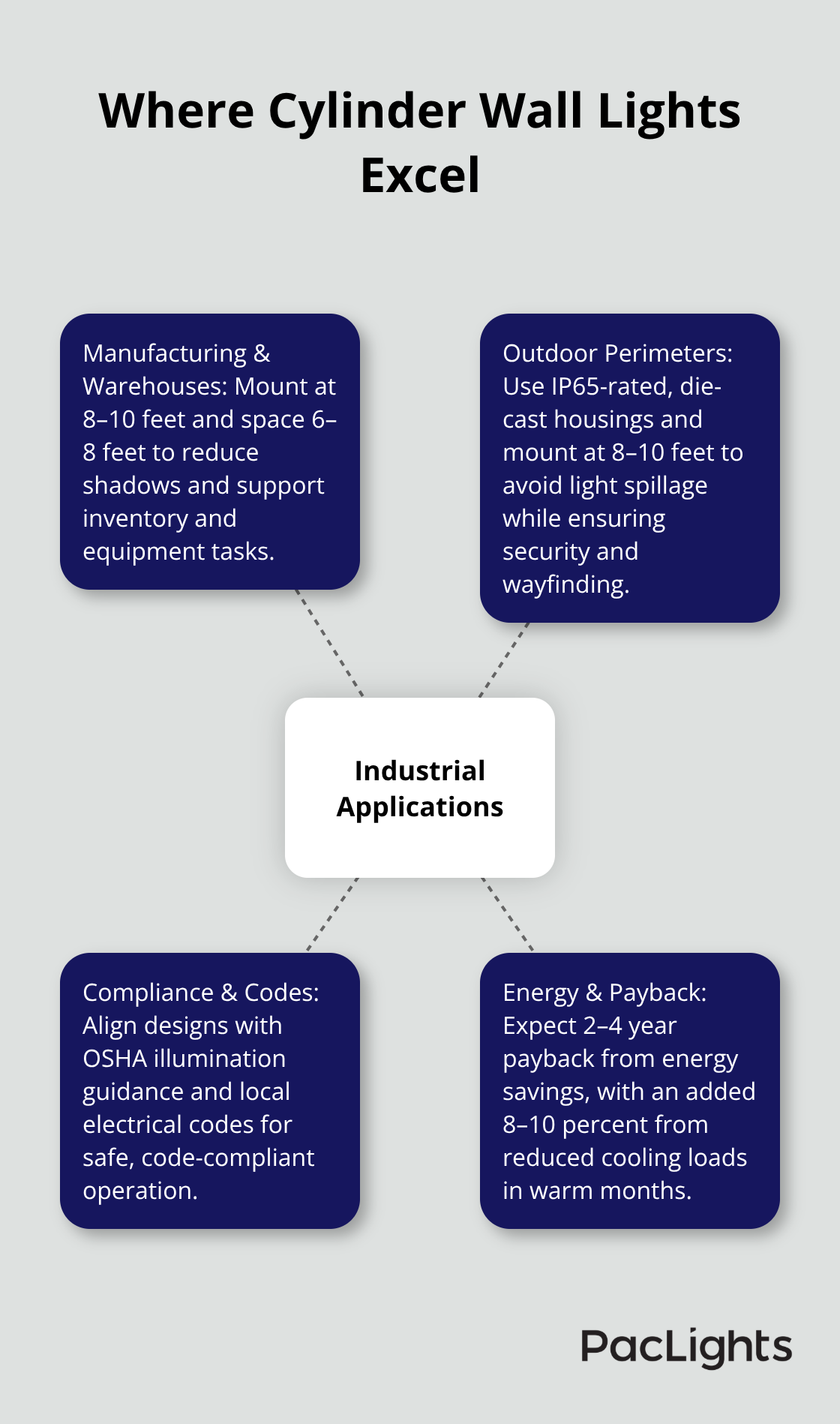
In a 50-fixture installation running 8 hours daily at 12 watts per fixture, you save approximately 1,050 dollars per year on electricity alone (based on average commercial rates of 0.14 dollars per kilowatt-hour). Reduced cooling loads from lower heat output mean your HVAC system works less hard during warm months, adding another 8 to 10 percent to your savings.
The payback period typically falls within 2 to 4 years from energy savings alone, after which ongoing operation costs drop significantly. Occupancy-based dimming and intelligent controls push savings even further, reducing output to 20 percent during unoccupied periods and delivering total reductions of 40 to 60 percent versus fixed-output systems.
These performance gains set the stage for selecting fixtures that match your specific facility needs and environmental demands.
Key Features and Specifications to Consider
Material Construction for Long-Term Durability
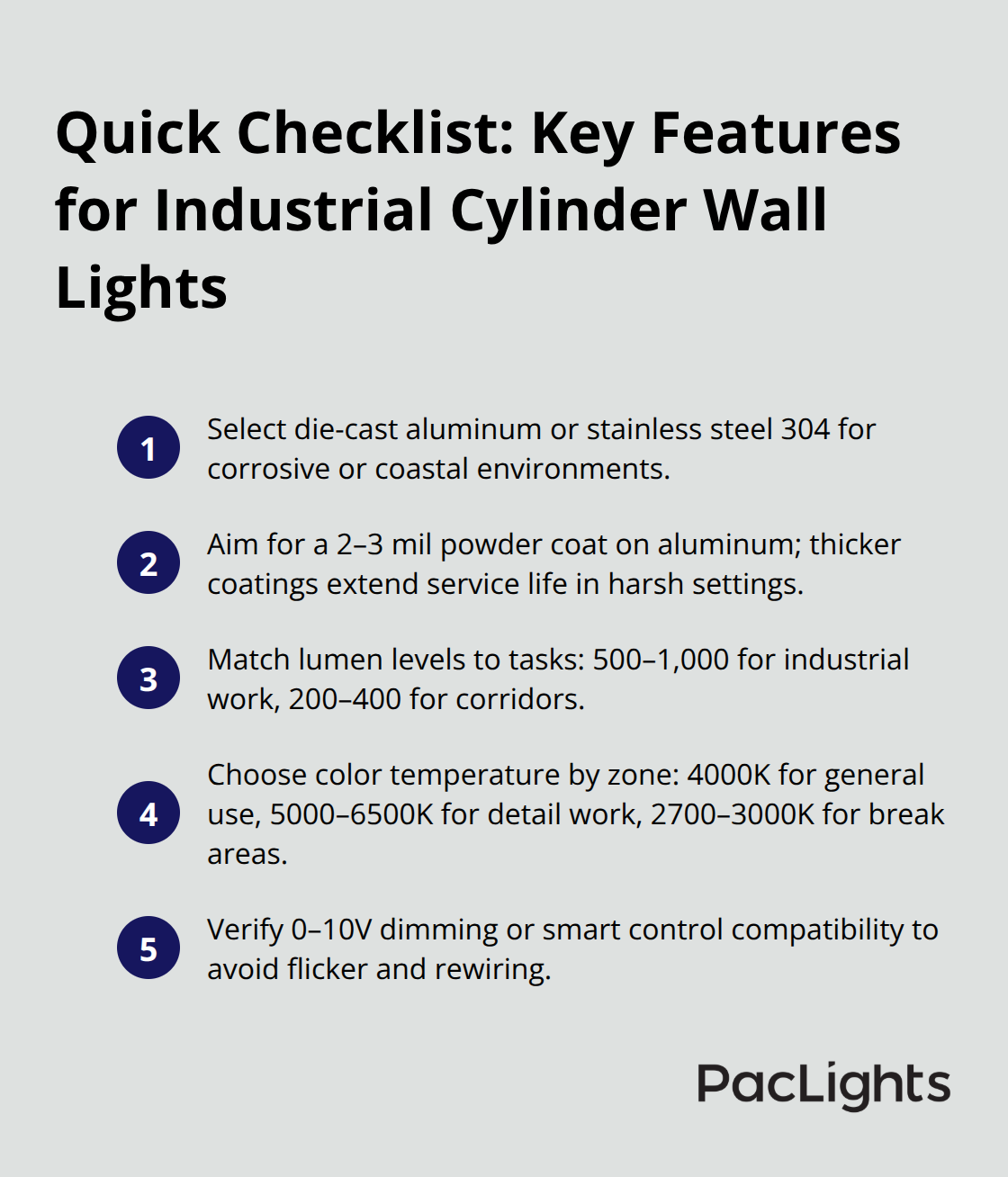
Material choice determines whether your fixtures survive five years or fifteen. Die-cast aluminum with powder-coated finishes handles standard industrial conditions, but coastal and high-salt environments demand stainless steel 304 housings to prevent corrosion that accelerates fixture failure. The coating thickness matters more than most operators realize-a 2 to 3 mil powder coat on aluminum provides baseline protection, while thicker applications extend service life significantly in aggressive environments.
For indoor spaces with moisture exposure like covered loading docks, standard painted steel suffices, but outdoor or corrosive settings require corrosion-resistant materials to avoid premature failures that interrupt operations. Tempered or impact-resistant glass diffusers work for most applications, but UV-stabilized acrylic prevents yellowing in direct sunlight and maintains clarity over decades. Aluminum housings function as heat sinks, and effective thermal management through design fins or larger surface areas dissipates heat from LED drivers and modules to preserve the 50,000-hour lifespan that justifies the initial investment.
Lumen Output and Color Temperature Selection
Lumen output and color temperature must align with your specific tasks rather than follow generic standards. Warehouses and manufacturing floors typically need 500 to 1,000 lumens depending on task complexity and ceiling height, while commercial corridors require 200 to 400 lumens per fixture with 6 to 8 feet spacing to prevent hotspots and dark zones.
Color temperature directly impacts productivity-4000K serves most industrial facilities as a practical neutral standard, but 5000K to 6500K improves focus and safety for analytical work and quality inspection stations, while 2700K to 3000K suits break areas and hospitality zones. Your choice of color temperature shapes how workers perceive their environment and influences how efficiently they complete tasks.
Mounting Height and Beam Spread Control
Mounting height affects both performance and safety; ambient lighting typically sits at 60 to 72 inches from the floor, while task lighting at 48 to 54 inches delivers focused illumination on machinery or work surfaces. Surface-mounted cylinders that tilt up to 50 degrees enable targeted task lighting without reworking mounting infrastructure, and beam spread choices directly control coverage-narrow 6-inch beams suit tight spaces, while 8-inch medium beams cover larger areas with balanced illumination.
Dimming and Control System Integration
Dimming compatibility matters during installation; verify that your LED driver supports 0–10V dimming or smart controls to avoid flicker or reduced fixture lifespan, and confirm compatibility with existing networked controls to prevent costly rewiring. When you select fixtures with flexible control options, you gain the ability to adjust light output based on occupancy, time of day, or specific operational needs.
These specifications form the foundation for selecting fixtures that perform reliably in your facility. The next step involves understanding how different industrial environments demand different approaches to lighting design and placement.
Real-World Applications for Industrial Cylinder Wall Lights
Manufacturing Floors and Warehouses
Manufacturing floors and warehouses operate on tight margins where every operational disruption costs money. Cylinder wall lights mounted at 8 to 10 feet on structural pillars and perimeter walls create layered illumination that handles the specific demands of these spaces. In a typical warehouse, spacing fixtures 6 to 8 feet apart prevents hotspots that create shadows on merchandise or machinery, while 500 to 1,000 lumens per fixture supplies adequate brightness for inventory management and equipment operation.
The 4000K color temperature standard for industrial facilities provides neutral, fatigue-reducing light that keeps workers alert during long shifts. When you install dimmable drivers with occupancy sensors in warehouses that operate 16 to 20 hours daily, the 40 percent energy reduction from motion-based dimming translates directly to lower utility costs. A 50-fixture warehouse installation using 12-watt LED cylinders with motion controls can save approximately 1,400 to 1,600 dollars annually compared to fixed-output systems, and that calculation excludes the additional 8 to 10 percent savings from reduced cooling load.
Outdoor Industrial Perimeters
Outdoor industrial perimeters demand IP65-rated fixtures with die-cast aluminum housings and powder-coated finishes that withstand exposure to salt spray, temperature swings, and moisture. Mounting cylinders at 8 to 10 feet on exterior walls prevents light spillage into upper-floor windows while delivering adequate ground illumination for security and wayfinding. Coastal facilities should specify stainless steel 304 housings to avoid the corrosion that forces replacements every 3 to 5 years instead of the standard 8 to 10 year service intervals.
Compliance and Code Requirements
Local electrical codes and safety standards determine final specifications, and compliance is non-negotiable. OSHA guidelines require adequate illumination for hazard identification and safe equipment operation, typically 50 to 100 lumens per linear foot in corridors and 200 to 400 lumens in work zones. PacLights provides free lighting layout designs and ROI assessments that verify your installation meets code requirements while optimizing fixture placement for your specific facility footprint and operational schedule.
Final Thoughts
Industrial cylinder wall lights transform facility operations by cutting energy costs by 80 percent while eliminating maintenance cycles that interrupt production. A 50-fixture installation saves approximately 1,050 dollars annually on electricity alone, with payback periods typically falling within 2 to 4 years, and occupancy sensors push total energy reductions to 40 to 60 percent. Material construction, lumen output, mounting height, and control system integration determine whether fixtures perform reliably for a decade or require costly replacements within years.
We at PacLights understand that industrial facilities operate under pressure to reduce costs without sacrificing safety or productivity. Our team provides free lighting layout designs and ROI assessments that verify your installation meets code requirements while optimizing fixture placement for your specific operational schedule. Contact us to discuss how industrial cylinder wall lights can transform your facility’s performance and bottom line.
Disclaimer: PacLights is not responsible for any actions taken based on the suggestions and information provided in this article, and readers should consult local building and electrical codes for proper guidance.