

Datacenters operate around the clock, but most lighting systems waste energy during unmanned hours. At PacLights, we’ve seen facilities cut energy consumption by 30–40% simply by switching to automated lighting controls that respond to actual occupancy rather than running on fixed schedules.
This guide walks you through how motion sensors, daylight harvesting, and smart scheduling work together to reduce costs while maintaining the reliability your infrastructure demands.
How Occupancy Sensors and Networked Controls Cut Datacenter Lighting Costs
Motion Sensors Eliminate Wasted Hours
Motion sensors and occupancy detection form the backbone of any serious energy-reduction strategy in unmanned datacenters. Unlike fixed schedules that keep lights running during empty hours, PIR sensors and infrared detectors activate lighting only when technicians enter a zone, eliminating waste immediately. A Malaysian facility deployed 300 motion-sensor luminaires and cut monthly on-site visits by 80%, which means lights that once ran continuously now operate only during maintenance windows. The energy savings stack up fast: facilities typically see 30–40% reductions in lighting load within the first year, translating directly to lower electricity bills and reduced cooling demand since LED fixtures emit far less heat than traditional systems.
Daylight Harvesting Amplifies Your Savings
Pairing motion detection with daylight harvesting amplifies energy reductions further. Ambient light sensors automatically dim or shut off artificial lights when natural daylight provides sufficient illumination. This matters even in datacenters with limited windows or skylights because storage areas and back rooms often receive enough ambient light to reduce fixture runtime substantially. The combination of occupancy and daylight controls creates a layered approach that captures savings from multiple sources simultaneously.
Building Management System Integration Unlocks Real-Time Control
Integrating automated lighting into your building management system creates a unified control layer that eliminates manual adjustments and enables real-time visibility across all zones. When lighting connects to your BMS via DALI, Modbus, or BACnet protocols, facility managers gain instant dashboards showing energy consumption per zone, occupancy patterns, and fixture health alerts. This data reveals exactly where energy waste occurs and where maintenance problems develop before they cause outages. Remote monitoring platforms calculate live PUE metrics that isolate lighting’s contribution to overall facility inefficiency, making it easy to justify upgrades to leadership and track ROI quarterly.
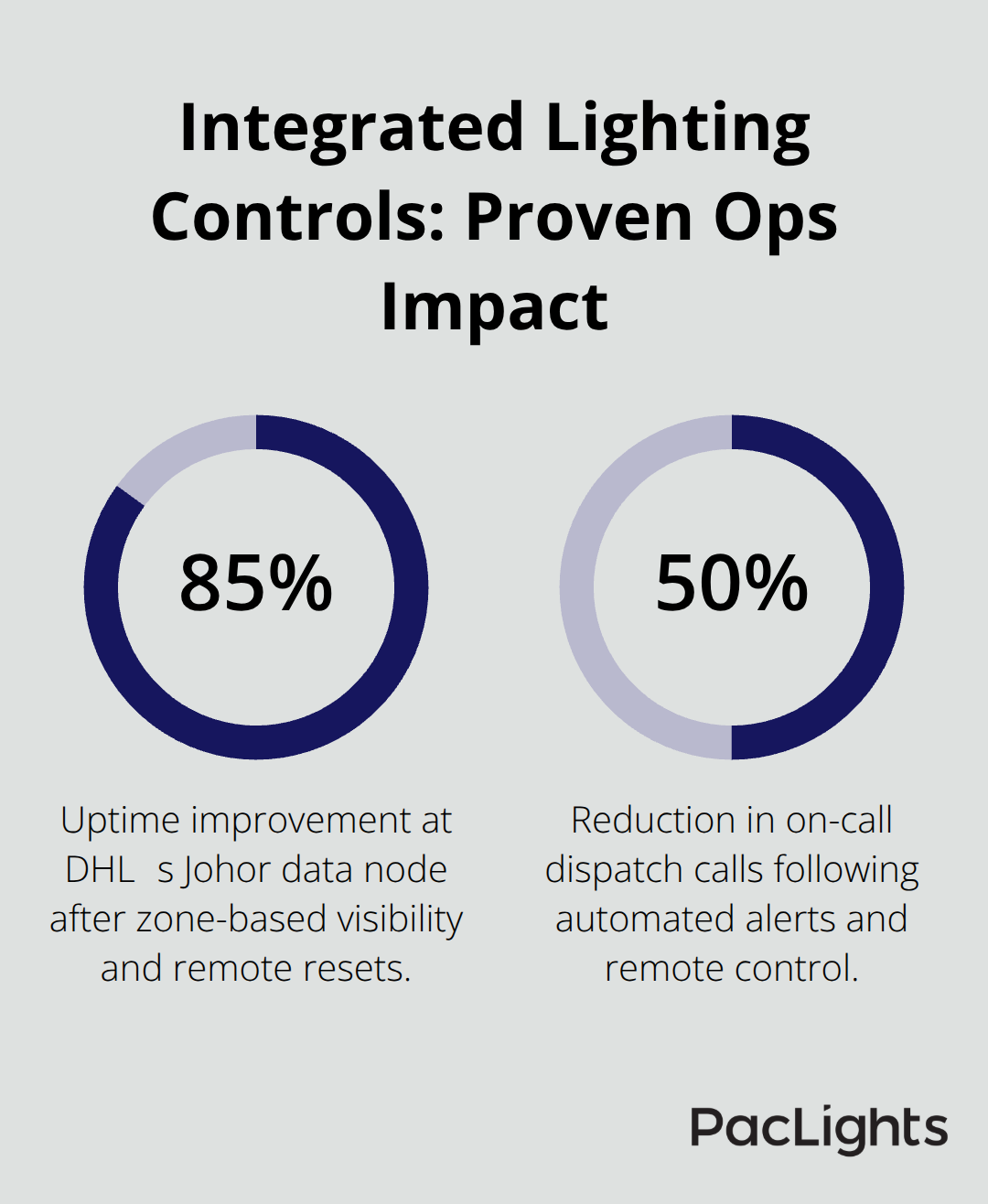
The real advantage emerges in unmanned operations: centralized alerts flag burnt-out fixtures or sensor failures automatically, reducing the time between detection and repair from days to hours. DHL’s data node in Johor achieved 85% uptime improvement and cut on-call dispatch by 50% after implementing zone-based visibility and remote resets through integrated lighting controls.
Labor Reduction Drives Faster Payback Than Energy Alone
Most datacenter operators underestimate ROI because they focus only on energy savings and ignore labor reduction. A typical retrofit replaces fluorescent fixtures with LED units and drops per-fixture power consumption from 200W to 50W. When you multiply that across hundreds or thousands of fixtures, the annual electricity savings alone cover equipment costs within 14 months at standard utility rates. LED datacenter solutions achieved approximately 62% year-over-year energy savings and recovered the full investment in under 14 months through electricity reductions alone.
Add labor benefits: unmanned facilities with automated lighting controls eliminate routine check visits to confirm lights are off, reduce emergency dispatch calls when occupancy-based systems prevent dark zones, and lower maintenance exposure risk during power reroutes because technicians spend less time in the facility overall. Per-outlet power monitoring via intelligent PDUs reveals the exact consumption of each lighting circuit, allowing you to shut down redundant fixtures and validate that sensors function correctly, preventing situations where lights stay on despite zero occupancy.
Phased Rollouts Reduce Financial Risk
For retrofit projects, phase installations zone by zone rather than all at once. This approach spreads costs across quarters, maintains operations uninterrupted, and allows you to measure results from early zones before committing the full budget. Early wins from pilot zones provide concrete data that justifies expansion to remaining areas, making it far easier to secure additional funding and build internal support for the full deployment.
Technologies That Power Unmanned Datacenter Operations
Motion and Ambient Sensors Create Redundant Detection
Unmanned datacenters demand lighting systems that operate independently without human intervention. Motion sensors alone cut energy consumption, but the real efficiency gains emerge when you combine multiple detection methods with networked controls that talk to your building management system. PIR sensors and infrared detectors activate lighting only when technicians enter a zone, while ambient light sensors automatically reduce fixture brightness when natural light enters through windows or skylights. This redundancy matters: if one detection method fails, others still prevent dark zones or unnecessary runtime. A Malaysian facility deployed 300 motion-sensor luminaires across zones and reduced monthly site visits by 80% while maintaining full visibility into lighting status and energy use through centralized dashboards. Daylight harvesting adds another layer by automatically adjusting fixture output even in storage areas where you might not expect meaningful daylight contribution. When integrated with networked controls, these sensors feed real-time data back to your BMS, eliminating the need for technicians to manually verify that lights function correctly or consume appropriate power levels.
Networked Controls Coordinate Facility-Wide Responses
Networked lighting controls transform isolated fixtures into a coordinated system that responds to facility-wide patterns rather than individual zones. DALI, Modbus, and BACnet protocols allow your lighting network to communicate directly with building management systems, creating unified dashboards that show energy consumption per zone, occupancy patterns, and maintenance alerts without requiring separate monitoring platforms. Smart scheduling layers time-based rules on top of sensor data-for example, reducing fixture brightness during predicted low-occupancy periods or automatically shutting down backup lighting in rarely accessed zones. This integration eliminates manual adjustments and creates a single source of truth for lighting performance across your entire facility.
Remote Management Reduces Response Time and Labor
Remote monitoring and management capabilities eliminate the need for on-site staff to reset sensors, replace burnt-out fixtures, or investigate why a zone remains dark. Centralized alerts notify facility managers instantly when issues occur, reducing response time from days to hours. DHL’s Johor data node achieved a 50% reduction in on-call dispatch calls after implementing zone-based remote control and automated alerts, proving that visibility into lighting status directly translates to faster maintenance and lower labor costs. Per-outlet power monitoring via intelligent PDUs reveals exact consumption of each lighting circuit, allowing you to validate that motion sensors actually function correctly and shut down redundant fixtures that consume power without providing value. This granular data also supports predictive maintenance by identifying patterns that precede fixture failure, enabling proactive replacement before outages occur rather than reactive emergency repairs that disrupt operations.
Choosing the Right Control Protocol for Your Infrastructure
Your choice of control protocol shapes how easily lighting integrates with existing systems and scales across multiple zones. DALI offers standardized communication with strong emergency support but has bus topology limitations in very large facilities. Modbus and BACnet provide broader interoperability with most building management systems and support larger networks without additional infrastructure. PoE (Power over Ethernet) delivers power and data through a single cable, simplifying installation in new builds, but introduces switch dependency and IP conflict risks that require careful network planning. Wireless protocols like Zigbee and Mesh suit edge sites with no additional cabling but can suffer signal interference in high electromagnetic environments common near server equipment. Protocol flexibility allows you to retrofit existing infrastructure with minimal rewiring-many modern fixtures support multiple protocols simultaneously, letting you adapt to your facility’s specific constraints rather than forcing a complete system replacement.
The combination of occupancy detection, daylight harvesting, networked controls, and remote management creates a foundation for truly autonomous lighting operations. With these technologies in place, your facility maintains full visibility and control without requiring constant human oversight, setting the stage for integrating lighting data with broader facility automation systems that optimize power, cooling, and occupancy across your entire infrastructure.

Putting Automated Controls Into Your Datacenter
Assess Your Current Lighting Infrastructure First
Start with a realistic assessment of your current lighting infrastructure before investing in upgrades. Walk through your facility during both occupied and unoccupied hours, documenting which zones stay lit around the clock and which experience variable occupancy. Use a simple spreadsheet to record fixture types, wattage per unit, total count per zone, and current control method-manual switches, timers, or nothing at all.

Many datacenters discover they run 40% of lighting in zones that see technicians only once weekly, instantly revealing where sensor-based controls deliver the fastest payback. Count your fixtures honestly: a 50,000-square-foot facility typically runs 150–300 luminaires, and replacing each 200W fluorescent unit with a 50W LED cuts per-fixture power consumption by 75%, but only if you actually know how many fixtures exist. Measure ambient light levels in storage areas and back rooms using a smartphone light meter app during daylight hours-if you find 300–500 lux from natural light, daylight harvesting becomes viable and reduces fixture runtime significantly.
This assessment takes a few hours but prevents costly mistakes like oversizing motion sensor networks in low-occupancy zones or installing daylight harvesting where windows don’t actually contribute meaningful light.
Choose Retrofit Over New Builds for Existing Facilities
Retrofit projects almost always outperform new builds for existing datacenters because they preserve current electrical infrastructure while upgrading to modern controls. Replacing fluorescent fixtures with LED units and adding motion sensors to existing conduit and wiring costs 40–60% less than redesigning the entire electrical system for a new facility.
Start with your highest-occupancy zones-server rooms, cable vaults, and maintenance corridors where technicians spend the most time-because these areas deliver the fastest ROI and provide proof points for expanding to secondary zones. Phase the retrofit across three to six months rather than attempting a facility-wide changeover in weeks, which minimizes operational disruption and allows you to validate that sensors perform correctly before scaling up.
Select Fixtures That Support Multiple Control Protocols
Select fixtures that support multiple control protocols simultaneously because this flexibility lets you integrate with your existing building management system without forcing a complete platform replacement. Protocol choice matters: DALI works well for smaller facilities under 200 fixtures, while Modbus and BACnet scale across larger networks without additional infrastructure investment.
Wireless control systems suit edge datacenters where running new control cabling isn’t practical, though electromagnetic interference from server equipment can degrade signal reliability in densely packed aisles. Test your chosen protocol in a single zone before committing the full budget-a two-week pilot reveals integration issues, sensor performance in your specific electromagnetic environment, and whether your BMS actually communicates correctly with lighting controls before you’ve invested in hundreds of fixtures.
Plan for Scalability and Future Expansion
Plan for scalability from day one by selecting fixtures and controls that support future expansion to unmanned operations or additional facilities. Modern LED fixtures with built-in sensor capabilities and networked controls adapt to growing facility footprints without requiring complete system replacement, whereas older fixed-schedule systems force rip-and-replace upgrades when your operational model changes.
Document your current electrical capacity and future expansion plans because adding intelligent PDU power monitoring and remote management capabilities consumes bandwidth and processing power that your current infrastructure might not support. PacLights offers free lighting layout designs and ROI assessments that identify which zones deliver fastest payback and recommend fixture types matched to your specific occupancy patterns and expansion timeline, eliminating guesswork from the retrofit planning process.
Final Thoughts
Automated lighting controls transform unmanned datacenters from energy-intensive facilities into optimized operations that run efficiently without constant human oversight. Motion sensors, daylight harvesting, networked controls, and remote management eliminate the waste inherent in fixed-schedule systems while simultaneously reducing labor costs and maintenance response times. Facilities that implement these technologies report 30–40% reductions in lighting energy consumption within the first year, with additional savings from lower cooling demand since LED fixtures emit significantly less heat than traditional systems.
Real-time visibility into lighting performance through integrated building management systems enables predictive maintenance that catches fixture failures before they cause outages, reducing emergency dispatch calls by 50% or more. Per-outlet power monitoring reveals exactly which circuits consume power and which sensors function correctly, preventing situations where lights stay on despite zero occupancy. Phased retrofit approaches spread costs across quarters while providing early proof points that justify expansion to remaining zones, making it easier to secure funding and build internal support for facility-wide deployment.
Start by assessing your current lighting infrastructure and identifying zones where motion sensors deliver fastest payback. We at PacLights provide free lighting layout designs and ROI assessments that eliminate guesswork from retrofit planning and recommend fixture types matched to your specific occupancy patterns. Phase your retrofit across three to six months, validate that sensors perform correctly in your electromagnetic environment, and scale gradually as early wins demonstrate measurable returns.
Disclaimer: PacLights is not responsible for any actions taken based on the suggestions and information provided in this article, and readers should consult local building and electrical codes for proper guidance.