

Commercial facilities waste thousands of dollars annually on outdated lighting systems. A reliable surface mount downlight solution cuts energy consumption while delivering superior light quality across your entire space.
At PacLights, we’ve seen firsthand how the right downlights transform both operational costs and workplace performance. This guide walks you through everything you need to know to make the upgrade.
How Surface Mount Downlights Cut Operating Costs and Boost Productivity
Energy Savings That Show Up on Your Utility Bills
LED surface mount downlights consume 70 to 80 percent less energy than incandescent or fluorescent fixtures. A 50-watt incandescent downlight costs roughly $6 annually to operate, while a 10-watt LED equivalent runs at just $1.20 per year. Most facilities report monthly energy reductions between 15 and 25 percent after switching to surface mount LEDs. These aren’t theoretical numbers-they reflect real utility bills.
The payback period typically spans 2 to 4 years, and afterward, the savings compound year after year. Installation itself costs 30 to 40 percent less than recessed alternatives because surface mount fixtures attach directly to the ceiling without cavity preparation or structural modifications. A typical 10,000-square-foot retrofit completes in just 2 to 3 days, minimizing operational disruption.
Maintenance Costs Drop Dramatically
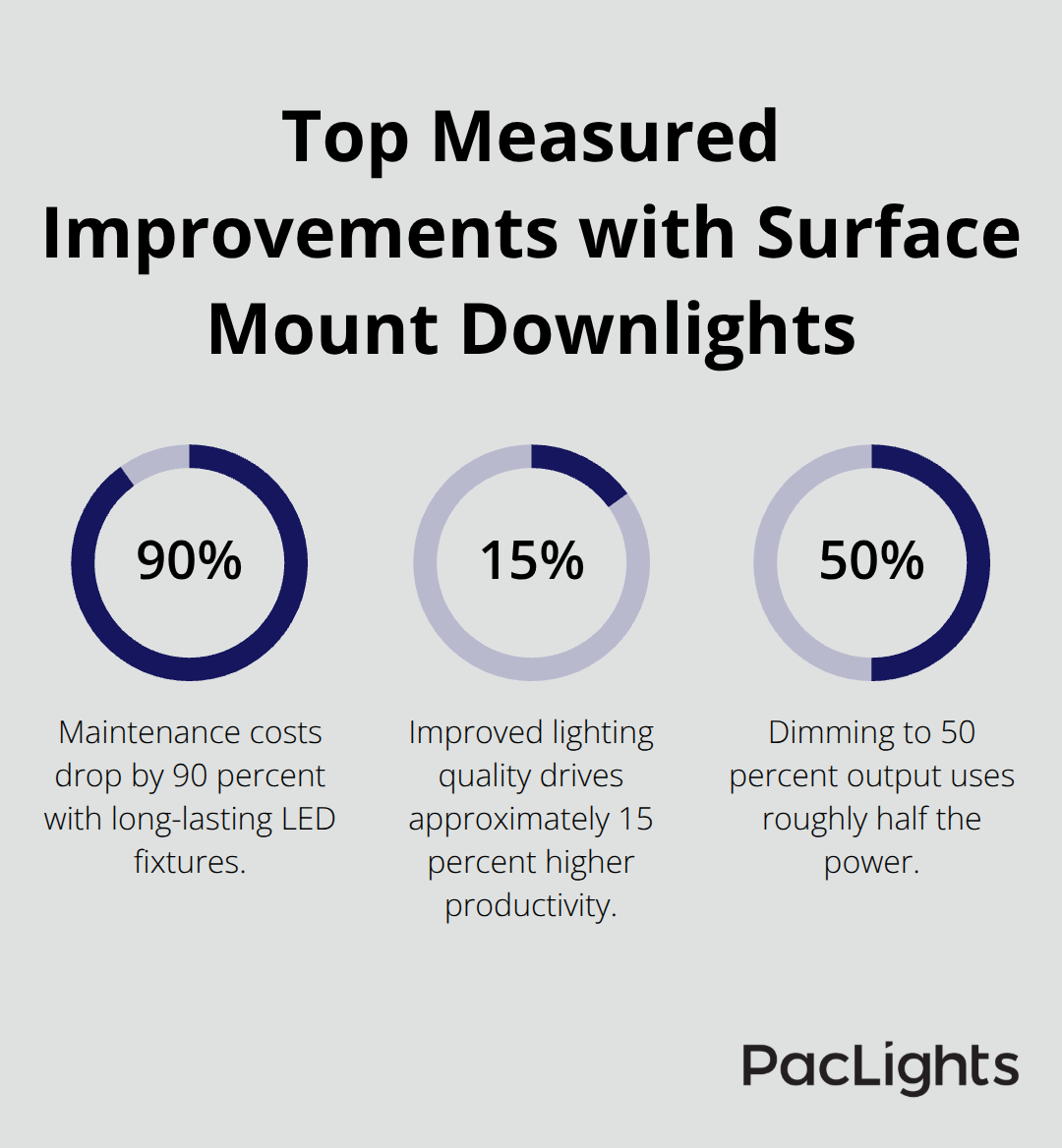
Labor and material expenses plummet because LED fixtures last 25,000 to 50,000 hours compared to 1,000 hours for incandescent bulbs. A facility managing 100 downlights can reduce maintenance costs to under $200 annually-a 90 percent reduction. This dramatic shift frees up maintenance staff to focus on other facility priorities rather than constant bulb replacements.
Light Quality Drives Measurable Productivity Gains
Light quality matters far more than most facility managers realize. The U.S. General Services Administration reports that spaces with improved lighting quality see approximately 15 percent higher productivity. Surface mount downlights deliver high color rendering index (CRI) above 90, which means colors appear accurate and defects become visible instantly in manufacturing and retail environments.
Color temperature selection directly influences performance. Cool white (4,000K to 5,000K) improves task accuracy by 5 to 15 percent in warehouses and manufacturing spaces, while 3,500K offers a balance between productivity and comfort in offices. Occupancy sensing and dimming capabilities amplify these benefits-they reduce unnecessary energy use in intermittently occupied spaces by 30 to 50 percent. A 100,000-square-foot building with occupancy-controlled lighting cuts annual energy costs by 20 to 30 percent, according to Lawrence Berkeley National Laboratory.
Thermal Management Protects Your Investment
Thermal management ensures these fixtures maintain consistent output and color stability over their entire lifespan. Poor thermal design shortens brightness and color accuracy, so selecting fixtures with proven heat sinks and high-conductivity materials prevents premature dimming. Robust thermal engineering (including effective ventilation in enclosed ceilings) guarantees reliable performance across extended operating cycles.
The right surface mount solution combines energy efficiency with superior light quality and durability. Understanding which features matter most for your specific facility type helps you select fixtures that deliver both immediate cost reductions and long-term operational reliability.
What Features Actually Matter in Commercial Downlights
Dimming and Control Capabilities Transform Energy Use
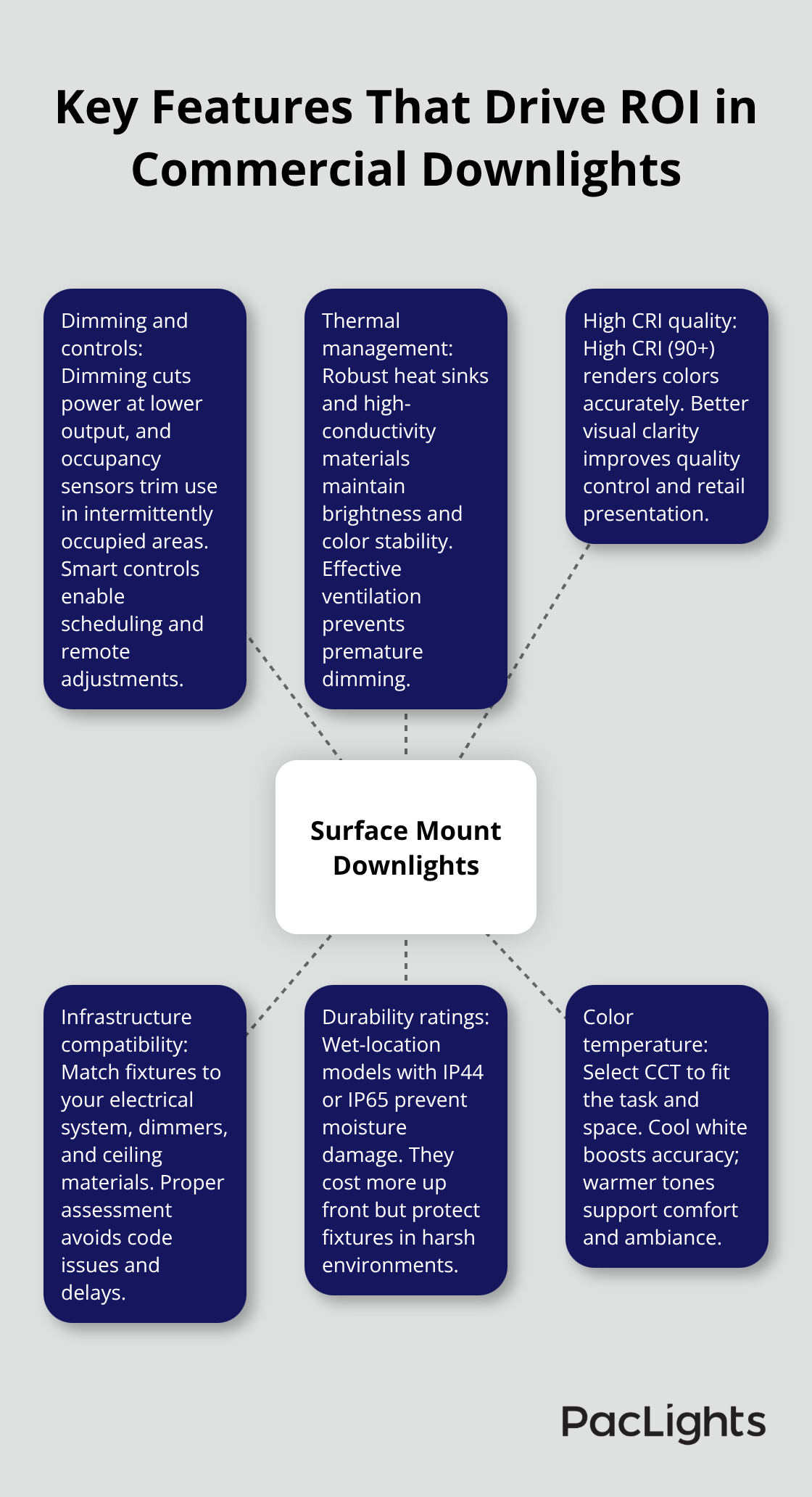
Dimming and control capabilities stand out immediately because they reshape how facilities consume energy. A downlight that dims to 50 percent output uses roughly half the power, and when paired with occupancy sensors, it cuts energy consumption in intermittently occupied spaces by 30 to 50 percent. Dimming also extends LED lifespan by lowering operating temperatures, meaning your fixtures last even longer than their rated 25,000 to 50,000 hours. Smart controls add 15 to 25 percent upfront cost, but they enable centralized scheduling and remote adjustments across your entire facility without manual intervention.
Motion sensors in hallways, storage areas, and bathrooms eliminate waste from lights left running in empty spaces. The real advantage emerges when you integrate dimming with daylight harvesting-sensors detect natural light and reduce fixture output automatically, cutting energy use further without sacrificing visibility.
Thermal Management Maintains Consistent Performance
Thermal management separates fixtures that maintain consistent output from those that dim prematurely and shift color over time. Poor heat dissipation causes LEDs to lose brightness and color accuracy, shortening the practical lifespan well before the rated hours expire. Select fixtures with robust heat sinks, high-conductivity materials, and proven thermal engineering. Enclosed or poorly ventilated ceilings trap heat, so verify that your chosen downlight includes effective thermal design for your specific installation environment.
Durability also depends on protective ratings for your space. Wet-location variants with IP44 or IP65 ratings cost 20 to 40 percent more than standard models but prevent moisture damage in parking garages, canopy areas, and humid environments like kitchens or laundry rooms.
Infrastructure Compatibility Prevents Installation Delays
Compatibility with existing infrastructure matters equally. Before upgrading, assess whether your current electrical system supports new fixtures, whether dimmer compatibility requires adjustments, and whether your ceiling material (drywall, concrete, or metal) allows straightforward surface mounting. A qualified electrician can identify any wiring upgrades needed and confirm compliance with local building codes.
Surface mount fixtures attach directly without cavity preparation, so integration typically proves simpler than recessed alternatives. When planning your upgrade, measure ceiling height and material first, then calculate required lumen output for your space dimensions. This practical groundwork prevents costly mistakes and ensures your new downlights deliver the efficiency and light quality you expect.
With the right features in place, your facility gains both immediate operational savings and long-term reliability. The next step involves matching these capabilities to your specific space type-each environment presents unique lighting demands that shape which features deliver the greatest return.
Applications of Surface Mount Downlights Across Industries
Retail Spaces Require Precision Lighting for Product Accuracy
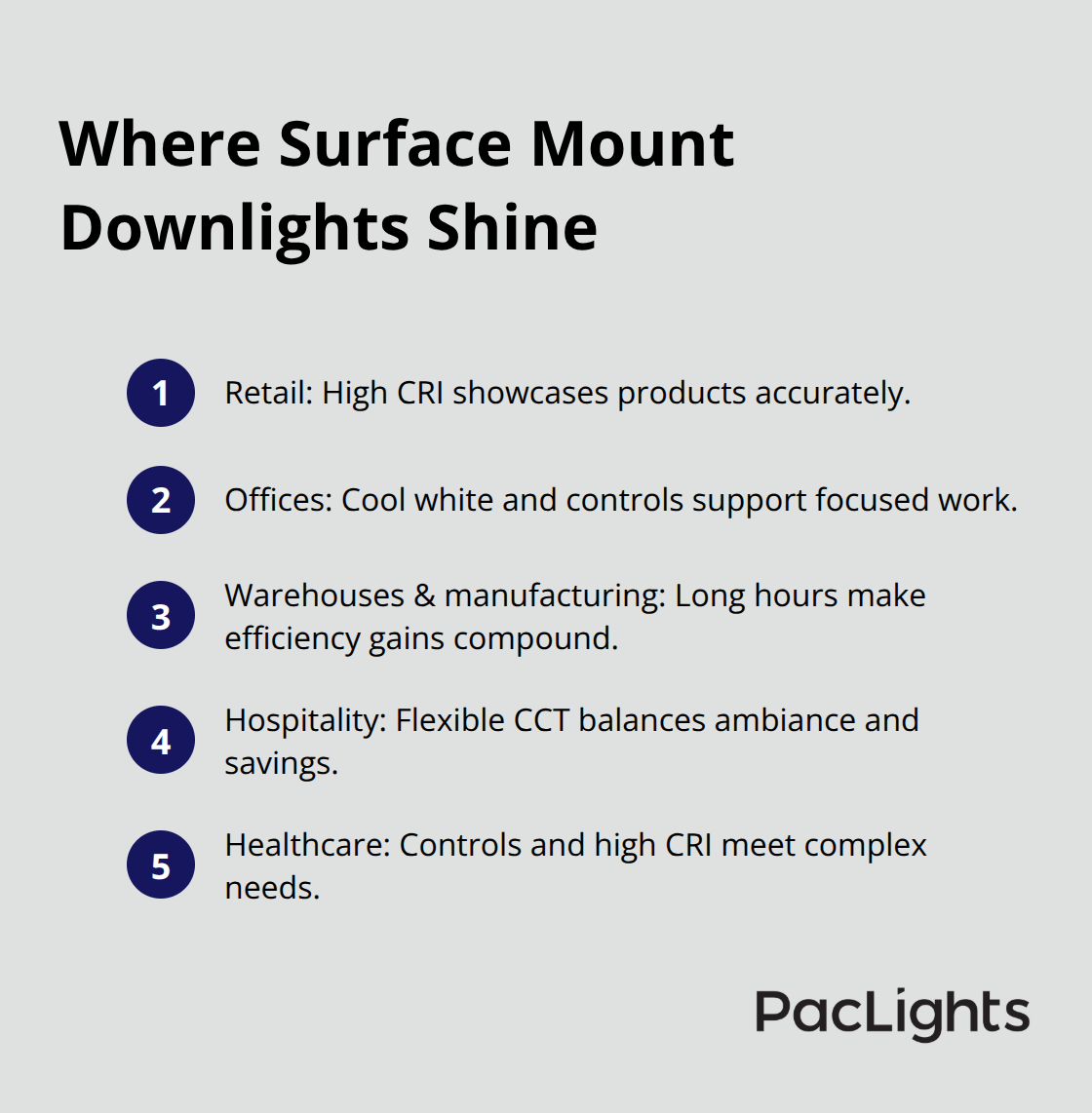
Retail environments demand precision lighting that showcases products accurately while controlling energy costs. Apparel retailers benefit most from high CRI fixtures above 90, which reveal fabric colors and textures exactly as customers will see them at home, reducing returns caused by color mismatches. Grocery stores and supermarkets face constant lighting demands across 24-hour operations, making the 70 to 80 percent energy reduction from LEDs particularly valuable. A typical 40,000-square-foot grocery store switching from fluorescent to surface mount LEDs cuts annual lighting costs by roughly $8,000 to $12,000.
Office Spaces Thrive with Task-Focused Lighting Control
Office spaces require different treatment entirely. Cool white light at 4,000K to 5,000K improves focus and alertness in task-heavy environments, while occupancy sensors in conference rooms and break areas eliminate waste from forgotten lights. A mid-sized office building with 50 conference rooms can reduce lighting energy consumption by 30 to 50 percent when motion sensors turn off lights automatically in unoccupied spaces. Dimming capabilities matter here too because employees adjust brightness based on screen glare and natural light conditions throughout the day.
Warehouses and Manufacturing Maximize Operational Efficiency
Warehouses and manufacturing facilities see the most dramatic returns because they operate long hours with high lumen requirements. Task accuracy improves by 5 to 15 percent under cool white light, which directly impacts quality control and worker safety. A 20,000-square-foot warehouse typically needs 12 to 16 fixtures with 60-degree beam angles to eliminate shadows, and surface mount installation completes over a weekend without disrupting operations.
Hospitality Settings Balance Atmosphere with Energy Control
Hospitality spaces (including hotels, restaurants, and conference centers) require flexible color temperature options to establish atmosphere while maintaining efficiency. Hotels particularly benefit from dimming controls that reduce energy use in guest rooms between occupancies, while restaurant dining areas need warm white light at 2700K to 3000K for ambiance.
Healthcare Facilities Demand Complex Lighting Solutions
Healthcare facilities present the most complex requirements because patient comfort, staff efficiency, and infection control all depend on lighting quality. Operating rooms demand high CRI and flicker-free output, while patient rooms benefit from dimming to support circadian rhythms and reduce stress. Hallways and administrative areas in healthcare settings see the greatest energy savings because they operate continuously with variable occupancy, making occupancy sensors and daylight harvesting essential features that cut annual energy costs by 20 to 30 percent across large medical facilities.
Final Thoughts
Surface mount downlights deliver measurable financial returns that extend far beyond the initial installation. Your facility cuts energy costs by 70 to 80 percent compared to traditional fixtures, recovers the investment within 2 to 4 years, and then enjoys compounding savings for decades. Maintenance expenses drop by 90 percent because LED fixtures last 25,000 to 50,000 hours instead of requiring constant bulb replacements.
The productivity gains matter equally. Improved lighting quality drives approximately 15 percent higher productivity according to the U.S. General Services Administration, while cool white light enhances task accuracy by 5 to 15 percent in manufacturing environments. Occupancy sensors and dimming controls cut energy consumption by 30 to 50 percent in intermittently occupied spaces, and a reliable surface mount downlight solution transforms both your bottom line and your workforce’s performance simultaneously.
Installation takes 2 to 3 days for a 10,000-square-foot space, costs 30 to 40 percent less than recessed alternatives, and requires no ceiling reconstruction. Start with your ceiling height and material, then calculate the lumen output your space requires. We at PacLights offer free lighting layout designs and ROI assessments tailored to your facility’s specific dimensions and usage patterns-contact us to transform your facility’s efficiency.
Disclaimer: PacLights is not responsible for any actions taken based on the suggestions and information provided in this article, and readers should consult local building and electrical codes for proper guidance.