

Selecting the right commercial LED lighting fixtures can feel overwhelming when you’re juggling energy costs, performance specs, and budget constraints.
At PacLights, we’ve helped countless facilities cut through the noise and make smart lighting decisions. This guide walks you through the key factors that actually matter-from efficiency ratings to durability-so you can invest in fixtures that deliver real savings and performance.
Energy Efficiency and ROI: The Numbers That Matter
Match Lumens Per Watt to Your Actual Light Output
Energy efficiency ratings matter far less than most facilities think. What actually drives your return on investment is matching the right lumens-per-watt specification to your actual operating hours and local electricity rates. A fixture rated at 140 lumens per watt sounds impressive until you realize it delivers only 5,000 lumens when you need 10,000. Start by identifying your facility’s real usage patterns. A warehouse running 12 hours daily will see dramatically different payback timelines than an office with 8-hour shifts. Calculate your baseline: multiply your current fixture wattage by annual operating hours, then by your electricity rate per kilowatt-hour. Most commercial facilities pay between $0.08 and $0.12 per kilowatt-hour, though this varies significantly by region and utility.
Calculate Real Savings Across Your Fixture Portfolio
Once you have that baseline number, compare it to LED alternatives with the same light output. A single 400-watt metal halide fixture costs roughly $300 annually in energy and maintenance combined. Switching to an LED equivalent rated at 120+ lumens per watt typically cuts that to under $75 per year. The math compounds quickly across dozens of fixtures. Over 15 years, that’s $3,375 in savings per fixture, which justifies a higher upfront investment in quality gear.
Unlock Rebates Before You Purchase
This is where most facilities leave money on the table. Design Lights Consortium-qualified fixtures often unlock utility rebates ranging from $20 to $80 per unit, depending on your location and local programs. The DSIRE database tracks available incentives by state and utility, and federal agencies can access ENERGY STAR-designated products that qualify for procurement advantages. Payback periods typically fall between 18 and 24 months when rebates are factored in, but that assumes you pursue the rebate before installation. Pre-approval is critical. Contact your local utility before purchasing and specify that you’re installing DLC-qualified fixtures to confirm eligibility.
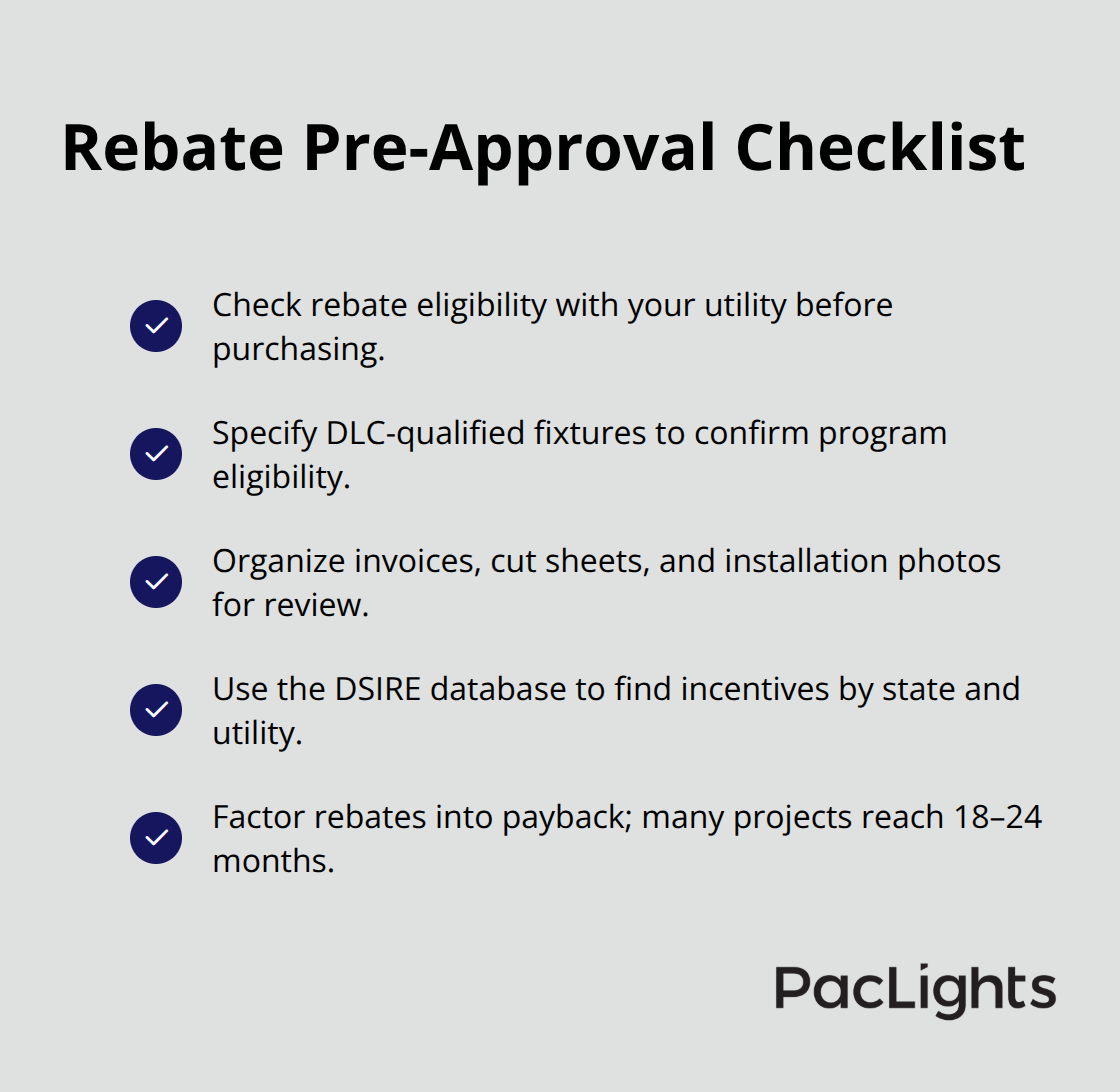
Keep all invoices, cut sheets, and installation photos organized-reviewers scrutinize documentation.
Explore Additional Financing and Tax Incentives
Beyond utility rebates, Section 179D deductions allow up to $1.88 per square foot for qualifying energy upgrades on commercial buildings, though you’ll need third-party certification to claim it. Some states and municipalities also offer PACE financing or on-bill programs that spread LED costs across your energy savings, eliminating upfront capital requirements entirely. These options shift your focus from immediate payback to long-term operational efficiency. With your ROI picture clear, the next step is evaluating the specific features that determine whether a fixture will actually perform in your space.
Key Features That Drive Real Performance
Color Temperature and Rendering Shape How Your Space Functions
Color temperature and color rendering directly influence how your space functions and how occupants perceive it. Most facilities overlook these specs entirely, focusing only on lumens and wattage. The Illuminating Engineering Society recommends 4000K for offices and 5000K for warehouses, but your choice depends on your specific task requirements. If you operate a retail display area, you need 90+ Color Rendering Index to show products accurately-anything lower makes merchandise look washed out and reduces sales appeal. For healthcare or food service, high R9 values matter more than the overall CRI number, since R9 measures red saturation and skin tone accuracy. The tradeoff is real: achieving higher color fidelity typically costs 10-15% more upfront, but the operational benefits justify it. A warehouse running on 3000K lighting will fatigue workers faster than one using 5000K, directly impacting productivity and safety.
Dimming and Control Compatibility Determines Integration Success
Dimming and control compatibility determines whether your fixture integrates with motion sensors, daylight harvesting systems, or building management platforms. Most LED fixtures support 0-10V or DALI dimming, but not all control systems use the same protocol. Before purchasing, confirm your existing infrastructure-a retrofit that forces you to replace control wiring adds thousands in labor costs. DLC-qualified fixtures often include dimming compatibility as standard, which also unlocks additional rebate opportunities worth $10-30 per unit. Advanced controls like occupancy sensors reduce energy consumption by 30-50% in spaces with variable occupancy, transforming a good investment into an exceptional one.
Durability Ratings Protect Against Environmental Stress
Durability ratings tell you whether a fixture survives your actual environment. IP65 ratings handle dust and water spray, suitable for most warehouses and outdoor areas. IP67 fixtures work in heavy-duty industrial settings with washdown requirements. If you operate in a freezer or walk-in cooler, standard fixtures fail within months-you need vapor-tight housings rated for temperature extremes. Warranty coverage varies dramatically: most quality commercial fixtures offer 5-year manufacturer warranties, but some competitors cut corners with 2-year coverage. A 5-year warranty typically indicates the manufacturer stands behind lumen maintenance claims and driver reliability. Check the fine print-some warranties exclude labor costs or require third-party certification for claims. Over a 15-year fixture lifespan, superior durability specifications prevent costly mid-life replacements that disrupt operations and require emergency maintenance calls. These performance factors set the foundation for a successful installation, but many facilities still stumble when it comes to the actual selection process itself.

Common Mistakes When Selecting Commercial Lighting
The gap between a mediocre lighting retrofit and a high-performing one rarely comes down to fixture quality alone. It comes down to how you make the selection. Most facilities trip up in three specific ways that cascade into wasted money and poor performance.

Price-First Decisions Destroy Long-Term ROI
A facility manager sees a 2×4 troffer priced at $45 versus $75 and assumes the savings justify the choice. What they miss is that a cheaper fixture often delivers 110 lumens per watt instead of 150, burns 35% more energy annually, and includes a 2-year warranty instead of 5 years. Over 15 years, that $30 savings per fixture costs you $1,500 more in energy bills alone across just 50 units. The Federal Energy Management Program data shows that cost-effective LED luminaires deliver lifetime energy savings up to $161 per lamp compared to less efficient alternatives, yet most procurement decisions ignore this math entirely. Warehouse operators running 4,000 hours annually feel the damage immediately in monthly utility bills. Calculate your total cost of ownership across 15 years, factoring in energy consumption, maintenance labor, and replacement frequency. A fixture costing $30 more upfront but lasting 100,000 hours instead of 50,000 eliminates a mid-cycle replacement that disrupts operations and requires emergency labor.
Layout Without Strategy Creates Hotspots and Dead Zones
Many facilities install fixtures on a uniform grid without accounting for actual work zones, ceiling height variations, or daylight windows. This approach creates hotspots in some areas and dim zones in others, forcing workers to compensate with task lighting that wastes additional energy. The Illuminating Engineering Society recommends 300-500 lux for general office areas and 500-750 lux for task-intensive zones, but you cannot achieve these targets with generic placement. A warehouse needing 150-300 lux for general navigation but 300-500 lux in picking areas requires strategic fixture positioning that most installers skip. Proper photometric layout using design software prevents over-lighting empty corridors and under-lighting critical work areas. This step separates installations that merely meet code from those that optimize both performance and energy consumption.
Maintenance Neglect Shortens Fixture Life and Increases Costs
Many facilities select fixtures without reviewing replacement schedules, driver availability, or cleaning requirements. A 100,000-hour LED fixture running 12 hours daily lasts roughly 23 years, but lumen output degrades over time. Plan your replacement cycle when output drops 25% below initial levels, typically around year 10-12, not when fixtures fail completely. Vapor-tight fixtures in freezer environments require quarterly cleaning to maintain performance, yet few facilities budget for this. Establish a maintenance log and stock spare drivers to prevent costly emergency calls when a control system fails. These three mistakes compound across dozens of fixtures and years of operation, turning what should be a profitable investment into a costly liability.
Final Thoughts
Your facility type, operating hours, and task requirements should drive every purchasing decision for commercial LED lighting fixtures. A 24/7 manufacturing plant running 8,760 hours annually will see dramatically different ROI timelines than a retail space operating 60 hours weekly, so baseline your actual usage before comparing any specifications. Energy efficiency and long-term value must outweigh upfront price considerations, since a fixture costing $30 more initially but delivering 150 lumens per watt instead of 110 saves you $1,500 across 50 units over 15 years in energy costs alone.
DLC-qualified fixtures with 5-year warranties and advanced dimming compatibility typically cost 15-20% more upfront but eliminate mid-cycle replacements that disrupt operations and require emergency service calls. Factor in reduced maintenance labor from longer-lasting drivers and extended lumen maintenance, and the financial case becomes overwhelming. Professional guidance prevents costly mistakes that compound across dozens of fixtures and years of operation, helping you identify rebate opportunities and calculate realistic payback periods before you purchase.
We at PacLights evaluate your actual space conditions and help you avoid the common pitfalls outlined in this guide. Whether you need high bays for warehouse applications, troffer lights for offices, or specialty fixtures for hazardous locations, our team ensures your investment delivers both performance and savings. Contact us for a customized assessment of your facility’s lighting needs.
Disclaimer: PacLights is not responsible for any actions taken based on the suggestions and information provided in this article, and readers should consult local building and electrical codes for proper guidance.