

Downlights consume roughly 15% of commercial building energy budgets, making them one of the easiest places to cut costs without sacrificing performance. At PacLights, we’ve helped hundreds of facilities swap outdated fixtures for energy efficient downlight options that deliver better light quality and lower utility bills.
The right downlight choice depends on your space, budget, and lighting goals. This guide walks you through the options and shows you exactly what to expect.
LED Downlights and Recessed Options: Why They Outperform Everything Else
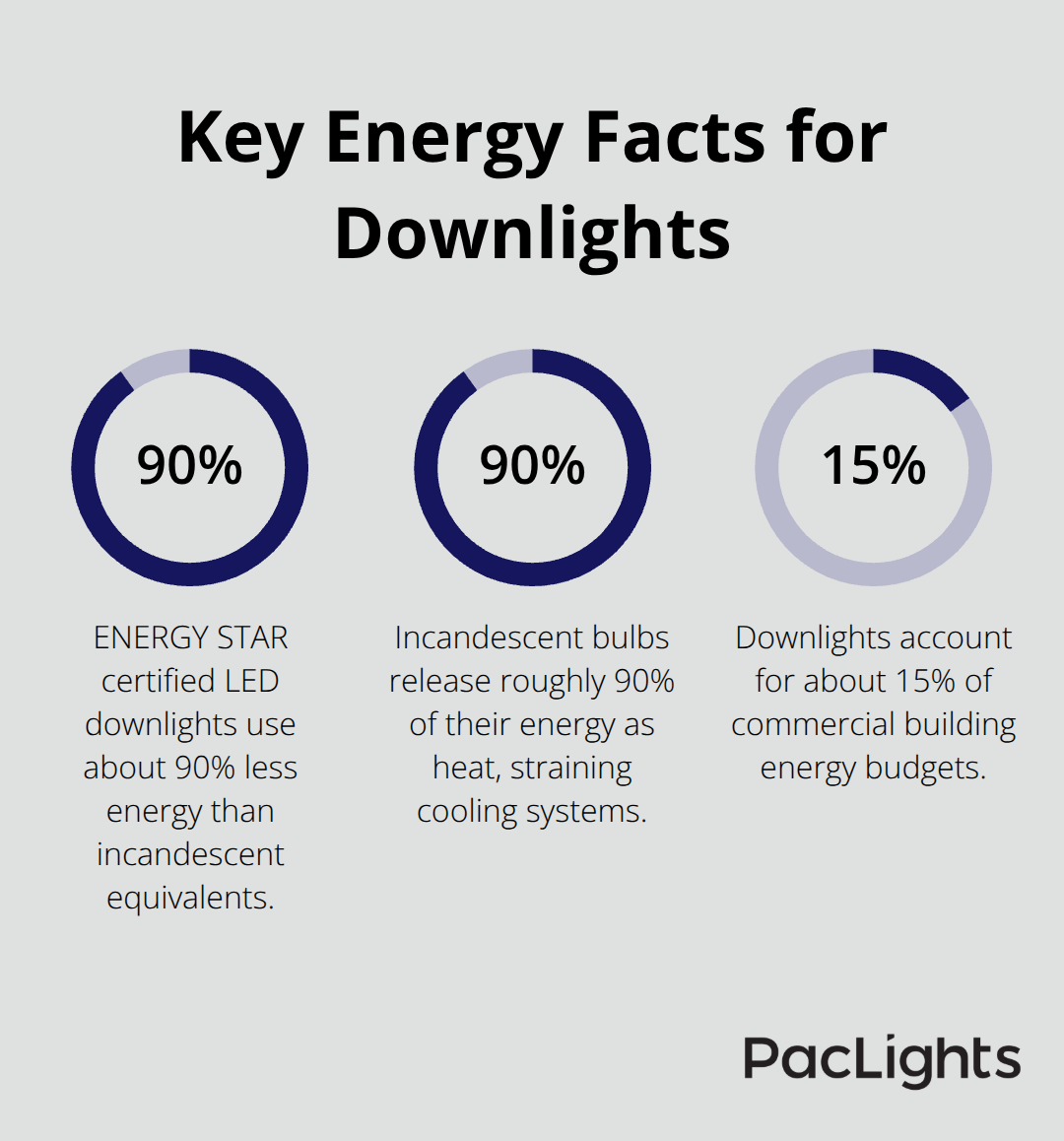
LED downlights outperform every other option available today, and the numbers prove it. An ENERGY STAR certified LED downlight uses roughly 90% less energy than an incandescent equivalent, according to ENERGY STAR. When a 60-watt incandescent produces about 800 lumens, an LED downlight delivers the same brightness at just 8–12 watts. If every downlight retrofit kit sold in the United States were ENERGY STAR certified, annual energy savings would exceed 1 billion dollars with more than 12 billion kilowatt-hours saved and over 18 billion pounds of greenhouse gas emissions prevented, according to ENERGY STAR.
Facilities swapping to LED downlights typically see payback within 1–3 years. LEDs eliminate the heat waste that incandescent bulbs create; incandescent bulbs release about 90% of their energy as heat, which forces air conditioning systems to work harder in warm months. LED downlights emit virtually no heat, lowering your cooling load immediately. Lifespan matters equally. LED downlights last 25,000–50,000 hours compared to incandescent bulbs at roughly 1,000 hours. That means fewer maintenance visits, less labor cost, and fewer replacement fixtures over a decade. For commercial spaces where downlights run 8–12 hours daily, an LED fixture easily lasts 5–10 years without replacement.
Recessed Downlights Create Clean, Professional Spaces
Recessed downlights sit flush with the ceiling, creating a clean architectural line that makes rooms feel larger and more open. This flush integration dominates kitchens, hallways, bathrooms, and offices. The United States has more than 600 million recessed downlights installed, making retrofits straightforward since most spaces already have the infrastructure.
When retrofitting, remodel downlights install from below the ceiling without attic access, while new-construction housings attach directly to joists for greater stability. Choose Type IC (insulation-contact) rated downlights if insulation will touch the fixture; non-IC models require at least 3 inches of clearance. For unconditioned attics, select Type AT (airtight) downlights to prevent conditioned air leakage.
Trim options span 3–14 inches and include baffle finishes for glare reduction, flush mounts for clean lines, gimbal designs for adjustability, and reflector options for brighter output. Finishes range from black and brushed nickel to chrome, rose gold, satin nickel, and white. Beam angles determine coverage: 15–30 degrees suits accent lighting, 30–60 degrees handles general illumination, and 60–120 degrees provides broad ambient light. Space fixtures roughly one per 25 square feet, positioned 4–6 feet apart in a grid pattern for even illumination without dark spots.
Adjustable Fixtures Target Light Where You Need It
Adjustable and directional downlights let you target light exactly where it’s needed, eliminating wasted illumination and glare. Gimbal-mounted fixtures rotate and tilt, making them ideal for highlighting artwork, architectural features, or work surfaces. This directional capability means fewer fixtures achieve the same task performance, cutting both upfront and operating costs.
Dimmable downlights offer another efficiency advantage-running lights at 50% brightness reduces energy consumption proportionally and extends fixture lifespan. Verify compatibility with your existing dimmer or consult the ENERGY STAR compatibility list before purchasing; not all LED downlights work with every dimmer type. Smart downlight options integrate with smartphone apps or voice assistants, enabling remote dimming, scheduling, and color-temperature adjustments.
Some fixtures offer color-temperature switching via built-in switches or apps, letting you shift from warm 2700K tones for evening relaxation to cool 4000–5000K for morning task clarity. This flexibility means one fixture adapts to multiple uses throughout the day rather than requiring separate ambient and task lighting layers. For maximum energy efficiency, combine adjustable fixtures with motion sensors or occupancy controls in hallways, storage areas, and intermittently used spaces; sensors eliminate the waste of lights running in unoccupied rooms.
Choosing the Right Downlight for Your Application
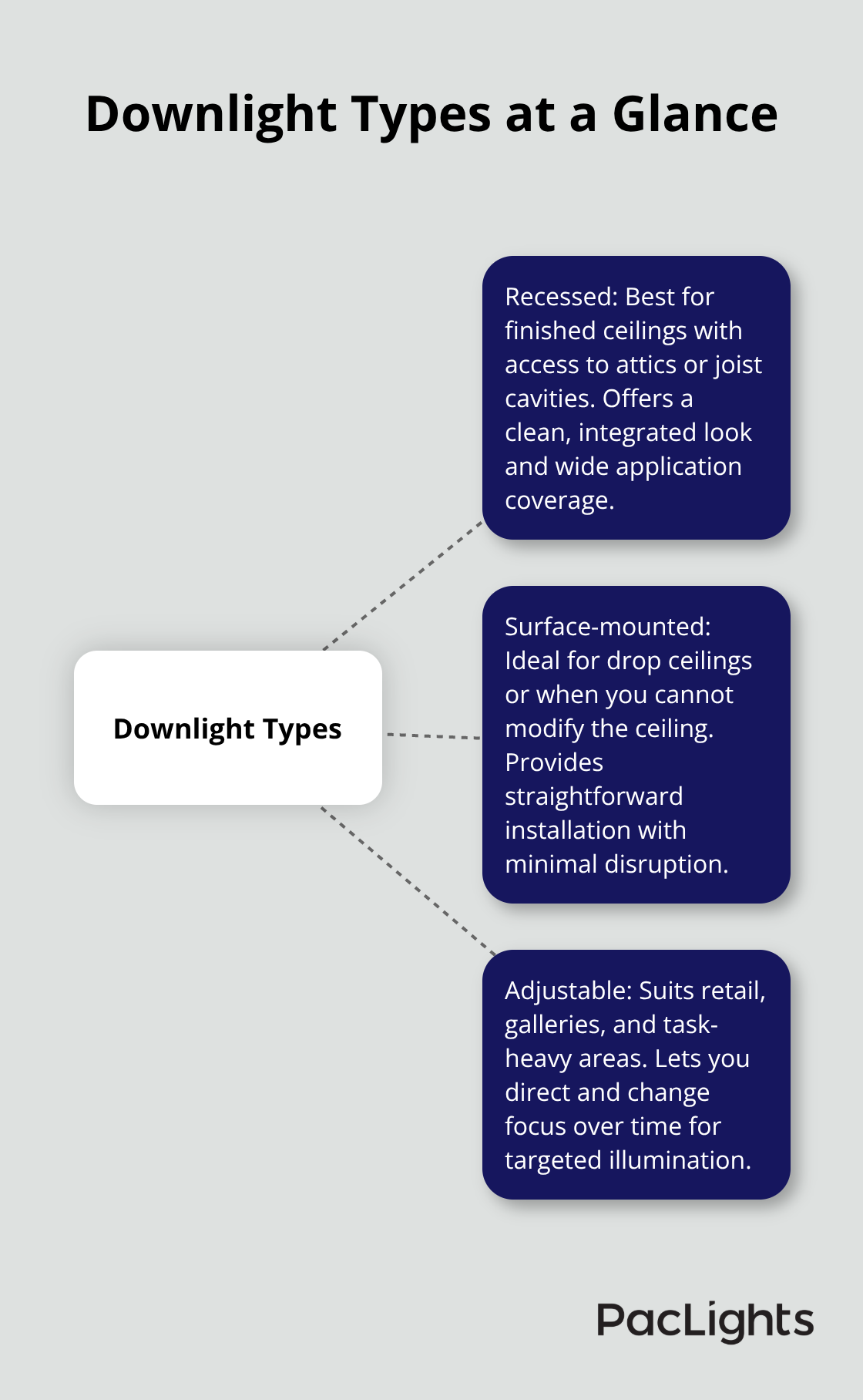
The downlight type you select depends on your space layout, existing infrastructure, and performance goals. Recessed options work best in finished ceilings with accessible attics or joist cavities, while surface-mounted alternatives suit drop ceilings or situations where ceiling modification isn’t possible. Adjustable fixtures excel in retail, galleries, and task-heavy environments where you need to highlight specific areas or change lighting focus over time.
Understanding these three categories positions you to evaluate the specific factors that drive your selection-light output, color temperature, energy consumption, and installation requirements all play roles in finding the right fit.
Key Factors That Actually Drive Your Downlight Selection
Brightness and Color Temperature Set the Foundation
Brightness and color temperature form the foundation of any downlight selection, but most facilities focus on wattage instead of lumens-a critical mistake. The Lighting Facts Label provides standardized brightness information in lumens, which determines how bright a space actually feels. A 60-watt incandescent produces roughly 800 lumens, but an 8–12 watt LED delivers that same 800 lumens. This shift means you stop thinking about watts and start thinking about light output.
Color rendering index (CRI) matters equally in task-heavy spaces. For kitchens and bathrooms, try for a CRI of 90 or higher to ensure accurate color fidelity when cooking or applying makeup. Neutral white tones between 3500–4100K work best for task areas, while warm 2700–3000K suits bedrooms and living rooms where relaxation matters. Cool 5000K options support focused work in offices and detail-oriented spaces. Most facilities install uniform color temperatures throughout their buildings-a costly error that wastes energy and frustrates occupants.
Energy Consumption Determines Your Real Payback Timeline
Energy consumption and long-term costs reveal why LED downlights dominate retrofit decisions despite higher upfront prices. ENERGY STAR certified downlights use approximately 90% less energy than incandescent equivalents. If every downlight retrofit kit sold in the United States were ENERGY STAR certified, annual energy savings would surpass 1 billion dollars with over 12 billion kilowatt-hours saved, according to ENERGY STAR. Most facilities recover their investment within 1–3 years through reduced electricity consumption alone, making the initial cost difference disappear quickly.
Installation Compatibility Determines Success or Failure
Installation compatibility determines whether a retrofit succeeds or fails in your specific ceiling type. Remodel downlights install from below without attic access, making them ideal for retrofits in finished spaces. New-construction housings require joist attachment and suit new builds or major renovations. Type IC rated fixtures tolerate insulation contact, but non-IC models need 3 inches of clearance minimum. Type AT airtight downlights prevent conditioned air leakage in unconditioned attics, protecting your HVAC efficiency.
Verify your ceiling structure, insulation proximity, and attic conditions before purchasing. Installing the wrong type wastes money and creates thermal or performance problems that persist for years. These installation details separate successful retrofits from costly mistakes, so understanding your space’s specific requirements prevents expensive missteps down the line.
How LED Downlights Perform in Real Commercial Settings
Office Spaces Show Immediate Energy Reductions
Office environments reveal exactly why LED downlights dominate retrofit decisions. A typical commercial office building operates downlights for 8–12 hours daily across hallways, conference rooms, open workspaces, and restrooms. When facilities retrofit to ENERGY STAR certified LED downlights, electricity consumption for lighting drops dramatically. According to ENERGY STAR, if every downlight retrofit kit sold in the United States switched to certified models, annual energy savings would exceed 1 billion dollars with over 12 billion kilowatt-hours saved. In practice, individual office retrofits achieve 75–80 percent energy reductions compared to incandescent systems.
A 10,000-square-foot office using roughly 400 recessed downlights at 60 watts each consumes 24 kilowatts continuously during operating hours. Switching those same fixtures to 10-watt LED equivalents reduces consumption to 4 kilowatts, delivering immediate utility bill reductions that compound monthly. Automated dimming cuts downlight energy consumption by 30–50% because fixtures rarely need to operate at full brightness, making payback timelines consistently fall between 1–3 years.
Retail Environments Demand High Color Accuracy
Retail spaces require high color rendering index (CRI) values of 90 or higher to ensure merchandise appears true-to-life under artificial lighting. Customers judge product quality based on how colors look on the floor, and poor CRI drives them to competitors. LED downlights maintain CRI 90+ consistently across their entire lifespan, unlike incandescent or halogen options that degrade over time. This consistent performance protects sales and customer satisfaction throughout the fixture’s operational life.
Industrial Facilities Prioritize Durability and Output
Industrial facilities prioritize durability and consistent output across large, high-ceiling spaces. A 10,000-lumen high-intensity discharge fixture typically consumes 100–400 watts, while an LED delivering similar brightness uses roughly 50–100 watts. Industrial spaces running 16–24 hours daily see the fastest payback periods because total energy consumption is substantially higher.
LED downlights lasting 25,000–50,000 hours mean a facility running lights continuously replaces fixtures every 3–5 years instead of monthly. Maintenance crews spend less time on ladders and scissor lifts, reducing labor overhead significantly. Thermal output matters in industrial settings too; incandescent and HID fixtures release 80–90 percent of energy as heat, forcing cooling systems to work harder. LED downlights emit virtually no heat, reducing air conditioning load in warehouses and manufacturing spaces where downlights run alongside heavy equipment already generating substantial heat.
Heat Reduction Cuts Cooling Costs Substantially
The thermal advantage of LED technology extends beyond simple comfort. In facilities where downlights operate continuously, the elimination of heat waste translates to measurable reductions in air conditioning demand. A warehouse with 500 downlights running 20 hours daily experiences significant cooling load reduction when switching from incandescent to LED fixtures. This dual benefit-lower lighting energy plus reduced cooling energy-compounds the financial advantage of LED retrofits in warm climates or facilities with high internal heat loads.
Performance Advantages Drive Operational Savings
These performance advantages translate directly into operational cost reductions that extend far beyond the electricity meter. Lower maintenance frequency, reduced labor costs, improved product presentation in retail, and decreased cooling demand all contribute to total cost of ownership that favors LED downlights across every commercial and industrial application.
Final Thoughts
Energy efficient downlight options deliver measurable returns across every facility type, from small offices to sprawling industrial warehouses. LED downlights use 90% less energy than incandescent equivalents, last 25,000–50,000 hours instead of 1,000, and pay for themselves within 1–3 years through electricity savings alone. When you add reduced maintenance labor, lower cooling costs from eliminated heat waste, and improved light quality, the financial case becomes overwhelming.
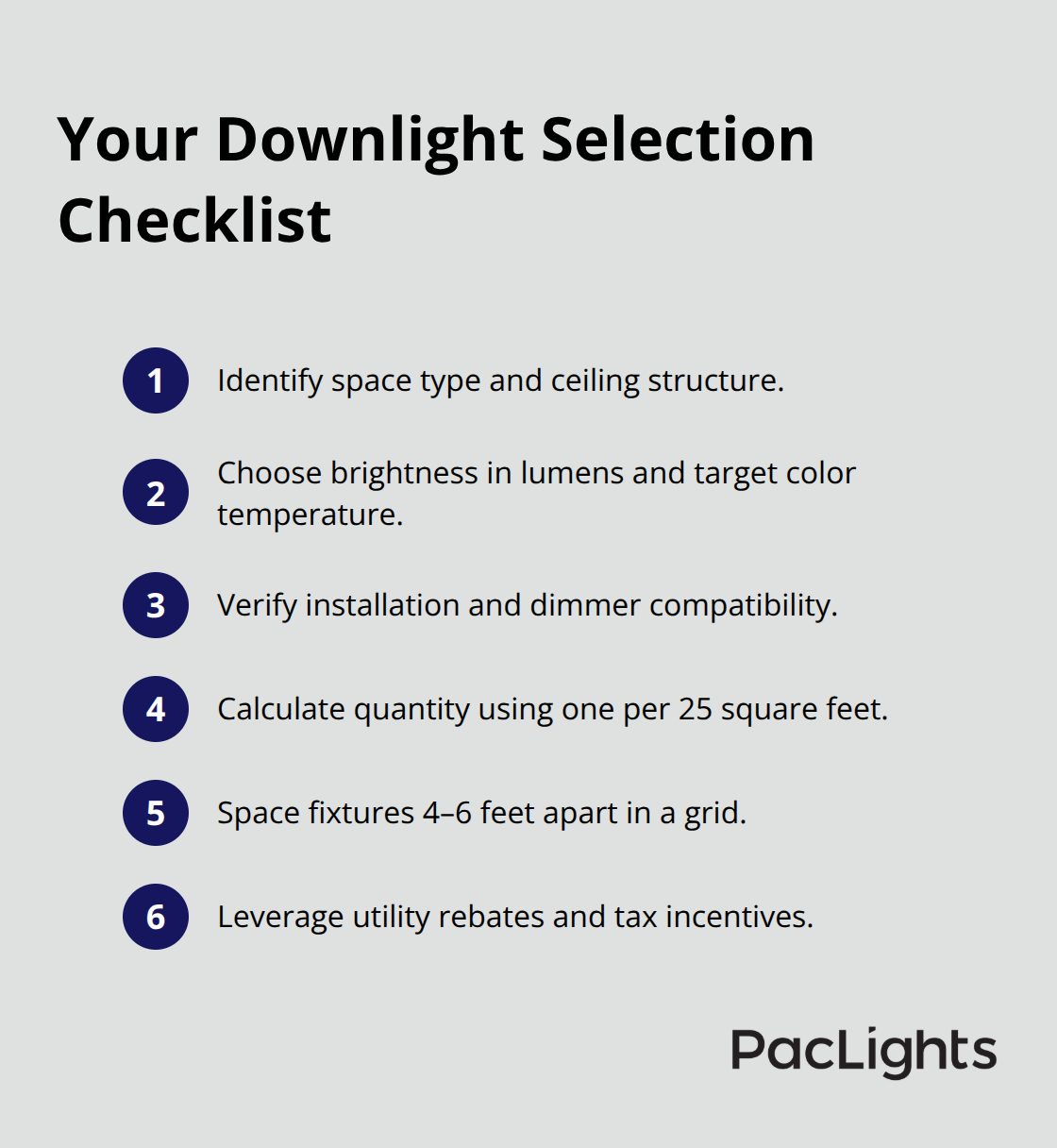
Matching downlights to your specific needs requires understanding three core elements: identify your space type and ceiling structure to determine whether you need remodel fixtures for retrofits or new-construction housings, define your lighting goals through appropriate brightness in lumens and color temperature for your activity type, and verify installation compatibility by checking insulation proximity and dimmer compatibility before purchasing. Calculate how many fixtures you need using the one-per-25-square-feet guideline, then space them 4–6 feet apart in a grid pattern for even illumination. Factor in your local utility rebates and tax incentives, which can offset 20–40% of upfront costs and accelerate payback timelines significantly.
We at PacLights help facilities navigate this process through free lighting layout designs and ROI assessments that show exactly what you’ll save with energy efficient downlight options tailored to your space. Contact PacLights for a customized lighting plan that matches your facility’s unique requirements and financial goals.
Disclaimer: PacLights is not responsible for any actions taken based on the suggestions and information provided in this article, and readers should consult local building and electrical codes for proper guidance.