

Wafer downlights are transforming how facilities manage energy costs and ceiling space. At PacLights, we’ve seen firsthand how thin-profile LEDs deliver measurable savings without compromising on design or performance.
This guide walks you through the real numbers behind wafer downlight efficiency, from power consumption to installation flexibility. You’ll learn exactly how to calculate your ROI and identify the best retrofit strategy for your space.
How Much Energy Do Wafer Downlights Actually Save
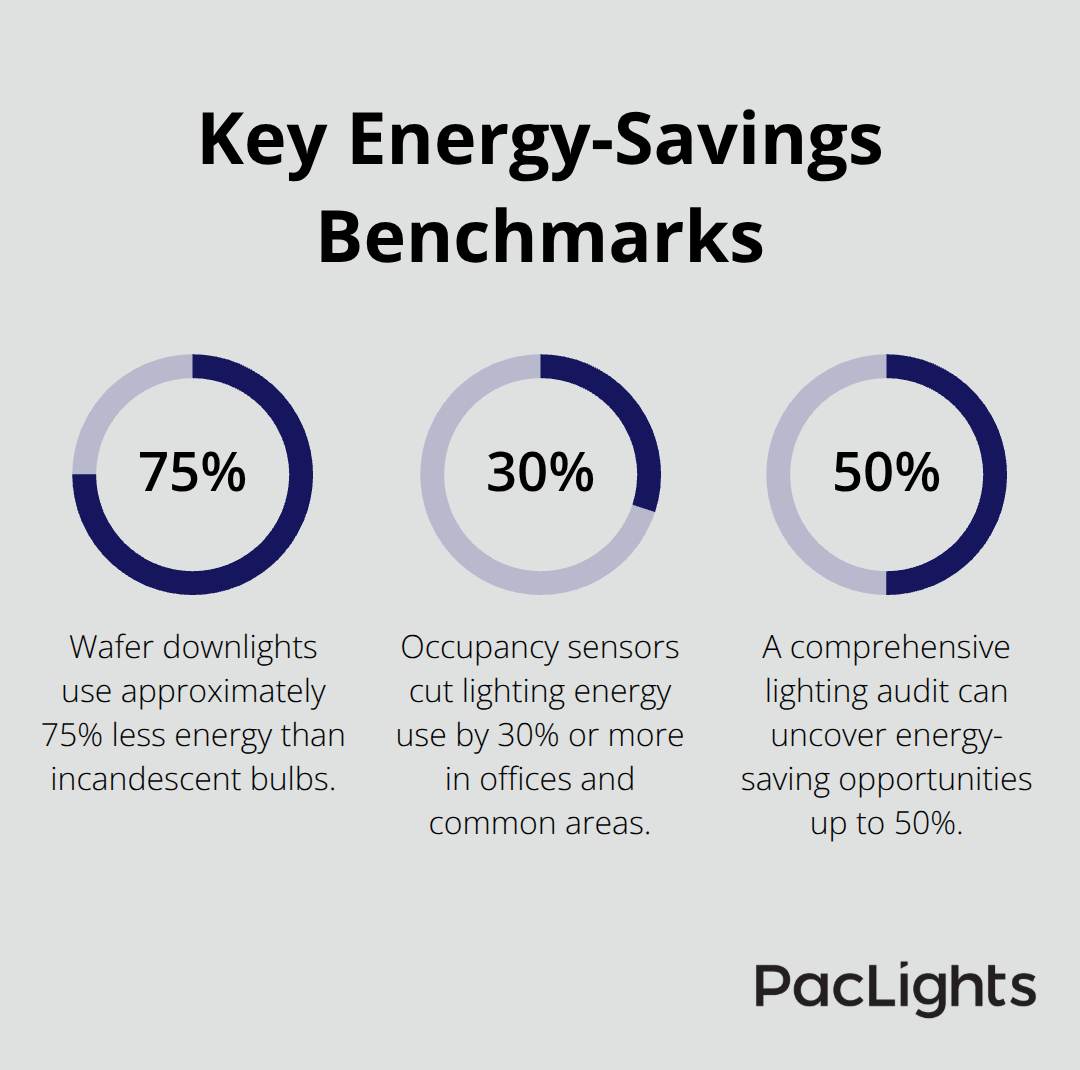
Wafer downlights consume approximately 75% less energy than incandescent bulbs, according to the U.S. Department of Energy. This difference translates directly into measurable reductions on your electricity bill. If you operate 20 fixtures for 12 hours daily at a rate of $0.125 per kilowatt-hour, switching from 400-watt metal halide fixtures to 150-watt LED wafer downlights generates roughly $2,737.50 in annual energy savings. That calculation assumes 365 operating days per year and reflects real-world usage patterns in commercial and industrial spaces.
The payback period for this retrofit typically falls between 9 and 14 months, depending on your current electricity rates and fixture count. Energy Star-certified wafer downlights must use less power than incandescent equivalents while meeting strict color quality standards, so you don’t sacrifice light output for efficiency gains.
Maintenance Costs Drop Significantly
LED wafer downlights operate for approximately 50,000 hours, which translates to roughly 45 years at 3 hours per day. Traditional fixtures like metal halide lamps last only 6,000 to 15,000 hours, forcing frequent replacements that compound labor and material costs. A facility replacing 20 metal halide fixtures could spend around $13,000 on maintenance over the lifespan of a single LED installation.
When an LED wafer downlight reaches end-of-life, you replace the entire fixture rather than just a bulb, but this happens far less frequently than with traditional lighting. This extended lifespan eliminates the operational disruption and safety risks associated with constant maintenance cycles in warehouses, offices, and retail environments.
Environmental Impact Justifies the Upgrade
Energy efficiency standards set by the DOE project that widespread LED adoption will cut greenhouse gas emissions by approximately 70 million metric tons annually, equivalent to the yearly emissions from around 9 million homes. Your facility’s specific contribution depends on how many fixtures you retrofit, but even modest upgrades reduce your carbon footprint measurably.
Upgrading those 20 fixtures from metal halide to LED wafer downlights eliminates roughly 21,900 kilowatt-hours of annual consumption, preventing approximately 9.6 metric tons of CO2 from entering the atmosphere each year. The DOE also projects that energy efficiency standards will save American households and businesses more than $27 billion on utility bills over 30 years, making the environmental case inseparable from the financial one.
These numbers reflect concrete energy reductions that benefit your bottom line while supporting emissions reduction goals. Understanding your actual energy consumption and potential savings sets the foundation for calculating your facility’s specific return on investment-the focus of the next section.
Design Advantages of Wafer Downlights
Recessed Fixtures That Demand Less Ceiling Space
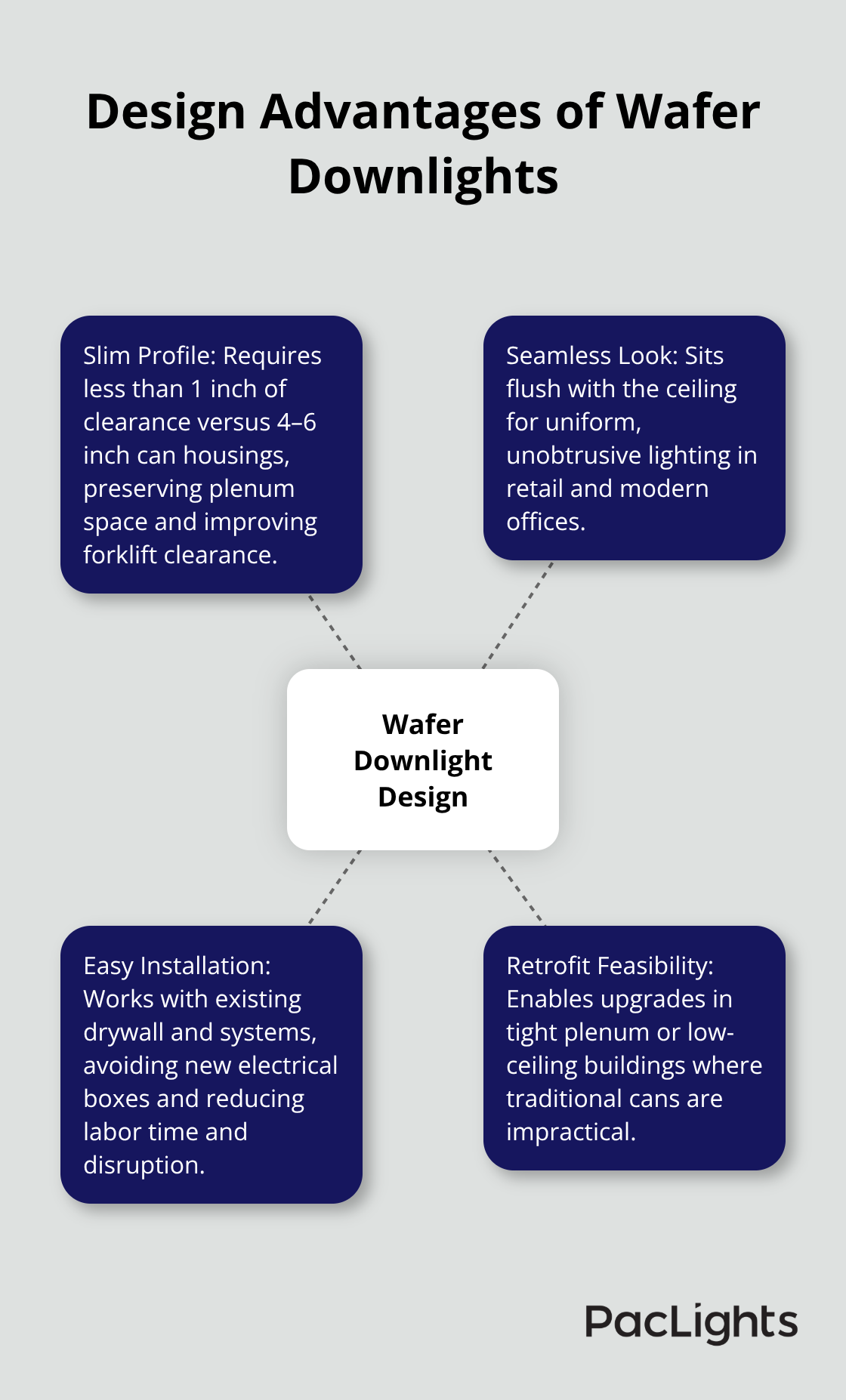
Wafer downlights eliminate the need for recessed can housings, which means you retain usable ceiling space that traditional fixtures consume. A standard recessed can requires 4 to 6 inches of plenum depth, while wafer downlights operate with less than 1 inch of clearance. If your facility has limited space above the ceiling-common in retrofits, basement installations, or buildings with low structural ceilings-this difference determines whether a lighting upgrade remains feasible. You connect wafer downlights directly to existing wiring without installing separate electrical boxes, cutting both labor time and material costs during retrofit projects.
In warehouses where every inch of ceiling height affects forklift clearance or inventory storage, this compact design removes a major constraint that would otherwise force you to choose inferior lighting solutions or abandon energy-efficient upgrades altogether.
Seamless Aesthetics That Support Modern Design
Wafer downlights sit flush with the ceiling, creating a seamless surface that doesn’t interrupt sightlines or draw attention to the fixture itself. Retail environments benefit significantly from this approach because uniform, unobtrusive lighting lets merchandise become the focal point rather than the ceiling infrastructure. Modern office design increasingly favors clean ceiling lines, and wafer downlights support that preference without sacrificing brightness or color quality. The fixture’s low-profile design blends into contemporary interiors while maintaining the light output your space requires.
Installation That Works With Existing Systems
Installation compatibility matters more than many facility managers acknowledge: wafer fixtures work with existing drywall and ceiling systems in ways that traditional cans cannot. You avoid the extensive structural modifications that can lights sometimes require, reducing project timelines and unexpected costs. GE Lighting research from 2022 confirms that wafer lights outperform can lights in retrofit scenarios specifically because they eliminate the need for new electrical boxes and extensive ceiling preparation. When you upgrade lighting in occupied commercial or industrial spaces, this streamlined installation approach minimizes operational disruption and allows you to complete retrofits during scheduled maintenance windows rather than requiring extended downtime.
These design advantages set the stage for calculating the actual financial returns your facility will realize-a calculation that depends on understanding your current energy consumption and retrofit costs.
What’s Your Real ROI on Wafer Downlight Upgrades
Calculate Your Actual Savings
Calculating return on investment requires three specific numbers: your net installation cost, annual energy savings, and annual maintenance savings. Start by determining your current fixture wattage and the LED wattage you’ll install, then multiply the difference by your annual operating hours and electricity rate. If you currently run 20 fixtures at 400 watts each for 12 hours daily at $0.125 per kilowatt-hour, your annual energy consumption totals 29,200 kilowatt-hours. Switching to 150-watt wafer downlights reduces that to 10,950 kilowatt-hours, saving $2,737.50 annually on electricity alone.
Next, account for maintenance: your metal halide fixtures last 6,000 to 15,000 hours, while LED wafer downlights reach 50,000 hours. Over the LED lifespan, maintenance costs for metal halide could total $13,000 in labor and replacement materials. Divide that by the LED life in years-roughly 11.4 years at 12 hours daily-and you gain approximately $1,140 in annual maintenance savings. Your total annual savings equal $3,877.50.
Determine Your Payback Timeline
If the net cost after rebates and discounts totals $2,875, your payback period drops to less than 9 months, with first-year ROI exceeding 135 percent. Utility rebates directly accelerate this timeline: the Department of Energy reports that many programs offer per-fixture incentives that can reduce your net investment by 30 to 50 percent. Use your utility provider’s instant rebate finder to confirm exact incentives before purchasing.
Plan Your Retrofit Strategy
Retrofit strategy depends entirely on your facility’s constraints and budget timeline. Phased upgrades allow you to spread costs across multiple fiscal years while capturing immediate energy savings in high-traffic areas first-typically warehouses prioritize zones with the longest operating hours to maximize payback speed. Whole-property upgrades unlock larger rebates and additional supplier discounts that per-fixture purchases cannot match; bulk orders often qualify for 5 percent off when using your own shipping account or 2 percent off for check payment.
Amplify Savings With Smart Controls
Smart controls amplify savings beyond fixture efficiency alone: occupancy sensors reduce lighting energy use by 30 percent or more in offices and common areas, according to ENERGY STAR data, while daylight harvesting systems that adjust artificial light based on natural availability further lower consumption. Networked lighting controls enable granular management with task tuning and demand response capabilities, maximizing returns from your wafer downlight system.
Validate Your Numbers With an Audit
A comprehensive lighting audit can reveal energy-saving opportunities totaling up to 50 percent in some facilities, providing a clear upgrade roadmap before implementation. Your retrofit success hinges on matching fixture selection to actual usage patterns rather than oversizing for theoretical peak demand-this approach prevents costly mistakes and ensures your projected savings materialize in practice.
Final Thoughts
Wafer downlight efficiency delivers measurable financial and environmental returns that extend far beyond the initial installation. A 20-fixture retrofit from metal halide to wafer downlights pays for itself in under nine months, then continues generating savings for decades as LED lifespans reach 50,000 hours. Occupancy sensors and daylight harvesting systems amplify your savings beyond fixture efficiency alone, pushing total energy reductions toward 30 to 50 percent in many facilities.
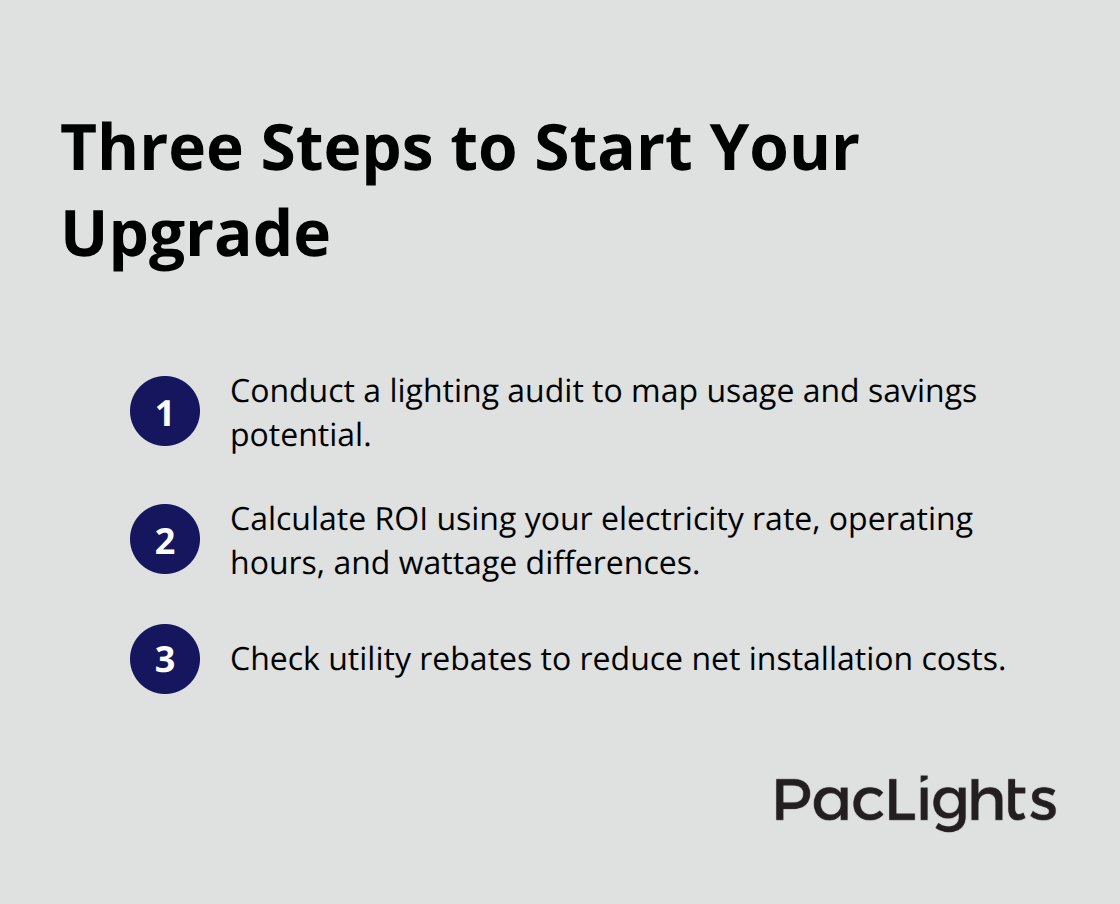
Starting your upgrade requires three concrete steps: conduct a lighting audit to identify your current consumption and retrofit opportunities specific to your facility’s usage patterns, calculate your actual ROI using your electricity rate and operating hours to confirm payback timelines, and explore utility rebates through your local provider to reduce net installation costs. Your carbon footprint shrinks proportionally with energy reductions, aligning operational cost reduction with environmental responsibility.
We at PacLights support this process through free lighting layout designs and ROI assessments tailored to your commercial or industrial space.
Our team helps you select wafer downlights matched to your specific requirements while identifying retrofit solutions that minimize disruption to operations. Contact PacLights to discuss your facility’s lighting needs and begin capturing the efficiency gains your space deserves.
Disclaimer: PacLights is not responsible for any actions taken based on the suggestions and information provided in this article, and readers should consult local building and electrical codes for proper guidance.