

Modern facilities demand lighting that works as hard as the spaces themselves. Surface mount downlight design delivers exactly that-clean aesthetics paired with serious energy savings and installation flexibility that recessed options simply can’t match.
At PacLights, we’ve seen firsthand how the right lighting transforms both the look and operating costs of commercial and industrial spaces. This guide breaks down why surface mount downlights are becoming the standard for facilities that refuse to compromise on efficiency or design.
What Surface Mount Downlights Actually Are
Surface mount downlights sit directly on your ceiling surface rather than recessing into it, delivering focused illumination through a compact fixture body. The core components are straightforward: an LED light source, a driver (the power supply), a heat sink to manage thermal buildup, and a lens or diffuser to shape and soften the light output. The fixture mounts to drywall, concrete, metal, or suspended ceilings using a base plate and fasteners, then connects to your electrical supply through standard wiring. Unlike recessed fixtures that require cutting into ceiling cavities and installing complex housing, surface mount designs arrive ready to install. A 10,000 square foot retrofit installation takes two to three days, compared to five to seven days for recessed systems, cutting labor costs by 30 to 40 percent. This speed matters because it reduces operational disruption and accelerates payback on your investment.
Why Surface Mount Outperforms Recessed Installation
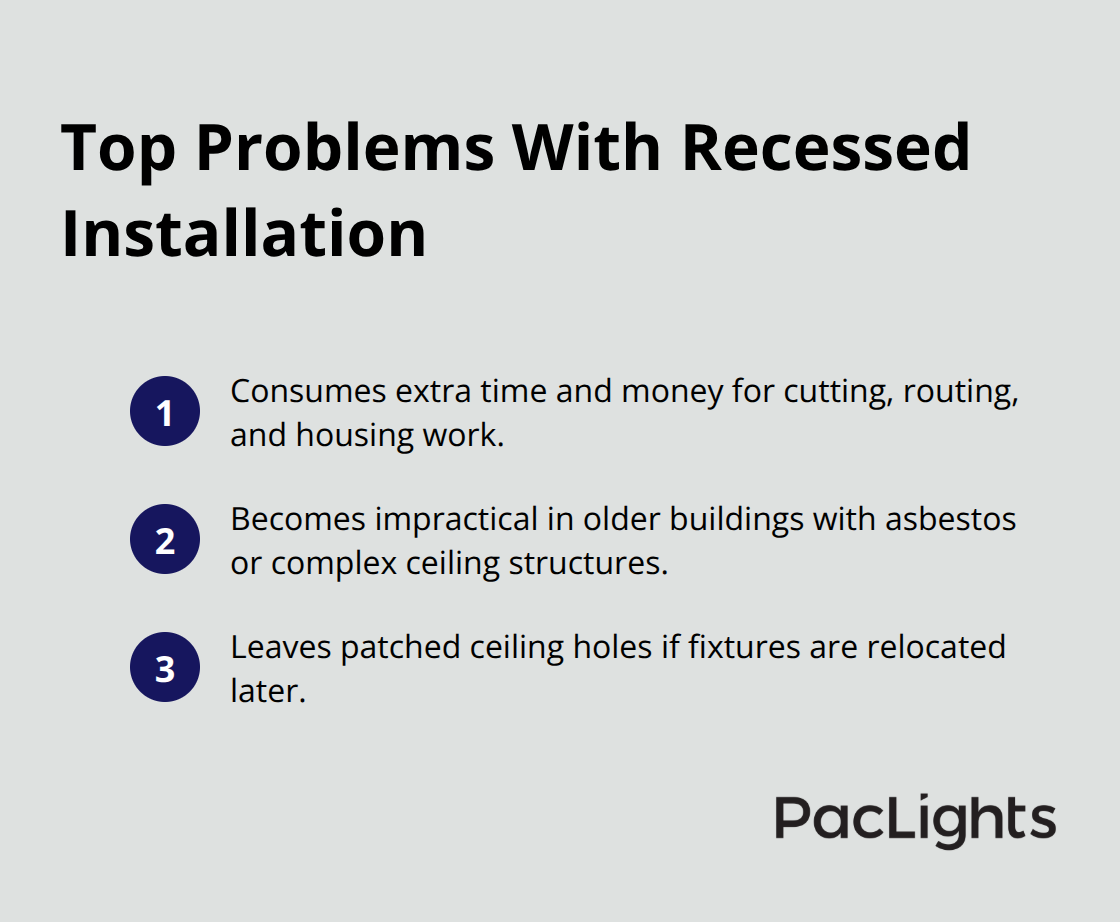
Recessed lighting demands structural work that surface mount eliminates entirely. Installing a recessed fixture means cutting holes in your ceiling, routing wiring through cavities, and securing housings behind drywall or suspended tiles. This approach creates three major problems: first, it consumes time and money; second, it becomes impractical in older buildings with asbestos or complex ceiling structures; third, it leaves patched holes if you ever relocate fixtures.
Surface mount downlights skip these headaches. They mount directly to existing ceilings without modification, work on any surface material, and can be repositioned in hours rather than days. A facility with 100 fixtures can move or upgrade them without ceiling reconstruction. Installation costs run 30 to 40 percent lower than recessed options according to real-world retrofit data. The electrical work simplifies too-no running cables through ceiling voids, just standard connections at each fixture location.
Real-World Applications Across Industries
Warehouses, manufacturing floors, retail showrooms, office spaces, and parking structures rely on surface mount downlights because they deliver performance without renovation costs. Warehouse operations benefit most because these spaces rarely tolerate the downtime that recessed installation demands. A 50,000 square foot manufacturing facility can install 200 surface mount fixtures in three days and see immediate energy reductions of 15 to 25 percent compared to older fluorescent or halogen systems. Retail environments use them for precise task lighting above merchandise displays, where beam angles between 15 and 30 degrees highlight products accurately. Office buildings choose surface mount designs when ceiling height is limited or when facilities need lighting flexibility for hot-desking or space reconfigurations. Parking structures and canopies require weatherproof variants, and IP-rated surface mount fixtures handle moisture and salt spray without performance loss.
What Makes Surface Mount Technology Stand Out
The installation speed and cost advantage create a compelling case, but the real strength lies in flexibility. Surface mount fixtures adapt to spaces that recessed systems cannot serve-low ceilings, concrete structures, and facilities where ceiling modification triggers code reviews or structural concerns. The ability to reposition fixtures in hours (not days) means your lighting layout can evolve as your operations change. This adaptability translates directly into longer fixture life and lower total cost of ownership because you’re not locked into a permanent installation. When your facility layout shifts, your lighting shifts with it. This flexibility extends to control integration as well, enabling you to add motion sensors, daylight harvesting, or networked controls without rewiring the entire ceiling. The next section explores how this technology translates into measurable energy savings and operating cost reductions that justify the switch from traditional lighting systems.
Energy Efficiency and Cost Savings with Surface Mount Downlights
LED surface mount downlights consume 70 to 80 percent less energy than incandescent or fluorescent fixtures according to the U.S. Department of Energy, which translates into tangible monthly reductions. A facility running 50 incandescent downlights at 50 watts each pays roughly $6 per fixture annually in electricity costs. Switching to equivalent 10-watt LED surface mount fixtures drops that to $1.20 per year, saving $240 annually across just 50 fixtures. Larger installations see proportional gains: a 100,000 square foot office building with 400 downlights can expect annual energy savings between $3,200 and $4,800 depending on local utility rates and operating hours.
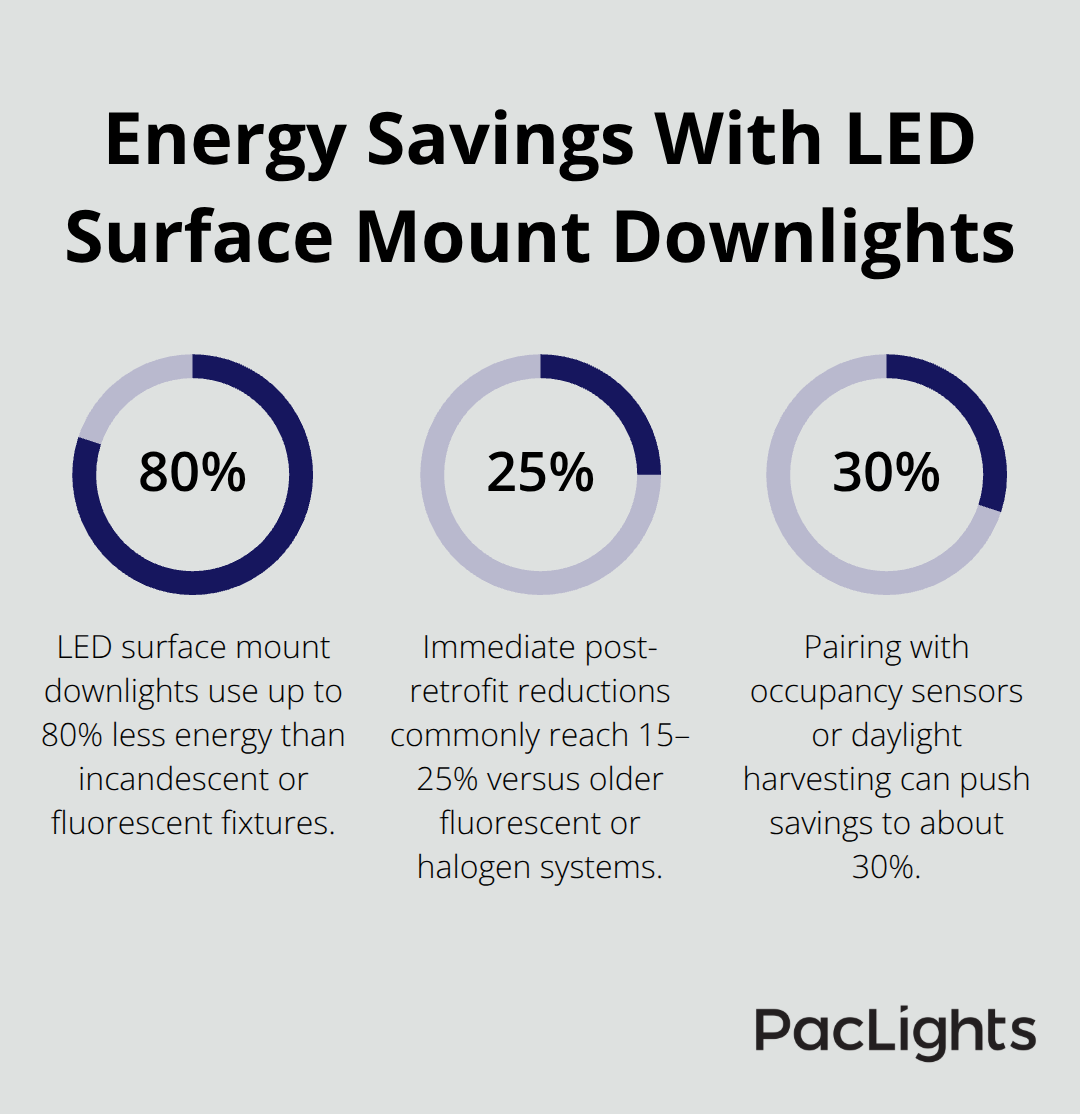
Real-world facility audits show energy reductions of 15 to 25 percent immediately after converting from older fluorescent or halogen systems, with some installations reaching 30 percent reductions when paired with occupancy sensors or daylight harvesting controls. These results come from actual operational data, not theoretical projections. The payback period typically falls between two and four years, after which the system operates at a fraction of the original cost. This timeline matters because your investment recovers itself through operational savings alone, before considering maintenance cost reductions or the extended fixture lifespan.
Maintenance Costs Drop Dramatically
LED downlights operate for 25,000 to 50,000 hours, roughly 8 to 17 years at eight hours daily, far exceeding incandescent bulbs at 1,000 hours and fluorescent fixtures at 8,000 to 15,000 hours. A facility with 100 downlights replacing traditional bulbs every two years currently spends roughly $2,000 annually on maintenance labor and replacement parts. Switching to LEDs with 40,000-hour lifespans cuts that maintenance burden to under $200 annually, a 90 percent reduction.
The operational impact extends beyond cost: fewer replacement cycles mean less ladder work, smaller parts inventories, and reduced downtime when fixtures need attention. Surface mount designs amplify this advantage because they mount on ceiling surfaces rather than recessed cavities, making access straightforward and replacement faster. A technician can swap a surface mount fixture in 15 to 20 minutes versus 45 to 60 minutes for recessed units. Over a decade, this accessibility difference compounds into thousands of dollars in labor savings.
Lower heat emission from LED fixtures also reduces HVAC load compared to halogen or fluorescent alternatives. Industrial facilities with 24/7 operations see the greatest benefit because extended run times amplify both energy and maintenance savings.
Installation Speed Cuts Initial Project Costs
Surface mount installation costs run 30 to 40 percent lower than recessed systems, partly because labor time shrinks dramatically. A 10,000 square foot retrofit takes two to three days with surface mount fixtures versus five to seven days for recessed installation, eliminating ceiling void work and complex housing installation. This speed translates directly into lower labor expenses and faster facility operations recovery.
A manufacturing facility installing 200 fixtures across three production days experiences minimal operational disruption compared to a week-long recessed installation requiring ceiling access and structural coordination. The electrical work simplifies as well since surface mount fixtures connect through standard wall-mounted switches and circuits without requiring ceiling-cavity wiring runs. No asbestos concerns emerge in older buildings, no structural assessments delay projects, and no patched ceiling voids remain after installation.
These factors combine to reduce total project cost by thousands of dollars for medium and large installations. A 50,000 square foot warehouse installing 300 surface mount fixtures at $150 per fixture plus installation costs roughly $67,500 total. At 20 percent annual energy savings of $6,000 plus $1,800 in reduced maintenance, the facility recovers its investment in under eight years while capturing benefits immediately.
How Control Systems Amplify Your Savings
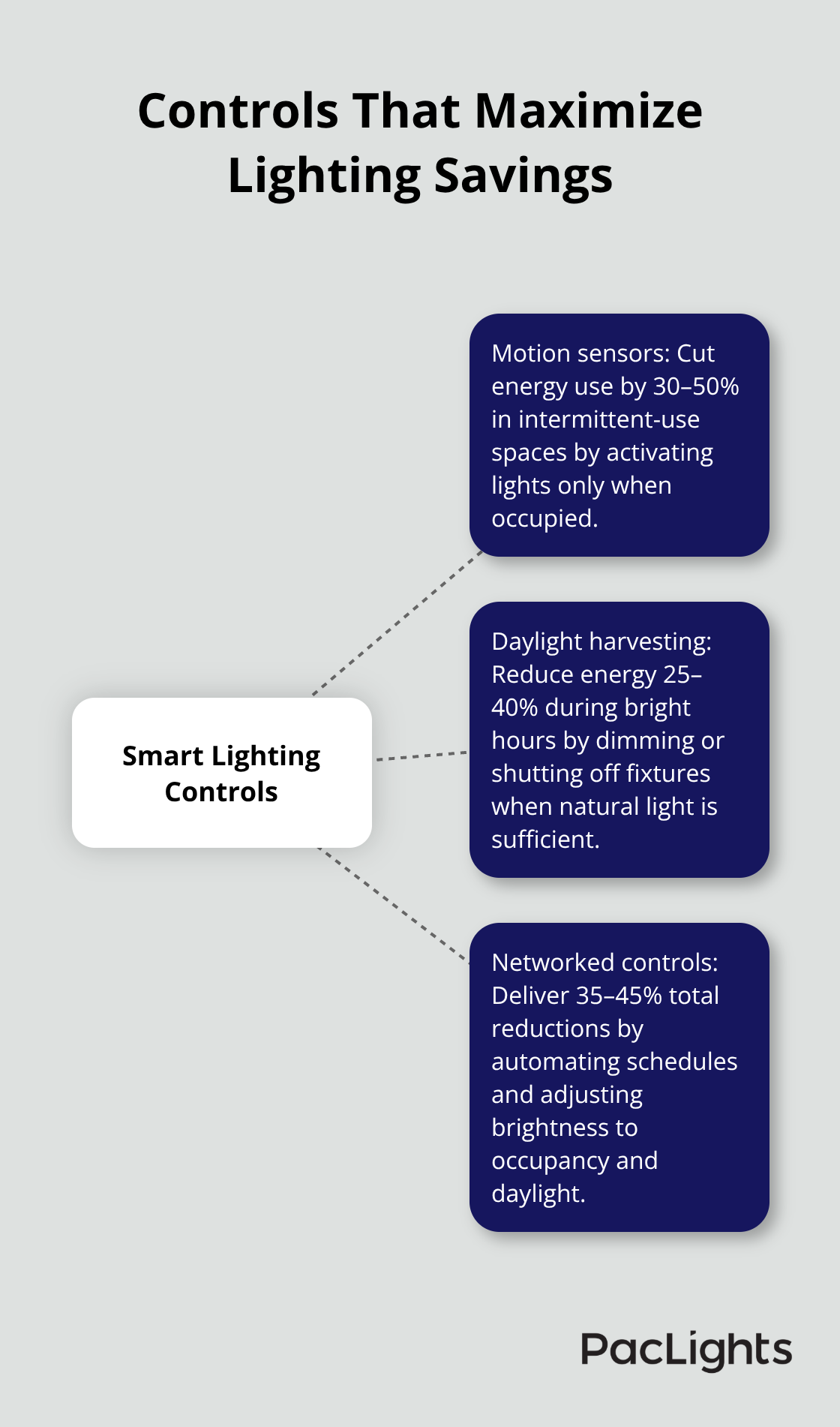
Adding occupancy sensors or daylight harvesting controls to surface mount fixtures pushes energy reductions from 15 to 25 percent up to 30 percent or higher. Motion sensors cut energy use by 30 to 50 percent in intermittent-use areas like storage rooms or conference spaces. Networked controls deliver 35 to 45 percent total energy reductions when facilities automate lighting schedules and adjust brightness based on occupancy and natural light availability.
The installation advantage matters here too: surface mount fixtures accept control integration without rewiring the entire ceiling. Adding a motion sensor or connecting to a networked control system takes hours, not days. This flexibility means you can start with basic fixtures and upgrade controls later as your facility needs evolve, spreading costs across multiple budget cycles while capturing energy savings from day one.
The combination of lower installation costs, dramatic energy reductions, and minimal maintenance requirements creates a financial case that justifies the switch from traditional lighting. What remains is understanding how to design a surface mount system that delivers both performance and the aesthetic appeal that modern facilities demand.
Design Flexibility and Aesthetic Advantages
Modern facilities succeed when lighting adapts to the space rather than forcing the space to adapt to lighting constraints. Surface mount downlights excel here because they deliver genuine design flexibility without sacrificing performance or aesthetics. Unlike recessed fixtures that demand ceiling voids and structural planning, surface mount designs work with your existing ceiling exactly as it sits. This fundamental advantage opens possibilities that traditional systems simply cannot match. A low-ceiling warehouse, a concrete industrial floor, or an office with suspended tiles suddenly becomes viable for premium lighting without renovation costs. The fixture itself becomes a design element rather than a hidden component, which means aesthetics matter from day one.
Finishes and Beam Angles Shape Your Space
Finishes arrive in brushed aluminum, black, white, and satin nickel to align with contemporary interiors, and trim styles range from minimalist flat designs to adjustable gimbal heads that direct light precisely. A 20-foot-wide retail display benefits from narrow 15-degree beam angles that highlight merchandise with sharp focus, while a 40-by-60-foot warehouse demands wider 60-degree distributions to cover floor space evenly without dark spots. The practical rule here is roughly one fixture per 25 square feet spaced four to six feet apart in a grid pattern, which ensures consistent illumination and eliminates the hotspots and dim zones that plague poorly planned installations.
Color Temperature Drives Productivity and Comfort
Color temperature selection matters equally: warm white at 2700 to 3000 Kelvin suits customer-facing areas and break rooms where comfort drives perception, while cool white at 4000 to 5000 Kelvin sharpens focus in manufacturing zones and offices where task accuracy counts. Real productivity data from the U.S. General Services Administration shows approximately 15 percent higher productivity in better-lit spaces, which means selecting the right color temperature directly impacts operational output.
Motion Sensors and Daylight Harvesting Cut Energy Use
Control integration transforms surface mount fixtures from static light sources into responsive systems that adapt to occupancy and daylight conditions. Motion sensors installed in storage areas or conference rooms cut energy consumption by 30 to 50 percent because lights operate only when the space is in use. Daylight harvesting systems automatically dim or turn off fixtures when natural light exceeds a programmed threshold, capturing 25 to 40 percent energy reductions during peak daylight hours according to Department of Energy guidance.
Networked Controls Deliver Maximum Savings
Networked lighting controls deliver the most comprehensive savings, reducing total energy use by 35 to 45 percent when facilities automate schedules, adjust brightness by occupancy patterns, and coordinate with HVAC systems. The installation advantage matters critically here: surface mount fixtures accept these controls without ceiling reconstruction or complex rewiring. Adding a motion sensor takes hours, not days, and upgrading to networked controls requires no ceiling access at all. This design flexibility means you can start with basic fixtures and layer controls later as your facility needs evolve, spreading capital costs across multiple budget cycles while capturing energy savings from day one. A 100,000-square-foot office building with occupancy-controlled lighting can reduce annual costs by 20 to 30 percent, translating into thousands of dollars in recoverable savings that justify the control system investment within 18 to 24 months.
Final Thoughts
Surface mount downlight design delivers what modern facilities actually need: lighting that installs fast, saves money immediately, and adapts as your operations change. Installation takes two to three days instead of a week, cutting labor costs by 30 to 40 percent and eliminating ceiling reconstruction entirely. Energy consumption drops 70 to 80 percent compared to incandescent or fluorescent systems, translating into annual savings of thousands of dollars for medium and large facilities. Maintenance costs plummet because LED fixtures last 25,000 to 50,000 hours, reducing replacement cycles from every two years to once per decade or longer.
Traditional lighting cannot match this performance profile. Recessed systems demand structural work, create asbestos concerns in older buildings, and lock fixtures into permanent positions. Halogen and fluorescent alternatives consume far more energy and require constant bulb replacement. Surface mount fixtures outperform all of them because they work with your existing ceiling, accept control integration without rewiring, and deliver measurable ROI within two to four years.
We at PacLights offer free lighting layout designs and ROI assessments to optimize fixture spacing, beam angles, and control strategies for your exact space. Our team helps you calculate payback timelines, identify rebate opportunities, and plan phased upgrades that spread costs across multiple budget cycles. Contact PacLights to explore surface mount solutions tailored to your facility and start capturing energy savings today.
Disclaimer: PacLights is not responsible for any actions taken based on the suggestions and information provided in this article, and readers should consult local building and electrical codes for proper guidance.