

Datacenters consume massive amounts of energy, with lighting accounting for up to 15% of total power usage. Traditional fluorescent and metal halide systems create heat, waste electricity, and require constant maintenance.
We at PacLights have helped facilities reduce their datacenter lighting costs by 60-80% through strategic LED retrofits and smart controls. The right lighting transformation delivers immediate energy savings while improving visibility and reducing operational headaches.
Why Current Datacenter Lighting Systems Fail
Energy Bills That Spiral Out of Control
Most datacenters still operate with fluorescent T8 systems or metal halide fixtures that consume 400-1000 watts per fixture. These legacy systems generate 30-40% of their energy as waste heat, which forces HVAC systems to work harder and drives cooling costs up by 20-25%. A typical 50,000 square foot datacenter with traditional lighting pays $180,000-$240,000 annually just for electricity. The Lawrence Berkeley National Laboratory found that outdated commercial facility lighting wastes 2.6 billion kilowatt-hours yearly across the United States.

Uneven Light Creates Dangerous Work Conditions
Traditional high-intensity discharge lights create severe light distribution problems with foot-candle readings that vary from 10 to 80 within the same aisle. These hot spots force technicians to use flashlights even in supposedly lit areas, which increases error rates during maintenance by 35% according to Uptime Institute research. Poor visibility leads to longer troubleshooting times, with the average server repair taking 18% longer under inadequate lighting. Metal halide fixtures also take 15-20 minutes to reach full brightness after power cycling (leaving workers in dangerous low-light conditions during emergency situations).
Maintenance Costs That Never Stop
Fluorescent tubes fail every 12-18 months in datacenter environments due to heat stress and frequent switching cycles. Each replacement costs $75-$120 in labor plus materials, with facilities spending $8,000-$15,000 annually on bulb changes alone. Metal halide lamps last slightly longer but cost $200-$300 per replacement cycle. These frequent failures disrupt operations and require maintenance staff to work around live equipment, which creates safety risks that insurance companies increasingly flag during facility audits (particularly in high-density server environments).
Modern LED retrofit solutions address these fundamental problems while delivering measurable improvements in energy efficiency, light quality, and operational reliability.
How Much Can LED Retrofits Actually Save?
Immediate Energy Reductions That Transform Operating Budgets
LED retrofit fixtures consume 50-70% less electricity than fluorescent systems and 80-85% less than metal halide installations. A 50,000 square foot datacenter that replaces 200 fluorescent fixtures with LED equivalents saves 120,000-150,000 kilowatt-hours annually. This translates to $12,000-$18,000 in direct energy cost reductions. The Department of Energy reports that LED systems generate only 5-10% waste heat compared to 40% from traditional systems, which reduces HVAC loads by $8,000-$12,000 yearly. Most facilities achieve complete ROI within 18-24 months, with energy savings that continue for decades afterward.
Uniform Light Distribution Eliminates Safety Hazards
LED fixtures deliver consistent 30-50 foot-candles across entire datacenter floors with less than 10% variation between measurement points. This uniform distribution eliminates the dangerous hot spots and shadows that plague traditional systems. Recent facility management studies show maintenance errors drop by 45% with proper LED installation. Modern LED arrays provide instant full-brightness operation without warm-up delays, which means emergency situations receive immediate proper illumination. The improved visibility cuts average troubleshooting time by 25-30% while workplace accidents decrease significantly (saving facilities $15,000-$25,000 per incident in insurance claims and downtime).

Maintenance Freedom Through Extended Lifecycles
Quality LED systems operate for 100,000-150,000 hours compared to 15,000-20,000 hours for fluorescent tubes. Replacement cycles shift from every 1-2 years to every 15-20 years. This dramatic lifespan extension eliminates $8,000-$15,000 in annual replacement costs while it frees maintenance teams for higher-value technical work. LED fixtures also resist vibration and temperature fluctuations better than fragile glass tubes. Premature failures drop by 90% in demanding datacenter environments where equipment vibration and heat stress traditional components (particularly in high-density server areas).
Smart controls and automation systems take these LED efficiency gains even further through intelligent power management and adaptive responses.
How Smart Controls Multiply LED Efficiency
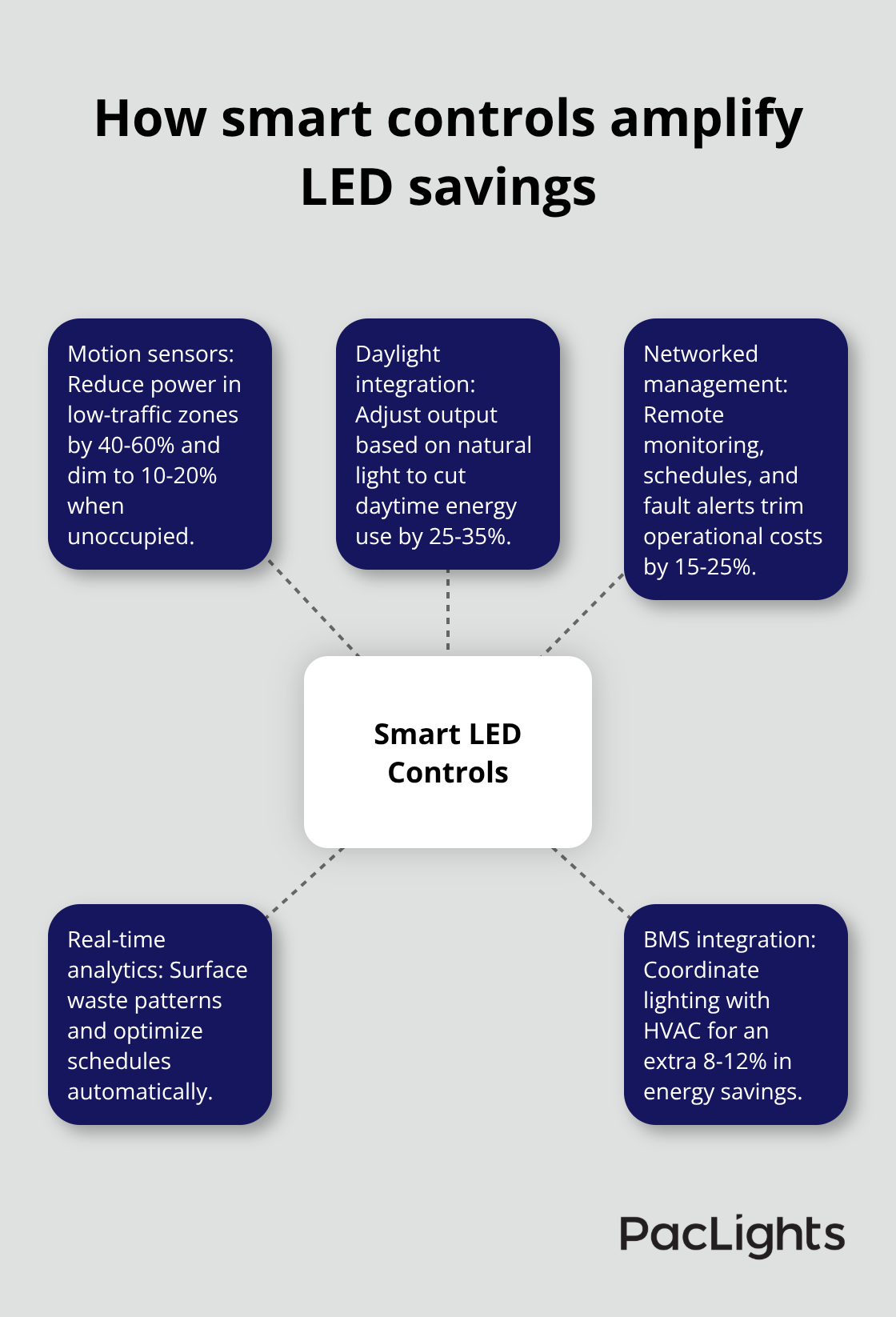
Motion Sensors Cut Wasted Power by 40-60%
Occupancy sensors reduce datacenter power consumption by 40-60% in low-traffic areas like storage rooms, mechanical spaces, and backup equipment zones. These sensors detect movement within 20-30 feet and automatically dim lights to 10-20% when areas remain unoccupied for 5-10 minutes. The National Institute of Standards and Technology found that datacenters waste 35% of power in spaces accessed less than twice daily. Motion detection systems cost $150-$300 per zone but generate $800-$1,200 annual savings in medium-sized facilities. Advanced microwave sensors work better than infrared versions in server environments because they penetrate through equipment racks and detect movement behind obstacles.
Daylight Integration Reduces Daytime Power Draw by 30%
Photosensors automatically adjust artificial lights based on available natural light, which cuts daytime energy consumption by 25-35% in perimeter areas with windows or skylights. These systems maintain consistent illumination levels while they reduce electric output when daylight increases. The California Energy Commission reports that facilities with daylight harvesting save $2-$4 per square foot annually. Modern photosensors respond within 2-3 seconds to light changes and prevent the flicker issues that plagued earlier systems. Dimming controls work seamlessly with LED fixtures to maintain 30-50 foot-candle levels while they minimize power draw during peak daylight hours (particularly in facilities with significant window exposure).
Networked Systems Enable Remote Management and Analytics
Centralized management platforms reduce operational costs by 15-25% through remote monitoring, schedules, and fault detection. These systems track energy usage patterns, identify failed fixtures before complete failure, and generate maintenance alerts that prevent emergency service calls. Facilities equipped with networked controls report 70% fewer service calls and 45% faster problem resolution times. Advanced platforms integrate with building management systems to coordinate lights with HVAC operations, which creates additional energy savings of 8-12%. Real-time energy monitoring helps facilities optimize schedules and identify waste patterns that manual systems miss completely (especially during off-peak hours when traditional systems operate at full power unnecessarily).
Final Thoughts
Datacenter lighting transformation delivers immediate financial returns through 60-80% energy cost reductions and eliminates maintenance headaches that drain operational budgets. LED retrofits with smart controls cut annual electricity expenses by $20,000-$30,000 in medium-sized facilities while they reduce HVAC loads and workplace accidents. The technology pays for itself within 18-24 months through direct energy savings alone.
Implementation takes 2-4 weeks for most facilities with minimal operational disruption. Start with high-traffic areas where safety improvements matter most, then expand to storage and mechanical spaces where motion sensors maximize savings. Professional assessments identify the biggest opportunities and prevent costly mistakes during installation.
We at PacLights provide free lighting layout designs and ROI assessments that show exact savings potential for your specific facility. Our LED retrofit solutions include optional daylight and motion controls plus advanced networked systems for remote management (perfect for facilities that need centralized control). The combination of proven technology and expert guidance makes datacenter lighting upgrades straightforward investments that improve operations while they cut costs for decades.
Disclaimer: PacLights is not responsible for any actions taken based on the suggestions and information provided in this article, and readers should consult local building and electrical codes for proper guidance.