

Cylinder wall lights have become a go-to choice for anyone looking to add style and function to their spaces. Whether you’re lighting a hallway or enhancing your building’s exterior, modern cylinder wall lighting delivers clean lines and reliable performance.
At PacLights, we’ve seen firsthand how the right wall fixtures transform both residential and commercial environments. This guide walks you through everything you need to know to choose and install the perfect solution for your project.
What Makes Cylinder Wall Lights Stand Out
Cylinder wall lights deliver a visual impact that flat or bulky fixtures simply cannot match. The cylindrical form creates clean geometric lines that complement contemporary architecture while remaining subtle enough not to dominate a space. Unlike traditional sconces with ornate frames or protruding arms, modern cylinders sit flush against walls with minimal backplate protrusion, making them ideal for minimalist interiors and refined commercial settings. This design approach has become the default aesthetic across high-end residential and hospitality projects because it works-the form follows function without unnecessary embellishment. The aluminum or steel housings integrate LED modules directly, eliminating visible bulbs or sockets that would break the visual continuity. When you mount a cylinder light, you add an architectural accent that reads as intentional and refined rather than an afterthought.
Performance Where It Counts
Cylinder wall lights excel through their beam control and thermal efficiency. Narrow beam angles between 15 and 24 degrees create dramatic accent lighting for facades and architectural features, while wider 36 to 60 degree patterns deliver softer functional illumination for hallways and corridors. A 12-watt LED cylinder matches the output of a 50-watt metal halide fixture while consuming 76% less energy, which compounds significantly over time. Most quality cylinders operate at over 100 lumens per watt, with lifespans exceeding 25,000 hours-meaning you replace them far less frequently than traditional halogen alternatives. The integrated LED design eliminates driver failures common in older systems because everything is sealed and purpose-built. For outdoor installations, aluminum heat sinks with fins keep junction temperatures low, preserving brightness across seasonal temperature swings (from freezing winters to intense summer heat). This thermal management directly extends lifespan and prevents the lumen depreciation you see in poorly designed fixtures.
Energy Savings and Total Cost Reality
LED cylinder lights deliver approximately 80% energy reduction compared to incandescent or halogen predecessors, but the real financial story extends beyond electricity consumption. A premium 12-watt cylinder fixture priced around 150 dollars outperforms a budget 60 dollar alternative within roughly 18 months when you factor in energy costs and maintenance labor. Commercial projects with occupancy sensors and dimmable drivers achieve approximately 40% energy savings beyond standard LED efficiency because the fixture adjusts output based on actual occupancy and daylight levels. For a typical residential hallway with three fixtures running 4 hours daily, switching from 40-watt halogen cylinders to 12-watt LEDs saves approximately 410 kilowatt-hours annually-roughly 50 dollars per year depending on local rates. Over a 10-year period with minimal maintenance, that amounts to 500 dollars in direct savings plus avoided replacement costs. Outdoor installations see even faster payback because they typically run longer hours, making the 70% energy cost reduction highly material to annual operating budgets.
Selecting the Right Specifications for Your Project
The specifications you choose determine whether a cylinder light performs as intended or underperforms in your space. Color temperature ranges from warm white (2700–3000K) for residential areas to neutral white (4000K) for facades and corridors, and cool white (5000K+) for industrial settings where clarity matters most. IP ratings protect against environmental exposure-indoor dry spaces typically use IP20, while outdoor or wet locations require IP65+ for dust and water resistance. Beam angles and lumen output must match your primary purpose: accent lighting demands narrow beams and lower wattage, while functional hallway lighting requires medium to wide beams (36–60 degrees) and sufficient lumens to prevent dark spots. Material selection also impacts longevity; die-cast aluminum housings with powder-coated finishes resist corrosion far better than steel alternatives in coastal or humid climates. These choices directly affect both initial cost and long-term performance, so understanding your environment and lighting goals before purchasing prevents costly mistakes and ensures the fixture delivers the aesthetic and functional results you expect.
How to Install Cylinder Lights Where They Actually Work
Hallway lighting fails when fixtures create hot spots or dark zones, which happens when spacing exceeds 8 feet or mounting heights ignore wall proportions. Space cylinder lights 6 to 8 feet apart along hallways to achieve even ambient illumination without clustering. Mount fixtures at approximately 5.5 to 6.5 feet from the floor in residential hallways-this height positions light at eye level without causing glare when people walk past. For commercial corridors, the same 5.5 to 6.5 foot height works, but use 10 to 12 foot spacing with 40-degree beam angles to support wayfinding while keeping surrounding areas comfortable.
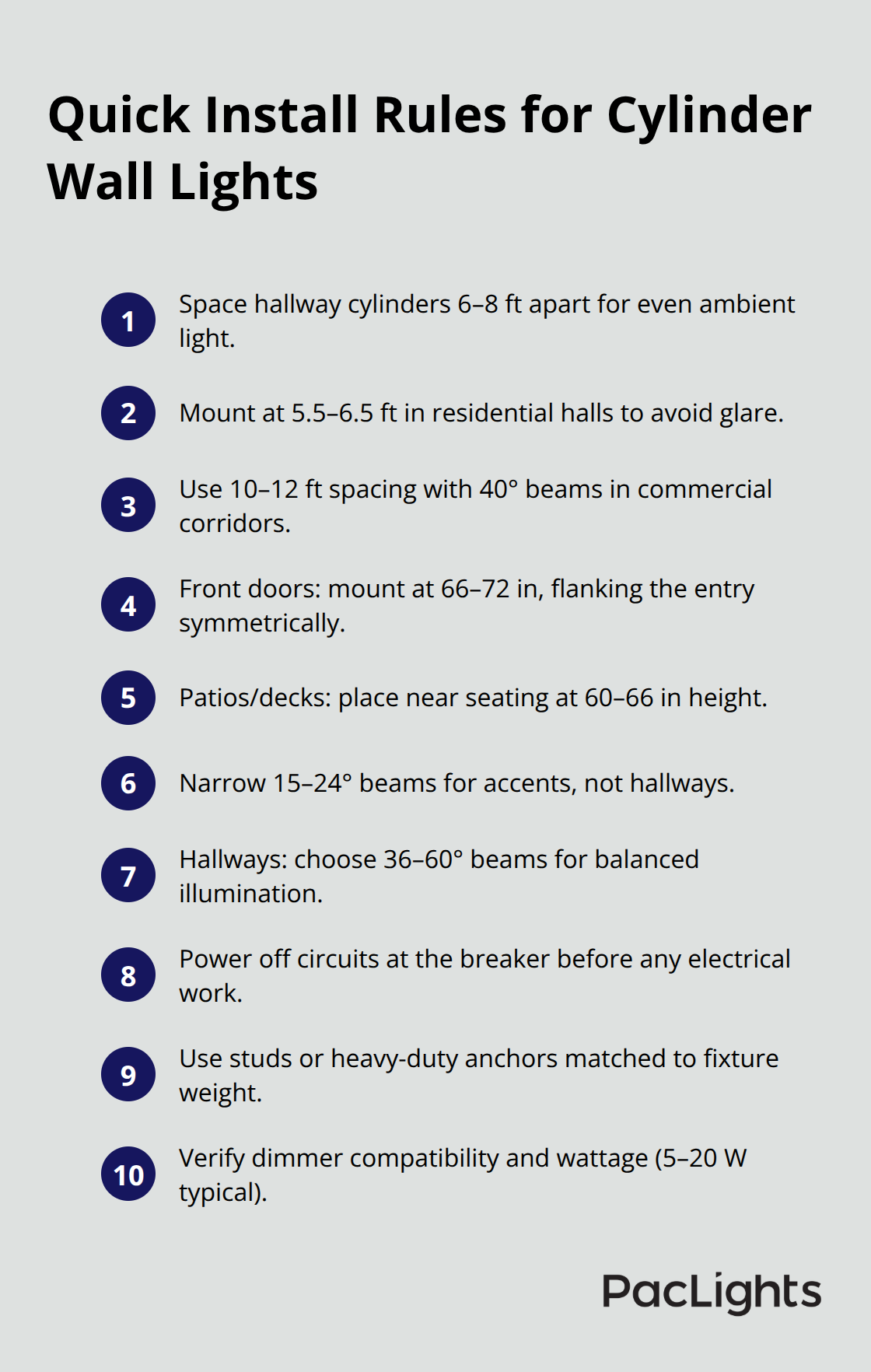
Narrow 15 to 24 degree beams create dramatic architectural accents on walls but perform poorly for functional hallway lighting because they concentrate light too intensely. Choose medium to wide beams between 36 and 60 degrees for hallways, which deliver softer, more balanced illumination across the wall surface. A 12-watt cylinder at 3000K color temperature provides sufficient output for residential hallways without over-illuminating the space-going brighter wastes energy and creates harsh shadows.
Exterior Installations Demand Different Heights and Spacing
Front door lighting should mount at 66 to 72 inches from the ground, roughly one-third of typical door height, and install symmetrically on both sides of the entry. This height balances visual prominence with practical illumination without creating harsh downward shadows across faces. Garage openings benefit from fixtures mounted above or beside doors to illuminate paths without glare, and multiple fixtures provide even coverage across wider openings. Patio and deck installations should place sconces near seating at approximately 60 to 66 inches high to balance ambiance with clear sightlines. On large or tall facades, select higher-lumen cylinders to achieve sufficient illumination without crowding the design with excessive fixtures.
Material Selection Prevents Premature Failure
Aluminum housings with powder-coated finishes outperform steel alternatives in coastal or humid climates because aluminum resists corrosion far better. Marine-grade brass or stainless steel work for extreme coastal exposure, but they cost significantly more and require ongoing maintenance to prevent patina. Die-cast aluminum with matte black, aged bronze, or textured finishes coordinates well with contemporary architecture while hiding dust and fingerprints better than polished chrome or brushed nickel.
IP65 or higher ratings are mandatory for outdoor installations-this protects against dust and water spray from rain, hoses, and coastal salt air. IP20 suffices for interior hallways in dry spaces, but bathrooms require IP44 minimum because moisture accumulates near showers and sink areas. Verify wet-location versus damp-location ratings on product labels before purchasing. Wet-location fixtures handle open wall exposure; damp-location fixtures suit protected areas under eaves or soffits.
Planning Locations Prevents Costly Reinstallation
Use painter’s tape or chalk to mark proposed fixture heights and spacing on walls, then step back and assess visual balance before drilling. Power off all circuits at the breaker before beginning electrical work, then follow local electrical codes for wire routing and junction box placement. Secure cylinders to wall studs whenever possible to handle the fixture weight and vibration from wind. If studs don’t align with your planned locations, use heavy-duty anchors rated for the fixture weight-cheap anchors fail and require reinstallation.
Test beam direction and light spread before finalizing mounting, as some fixtures allow directional adjustment after installation, which helps fine-tune coverage. Dimmable models require compatible dimmers; verify compatibility to avoid flicker and ensure the fixture’s power draw (typically 5 to 20 watts per cylinder) matches your dimmer capacity. With proper material selection and installation planning complete, the next step involves choosing the right specifications to match your specific space and lighting goals.
Choosing the Right Cylinder Wall Lights for Your Space
Material Durability Determines Replacement Frequency
Aluminum housings resist corrosion far better than steel alternatives, especially in humid or coastal climates where salt air accelerates rust formation. Die-cast aluminum with powder-coated finishes in matte black, aged bronze, or textured graphite coordinates naturally with contemporary architecture while hiding dust and fingerprints better than polished chrome. Marine-grade brass or stainless steel work for extreme coastal exposure, but they cost 40 to 60 percent more than aluminum and require ongoing maintenance to prevent unwanted patina. For interior hallways, aluminum suffices completely since moisture exposure remains minimal. Exterior installations demand IP65 ratings minimum, which protect against dust and water spray from rain and coastal salt air. IP20 ratings work for dry interior spaces, but bathrooms require IP44 minimum because moisture accumulates near showers. Verify wet-location versus damp-location ratings on product labels before purchasing-wet-location fixtures handle open wall exposure while damp-location fixtures suit protected areas under eaves or soffits. A quality aluminum cylinder lasts 25,000 to 50,000 hours with minimal maintenance, while cheaper steel alternatives corrode within 3 to 5 years in harsh environments, forcing costly reinstallation.
Color Temperature and Lumen Output Shape Performance
Warm white at 2700 to 3000K suits residential hallways and entryways because it creates inviting ambiance without appearing yellow or clinical. Neutral white at 4000K works for contemporary facades and commercial corridors where you need clarity without the sterile feeling of cool white. Cool white at 5000K and above belongs in industrial settings or security applications where color fidelity and visibility matter most. Mixing temperatures actually works better than standardizing across your entire building-use 3000K in residential hallways and 4000K on exterior facades to enhance the visual separation between interior comfort and exterior functionality. A 12-watt LED cylinder at 3000K delivers sufficient brightness for residential hallways without over-illumination that wastes energy. For commercial corridors, step up to 15 or 18 watts at 4000K to support wayfinding without creating harsh shadows. Lumen output should match your purpose: accent lighting demands 200 to 400 lumens per fixture, while functional hallway lighting requires 400 to 800 lumens depending on spacing and beam angle. Higher lumen counts waste energy if your space doesn’t require that brightness-a 15-watt fixture at 1,200 lumens in a narrow residential hallway creates glare and forces you to dim it constantly, eroding the energy savings that made LED attractive in the first place.
Smart Controls Unlock Flexibility Without Unnecessary Complexity
Dimmable LED cylinders cost 15 to 25 percent more upfront than fixed-output models, but they provide flexibility for changing tasks without rewiring. Verify that your chosen dimmer matches the fixture’s power draw-most cylinders pull 5 to 20 watts, and cheap dimmers cause flicker with lower-wattage LEDs. Motion sensors make sense for commercial corridors and garage areas where fixtures run empty for hours, but they perform poorly in residential hallways where people linger. Voice assistant compatibility and app-based scheduling appeal to homeowners, but the real value emerges in commercial retrofits where occupancy sensors and networked controls deliver approximately 40 percent energy savings beyond standard LED efficiency. These smart systems adjust output based on actual occupancy and daylight levels, preventing fixtures from running at full brightness during daylight hours or when spaces sit empty. Tunable white fixtures that shift from 2700K to 4000K add 20 to 30 percent to the purchase price but eliminate the need to choose between warm and cool tones if your space serves multiple purposes. For most residential projects, basic dimmability solves 90 percent of the problems without unnecessary complexity. Commercial installations benefit far more from motion sensors and networked controls because the payback period drops to 18 to 24 months through reduced energy consumption and maintenance labor.
Final Thoughts
Modern cylinder wall lighting transforms spaces through clean aesthetics, precise beam control, and measurable energy savings that compound over time. A 12-watt LED cylinder matches 50-watt halogen output while consuming 76% less energy and lasting over 25,000 hours-eliminating the frequent replacement cycles that drain budgets. Your decision hinges on identifying your primary purpose: accent lighting on facades demands narrow 15 to 24 degree beams, while functional hallway illumination requires medium to wide beams between 36 and 60 degrees with sufficient lumens to prevent dark zones.
Material selection and IP ratings protect your investment across different environments. Aluminum housings with powder-coated finishes resist corrosion far better than steel alternatives in coastal or humid climates, while IP65 ratings safeguard outdoor installations and IP44 protects bathrooms from moisture damage. Color temperature shapes the entire experience-warm white at 2700 to 3000K creates inviting residential spaces, and neutral white at 4000K supports contemporary facades and commercial corridors without appearing disjointed.
Total cost of ownership reveals the true financial picture beyond upfront price. A premium fixture priced around 150 dollars outperforms a budget alternative within 18 months when energy and maintenance savings compound, and we at PacLights help you evaluate options specific to your space through free lighting layout designs and ROI assessments. Contact our team to explore how modern cylinder wall lighting transforms your project while delivering measurable returns on your investment.
Disclaimer: PacLights is not responsible for any actions taken based on the suggestions and information provided in this article, and readers should consult local building and electrical codes for proper guidance.