

Cylindrical fixtures are still running on outdated technology in most buildings. We at PacLights see this every day-businesses paying far too much for lighting that no longer performs well.
A cylinder lighting retrofit in 2026 makes financial sense. The payback period is shorter than ever, and energy savings are real and measurable.
Why Cylinder Lights Cost You More Than They Should
Halogen cylinder fixtures typically use 75–150 watts per bulb, while modern LED equivalents deliver the same light output using only 10–20 watts. A facility running 20 cylinder fixtures for 12 hours daily spends roughly $400–$600 annually on electricity alone. Scale that to 16 hours daily, and costs jump to $800–$1,000 per year. Commercial buildings allocate up to 40 percent of total energy consumption to lighting, which means cylinder inefficiency compounds across your entire operating budget.
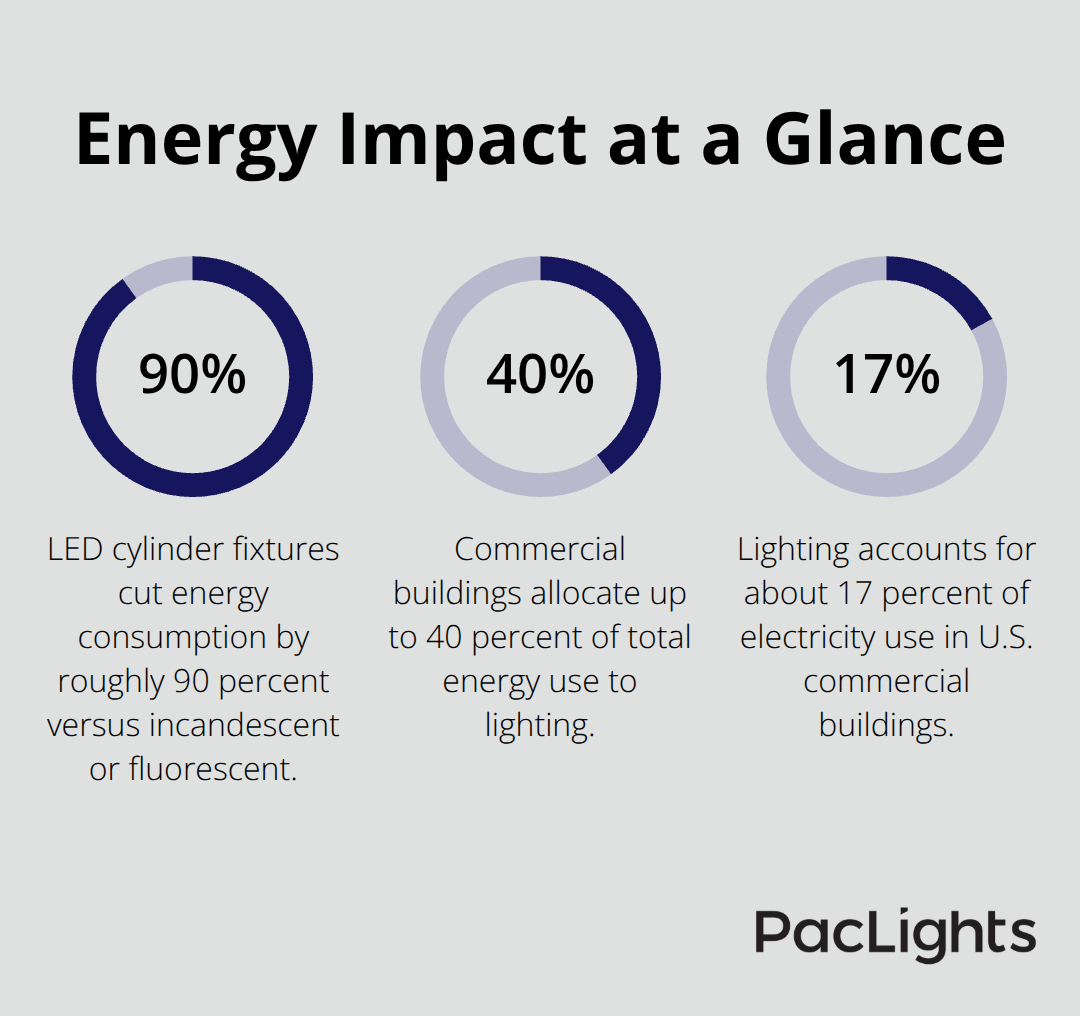
According to ENERGY STAR, LED cylinder fixtures cut energy consumption by roughly 90 percent compared with traditional incandescent or fluorescent lighting, making the case for retrofit immediate and undeniable.
The Real Numbers Behind Your Payback
A retrofit costs between $3,000–$5,000 for 20 fixtures but typically pays for itself in 18–24 months. If your space has a monthly lighting bill of $8,000, a retrofit could yield approximately $7,200 in annual savings. After the payback window closes, those savings become pure profit. Older magnetic dimmers may require upgrading to electronic dimmers before installation, adding roughly $200–$400 to your project budget, but this one-time expense still accelerates your return. The EPAct 179 deduction can offset 10–20 percent of retrofit costs, further shortening payback. Rebates and incentives for LED fixtures can reach as high as $249 per fixture through ENERGY STAR programs, directly reducing your out-of-pocket expense. High-use spaces should be retrofitted first to accelerate payback; calculate annual hours per fixture and prioritize by wattage multiplied by hours to identify which areas deliver the fastest returns.
Maintenance Costs Drop Dramatically
LED cylinder fixtures last about 50,000 hours-roughly 50 times longer than incandescent bulbs at 1,000 hours and five times longer than fluorescent cylinders at 10,000 hours. This means fewer replacement calls, less downtime, and reduced labor costs over the fixture’s lifetime. Field-replaceable LEDs extend fixture life further and simplify maintenance, allowing you to upgrade output or color temperature without swapping the entire unit. LED retrofits also reduce heat output, lowering HVAC load and potentially extending the life of surrounding components. In U.S. commercial buildings, lighting accounts for about 17 percent of electricity use according to ENERGY STAR; upgrading cylinder fixtures directly lowers this portion of your operating budget while reducing the environmental footprint by 60–70 percent and eliminating mercury from your lighting system.
What Retrofit Options Actually Exist
Direct replacement LED modules fit into your existing cylinder housings without structural changes. Complete fixture replacement works for spaces where you want to upgrade the entire assembly, though this approach costs more and takes longer.
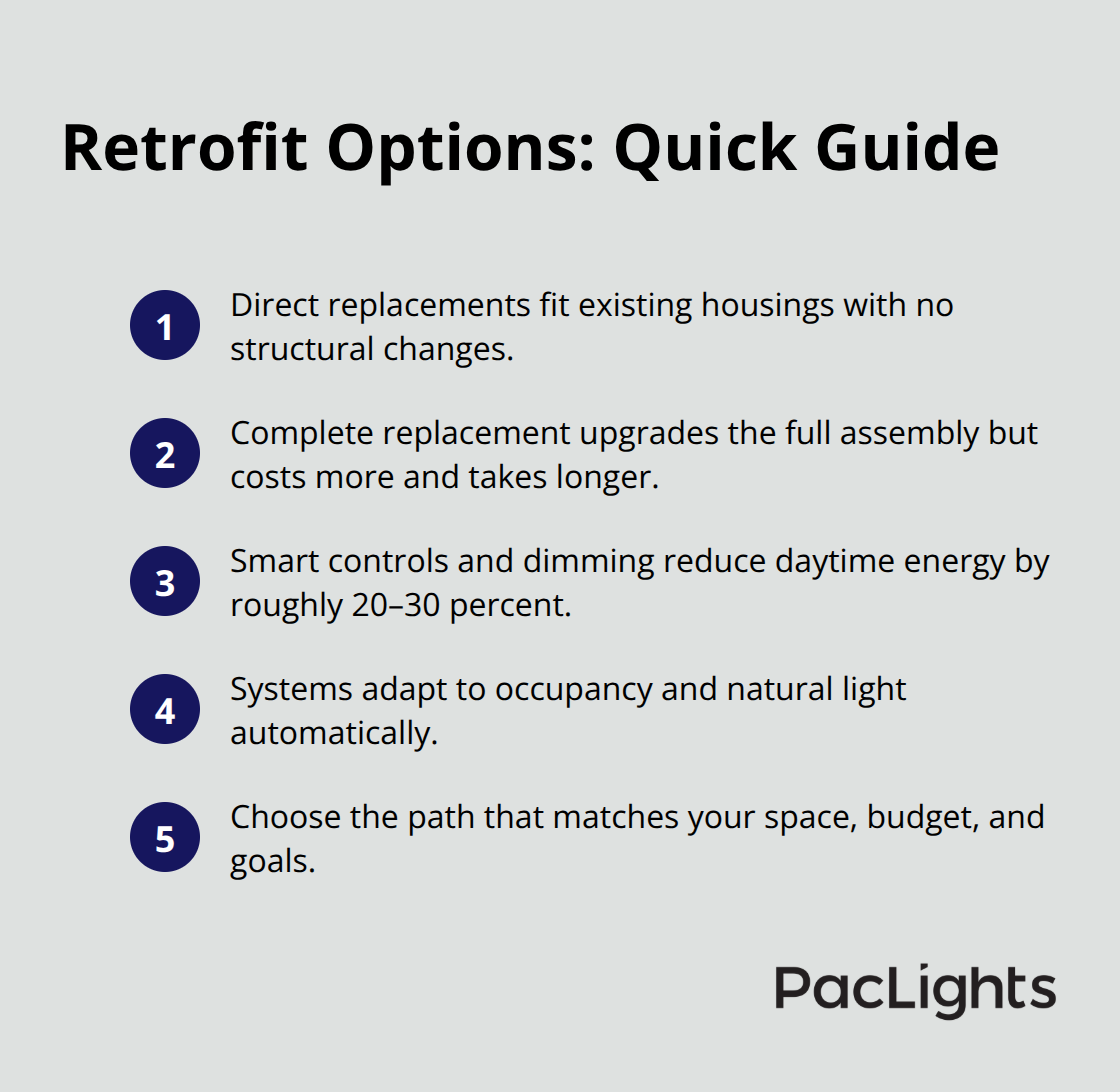
Smart controls and dimming capabilities (including daylight harvesting and motion sensing) reduce daytime energy consumption by roughly 20–30 percent in perimeter zones. These technologies transform your cylinder lighting into a responsive system that adapts to occupancy and natural light. Your next step involves identifying which retrofit path matches your space, budget, and performance goals.
Which Retrofit Path Fits Your Space and Budget
Direct Replacement LED Modules: Speed and Cost-Effectiveness
Direct replacement LED modules offer your fastest and most cost-effective option. These kits slide into your existing cylinder housings without touching your electrical infrastructure, ceiling structure, or aesthetic design. Installation takes hours rather than days, and you avoid the mess and disposal costs of full fixture removal. Retrofit kits for cylinder fixtures typically deliver 680–1,400 lumens, covering most commercial applications from task lighting to ambient illumination. Measure your housing diameter (4, 5, or 6 inches) and verify whether your fixture is IC-rated or non-IC before ordering, as this determines which kit works with your space. Verify your site voltage (120V or 277V) as well, since most kits run on standard North American power.
Installation Process and Timeline
The three-step installation process moves quickly: disconnect old hardware, connect the new LED module with proper color matching, and mount the assembly flush before testing. A team of two technicians retrofits 20 fixtures in an eight-hour shift, meaning overnight installations work well for commercial spaces that cannot tolerate daytime downtime. Color temperature options range from 2700K warm white to 4000K bright white, so you can tailor ambiance by space without replacing housings. Kitchen islands benefit from 1,200–1,500 lumens at 3000K, while hallways work well at around 800 lumens at 4000K. If your fixtures use older magnetic dimmers, budget $200–$400 to upgrade to electronic dimmers before installation, as magnetic dimmers cause LED flicker and hum. Dimmable retrofit options exist and maintain full control flexibility once compatible dimmers are in place.
Complete Fixture Replacement: When It Makes Sense
Complete fixture replacement makes sense only in specific situations. If your cylinder housings are damaged, corroded, or mounted in positions that make retrofit access difficult, replacement is justified. If you want to upgrade to fixtures with integrated smart controls, daylight harvesting sensors, or tilt-adjustable mounting (up to 50 degrees for precise aiming), replacement delivers features that retrofit modules cannot match. Networked controls, motion sensing, and scheduling systems reduce energy use further by adapting light output to occupancy and daylight conditions. Daylight harvesting sensors alone reduce daytime consumption by roughly 20–30 percent in perimeter zones.
Cost Comparison: Retrofit Versus Replacement
Replacement costs $8,000–$15,000 for a 20-fixture project because you pay for new housings, new electrical work, and installation labor. Retrofit modules cost $3,000–$5,000 for the same space, making retrofit the financially superior choice for most buildings. Start with retrofit unless your fixtures are genuinely beyond repair or your performance goals demand integrated smart systems that retrofit modules cannot provide. Professional guidance helps you compare retrofit versus replacement costs for your specific space. We at PacLights offer free ROI assessments and lighting layout designs that translate your current fixtures and energy bills into concrete payback timelines and upgrade recommendations, helping you determine which path delivers the best value for your facility.
How Long Until Your Retrofit Pays for Itself
The Payback Math Works in Your Favor
The math behind cylinder retrofit payback is straightforward. A facility with 20 fixtures running 12 hours daily currently spends $400–$600 annually on electricity. Upgrade to LED modules, and you cut that to roughly $100–$150 per year, yielding $300–$500 in annual savings. At a retrofit cost of $3,000–$5,000, your payback window lands between 18–24 months. If your space runs fixtures 16 hours daily instead, annual savings jump to $700–$900, compressing payback to 12–18 months.
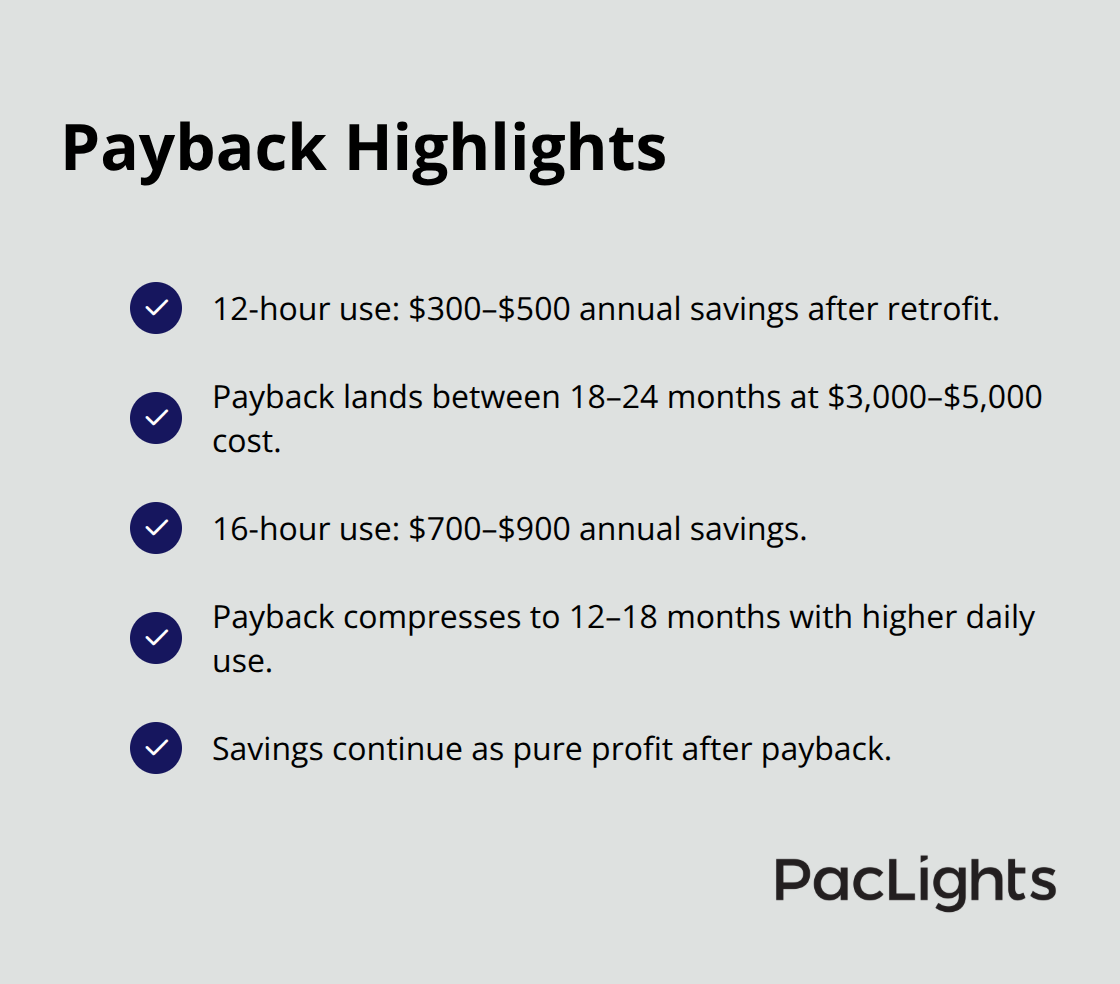
These timelines assume no rebates or tax incentives. Factor in ENERGY STAR rebates of up to $249 per fixture, and payback accelerates further. The EPAct 179 deduction covers 10–20 percent of retrofit costs, meaning a $4,000 project could see $400–$800 in tax relief. After payback closes, every dollar saved becomes profit with zero additional investment required.
Prioritize High-Use Fixtures First
Your priority should be identifying which fixtures deliver the fastest returns. Calculate the annual operating hours for each cylinder (wattage multiplied by daily hours), then rank fixtures by energy consumption. A 100-watt halogen cylinder running 16 hours daily costs far more to operate than a 100-watt fixture running 8 hours. Start retrofits in warehouses, office floors, and retail spaces that run 12 or more hours daily; these spaces hit payback targets fastest and fund subsequent phases of your upgrade.
A facility with an $8,000 monthly lighting bill could achieve roughly $7,200 in annual savings through comprehensive retrofit, though this assumes most fixtures qualify for upgrade. Real-world projects rarely retrofit every fixture at once.
Phase Your Upgrades to Spread Costs
Staging retrofits across multiple phases spreads costs while using savings from completed work to fund the next phase. Retrofit a high-priority zone in month one, measure the energy reduction on your utility bill, then use that savings to finance retrofits in month three or four. This approach eliminates large upfront capital expenses and proves ROI before committing to additional phases.
Building codes and permit requirements vary by location, so budget $500–$2,000 for electrical inspections and compliance work depending on your jurisdiction. Professional lighting design typically costs $500–$1,500 but prevents costly mistakes like over-lit or under-lit zones that waste energy or require rework.
Get Expert Guidance for Your Timeline
We at PacLights provide free ROI assessments and lighting layout designs that model energy savings for your specific fixtures and usage patterns. These tools translate estimated payback into actionable upgrade timelines tailored to your budget and facility priorities.
Final Thoughts
Cylinder lighting retrofit in 2026 delivers measurable financial returns that compound over time. Your retrofit investment converts to pure savings within 18–24 months, while LED fixtures running 50,000 hours eliminate the constant replacement cycles that drain maintenance budgets. Energy consumption drops by roughly 90 percent compared to traditional halogen or fluorescent cylinders, directly lowering the 40 percent of commercial building energy costs allocated to lighting, and your facility reduces carbon emissions by 60–70 percent while eliminating mercury entirely.
Upgraded cylinder fixtures improve workplace quality and customer experience through precise color temperatures and glare-control features that enhance visibility without the heat output that strains HVAC systems. Tilt-adjustable fixtures and field-replaceable LEDs give you flexibility to adapt lighting as your space evolves, avoiding costly full replacements down the road. Smart controls and daylight harvesting sensors reduce daytime consumption by 20–30 percent in perimeter zones, transforming static fixtures into responsive systems that match occupancy and natural light conditions.
Start by calculating your current annual lighting costs and identifying high-use spaces running 12 or more hours daily, as these areas deliver the fastest payback and fund subsequent retrofit phases without requiring large upfront capital. We at PacLights provide free ROI assessments and lighting layout designs that model energy savings for your specific fixtures, helping you prioritize upgrades and confirm payback timelines before committing resources.
Disclaimer: PacLights is not responsible for any actions taken based on the suggestions and information provided in this article, and readers should consult local building and electrical codes for proper guidance.