

Datacenters consume roughly 1% of global electricity, with lighting accounting for 20-30% of that total. At PacLights, we’ve seen motion sensor lighting systems cut datacenter lighting costs by 30-50% in real deployments.
The payback period typically ranges from 2-4 years, making this one of the fastest ROI upgrades available. This guide walks through the technology, implementation strategies, and financial benefits that make motion lighting a smart investment for any facility.
How Motion Sensor Technology Cuts Datacenter Lighting Waste
How Motion Sensors Detect Occupancy
Motion sensor lighting activates illumination only when technicians or automated systems enter a space. In datacenters, this matters because aisles and maintenance corridors often sit empty for hours. PIR sensors detect heat from human movement, while ultrasonic sensors use sound waves to identify motion. Dual-technology sensors combine both methods for accuracy in environments with equipment vibration or temperature fluctuations. Dual-technology sensors perform best in datacenters because they eliminate false triggers from cooling systems or vibrating equipment, ensuring lights activate reliably when staff arrive for maintenance without wasting energy on phantom activations.
Regulatory Requirements and Compliance
The 2024 International Energy Conservation Code now mandates occupant sensor controls in computer rooms, making motion lighting a compliance requirement rather than an optional upgrade. This regulatory shift reflects what operators observe in the field: datacenters that deploy motion sensors achieve 30-50% energy reductions in lighting. Some facilities report even higher savings when sensors coordinate with dimming controls that reduce output to 50% during low-occupancy periods.
Real-World Performance Results
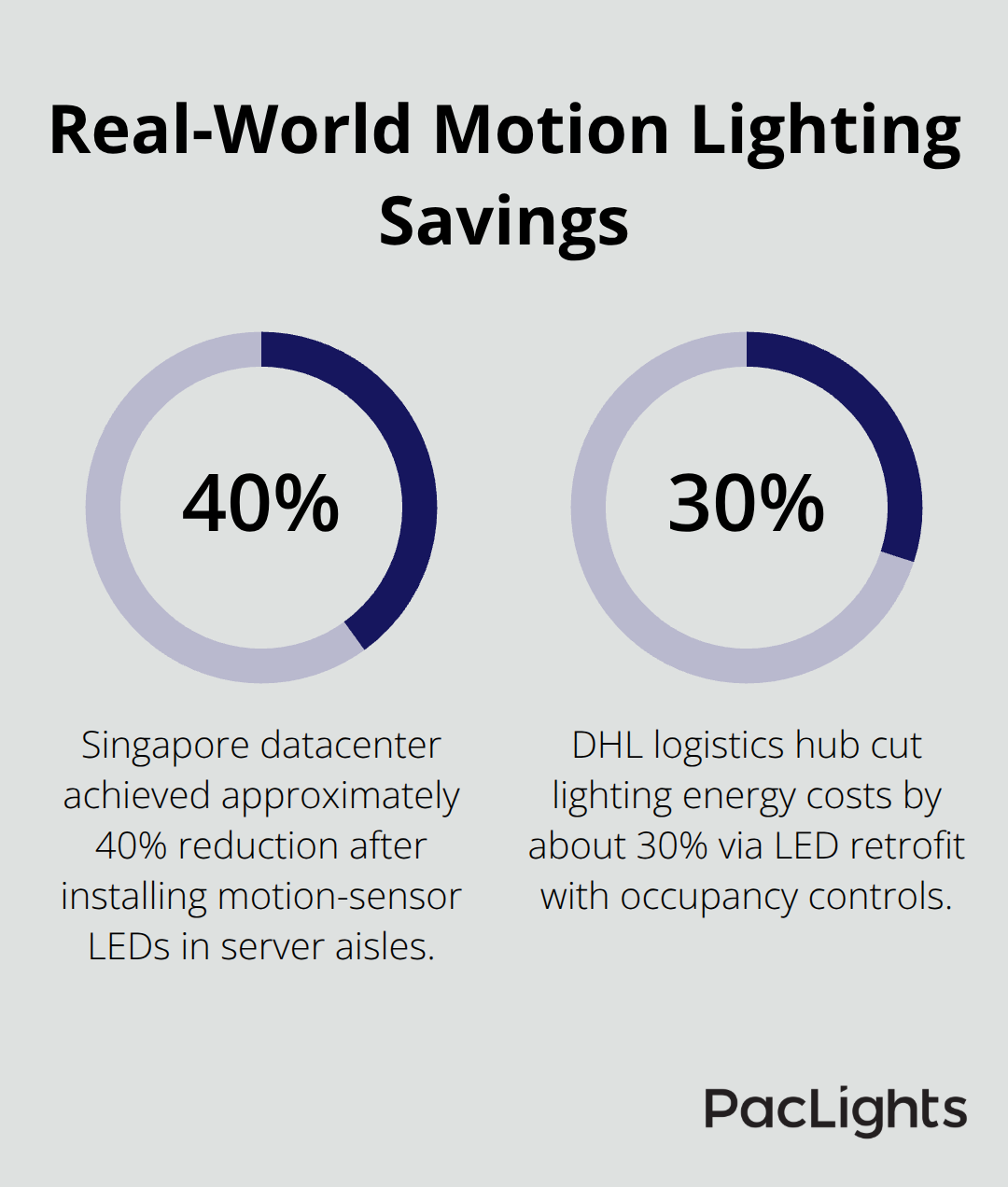
A Singapore datacenter reduced energy consumption by roughly 40% after installing motion-sensor LEDs in server aisles. A DHL logistics hub cut lighting energy costs by approximately 30% through LED retrofit with occupancy controls. The difference between success and mediocre performance hinges on sensor placement and sensitivity calibration.
Sensor Placement and Configuration
Sensors must cover critical corridors and maintenance routes without triggering from equipment movement, which requires professional installation and testing. Place sensors in high-traffic areas like equipment rows, entry points, and maintenance zones, then walk the detection zone to verify activation before full deployment. Adjustable sensitivity and timeout duration settings let you fine-tune performance for your specific layout-shorter timeouts in low-traffic areas minimize wasted illumination, while longer timeouts in active maintenance zones prevent constant on-off cycling that frustrates staff.
Integration with Building Management
The integration of motion lighting with building management systems enables real-time monitoring and predictive maintenance alerts. This transformation turns lighting from a passive utility into an active tool for operational efficiency. When you connect motion sensors to your existing controls, you gain visibility into occupancy patterns and can adjust settings across multiple zones simultaneously. These systems also provide condition data that helps identify maintenance needs before equipment fails, reducing downtime and extending fixture life.
With sensor placement optimized and controls configured, the next step involves selecting the right fixtures and integration approach for your specific datacenter layout.
How to Plan and Deploy Motion Sensor Lighting in Your Datacenter
Audit Your Current Lighting Footprint
Start by mapping your existing lighting before purchasing equipment. Walk your aisles during peak maintenance hours and note which areas stay dark or poorly lit, then observe traffic patterns during off-peak times to identify zones where lights burn unnecessarily. Document the wattage of existing fixtures, their burn hours, and current electricity costs per kilowatt-hour from your utility bills. This baseline data becomes your measurement stick for calculating actual savings post-deployment.

Many operators skip this step and overestimate their ROI because they lack concrete before numbers. Schedule this audit over 2-3 weeks to capture realistic usage across different shifts and maintenance windows.
Calculate Your Current Annual Lighting Spend
Once you have this data, multiply total wattage by operating hours by your utility rate. A 5,000-square-foot datacenter with 50 fixtures at 100 watts each, running 24 hours daily at $0.12 per kilowatt-hour, spends roughly $26,280 annually on lighting alone. Motion sensor retrofits typically reduce this by 30-50 percent, meaning savings of $7,884 to $13,140 per year in that scenario. This calculation shows stakeholders the real financial impact of your upgrade investment.
Select and Position Dual-Technology Sensors
Dual-technology sensors outperform PIR-only or ultrasonic-only options in datacenter environments because they eliminate false triggers from vibrating equipment and temperature swings. Install sensors at 8-10 feet height and angle them downward to maximize coverage of critical maintenance routes. Test sensitivity settings in each zone before full rollout because a corridor with constant equipment vibration needs different calibration than an entry vestibule. The 2024 International Energy Conservation Code requires manual off controls alongside occupancy sensors, so your installation must include accessible switches that let technicians override automatic operation when needed.
Integrate with Your Building Management System
Integration with your existing building management system transforms isolated sensors into a coordinated network that tracks occupancy patterns, adjusts dimming levels, and logs maintenance alerts across multiple zones simultaneously. Systems communicating via BACnet or Modbus protocols work with most modern datacenter controls, but verify compatibility before committing to hardware. This networked approach (combined with motion detection and dimming) delivers the energy reductions that justify the investment.
Deploy a Pilot Program First
Start with a pilot deployment in 3-5 aisles to quantify actual energy reduction and refine sensor placement before rolling out across the entire facility. This approach limits disruption and gives you real data to justify full-scale investment to stakeholders who otherwise see only upfront costs. Once your pilot demonstrates measurable savings, you’ll have the confidence and evidence needed to expand motion sensor lighting across your entire datacenter operation.
What’s Your Real Payback Timeline on Motion Sensor Lighting
Calculate Your Payback Period with Actual Numbers
The payback period for motion sensor lighting in datacenters typically ranges from 18 to 36 months depending on local electricity rates and deployment scope. Start with the baseline calculation from your audit: if your 5,000-square-foot facility spends $26,280 annually on lighting and motion sensors reduce consumption by 40 percent, you save $10,512 per year. A complete retrofit with dual-technology sensors, LED fixtures, and integration costs roughly $25,000-$35,000 installed, putting your payback at 2.4-3.3 years. However, this assumes standard commercial electricity rates around $0.12 per kilowatt-hour. Facilities in high-cost regions like California or the Northeast paying $0.18-$0.22 per kilowatt-hour see payback in 18-24 months because energy savings carry greater financial weight.
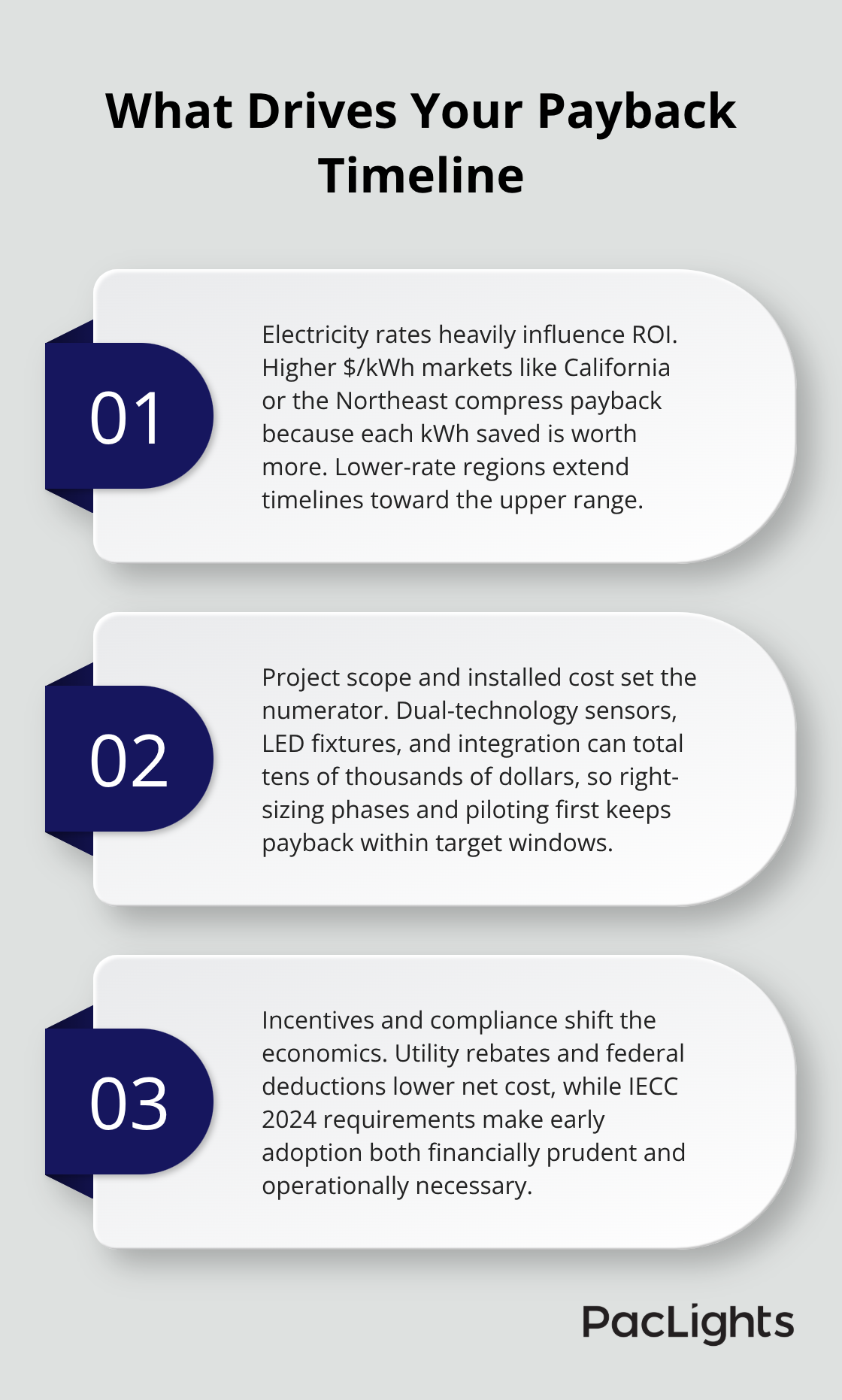
Conversely, operators in lower-cost regions might stretch toward the 4-year mark.
Account for Regulatory Compliance Timing
The 2024 International Energy Conservation Code mandate adds another layer to your investment decision: facilities that delay compliance face potential fines and eventually forced retrofits anyway, so deploying motion sensors now locks in your timeline rather than gambling on future regulatory pressure. This regulatory shift transforms motion sensor lighting from an optional efficiency upgrade into a business necessity. Calculate payback using your actual utility rate and measured baseline consumption, not industry averages, because that’s the only number that matters for your investment decision.
Reduce Maintenance Costs Significantly
Operational cost reductions extend far beyond the electricity savings from reduced lighting hours. LED fixtures combined with motion sensors dramatically lower maintenance costs because LEDs last 50,000-100,000 hours compared to 10,000-15,000 hours for traditional fixtures, and sensors prevent unnecessary burn-time that shortens fixture life. A datacenter replacing 100 fluorescent fixtures annually drops that to replacing 15-20 fixtures when paired with motion control. Over a five-year period, that’s 400-500 fewer fixture replacements, translating to roughly $8,000-$15,000 in avoided labor and material costs.
Capture Utility Rebates and Tax Incentives
Utility rebate programs accelerate payback significantly: many regional utilities offer $1-$3 per fixture rebates or $0.10-$0.20 per kilowatt-hour saved for motion sensor lighting in commercial facilities. Federal tax incentives under Section 179D allow deductions up to $1.88 per square foot for commercial lighting system upgrades that meet energy efficiency standards, potentially recovering 15-25 percent of your retrofit investment through taxes. Contact your local utility’s commercial programs department to identify available rebates before purchasing equipment because some programs require pre-approval, and missing the application window costs you thousands in missed incentives. The combination of direct energy savings, reduced maintenance expense, and rebate capture typically compresses your real payback to 18-28 months, making this investment substantially faster than most facility upgrades.
Final Thoughts
Motion sensor lighting delivers measurable financial returns alongside genuine environmental impact. Your datacenter saves 30-50% on lighting energy costs while reducing maintenance expenses through longer-lasting LED fixtures that require fewer replacements over time. The payback period of 18-36 months makes this one of the fastest ROI upgrades available, especially when you factor in utility rebates and federal tax incentives that compress your real investment timeline.
Motion lighting systems align your operations with the 2024 International Energy Conservation Code requirements for computer rooms, eliminating compliance risk while positioning your facility as an energy-conscious operator. Reduced electricity consumption lowers your facility’s carbon footprint and operational costs simultaneously. LED fixtures paired with motion sensors cut energy demand by millions of kilowatt-hours annually across large datacenter campuses, contributing meaningfully to decarbonization goals that matter to stakeholders and regulators alike.
Start with a pilot deployment in 3-5 aisles to capture real baseline data and validate energy reductions before full-scale rollout. We at PacLights provide free lighting layout designs and ROI assessments to help you quantify savings specific to your datacenter configuration. Contact us to discuss your motion sensor lighting strategy and unlock the financial and environmental gains waiting in your aisles.
Disclaimer: PacLights is not responsible for any actions taken based on the suggestions and information provided in this article, and readers should consult local building and electrical codes for proper guidance.