

Lighting accounts for about 10% of global electricity consumption, yet most buildings still rely on outdated fixtures that waste energy and money. At PacLights, we’ve seen firsthand how wafer downlight energy efficiency can transform both your utility bills and environmental footprint.
LEDs aren’t just brighter-they use 75% less energy than traditional incandescent bulbs while lasting 25 times longer. This guide shows you exactly how to maximize those savings.
How Much Energy Do LEDs Actually Save
The Real Numbers Behind LED Efficiency
The numbers tell a compelling story. According to the U.S. Department of Energy, LEDs consume roughly 75% less energy than incandescent bulbs and use about 44% less energy than fluorescent fixtures. Energy Star data shows an incandescent bulb costs around $7.23 per year to operate, while an equivalent LED costs just $1.08 annually-a difference of $6 per bulb every year. If your building has 50 light sockets, that translates to $300 in annual savings from bulbs alone.
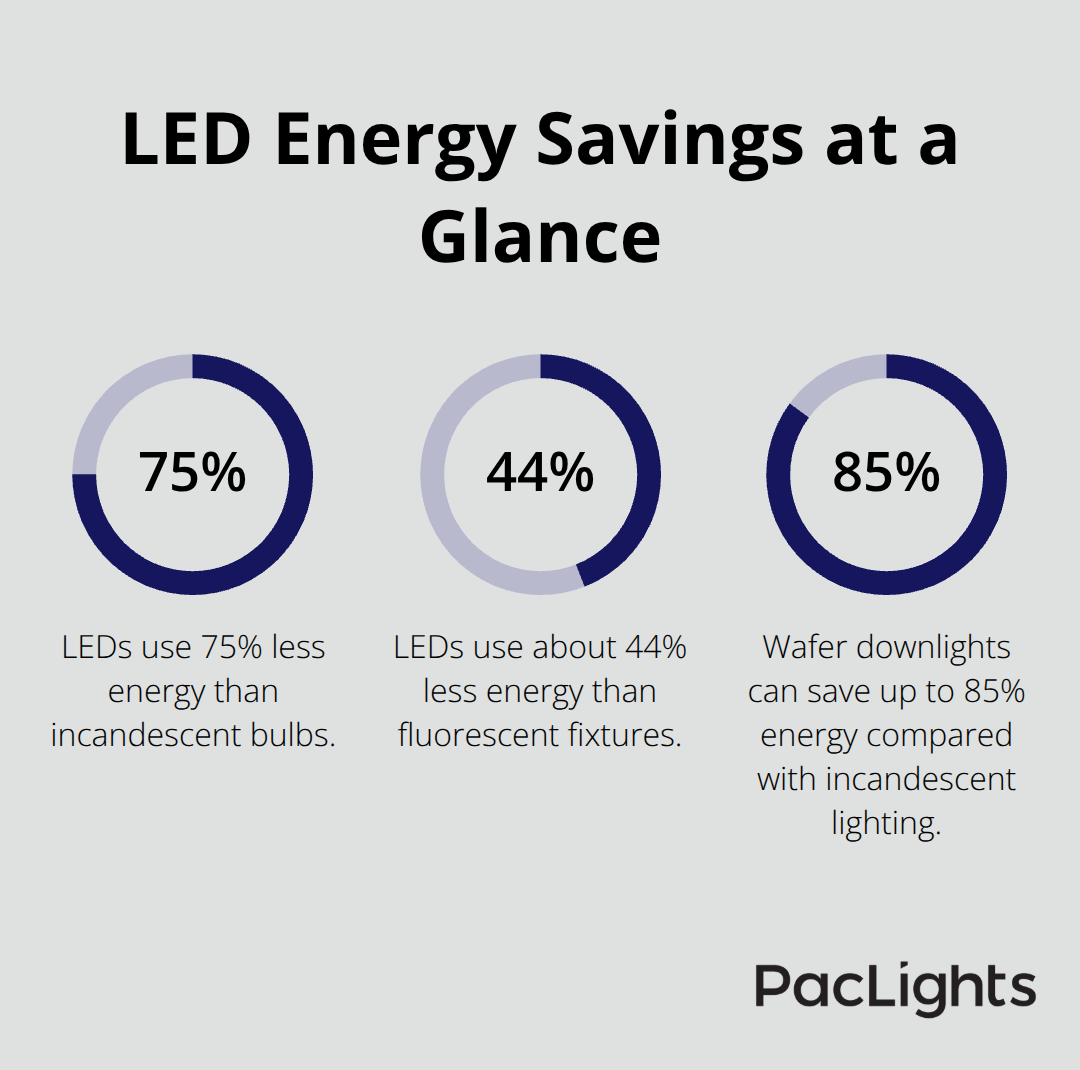
Wafer downlights push these advantages further. They can save up to 85% energy compared with incandescent lighting because they emit virtually no heat waste. The typical LED generates minimal thermal loss, which means almost all electricity converts directly into usable light rather than wasted heat. This matters especially in commercial and industrial spaces where cooling costs compound energy expenses.
Comparing Fixture Replacements and Payback
A metal halide lamp burning 400 watts can be replaced with a 150-watt LED delivering superior brightness and quality. Over a year running 12 hours daily at $0.125 per kilowatt-hour, that single swap saves approximately $2,737 in energy costs alone.
Long-term ownership costs shift dramatically with wafer LEDs. Traditional incandescent bulbs last 1,000 hours, metal halide lamps 6,000 to 15,000 hours, and fluorescent fixtures 20,000 to 30,000 hours. LED wafer downlights exceed 25,000 hours routinely, with premium models reaching 50,000 hours or beyond. This extended lifespan slashes maintenance labor and replacement inventory expenses.
In a facility replacing 20 fixtures with 50,000-hour LEDs instead of 10,000-hour metal halides, maintenance costs drop by roughly $13,000 over the LED’s operational life. When you factor in available utility rebates-many programs offer $100 per fixture-a $3,000 net investment in 20 wafer downlights can yield a first-year return on investment of 129% and lifetime ROI exceeding 1,400%. The payback period typically falls between 9 months and 18 months depending on your operating hours and local electricity rates.
Carbon Reduction and Environmental Responsibility
Buildings account for about 30% of global energy consumption, with lighting representing roughly 10% of that total. Switching to LED wafer downlights reduces your facility’s carbon footprint immediately. Lower electricity consumption means reduced demand from power plants and fewer emissions tied to generation.
A building operating 50,000 annual lighting hours and switching from halogen to LED cuts approximately 180 metric tons of CO2 emissions over a decade. This isn’t theoretical-it’s the direct result of consuming less electricity from the grid. These environmental gains compound across your entire facility when you upgrade multiple spaces and fixture types simultaneously.
Understanding your current energy consumption and available rebates positions you to make informed decisions about which fixtures deliver the strongest financial and environmental returns. The next section explores how to place and space these fixtures strategically to maximize those savings across your property.
Wafer Downlights Outperform Traditional Fixtures in Real Installations
Installation Simplicity and Cost Advantages
Wafer downlights succeed where traditional can lights and recessed fixtures fail because they demand far less ceiling modification. A standard recessed can light requires 6 to 8 inches of clearance above the ceiling, forcing costly structural work in retrofit projects. Wafer downlights fit into openings as small as 4 inches, meaning you can upgrade existing spaces without tearing into joists or rerouting ductwork. This practical advantage translates directly to lower labor costs.
A commercial facility retrofitting 100 fixtures saves thousands in installation expenses simply because wafer designs eliminate extensive ceiling work. The slim profile also allows installation in hallways, closets, and tight spaces where traditional fixtures simply won’t fit. You avoid the complexity and expense that plague conventional recessed lighting upgrades.
Thermal Management and Longevity
Heat dissipation matters more than most installers realize. LED wafer downlights produce minimal thermal output compared to halogen or metal halide alternatives, but proper ventilation remains essential. You must maintain adequate spacing from insulation and follow manufacturer guidelines on clearance-typically 3 inches minimum from combustible materials. Failure to respect these specifications causes premature LED degradation and voided warranties.
Quality wafer lights include aluminum heat sinks that actively manage thermal load, extending lifespan from 25,000 hours to 50,000 hours or beyond. This thermal engineering separates premium fixtures from budget alternatives that rely on passive cooling alone. The difference in operational life directly impacts your maintenance budget and total cost of ownership.
Brightness, Color, and Visual Quality
Brightness and color rendering determine whether your upgrade actually improves the space or merely saves energy while creating a dim, unflattering environment. Wafer downlights deliver 400 to 1,000 lumens depending on the model, sufficient for most commercial applications when spaced correctly.
Color temperature flexibility matters more in real-world installations than marketing claims suggest. Warm white at 2700K suits hospitality and residential spaces because it creates perceived comfort, while 4000K neutral white works best in offices and retail where task visibility matters. Cool daylight at 5000K belongs in industrial facilities and precision work areas only.
Color Rendering Index scores above 90 preserve natural color accuracy, critical in retail environments where merchandise appearance directly impacts sales. A grocery store with poor CRI lighting makes fresh produce look dull and unappetizing, directly harming customer perception and purchasing decisions. Specify CRI 90 or higher for any retail or design-focused installation.
Smart Controls and Adaptive Lighting
Dimming capability adds significant practical value beyond energy savings. A conference room equipped with dimmable wafers allows occupants to adjust brightness for presentations, reducing eye strain and cutting energy consumption during off-peak usage. Smart control integration with motion sensors and daylight harvesting systems amplifies these savings further by removing the human factor entirely.
Occupancy sensors alone reduce energy consumption by 15% to 30% in spaces with variable usage patterns. These automated systems respond to actual occupancy rather than relying on manual switches, capturing savings that manual operation simply cannot achieve.
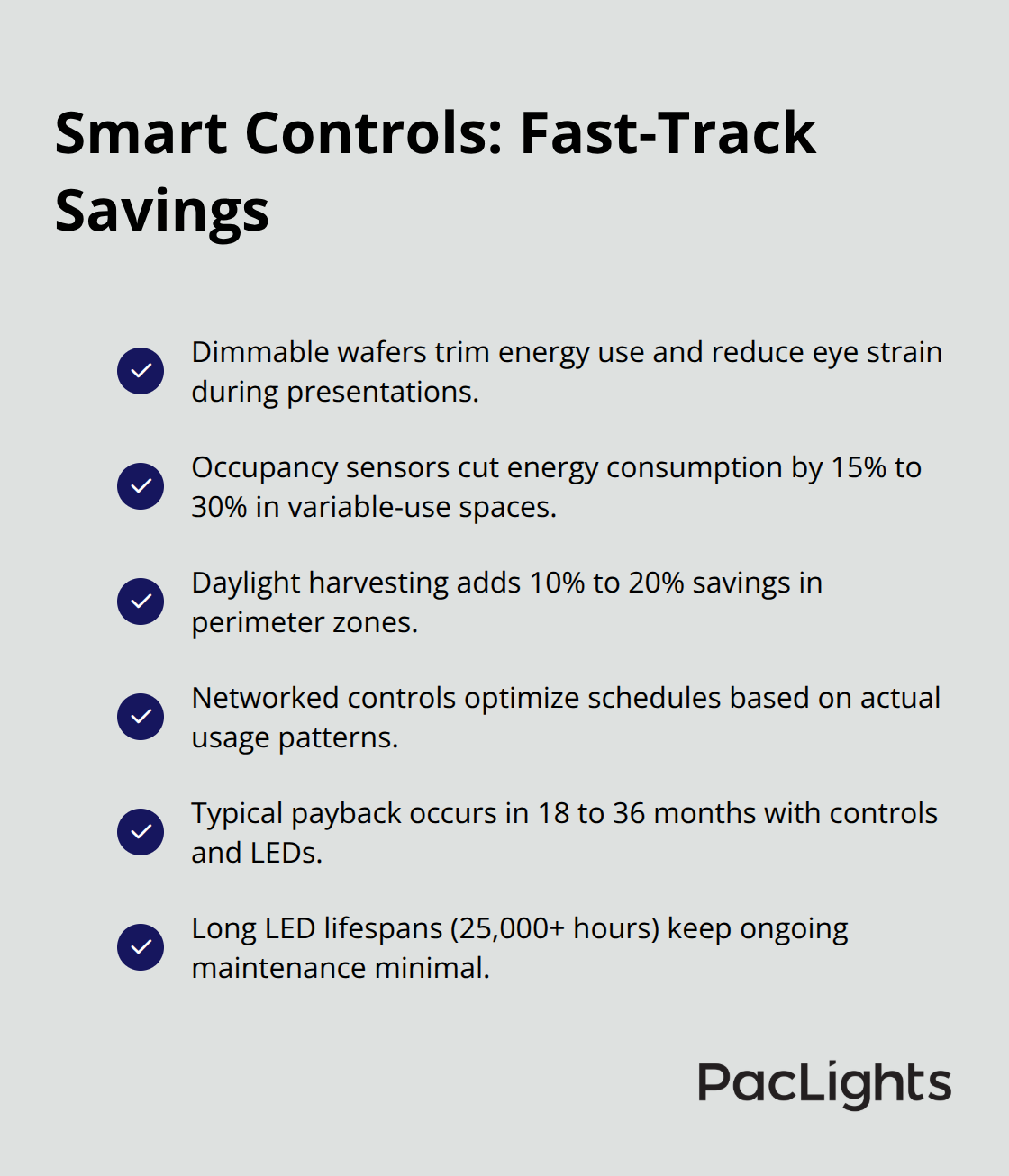
The combination of efficient fixtures and intelligent controls creates a lighting system that adapts to real building needs rather than operating at fixed levels regardless of demand.
Understanding how these performance factors work together positions you to select wafer downlights that deliver both immediate energy savings and long-term operational advantages. The next section explores how to place and space these fixtures strategically to maximize those savings across your property.
How to Position Wafer Downlights for Maximum Savings
Calculate Lumen Requirements, Not Fixture Counts
Spacing and placement determine whether your wafer downlight investment delivers promised energy savings or underperforms in real conditions. Most facilities calculate fixture counts incorrectly, either oversizing their layout and wasting energy or undersizing and creating dark zones that force occupants to add supplementary lighting. The correct approach starts with lumen requirements, not fixture counts.
A 30-foot-by-40-foot office space needs approximately 3,000 to 5,000 lumens depending on task type. General office work demands 300 to 500 lux, while detailed design work requires 750 lux or higher. If your wafer downlights deliver 600 lumens each, you need roughly 5 to 8 fixtures, not the 12 that inexperienced installers often specify.
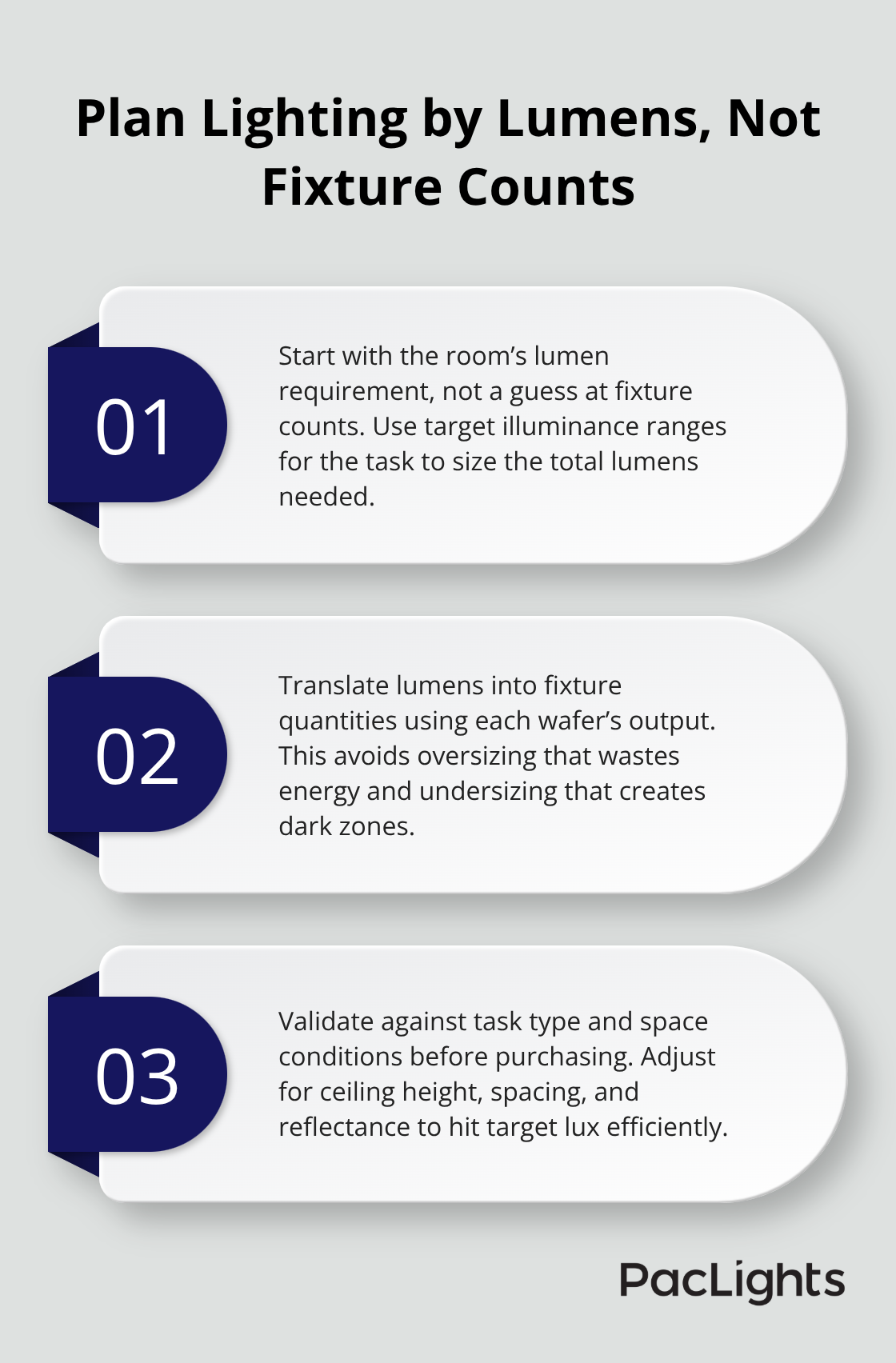
Oversized layouts consume 40% more energy than necessary while creating harsh glare and eye strain. Undersized layouts force workers to turn on additional lamps, negating efficiency gains entirely. The solution requires calculating your actual illumination needs based on task type, ceiling height, and surface reflectivity-light paint reflects 80% of incident light while dark surfaces absorb 40%, fundamentally changing how many fixtures you need.
Account for Room Variables and Surface Properties
Ceiling height and wall color dramatically affect how many fixtures you actually need. A 9-foot ceiling distributes light differently than a 12-foot ceiling, and reflective surfaces amplify light output while dark finishes absorb it. These variables determine whether your installation succeeds or fails in practice.
Professional lighting design accounts for these factors systematically. You calculate illumination levels based on actual space dimensions, material properties, and task requirements rather than applying generic rules of thumb. This precision prevents both energy waste and inadequate lighting that frustrates occupants and reduces productivity.
Deploy Motion Sensors for Variable-Occupancy Spaces
Motion sensors reduce energy consumption by 15% to 30% in spaces with variable occupancy. Conference rooms, restrooms, and storage areas see dramatic savings because lights operate only when needed rather than during entire business hours. A commercial building with 200 fixtures running 4,000 hours annually at $0.125 per kilowatt-hour saves approximately $1,800 per year from motion sensors alone, with payback occurring in roughly 18 months when combined with the fixture cost.
Daylight harvesting systems continuously monitor ambient light and reduce fixture output when natural light floods the space, capturing additional 10% to 20% savings in perimeter offices and retail environments. These automated systems respond to actual conditions rather than relying on manual switches, capturing savings that manual operation simply cannot achieve.
Integrate Smart Controls for Data-Driven Optimization
Smart controls that integrate motion detection, daylight sensors, and occupancy scheduling multiply efficiency benefits. Networked lighting systems allow facility managers to adjust brightness schedules based on actual usage patterns rather than static time clocks. This data-driven approach identifies which spaces sit empty during peak hours, allowing you to redirect energy toward areas where it actually matters.
Calculate your ROI by comparing current annual lighting energy costs against projected consumption with sensors installed, factoring in sensor hardware, wiring, and labor. Most facilities see payback between 18 and 36 months, after which every year delivers pure savings with minimal maintenance since LED lifespans extend 25,000 hours or beyond. PacLights offers free lighting layout designs and ROI assessments to help you quantify these savings before you invest.
Final Thoughts
Wafer downlight energy efficiency delivers measurable financial and environmental returns that extend far beyond initial installation. Switching from incandescent or halogen fixtures to LED wafers cuts energy consumption by 75% to 85%, translating to $300 annually from a 50-socket residential property or thousands more in commercial facilities. A business replacing 20 fixtures with 50,000-hour LEDs instead of shorter-lived alternatives recovers its investment within 9 to 18 months while eliminating roughly $13,000 in maintenance costs over the fixture lifespan.
Real-world installations confirm these projections consistently. A facility operating 12 hours daily at standard electricity rates saves approximately $2,737 annually per 400-watt-to-150-watt fixture swap, and motion sensors plus daylight harvesting push savings to 30% or higher in variable-occupancy spaces. The environmental impact compounds across your entire property: a building reduces roughly 180 metric tons of CO2 emissions over a decade when it cuts annual lighting hours from 50,000 to 37,500 through automation.
Your next step requires calculating actual requirements for your specific spaces rather than applying generic fixture counts. Ceiling height, wall color, task type, and occupancy patterns determine whether your upgrade succeeds or underperforms. Contact PacLights to receive free lighting layout designs and ROI assessments that quantify your savings before you invest.
Disclaimer: PacLights is not responsible for any actions taken based on the suggestions and information provided in this article, and readers should consult local building and electrical codes for proper guidance.