

Wafer downlight lumen output directly impacts how well your space is lit and how much energy you consume. At PacLights, we know that choosing the right brightness level isn’t just about comfort-it’s about efficiency and cost savings.
This guide breaks down what lumens actually mean, how they affect your lighting quality, and which output levels work best for different spaces.
What Lumens Really Tell You About Brightness
Lumens measure the total amount of visible light emitted from a source, and this is the only metric that matters when comparing brightness across different lighting technologies. A standard 100-watt incandescent bulb produces roughly 1,500 to 1,700 lumens, which serves as a useful reference point. The critical distinction is that lumens measure actual light output, while watts measure energy consumption. This separation is why wafer downlights are so efficient: a 9-watt LED wafer downlight can produce the same 800 lumens as a 60-watt incandescent, according to VOLT’s lumens-to-watts conversion data. When you shop for wafer downlights, ignore wattage entirely and focus on the lumen rating printed on the Lighting Facts label, which is standardized by the U.S. Department of Energy. This label guarantees you compare true brightness across products, not misleading power consumption figures.
How Beam Spread and Room Color Shape Perceived Brightness
The relationship between lumens and actual brightness perception depends heavily on how those lumens spread across your space. A 65-degree beam spread is the standard assumption for downlight calculations, and tighter beams require higher lumen outputs to achieve the same target brightness. Room dimensions matter too: a 100-square-foot living room targeting 20 foot-candles of brightness (the IES standard for residential living spaces) requires approximately 2,000 lumens total, while a 100-square-foot dining room needing 40 foot-candles requires about 4,000 lumens. Wall and ceiling color dramatically impacts perceived brightness-medium-dark surfaces can double your required lumens, and very dark surfaces can quadruple them.
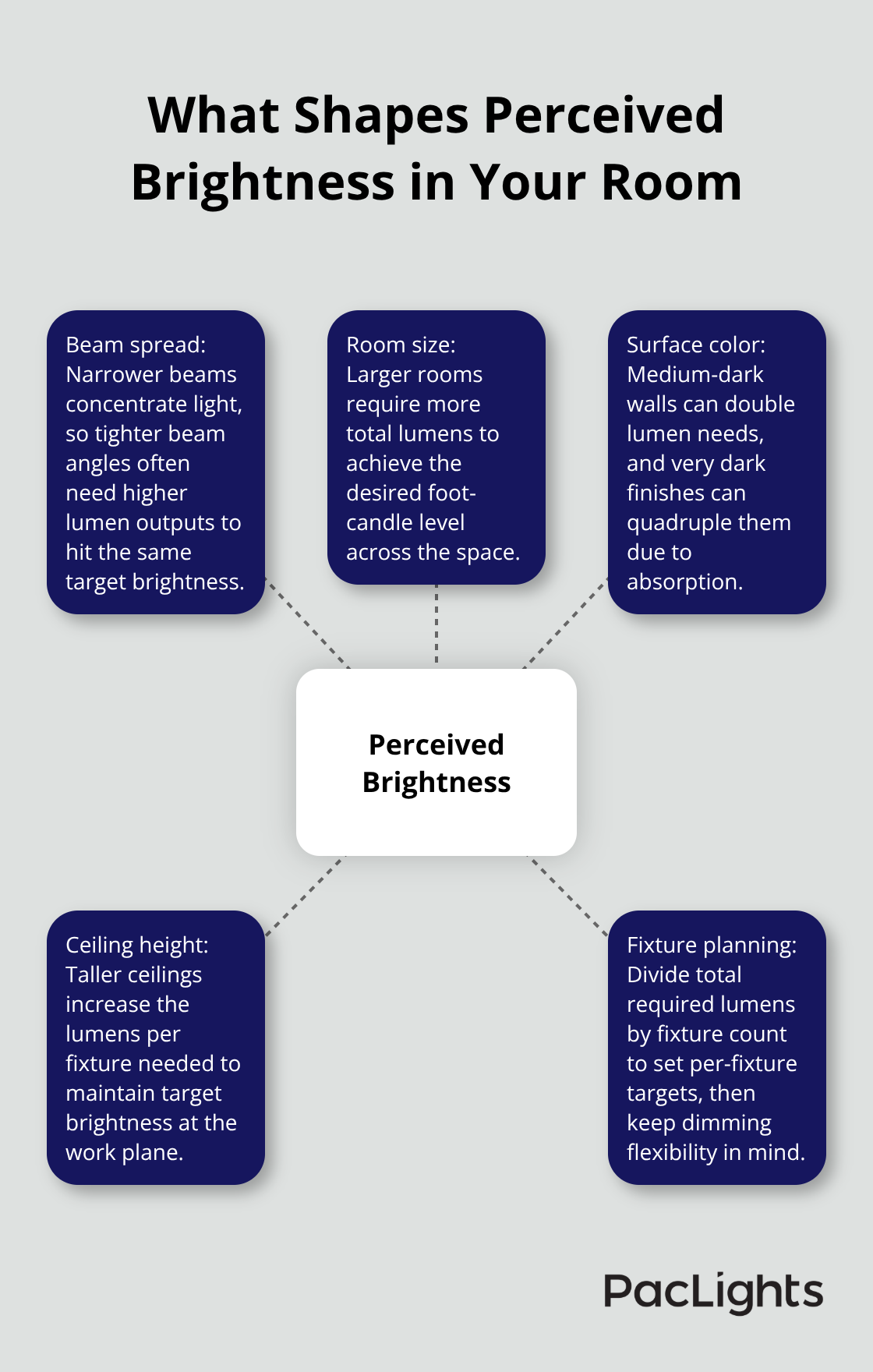
This is why you should calculate lumens per fixture by dividing your total requirement by the number of fixtures you plan to install, then add 10 to 20 percent extra capacity for flexibility and dimming control.
Candlepower, Color Temperature, and Actual Light Output
Candlepower, measured in candela, relates to how intense the light beam is in a specific direction, while lumens describe total output. In a standard 65-degree beam, approximately 1 candela equals 1 lumen of light intensity, but this relationship only applies to downlights with that specific beam angle. Color temperature-measured in Kelvin-does not change lumens; a 2700K warm white fixture and a 4100K neutral white fixture with identical lumen ratings deliver the same brightness, just different mood. The U.S. Department of Energy’s Lighting Facts program ensures that every LED product on store shelves displays accurate lumen output, so you can confidently compare models from different manufacturers. LED technology achieves 75 to 135 lumens per watt, compared to incandescent at 12 to 18 lumens per watt and halogen at 10 to 20 lumens per watt, according to ENERGY STAR data. This efficiency gap is why switching from traditional fixtures to LED wafer downlights cuts energy consumption by roughly 90 percent without sacrificing brightness.
Moving Forward: Efficiency Factors That Extend Performance
Understanding lumens sets the foundation for selecting the right fixture, but brightness alone doesn’t tell the complete story. The way a downlight converts electrical power into light output-and maintains that performance over time-determines whether your investment truly pays off.
How Wafer Downlights Convert Power Into Long-Term Performance
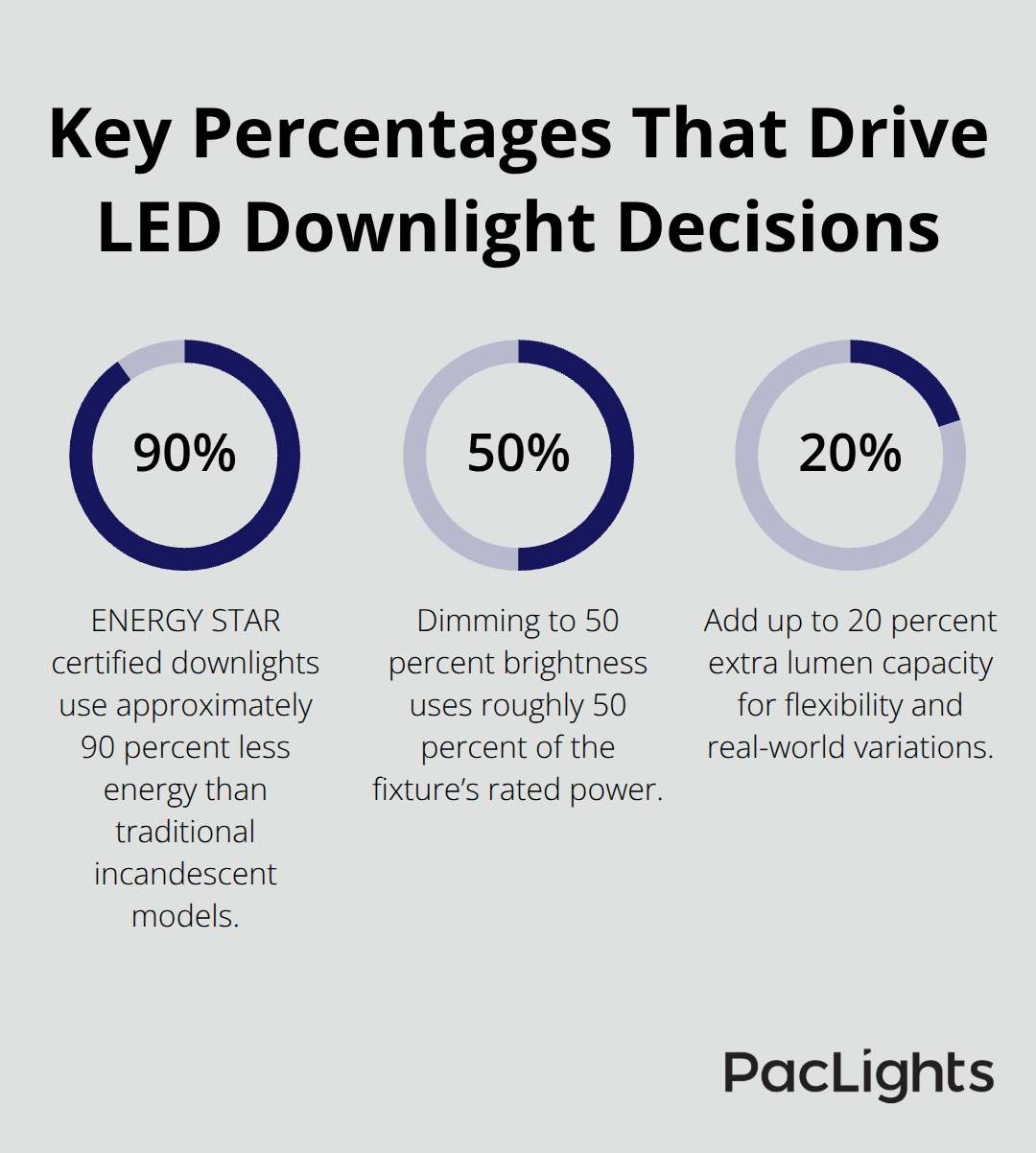
LED wafer downlights achieve their efficiency advantage through a fundamental difference in how they transform electricity into light. Where a 60-watt incandescent bulb wastes roughly 90 percent of its energy as heat, a 9-watt LED wafer downlight produces the same 800 lumens while converting that power far more effectively into visible light. This happens because LED technology operates at 75 to 135 lumens per watt according to ENERGY STAR data, compared to incandescent at 12 to 18 lumens per watt. The practical result is immediate: if every downlight and retrofit kit sold in the United States were ENERGY STAR certified, annual energy cost savings would exceed 1 billion dollars with over 12 billion kilowatt-hours saved and more than 18 billion pounds of greenhouse gas emissions prevented (equivalent to removing 1.8 million vehicles from roads). ENERGY STAR certified downlights use approximately 90 percent less energy than traditional incandescent models while delivering identical or superior brightness. When you select a wafer downlight, the wattage rating tells you almost nothing about performance; instead, focus on the lumen output and verify that the fixture carries ENERGY STAR certification, which guarantees the product has been tested for long-term performance and comes backed by a manufacturer warranty of at least three years.
Thermal Management Determines Real-World Lifespan
The heat a fixture produces directly affects how long it performs at rated brightness. Traditional recessed can lights generate significant heat that rises into the ceiling cavity, forcing your air conditioning to work harder and reducing the fixture’s lifespan through thermal stress. Wafer downlights emit minimal heat because LEDs convert most input power into light rather than thermal energy, which means the fixture itself stays cool and the surrounding ceiling space remains unaffected. This low heat output becomes critical in installations with limited ventilation or where insulation contacts the fixture; selecting an IC-rated (insulation contact) downlight prevents fire hazards and maintains steady performance. For installations beneath an unconditioned attic, Type AT (airtight) downlights minimize air leakage and preserve the energy you’ve invested in conditioning your indoor space. The combination of low heat and proper thermal management in quality wafer downlights extends effective lifespan and maintains consistent lumen output over years of use, whereas traditional fixtures often dim gradually as heat accumulates and degrades internal components.
Dimming Compatibility and Smart Control Reality
Not every LED wafer downlight works with every dimmer switch, and this incompatibility creates frustration for users who expect their new fixtures to function with existing controls. Verify dimmer compatibility on the dimmer manufacturer’s website or check the downlight packaging before purchase-ENERGY STAR maintains a compatibility list for reference. If you encounter a poor match, you face two options: replace the dimmer with a model rated for LED loads, or try a different downlight model with proven compatibility. This matters because running an incompatible dimmer with an LED fixture causes flickering, buzzing, or the light refusing to dim smoothly, negating the efficiency advantages you paid for. Smart wafer lights that offer app or voice control combined with dimming capability deliver real energy savings because you adjust brightness to match actual activity rather than running fixtures at full output all day. A fixture dimmed to 50 percent brightness consumes roughly 50 percent of its rated power, making smart controls a practical way to reduce consumption without sacrificing comfort.
Installation Ratings and Performance Standards
The specifications you choose during installation directly impact how your wafer downlights perform over their lifespan. ENERGY STAR certified downlights come in multiple configurations to match your specific installation environment, and selecting the wrong type compromises both safety and efficiency. IC-rated fixtures allow insulation to contact them safely, while non-IC-rated models require at least 3 inches of clearance from any insulation material. Type AT downlights seal air leaks in airtight installations, preventing conditioned air from escaping into unconditioned spaces above your ceiling. These installation ratings exist because they address real thermal and air-leakage challenges that affect your energy bills and fixture longevity. Checking your ceiling cavity conditions before purchase ensures you select the correct fixture type and avoid costly reinstallation later.
Moving Forward: Selecting Fixtures That Match Your Space
Understanding how wafer downlights convert power into light and maintain that performance over time positions you to make selections that actually deliver on efficiency promises. The next step involves matching specific lumen outputs and fixture types to the spaces where you’ll install them, accounting for room size, ceiling height, and the activities that happen in each area.
Matching Wafer Downlight Output to Your Space
Residential Brightness Standards and Calculation Methods
Selecting the right lumen output for wafer downlights requires matching brightness to actual room function, not guessing based on fixture size or price. The Illuminating Engineering Society (IES) provides specific foot-candle targets for different spaces, and these standards translate directly into the total lumens your installation needs. A living room targeting 10 to 20 foot-candles of brightness requires roughly 2,000 lumens across a 100-square-foot space, while the same-sized dining room needing 40 foot-candles demands approximately 4,000 lumens. Kitchens introduce task-specific demands: general food preparation areas need 30 to 40 foot-candles, but the stove and sink zones demand 70 to 80 foot-candles for safe cooking and cleanup. Bathrooms follow the same intensive lighting pattern at 70 to 80 foot-candles, especially around mirrors where grooming happens.
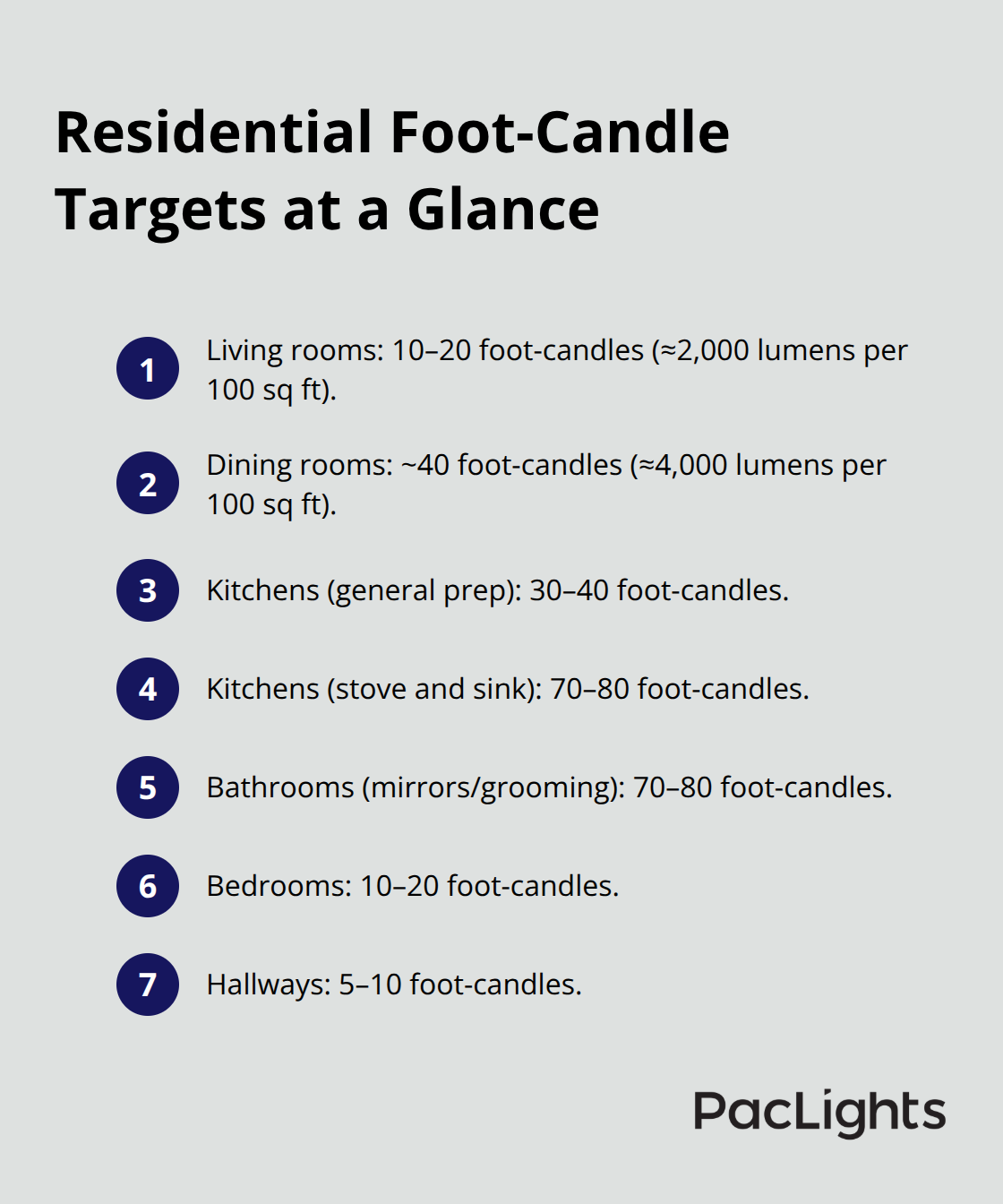
Bedrooms stay modest at 10 to 20 foot-candles, and hallways function adequately at just 5 to 10 foot-candles.
The calculation method is straightforward: multiply your room’s square footage by the target foot-candle level, then divide by the number of fixtures you plan to install to determine lumens per fixture. Ceiling height matters significantly-a 12-foot ceiling in a 12-by-12-foot room requires roughly 3,900 to 4,000 lumens total, substantially more than an identical footprint with an 8-foot ceiling. Dark wall and ceiling colors force you to add 50 to 100 percent more lumens to achieve the same perceived brightness, while very dark surfaces can require double that adjustment. Adding 10 to 20 percent extra lumen capacity above your calculated target gives you flexibility for dimming and accounts for real-world performance variations across fixture brands.
Commercial Space Requirements and Performance Standards
Commercial spaces follow stricter standards because task accuracy and worker safety depend on consistent, adequate illumination. Office environments typically require 50 to 75 foot-candles for general reading and writing tasks, while libraries demand 50 to 100 foot-candles to support detailed work and research. Hospital labs and surgical areas function at 75 to 100 foot-candles, and classrooms range from 30 to 100 foot-candles depending on whether instruction involves chalkboards, projectors, or hands-on activities. Retail spaces need even higher outputs because merchandise appearance and customer navigation drive sales-most retailers try for 75 to 100 foot-candles in sales areas and 100 to 150 foot-candles in fitting rooms or jewelry displays.
The practical difference between residential and commercial selection is that commercial installations cannot rely on dimming for energy savings; you must choose fixtures that deliver the exact lumen output required because turning down brightness compromises the space’s function. Wafer downlights excel in commercial applications because their low heat output prevents thermal stress in ceiling cavities where dozens of fixtures operate simultaneously, and their consistent lumen output maintains performance across long operating hours without dimming.
Energy Savings in Commercial Upgrades
If you upgrade existing commercial systems, switching to ENERGY STAR certified wafer downlights cuts energy consumption by approximately 90 percent compared to traditional incandescent or halogen fixtures, which translates directly into measurable cost reductions on monthly utility bills. This efficiency advantage compounds over time as you eliminate the heat load that forces air conditioning systems to work harder and the frequent bulb replacements that traditional fixtures demand. Commercial facilities with dozens or hundreds of fixtures see substantial annual savings that justify the upfront investment in modern LED technology.
Residential Selection Strategy
For residential projects, start with your room’s square footage and intended activities, calculate total lumens using IES standards, then select fixtures with dimming capability to adjust brightness for different times of day and moods. This approach (combining accurate calculations with flexible controls) lets you optimize both comfort and energy consumption without overbuilding your lighting system.
Final Thoughts
Wafer downlight lumen output determines both your lighting quality and energy costs, making informed selection the foundation of any successful installation. Ignore wattage entirely and focus on lumens, which measure actual brightness across all lighting technologies. Match your lumen requirements to room function using IES foot-candle standards, account for ceiling height and wall color, then add 10 to 20 percent extra capacity for dimming flexibility.
When selecting fixtures, prioritize ENERGY STAR certification, which guarantees 90 percent energy savings compared to traditional incandescent models and comes with manufacturer warranties of at least three years. Verify dimmer compatibility before purchase to avoid flickering or buzzing, and choose IC-rated or Type AT fixtures based on your specific installation environment. These details directly impact long-term performance and the actual savings you realize on utility bills.
The efficiency advantage of LED wafer downlights compounds over years of operation-a 9-watt LED producing 800 lumens versus a 60-watt incandescent delivering the same brightness illustrates the real-world impact with lower monthly energy consumption, reduced cooling loads from minimal heat output, and fewer replacement cycles. PacLights provides energy-efficient lighting solutions tailored to your needs with optional daylight and motion controls to further optimize energy use. Start with accurate lumen calculations, verify fixture specifications, and let performance data guide your decision rather than price alone.
Disclaimer: PacLights is not responsible for any actions taken based on the suggestions and information provided in this article, and readers should consult local building and electrical codes for proper guidance.