

Cylinder wall lights do more than illuminate a space-they shape how people experience it. At PacLights, we’ve seen firsthand how the right lighting transforms commercial environments, affecting everything from how customers feel to how safely employees work.
The appearance of these fixtures matters just as much as their function. A well-chosen cylinder wall light becomes part of your building’s identity while delivering the brightness and coverage your space needs.
Why Cylinder Wall Lights Transform Commercial Spaces
How Placement Shapes Customer and Employee Behavior
Cylinder wall lights shape how people move through and work within commercial environments in ways that overhead fixtures simply cannot. The placement and design of these fixtures directly influence foot traffic patterns, customer perception, and operational safety. In retail settings, cylinder wall lights mounted at eye level around displays create focal points that guide shoppers toward high-margin products. In hospitality environments, the same fixtures positioned along corridors establish a sense of welcoming luxury that justifies premium pricing. Strategic cylinder wall light placement reduces ambient light waste by concentrating illumination where it matters most, cutting energy consumption by 30 to 50 percent compared to uniform overhead lighting schemes.
Productivity and Safety in Warehouses and Offices
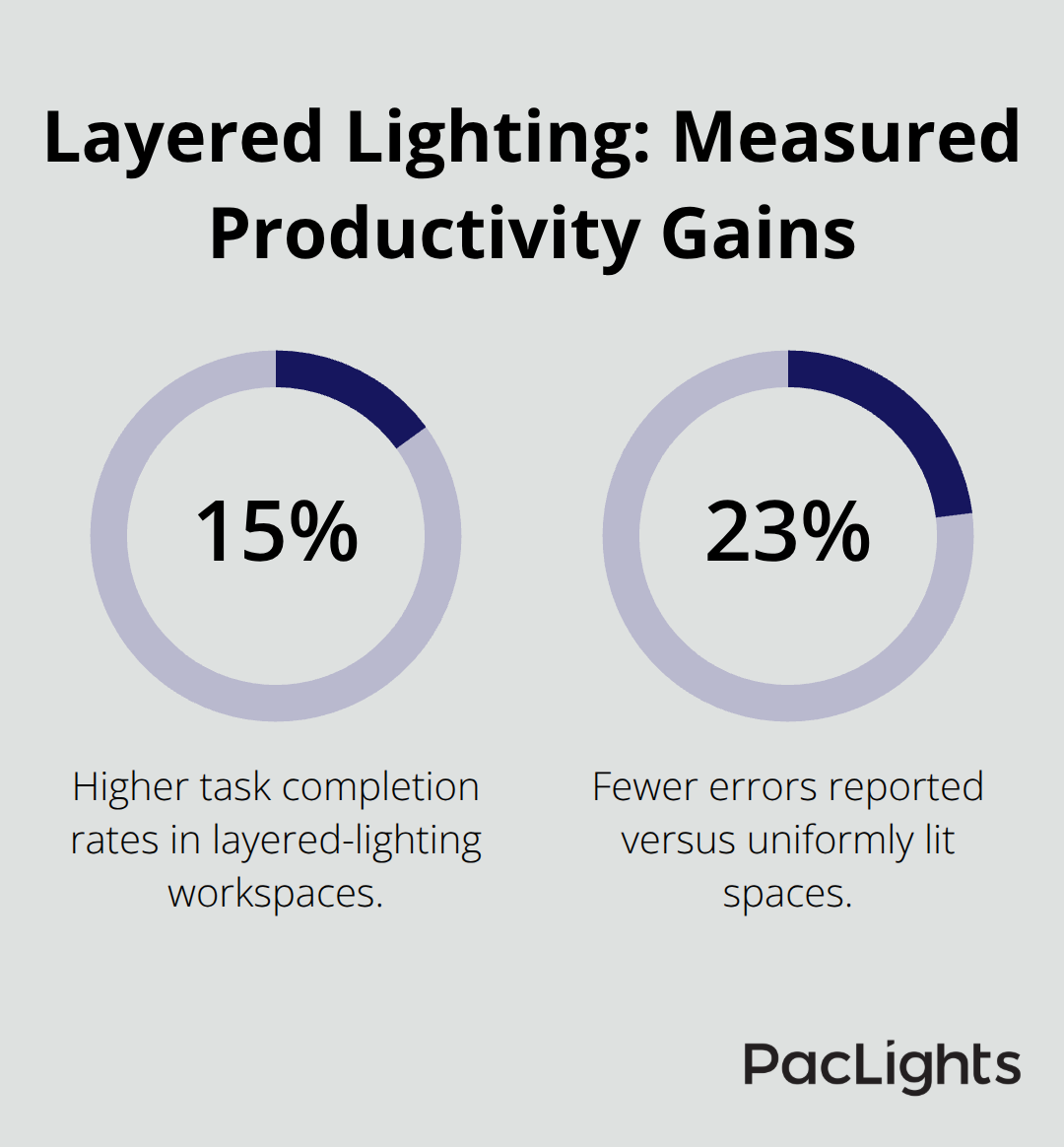
Employee productivity rises measurably when cylinder wall lights provide task-specific illumination in office and warehouse environments. A 2019 study published in the Journal of Environmental Psychology found that workers in spaces with layered lighting-combining ambient overhead light with focused wall sconces-reported 15 percent higher task completion rates and 23 percent fewer errors than those in uniformly lit spaces.
Color temperature selection matters intensely here: 4000K fixtures in commercial corridors and workstations support alertness and safety without the eye strain that cooler 5000K lighting creates during extended shifts.
In warehouses, cylinder wall lights rated at 200 to 400 lumens positioned at 60 to 72 inches height eliminate shadows along aisles and reduce accident rates by improving visibility of potential hazards.
The Financial Case for LED Cylinder Conversion
The financial case for upgrading to LED cylinder wall lights proves compelling across all commercial applications. A 50-fixture installation replacing older incandescent or halogen sconces with 10W LED cylinders saves approximately 2,000 watts during continuous operation, translating to annual energy savings exceeding 1,000 dollars at typical commercial rates of 0.14 dollars per kilowatt-hour. When combined with occupancy sensors or daylight harvesting controls, these savings jump to 70 to 80 percent in spaces with variable occupancy patterns.
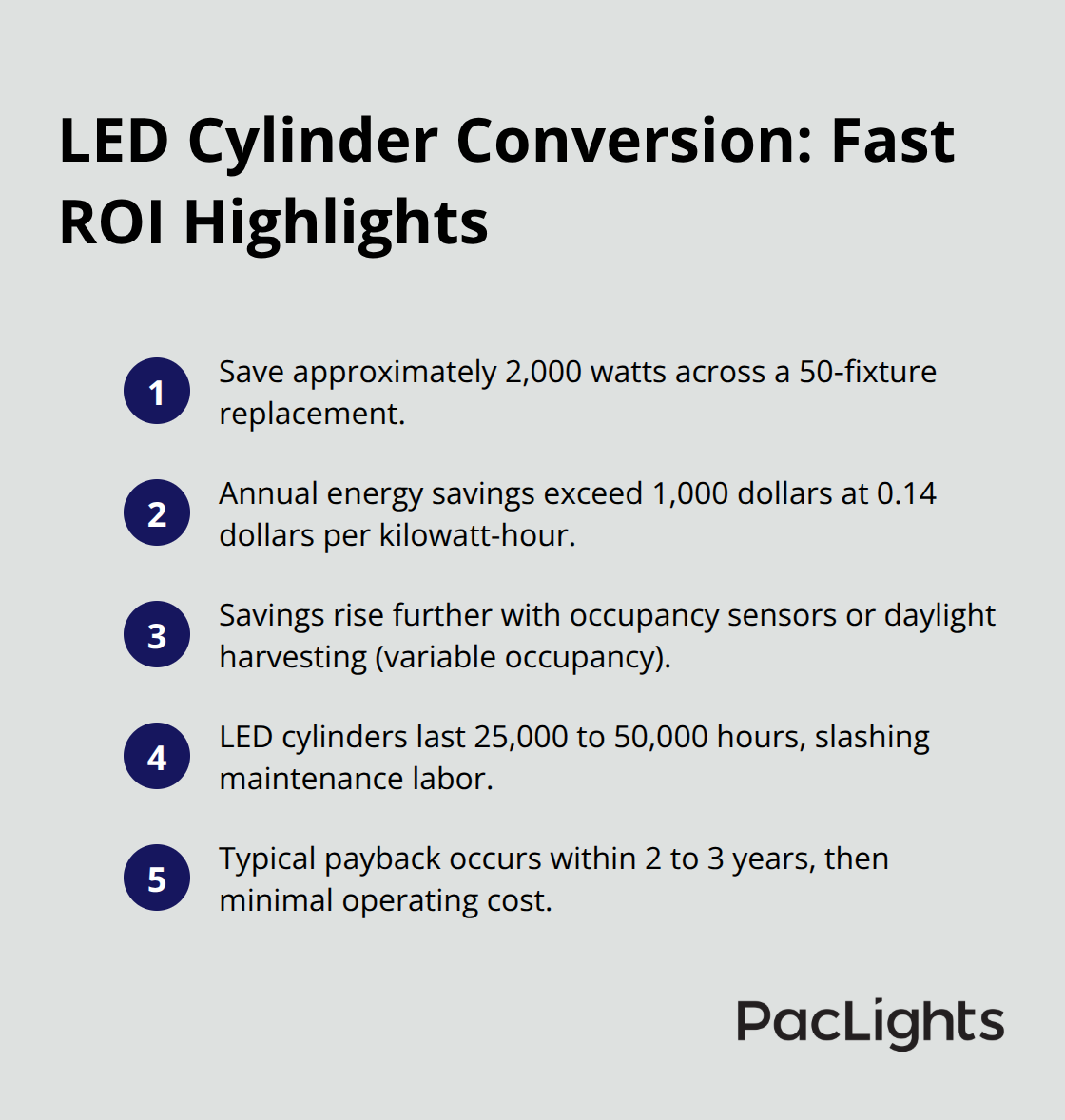
Maintenance costs drop further because LED cylinders deliver 25,000 to 50,000 hours of life, eliminating the labor-intensive bulb replacement cycles that plague traditional fixtures. A single mid-sized commercial installation can save 500 to 1,000 dollars annually in maintenance labor alone. The payback period typically ranges from 2 to 3 years, after which the fixture operates at minimal cost for a decade or more.
Material Selection and Environmental Performance
The materials you select for cylinder wall lights determine how long they perform in your specific environment. Aluminum housings with powder-coated finishes (2 to 3 mils thickness) resist corrosion in standard commercial settings, while 304-grade stainless steel handles coastal or high-humidity environments where salt spray accelerates deterioration. Tempered or impact-resistant glass diffusers paired with UV-stabilized acrylic prevent yellowing and cracking that untreated plastics experience under continuous exposure. These material choices directly affect your total cost of ownership and the fixture’s ability to maintain consistent light output over its lifespan.
What Materials and Finishes Actually Perform in Commercial Environments
Selecting Materials That Resist Corrosion and Degradation
The material you choose for cylinder wall lights determines whether your fixtures maintain consistent performance or deteriorate within a few years. Aluminum housings with powder-coated finishes at 2 to 3 mils thickness handle standard commercial interiors reliably, but this choice fails catastrophically in coastal regions or high-humidity facilities where salt spray accelerates corrosion. 304-grade stainless steel costs roughly 40 percent more upfront than coated aluminum, yet in saltwater-adjacent locations, this premium disappears within 3 to 5 years when you factor in replacement cycles for corroded fixtures. Request technical datasheets that specify coating thickness and material grades rather than accepting vague marketing claims about weather-resistance. Tempered or impact-resistant glass diffusers paired with UV-stabilized acrylic prevent yellowing that untreated plastics experience under continuous sun exposure, maintaining light output consistency across the fixture’s lifespan.
Managing Heat Dissipation for LED Longevity
In warehouse and industrial settings where fixtures operate 12 to 16 hours daily, thermal management through aluminum heat sinks and active cooling fins becomes non-negotiable because poor heat dissipation causes LED color shifts, brightness reduction, and premature failure within 2 to 3 years. Fixtures rated for 40°C operation often throttle output or fail completely in environments reaching 50°C, so you must consult de-rating curves against your actual ambient temperatures to prevent expensive surprises. Upward-facing designs trap more heat than horizontal orientations, and enclosed soffits or tight corners lacking airflow accelerate thermal stress on LED drivers.
Color Temperature and Light Distribution
Color temperature selection shapes both productivity and visual comfort in ways that fixture aesthetics alone cannot achieve. 4000K fixtures provide the practical standard for commercial corridors, warehouses, and office workstations because this temperature supports alertness without the eye strain that cooler 5000K lighting creates during extended shifts, while 2700 to 3000K finishes work exclusively in hospitality settings where warmth justifies premium pricing. The finish you select-matte black, brushed nickel, bronze, or antique brass-determines how light distributes through the fixture’s geometry and how it integrates with surrounding architecture. Matte finishes scatter light more diffusely across walls, creating softer ambient illumination that works well in retail and hospitality environments, while polished or brushed metallic finishes produce more focused beams that concentrate light on specific display areas or task zones.
Finishes That Define Modern Commercial Aesthetics
In modern commercial spaces favoring minimalist aesthetics, matte black cylinders deliver contemporary contrast that complements light-colored walls and pairs effectively with mid-century or industrial design elements. Copper and brass fixtures deliver elegance in upscale hospitality venues but require regular maintenance to manage patina and moisture-related deterioration, making them poor choices for facilities lacking dedicated maintenance budgets. Dimming compatibility matters intensely here: 0 to 10V dimming or smart controls can cut energy use by 30 to 50 percent versus always-on fixtures, but you must verify that the LED driver supports dimming to avoid flicker or premature failure.
Smart Controls and Energy Optimization
Advanced lighting controls transform cylinder wall lights from static fixtures into responsive systems that adapt to occupancy and daylight conditions. Smart controls enable centralized management across multiple fixtures, allowing you to adjust brightness and color temperature remotely based on time of day, occupancy patterns, or specific operational needs. When you combine material durability with intelligent dimming and occupancy sensors, your installation delivers both aesthetic consistency and measurable energy reductions that compound over years of operation. The next section examines how these material and control decisions translate into real-world performance across different commercial applications.
Where Cylinder Wall Lights Deliver Real Performance Across Industries
Retail Environments: Guiding Customer Attention
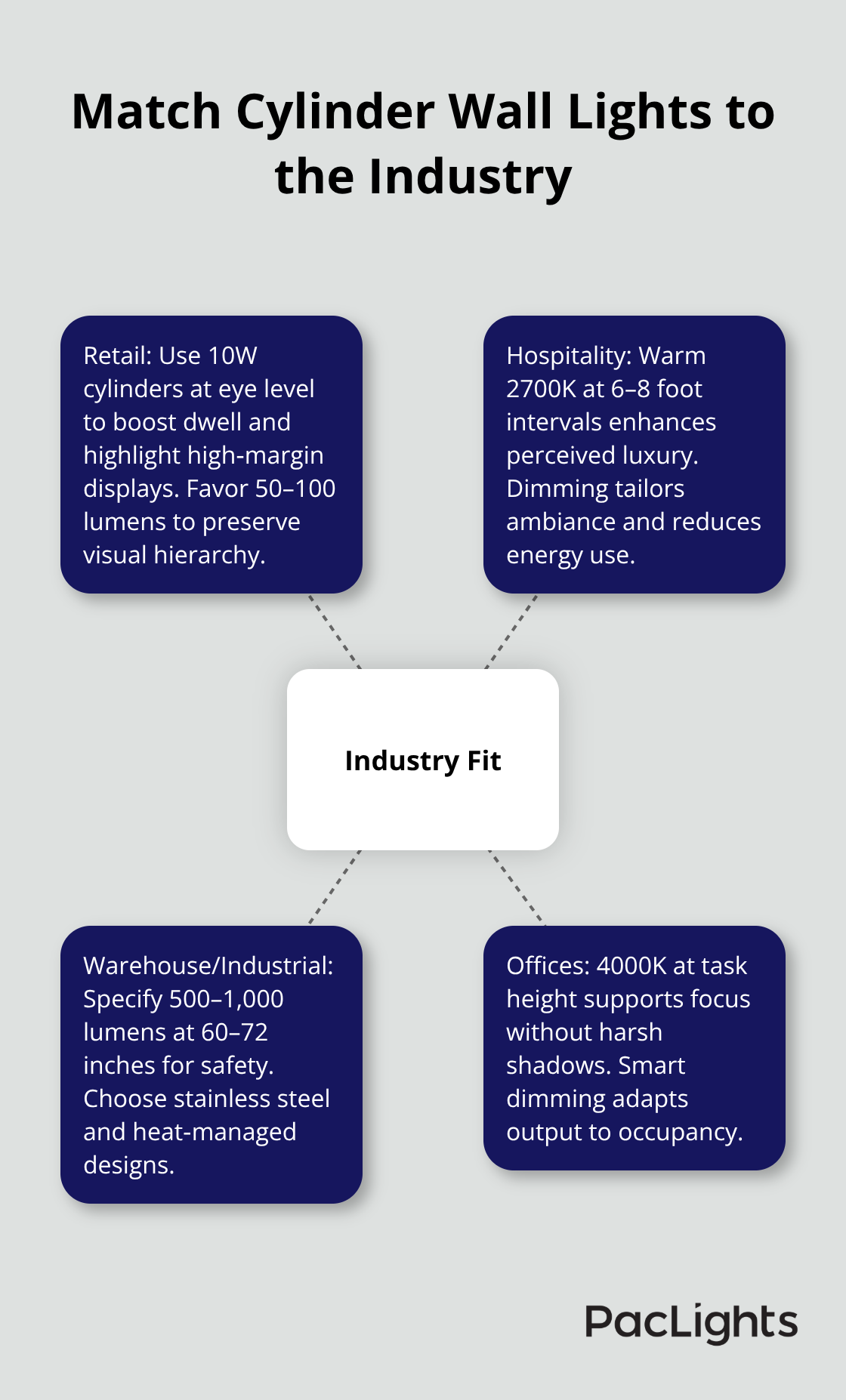
Retail environments demand cylinder wall lights that guide customer attention while maintaining consistent brightness across display zones. Positioning 10W LED cylinders at eye level-approximately 60 inches from the floor-over high-margin product displays increases dwell time and conversion rates because focused illumination draws the eye naturally to merchandise. A 2018 study by the Journal of Retailing and Consumer Services found that retailers using layered lighting with wall-mounted fixtures saw a 12 percent increase in average transaction value compared to uniformly lit spaces. These fixtures should emit 50 to 100 lumens per unit in retail displays rather than the 200 to 400 lumens required in commercial corridors, because excessive brightness overwhelms the visual hierarchy that drives purchasing decisions.
Hospitality Venues: Creating Luxury Through Light
Hospitality venues benefit from a fundamentally different approach to cylinder wall placement and specification. Warm 2700K cylinder lights positioned along corridors at 6 to 8 foot intervals create the visual depth and luxury perception that justifies premium room rates. The finish matters enormously here-matte black cylinders in modern hotels, bronze finishes in traditional properties-because the fixture becomes part of the guest experience rather than merely providing light. Dimming controls prove essential; restaurants that reduce fixtures to 60 percent brightness during dinner service cut energy consumption by 30 percent while simultaneously increasing perceived ambiance and customer satisfaction metrics. These hospitality spaces require 50 to 100 lumens per unit rather than the higher outputs demanded in commercial corridors, since excessive brightness strips away the intimate atmosphere that guests pay for.
Warehouse and Industrial Facilities: Prioritizing Safety and Durability
Warehouse and industrial facilities operate under completely different constraints than retail or hospitality spaces. These environments require 500 to 1,000 lumens minimum brightness from cylinder wall lights positioned at 60 to 72 inches height along aisles and work zones because poor visibility directly causes accidents and inventory errors. Upward-facing cylinder designs in warehouses trap heat and fail prematurely, so horizontal or downward-angled fixtures with active cooling fins extend LED life from 2 to 3 years to the full 25,000 to 50,000 hour rating. 304-grade stainless steel becomes mandatory in facilities with humidity, chemical exposure, or temperature fluctuations because aluminum corrodes rapidly under these conditions. Material selection here determines whether fixtures maintain performance or deteriorate within years of installation.
Office Buildings: Supporting Focus and Productivity
Office buildings and corporate spaces sit between retail and warehouse extremes-they need 4000K cylinder fixtures at 48 to 54 inches height around workstations and conference tables to support focus without creating harsh shadows that cause eye strain during 8-hour shifts. Smart dimming controls that reduce brightness to 70 percent during unoccupied periods deliver 40 to 60 percent total energy reductions in spaces with variable occupancy, and occupancy sensors automatically cut output when meeting rooms empty. These control strategies transform static fixtures into responsive systems that adapt to actual usage patterns rather than operating at constant output throughout the day.
Industry-Specific Requirements: Material Choices and Control Strategies
One-size-fits-all lighting fails across all three environments because each sector demands material choices, brightness levels, mounting heights, and control strategies that differ fundamentally. Retail spaces prioritize visual merchandising and customer psychology, hospitality venues emphasize ambiance and guest perception, while warehouses and offices focus on safety, productivity, and operational efficiency. The cylinder wall light that performs excellently in a hotel corridor creates excessive brightness in a retail display and insufficient output in a warehouse aisle. Selecting the right fixture for your specific industry means matching material durability to environmental conditions, brightness output to functional requirements, and control capabilities to occupancy patterns and operational schedules.
Final Thoughts
Cylinder wall lights appearance reflects your commitment to both visual quality and operational performance. Material choices like aluminum with proper powder coating for standard interiors or 304-grade stainless steel for coastal environments directly impact your total cost of ownership over five to ten years. Brightness output and color temperature must match your specific industry-retail spaces need 50 to 100 lumens per fixture at eye level, hospitality venues require warm 2700K light at 6 to 8 foot intervals, warehouses demand 500 to 1,000 lumens minimum with horizontal mounting, and offices need 4000K fixtures at task height with smart dimming.
The financial case compounds over time as LED cylinder fixtures save approximately 2,000 watts across a 50-fixture installation, delivering annual energy savings exceeding 1,000 dollars. Add occupancy sensors or daylight harvesting, and savings jump to 70 to 80 percent in variable-occupancy spaces. Maintenance costs drop because LED cylinders eliminate frequent bulb replacements, saving 500 to 1,000 dollars annually in labor, with payback typically occurring within 2 to 3 years.
We at PacLights understand that selecting the right cylinder wall lights requires matching material durability to environmental conditions, brightness output to functional requirements, and control capabilities to occupancy patterns. Contact our team to develop a lighting strategy that balances appearance with performance and delivers measurable returns on your investment.
Disclaimer: PacLights is not responsible for any actions taken based on the suggestions and information provided in this article, and readers should consult local building and electrical codes for proper guidance.