

Cylinder lights consume far more energy than modern LED alternatives, driving up your electricity bills year after year. At PacLights, we’ve helped countless facilities cut lighting costs by 60–70% through strategic retrofits.
This cylinder lighting retrofit guide walks you through upgrading your fixtures without shutting down operations. You’ll learn how to plan, execute, and measure the financial impact of your project.
Why Your Cylinder Lights Cost More Than They Should
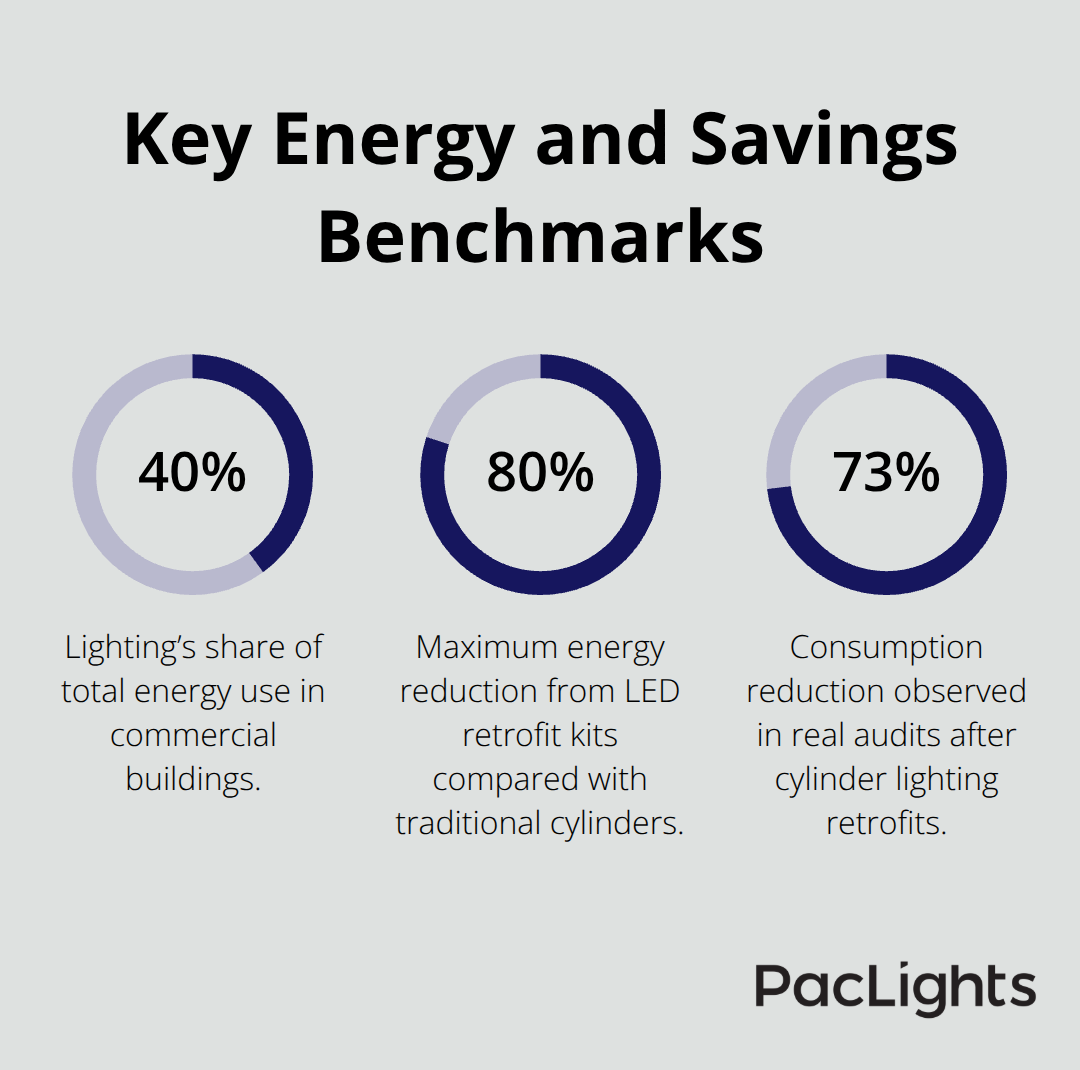
Traditional cylinder lights drain significantly more electricity than LED alternatives, and the numbers justify immediate action. A facility running 20 cylinder fixtures for 12 hours daily typically spends $400–$600 annually on electricity alone. If your building operates these lights longer-say 16 hours per day-that cost climbs closer to $800–$1,000 yearly. Commercial buildings allocate up to 40% of total energy consumption to lighting, so cylinder light inefficiency compounds across your entire operation.
The Hidden HVAC Penalty
Halogen and fluorescent cylinder fixtures generate substantial heat, forcing your HVAC system to work harder during cooling seasons. This hidden cost rarely appears on energy audits, yet it adds hundreds more to your annual bills. LED retrofit kits reduce energy consumption by up to 80% compared with traditional cylinders, meaning a $500 annual lighting bill could drop to $100 within months of upgrading. The payback period typically ranges from 2–3 years, after which you pocket pure savings.
Maintenance Costs That Drain Your Budget
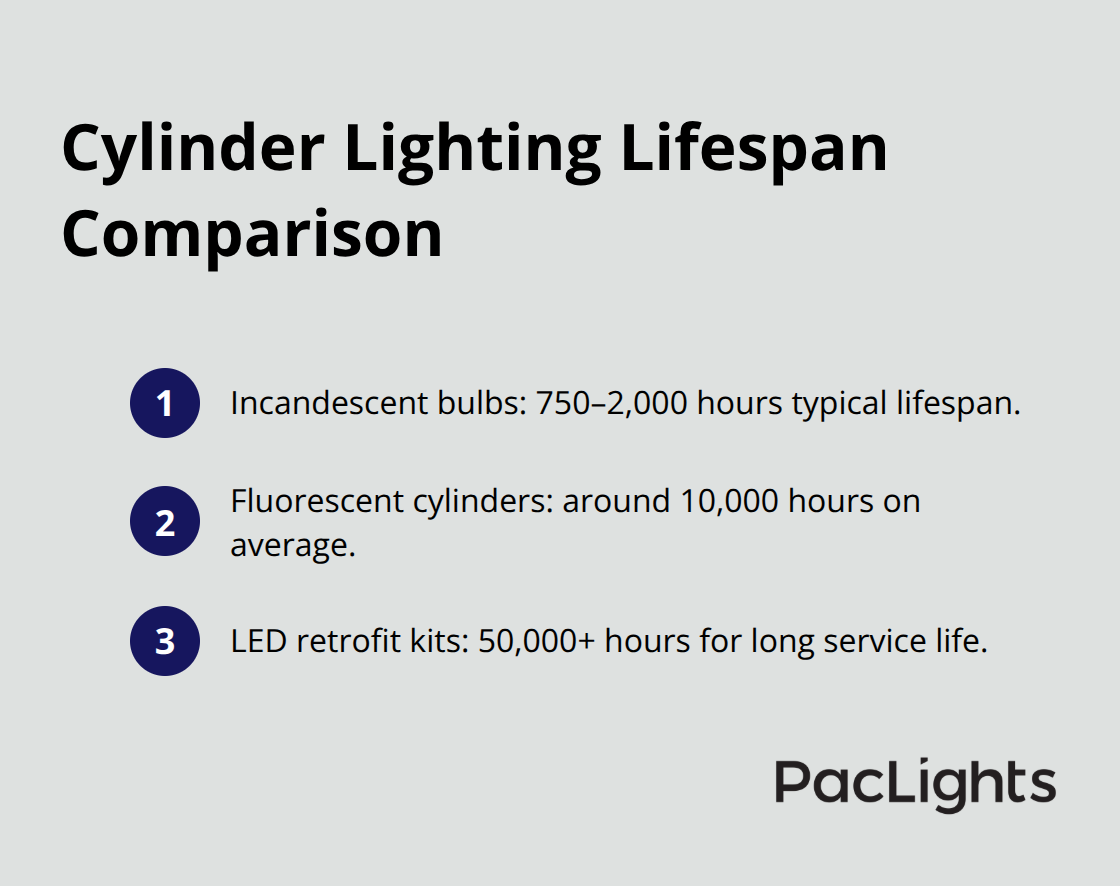
Older cylinder fixtures demand constant attention. Traditional incandescent bulbs last roughly 750–2,000 hours, while fluorescent cylinders manage around 10,000 hours. This forces frequent replacements, labor calls, and operational disruptions when fixtures fail during business hours. LED retrofit kits deliver 50,000 hours of lifespan or more-roughly 25–50 times longer than incandescent options. That translates to minimal maintenance over a decade.
One retrofit kit installation replaces dozens of bulb changes, eliminating the recurring expense of technician visits and material costs. Your maintenance team spends less time on ladders replacing burned-out fixtures and more time on strategic facility improvements. LED retrofits generate far less heat, which reduces strain on your cooling infrastructure and extends the lifespan of surrounding components. Government incentives like the EPAct 179 deduction (enacted in 2020) offset 10–20% of retrofit costs, accelerating your financial return.
Environmental Impact and Competitive Advantage
LED retrofits eliminate mercury from your lighting ecosystem, making disposal safer and more environmentally responsible than fluorescent alternatives. Reducing energy consumption by 60–70% cuts your facility’s carbon footprint substantially-a competitive advantage increasingly valued by clients, tenants, and stakeholders. Upgrading to LEDs aligns your operations with evolving energy codes and sustainability goals without major operational disruption. The North American LED lighting market reached $20.5 billion in 2023, reflecting widespread recognition that efficiency and environmental responsibility drive long-term value. Facilities that retrofit cylinder lighting demonstrate genuine commitment to sustainability rather than making vague green claims. These financial and environmental gains set the stage for the practical planning required to execute your retrofit successfully.
Planning Your Retrofit Without Guessing
Document Your Current Setup
Start by recording exactly what you’re working with. Measure and record the housing sizes of your existing cylinder fixtures-typically 4, 5, or 6 inches in diameter-and note whether each is IC-rated or non-IC-rated. This distinction matters because IC-rated housings tolerate enclosed insulation, while non-IC-rated fixtures require airflow around the retrofit kit. Check your site voltage as well, usually 120V or 277V, and verify this before ordering anything. A single voltage mismatch delays your project and forces you to reorder compatible kits.
Identify High-Priority Spaces
Walk through your facility during operating hours and identify which spaces run lights longest. High-use areas like warehouses, offices, and retail floors running 12+ hours daily deliver payback far faster than spaces used 6 hours daily. This prioritization strategy lets you target the fixtures that generate the fastest financial returns first, then phase in remaining upgrades over time.
Calculate Your Exact Payback Timeline
If 20 fixtures run 12 hours per day at current wattage, multiply that by your local electricity rate to establish your baseline. A facility spending $400–$600 annually on 20 cylinders sees approximately $3,220 in yearly savings after retrofitting, based on real energy audits showing 73% consumption reductions. That $3,220 divided by your retrofit cost reveals your payback timeline. Most quality retrofit kits cost $3,000–$5,000 installed across 20 fixtures, meaning payback reaches 18–24 months-well within the 5–10 year warranty most kits carry.
Evaluate Retrofit Versus Replacement
Retrofit kits preserve your existing housings and wiring, which costs substantially less than full fixture replacement and eliminates the rewiring expense that stretches timelines. However, compatibility matters. If your fixtures use magnetic dimmers, they cause LED flicker and require upgrading to electronic dimmers before installation. Dimmable LED retrofit kits exist, but the dimmer must support them or you waste the dimming capability.
Schedule Installation to Maintain Operations
A professional crew typically retrofits 20 fixtures in one night, so schedule installation during off-peak hours or overnight to avoid disrupting operations. Try prioritizing spaces where light output directly impacts revenue or safety first, then phase remaining areas over subsequent weeks. This staged approach maintains operations while generating immediate savings that fund later upgrades. With your facility mapped, costs calculated, and priorities set, you’re ready to execute the retrofit itself.
How to Execute Your Retrofit Without Stopping Work
Schedule Installation Around Your Operations
Timing your retrofit installation correctly determines whether your project saves money or costs you operational disruption. A professional crew can retrofit 20 cylinder fixtures in a single overnight shift, which means you schedule work between closing and opening without impacting business hours. If your facility operates 24/7, coordinate with your electrical contractor to retrofit one section at a time, working on lower-priority areas first while maintaining full lighting in high-traffic zones.
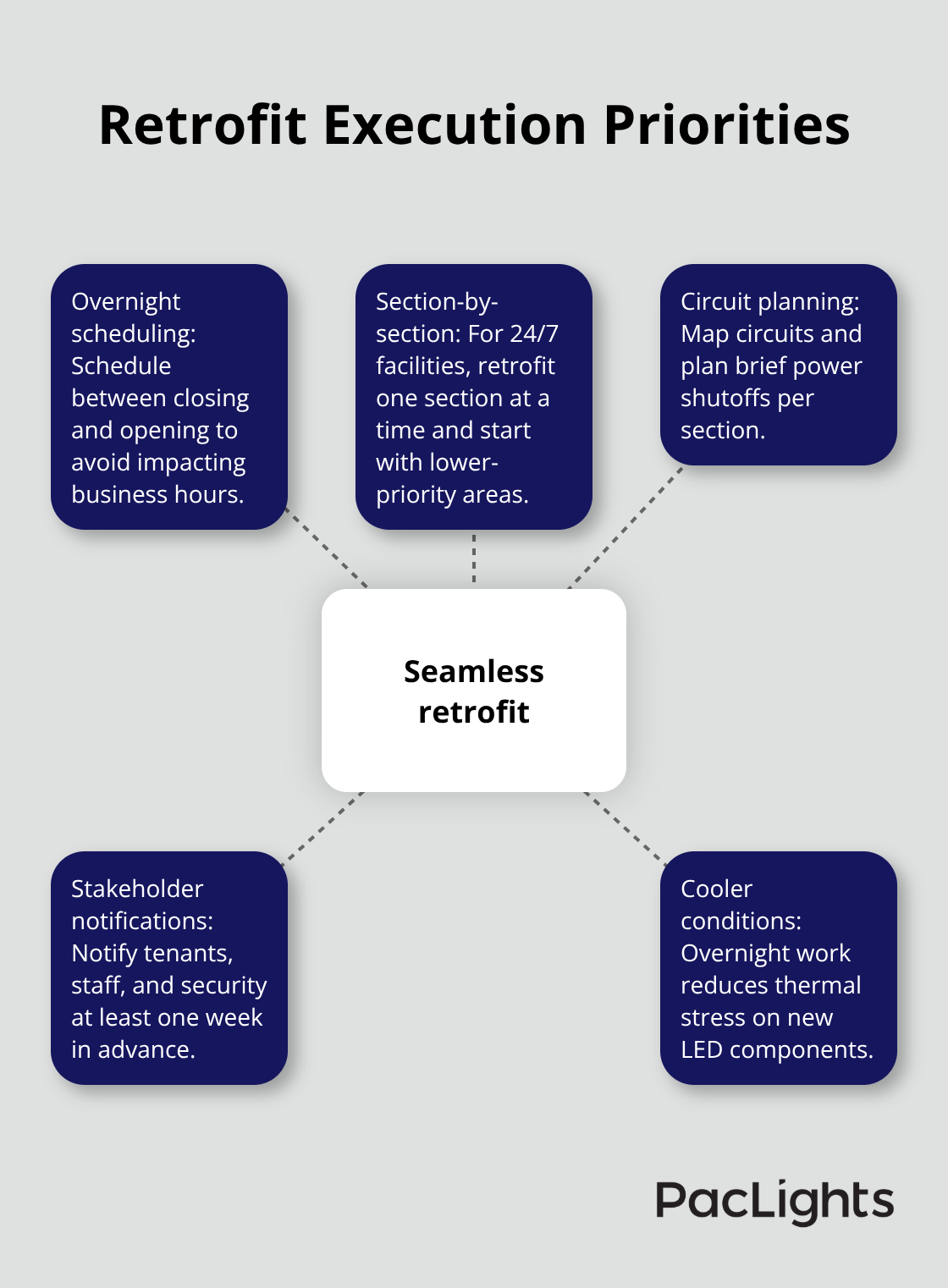
Most retrofit installations require shutting power at the circuit breaker for 15–30 minutes per section, so map out which circuits feed which spaces before work begins. This prevents surprises and lets your operations team prepare staff accordingly. Notify tenants, staff, and security at least one week ahead so no one relies on affected lighting during the installation window. A crew working overnight also avoids heat buildup from daytime operations, which actually improves installation quality since cooler conditions reduce thermal stress on new LED components.
Select Compatible Retrofit Kits and Fixtures
Selecting the right retrofit kit eliminates compatibility headaches that delay projects. Your housing measurements and voltage verification from the planning phase now become critical: a 5-inch IC-rated housing at 277V requires a different kit than a 6-inch non-IC fixture at 120V, and ordering wrong means weeks of delays. Retrofit kits delivering 680–1,400 lumens work for most cylinder applications, but verify your space’s foot-candle requirements with a lighting professional before purchase, especially in retail or healthcare settings where color accuracy matters. If your facility uses magnetic dimmers, replace them with electronic dimmers before retrofit installation, since magnetic dimmers cause LED flicker and waste the dimming capability of new kits. Dimmable LED retrofit kits cost slightly more upfront but preserve your existing control infrastructure and give you flexibility to adjust brightness without rewiring.
Prepare Your Electrical System
Before installation crews arrive, shut off power at the circuit breaker, inspect existing wiring for damage or deterioration, and confirm all electrical connections match the retrofit kit specifications. Damaged wiring must be replaced before retrofit work proceeds, which is why this inspection prevents costly mid-project discoveries. Adequate ventilation around retrofit housings protects against heat-related LED aging, so choose kits rated for enclosed or insulated fixtures when needed. After installation, test every fixture for proper brightness output and check for uniform illumination across the space-flicker indicates dimmer incompatibility that requires immediate adjustment.
Fund Later Phases With Energy Savings
Phasing upgrades across multiple weeks or months lets you fund later stages with energy savings from completed retrofits, turning the project into a self-funding initiative that spreads capital expense across your fiscal year rather than demanding a single large expenditure upfront. This approach maintains cash flow while you complete the retrofit across your entire facility.
Final Thoughts
Cylinder lighting retrofit projects deliver measurable financial returns within 2–3 years while cutting energy consumption by 60–70%. Your facility stops wasting money on inefficient fixtures and maintenance labor, freeing capital for other operational priorities. The payback timeline accelerates further if you prioritize high-use spaces first, where longer operating hours compress the return period to 18–24 months.
A facility running 20 fixtures for 12 hours daily typically spends $400–$600 annually on electricity alone, yet retrofitting those same fixtures cuts that cost to roughly $100–$200 yearly. This cylinder lighting retrofit guide shows you how real energy audits demonstrate 73% consumption reductions, generating $3,220 in annual savings that justify the retrofit investment to stakeholders. That financial clarity removes guesswork from your decision and proves the upgrade makes business sense.
We at PacLights offer free ROI assessments and lighting layout designs to quantify your payback timeline and energy savings before you commit to installation. Our team helps you identify compatible retrofit kits, schedule work around your operations, and capture available rebates that offset upfront costs. Contact us to discuss your retrofit project and receive a customized assessment for your facility.
Disclaimer: PacLights is not responsible for any actions taken based on the suggestions and information provided in this article, and readers should consult local building and electrical codes for proper guidance.