

Most commercial buildings still rely on outdated lighting systems that waste energy and drain budgets. At PacLights, we’ve seen firsthand how a commercial downlight retrofit transforms both operating costs and workplace quality.
Upgrading to LED downlights isn’t just about saving money-it’s about reclaiming control of your facility’s performance. This guide walks you through why the switch matters and how to make it happen.
Why Your Current Downlights Are Costing You Money
The Energy Waste Problem
Older downlight systems consume far more electricity than necessary because they rely on outdated technology that loses energy as heat rather than converting it to light. A typical 75-watt incandescent downlight produces the same light output as a 9-watt LED downlight, yet uses over eight times more power. According to the U.S. Department of Energy, commercial lighting accounts for roughly 17% of total electricity consumption in office buildings, and most of this waste originates from fixtures installed before 2015. If your facility has downlights older than a decade, you’re likely spending significantly more on electricity than comparable buildings with modern LED systems.
Calculating Your Annual Costs
The financial impact becomes obvious when you calculate annual expenses. A single outdated downlight burning 8 hours per day costs approximately 55 dollars per year in electricity alone, while an LED downlight alternative costs around 7 dollars. Multiply that across dozens or hundreds of fixtures, and the waste becomes substantial. This gap widens further when you factor in the total operational expenses across your entire facility.
Accelerating Degradation and Hidden Expenses
Aging fixtures create compounding problems that accelerate costs beyond electricity bills. Older halogen and incandescent downlights degrade quickly, with lumen output dropping 20-30% after just 2,000 hours of operation, forcing frequent replacements that disrupt business operations and add labor expenses. These fixtures also generate excessive heat, which increases cooling costs in your facility during warmer months-the U.S. Environmental Protection Agency estimates that lighting heat gain adds 10-15% to air conditioning loads in commercial buildings.
Environmental and Operational Impact
Your carbon footprint grows proportionally with aging systems. Replacing just 50 outdated downlights with LED alternatives eliminates approximately 50 tons of carbon dioxide emissions annually, equivalent to taking ten cars off the road for a year. Aging systems also lack any smart controls, meaning lights run at full brightness regardless of occupancy or daylight availability, wasting energy during unoccupied hours or when natural light is sufficient. Modern LED downlights with integrated daylight sensors or motion controls reduce unnecessary operation by 30-50%, directly cutting both energy consumption and maintenance headaches.
These mounting costs and inefficiencies make the case for upgrading clear. The next section explores how LED retrofit solutions address these problems and what the installation process actually involves.
LED Retrofit Solutions for Commercial Spaces
How LED Downlights Cut Energy Consumption
LED downlights convert electrical power directly into light instead of wasting it as heat. A 9-watt LED produces the same brightness as a 75-watt incandescent, but that efficiency difference compounds across your entire facility. Operating 100 downlights for 8 hours daily means switching to LEDs cuts electricity consumption by approximately 7,920 kilowatt-hours annually, translating to roughly $950 in annual savings at average U.S. commercial rates of $0.12 per kilowatt-hour. The U.S. Energy Information Administration reports that commercial facilities replacing pre-2015 downlights with modern LEDs see lighting energy costs drop by 40-60%. These savings appear immediately on your utility bills, not years from now.
Installation Process and Minimal Disruption
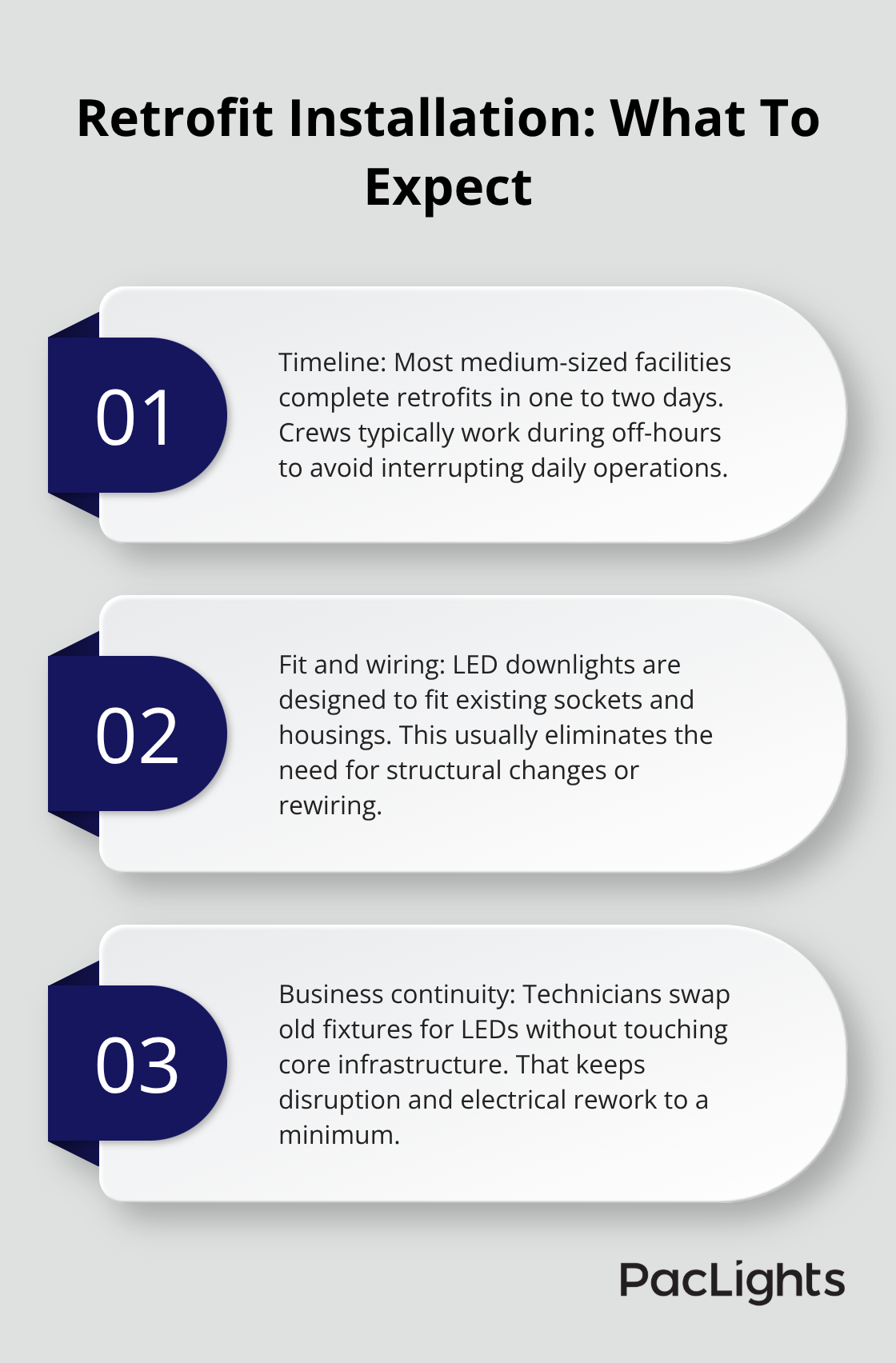
Installation typically takes one to two days for a medium-sized facility, with crews replacing fixtures during off-hours to avoid disrupting operations. Most retrofit projects require no structural modifications or rewiring since LED downlights fit existing sockets and housing, making the transition straightforward and minimally disruptive to your business. Technicians remove old fixtures and install new LEDs without affecting your building’s infrastructure or requiring expensive electrical work.
Return on Investment Timeline
Your payback period depends on fixture count and local electricity rates, but most commercial facilities recover retrofit costs within 3-5 years through energy savings alone. A facility with 150 outdated downlights spending $1,425 annually on lighting electricity would reduce that to roughly $570 with LED retrofits, saving $855 per year. If the retrofit project costs $4,500 total, you break even in approximately 5.3 years, then enjoy pure savings for the remaining 15-20 year lifespan of the LED fixtures. Many commercial clients also qualify for utility rebates and tax incentives that accelerate payback periods. The Department of Energy’s Better Plants program documents that participating facilities achieve average simple payback periods of 2.7 years for lighting upgrades. Beyond financial returns, LEDs produce consistent light quality without the dimming that plagues aging fixtures, improving workplace visibility and employee productivity from day one.
Smart Controls Maximize Your Savings
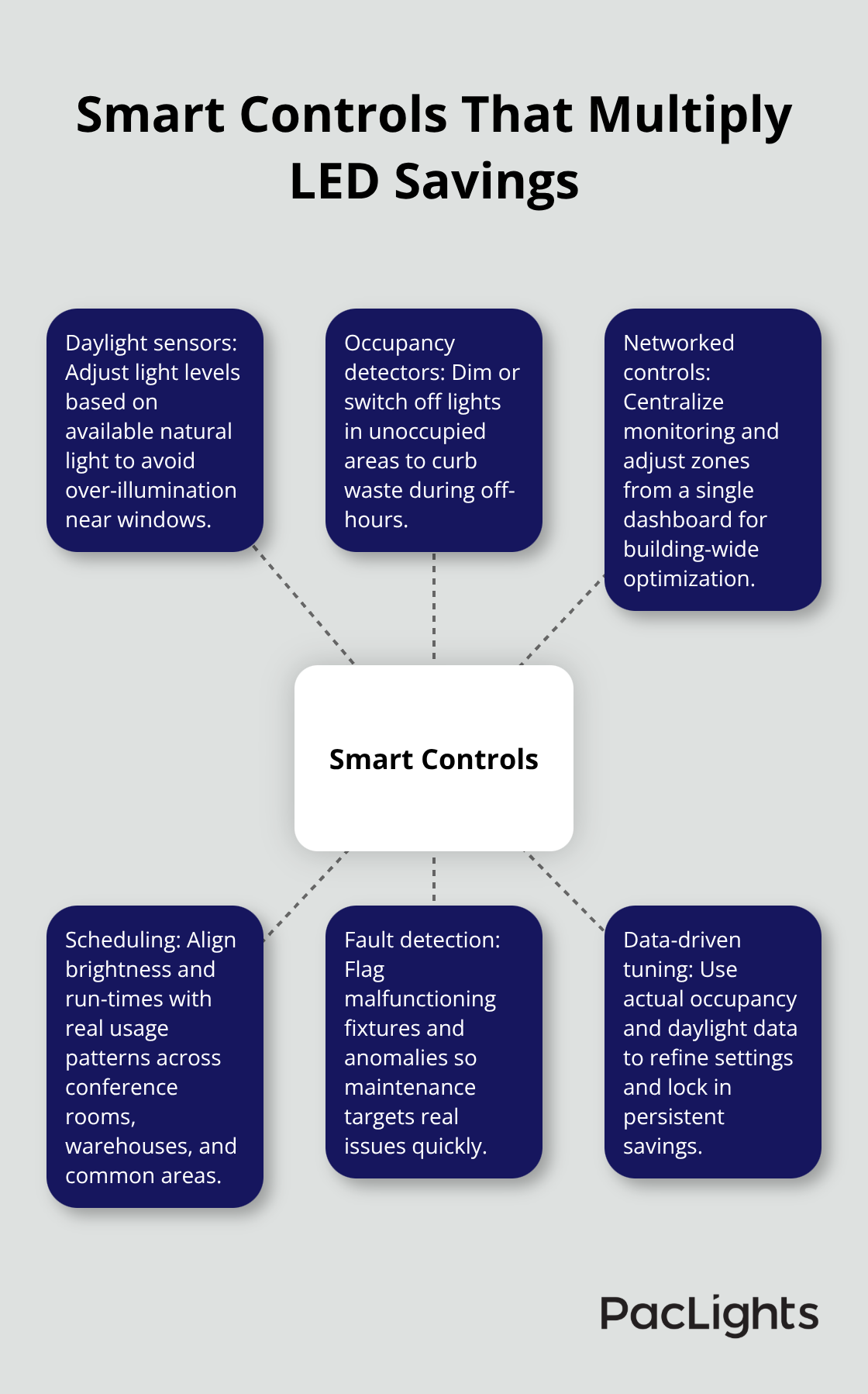
While basic LED retrofits deliver substantial energy reductions, adding smart controls amplifies those gains further. Daylight sensors and motion detectors prevent lights from running at full brightness during unoccupied hours or when natural light is sufficient, reducing unnecessary operation by 30-50%. Networked lighting controls allow facility managers to adjust brightness across multiple zones from a central system, optimizing energy use throughout your building. These advanced features transform your lighting system from a static installation into an active tool that responds to actual occupancy and environmental conditions.
The financial case for upgrading is clear, but the real transformation happens when you add intelligence to your lighting infrastructure. The next section explores how advanced controls and smart features work together to create a lighting system that adapts to your facility’s actual needs.
Advanced Controls and Smart Lighting Features
Sensors Reduce Energy Consumption Beyond LED Efficiency
Upgrading to LED downlights solves the energy waste problem, but adding smart controls transforms your lighting system into an active tool that responds to actual facility conditions. Daylight sensors and occupancy detectors prevent lights from running unnecessarily, cutting energy use by 30-50% beyond what basic LEDs alone achieve. A facility with 100 downlights operating 10 hours daily without controls consumes roughly 7,200 kilowatt-hours annually for lighting. Adding motion sensors and daylight harvesting reduces that to approximately 3,600-5,400 kilowatt-hours, depending on occupancy patterns and natural light availability. The U.S. Environmental Protection Agency’s Energy Star program reports that commercial buildings integrating occupancy controls see average lighting energy reductions of 20-30%, with some facilities achieving 40% savings when daylight sensors are properly calibrated.
Sensor Placement Determines Real-World Performance
Proper sensor positioning separates successful installations from wasted investments. Daylight sensors work best within 15-20 feet of windows where they detect natural light changes effectively, while occupancy detectors need clear sightlines to areas where people work. Poor sensor placement eliminates the investment’s value entirely, so specification matters far more than most facility managers realize. These aren’t theoretical numbers-they come from real buildings measuring actual consumption patterns.
Networked Controls Optimize Across Your Entire Facility
Networked lighting controls provide visibility and management capabilities that isolated sensors cannot match. Instead of relying on individual sensors making independent decisions, a networked system allows your facility manager to monitor lighting across zones, adjust brightness schedules, and identify malfunctioning fixtures from a central dashboard. Many commercial buildings waste energy on lighting schedules that no longer match actual usage patterns-conference rooms lit for full occupancy during off-hours, warehouse zones running at maximum brightness when daylight is sufficient, parking areas overlit according to decades-old standards. A networked system lets you optimize these patterns based on real data rather than assumptions.
Integration with Building Management Systems Creates Compounding Savings
Integration with your building management system creates additional efficiency gains by coordinating lighting with HVAC systems. Reducing brightness in unoccupied zones also reduces cooling loads, creating compounding savings that stack on top of your LED retrofit savings. A facility spending $570 annually on LED downlights might reduce that to $400-450 with optimized networked controls, generating an extra $120-170 in annual savings. The cost of adding networked controls typically ranges from $15-30 per fixture depending on system complexity, but the payback period remains competitive because the additional energy savings justify the control system investment within 2-3 years. Smart lighting systems allow you to manage energy consumption across your entire facility from one platform.
Final Thoughts
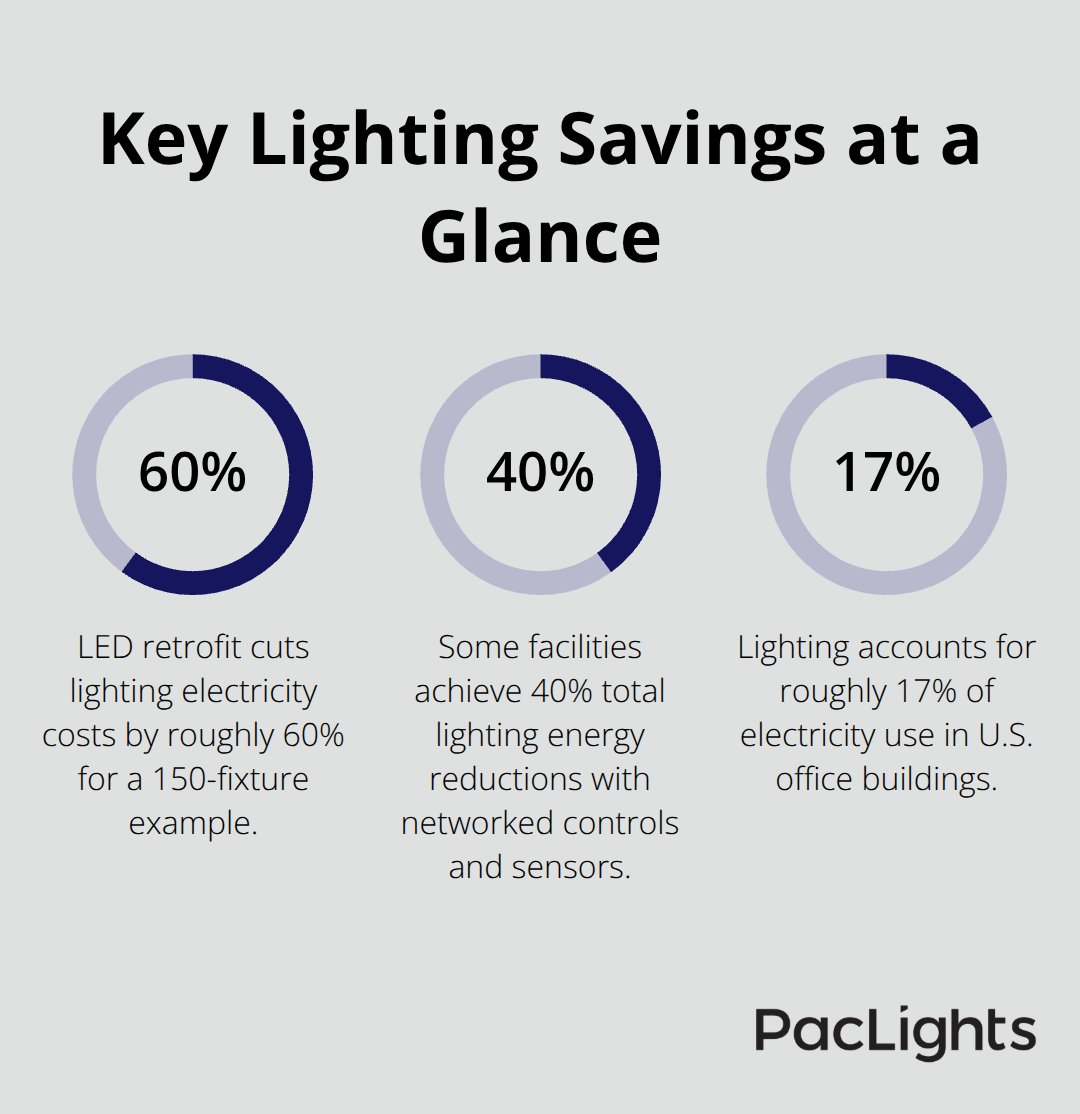
A commercial downlight retrofit delivers measurable returns across energy consumption, operating costs, and environmental impact. A facility replacing 150 outdated downlights with LEDs cuts lighting electricity costs by roughly 60%, saving $855 annually while eliminating approximately 50 tons of carbon dioxide emissions per year. When you add networked controls and occupancy sensors, those savings expand further, with some facilities achieving 40% total reductions in lighting energy use.
Most facilities recover retrofit investment costs within 3-5 years through energy savings alone, then enjoy 15-20 additional years of reduced operating expenses. Utility rebates and tax incentives often accelerate payback periods below three years. LED downlights eliminate the performance degradation that plagues aging systems, delivering consistent light quality and improved workplace visibility from day one.
Your retrofit project starts with a clear assessment of current conditions and energy consumption patterns. We at PacLights provide free lighting layout designs and ROI assessments to help you understand exactly what your facility can achieve. Contact us at PacLights to discuss your specific facility needs and receive a customized retrofit plan with realistic savings projections.
Disclaimer: PacLights is not responsible for any actions taken based on the suggestions and information provided in this article, and readers should consult local building and electrical codes for proper guidance.