

Datacenters are power-hungry facilities, and lighting often gets overlooked as a major energy drain. At PacLights, we’ve seen firsthand how outdated lighting systems waste thousands of dollars annually while contributing unnecessarily to carbon emissions.
The good news is that datacenter power saving lighting upgrades deliver real results. Strategic changes to your lighting infrastructure can cut energy consumption significantly while improving your bottom line.
Where Datacenter Energy Really Goes
Lighting’s Hidden Role in Datacenter Power Consumption
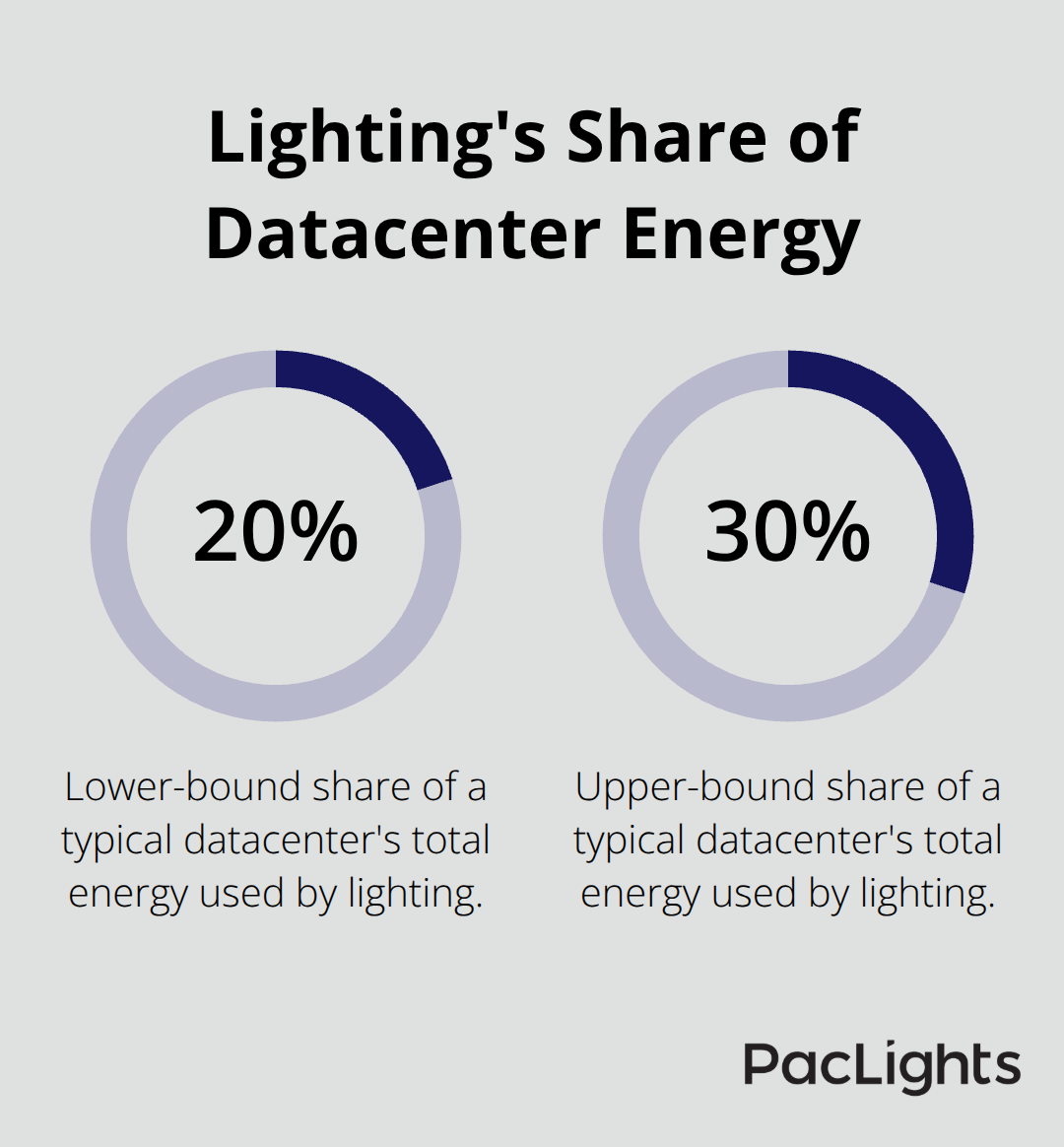
Servers and cooling systems grab all the attention, but lighting remains a silent energy killer in most datacenters. A typical datacenter allocates roughly 20-30% of its total energy budget to lighting alone, yet this figure often surprises facility managers who focus exclusively on compute power and mechanical cooling. The reality is that datacenter lighting runs 24/7 across vast floor spaces, server aisles, and administrative areas, consuming power constantly regardless of occupancy.
Traditional lighting systems compound this waste because they were designed decades ago for office environments, not for the specific illumination needs of modern datacenters.
The Efficiency Gap Between Old and New Lighting
Halogen downlights and fluorescent fixtures waste enormous amounts of energy compared to LEDs, which cut lighting energy use by roughly 90% compared with halogen alternatives. This efficiency gap means that a datacenter relying on older lighting infrastructure throws money away every single day. The difference in performance is staggering: a 60-watt incandescent produces around 700 lumens, while a 15-watt LED delivers approximately 800 lumens, demonstrating how newer technology produces more light with far less power.
Secondary Energy Drains from Outdated Systems
Outdated fixtures create a cascade of secondary problems that multiply energy waste. When halogen or fluorescent systems deliver insufficient light to critical areas, facility teams install additional fixtures to compensate, driving energy consumption even higher. Meanwhile, these older systems generate significant heat, forcing cooling systems to work harder and burn additional power just to counteract the lighting load. The absence of occupancy controls means aisles and storage spaces stay fully illuminated even when nobody works there, which happens frequently during maintenance windows, shift changes, or after-hours operations.
The Financial Reality of Lighting Waste
Datacenters without daylight harvesting or dimming technology run lights at maximum output regardless of natural light availability, wasting energy in spaces with windows or skylights. The financial impact is severe: a mid-sized datacenter with 50,000 square feet running traditional lighting spends $200,000 to $400,000 annually on lighting electricity alone. Upgrading to LED fixtures with motion sensors and dimming controls typically pays for itself within 2-4 years through energy savings, making this one of the highest-ROI upgrades available to datacenter operators. These improvements set the stage for understanding how specific technologies-LEDs, advanced controls, and daylight integration-transform datacenter lighting from a cost center into a profit opportunity.
LED Fixtures and Smart Controls Transform Datacenter Efficiency
Why LED Fixtures Form the Foundation
LEDs deliver the foundation for datacenter energy savings, but controls amplify those gains. The math is undeniable: LEDs consume roughly one-tenth the power of halogen downlights while producing equivalent or superior illumination. A 15-watt LED achieves around 800 lumens compared to a 60-watt incandescent at 700 lumens, meaning you gain brightness while slashing consumption. The shift matters because datacenters typically operate lighting continuously across 50,000 to 100,000 square feet or more.
If your facility currently runs 500 halogen fixtures at 60 watts each, you burn 30,000 watts just for lighting. Switching to LED equivalents drops that to roughly 3,000 watts, translating to approximately $27,000 in annual electricity savings (assuming industrial rates around $0.12 per kilowatt-hour). LED fixtures also reach lifespans of up to 50,000 hours, meaning you replace them far less frequently than older technologies, reducing maintenance costs and unplanned downtime during critical operations.
Motion Sensors Reduce Energy in Low-Occupancy Areas
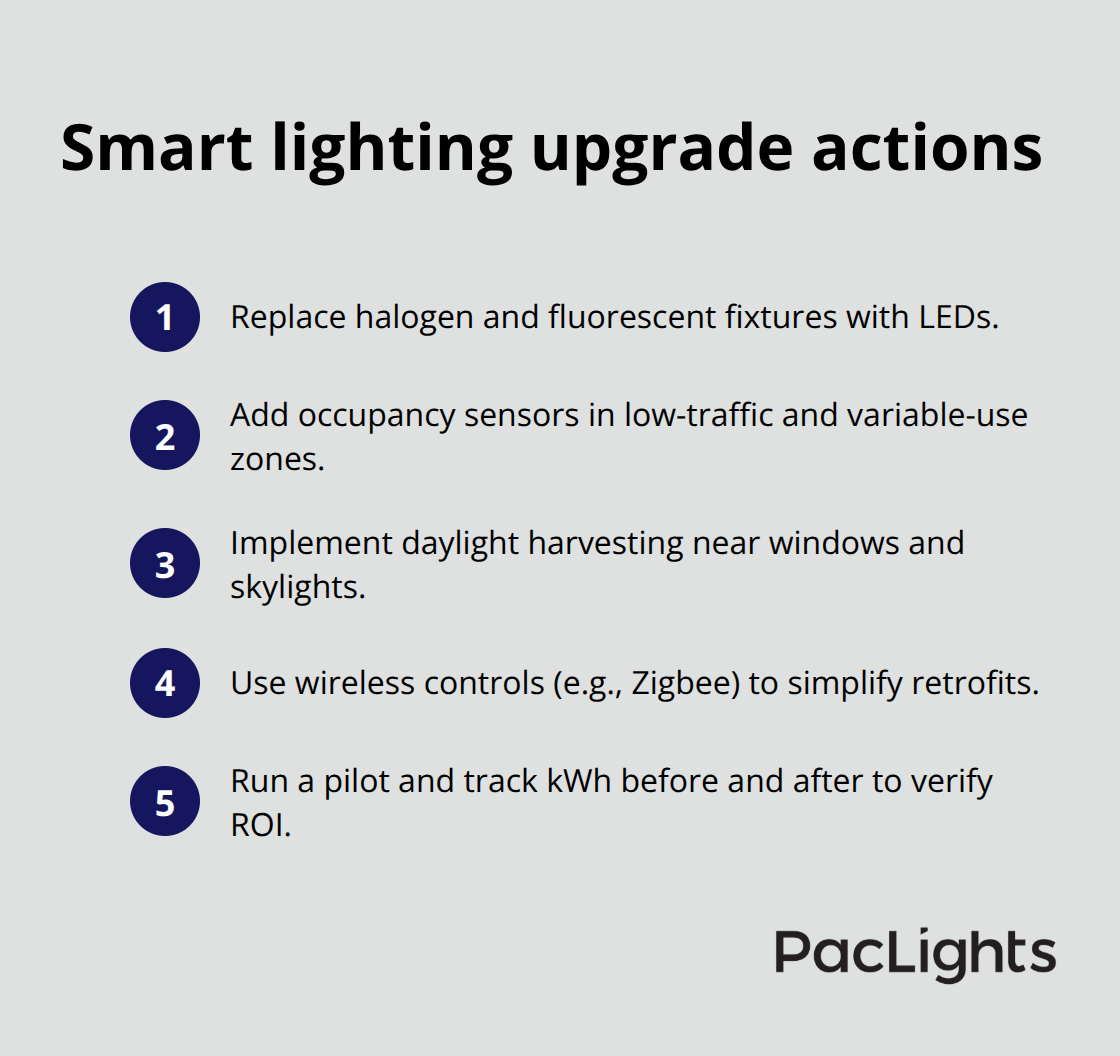
Motion sensors transform LEDs from a static efficiency gain into a dynamic power management tool. Install occupancy sensors in aisles, storage areas, and administrative zones where foot traffic varies throughout the day and shifts. These sensors reduce lighting in empty spaces to 20-30% brightness or shut lights off entirely, cutting energy consumption during low-occupancy periods by 40-60%.
Wireless control systems using Zigbee technology simplify installation in existing datacenters by eliminating complex wiring requirements. The result is faster deployment with minimal disruption to ongoing operations.
Daylight Harvesting Prevents Over-Illumination
Daylight harvesting works by measuring natural light levels through windows or skylights and automatically dimming artificial fixtures to maintain target illumination without waste. For task areas requiring high-detail work, try for approximately 400 lux; hallways and storage spaces need only about 80 lux, so dimming controls prevent over-illumination that wastes energy and causes eye strain or headaches.
This technology proves especially valuable in datacenters with administrative or monitoring stations positioned near exterior walls, where natural light availability fluctuates throughout the day.
Measuring Results Through Pilot Programs
A practical pilot approach involves retrofitting one zone with LED luminaires, installing occupancy sensors in aisles, and enabling daylight harvesting in a staff area over several months. Track kilowatt-hour consumption before and after to quantify actual ROI rather than relying on estimates. Most datacenter operators see payback within 2-4 years when combining LEDs with controls, making this among the highest-return infrastructure investments available.
These lighting upgrades set the stage for understanding the broader financial picture. The next section examines how to calculate energy cost reductions, project payback periods, and measure the environmental benefits that justify investment in modern lighting systems.
ROI and Long-Term Savings from Datacenter Lighting Upgrades
The Financial Case for Lighting Upgrades
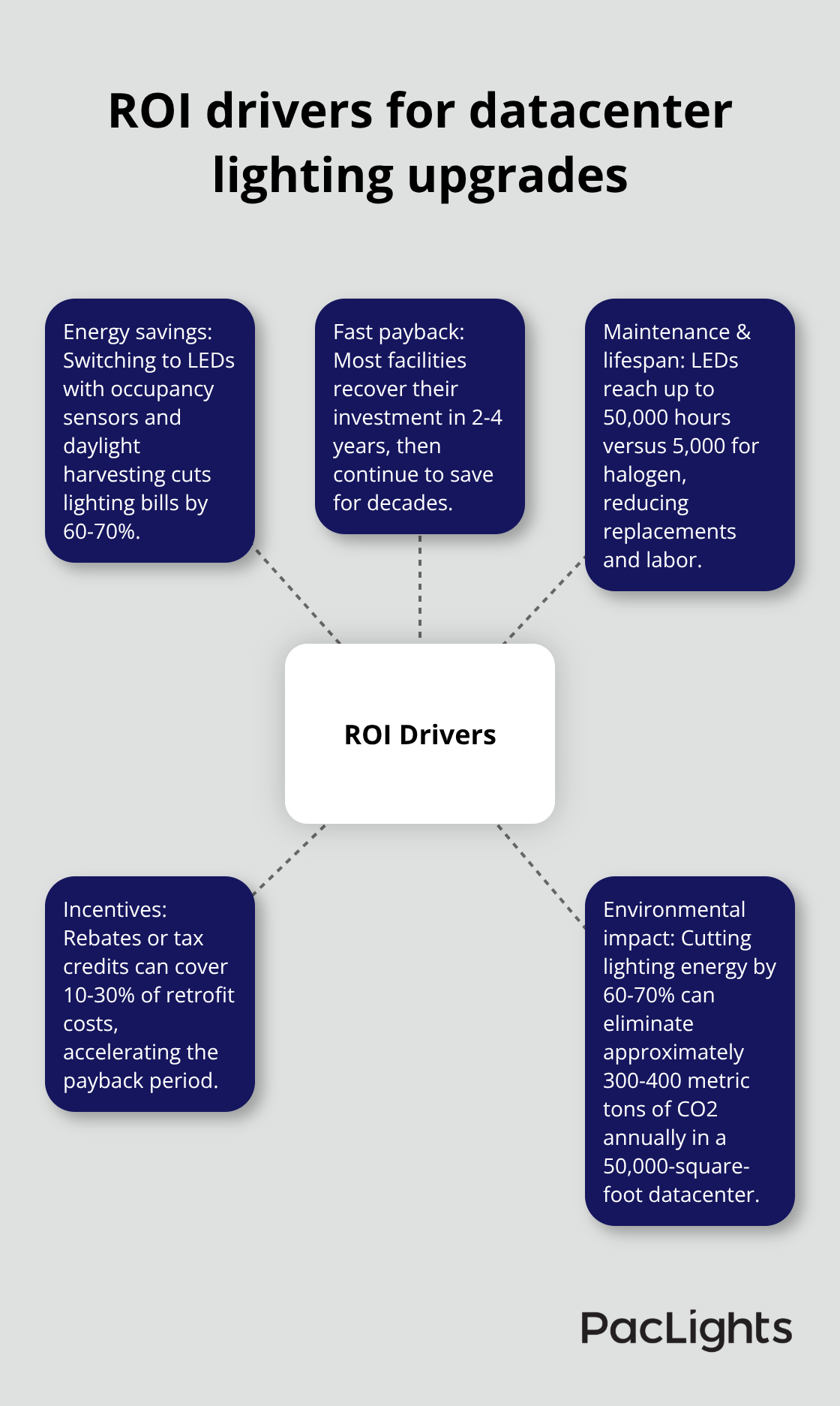
The financial case for datacenter lighting upgrades is straightforward: most facilities recover their investment within 2-4 years, then enjoy decades of reduced operating costs. A mid-sized datacenter with 50,000 square feet running traditional halogen or fluorescent lighting spends $200,000 to $400,000 annually on lighting electricity alone. Switching to LED fixtures with occupancy sensors and daylight harvesting cuts that bill by 60-70%, meaning annual savings of $120,000 to $280,000 depending on your current system and regional electricity rates.
Calculating Payback and Long-Term Savings
The payback calculation is simple: divide your total retrofit investment by annual savings, and you’ll find most projects recover their costs in 24-48 months. After that payback period expires, every kilowatt-hour saved flows directly to your bottom line. A datacenter running 100,000 square feet with comprehensive LED and control upgrades can save $500,000 or more annually once the system matures, making this one of the highest-ROI infrastructure investments available.
LED fixtures reach 50,000-hour lifespans compared to 5,000 hours for halogen systems, meaning you replace fixtures far less frequently and avoid costly maintenance disruptions during critical operations. This extended lifespan typically saves an additional $30,000-$60,000 per year in labor and replacement costs for larger facilities.
Environmental Benefits and Regulatory Incentives
Reducing datacenter lighting energy consumption by 60-70% through LED and control upgrades cuts your facility’s carbon footprint significantly, which matters increasingly as corporations commit to net-zero emissions targets and governments implement stricter energy efficiency standards. A 50,000-square-foot datacenter switching from traditional to LED lighting with controls eliminates approximately 300-400 metric tons of annual carbon dioxide emissions (equivalent to taking 65-85 cars off the road for a year).
Many jurisdictions now offer rebates or tax incentives for energy-efficient lighting upgrades, which can cover 10-30% of retrofit costs and accelerate your payback timeline. Additionally, documenting these energy savings strengthens your facility’s sustainability credentials, which increasingly influences customer decisions and attracts enterprise clients seeking partners with strong environmental performance.
Upgrading Your Datacenter Lighting System
LED retrofit solutions designed for datacenter environments include high-bay fixtures, troffer lights, and advanced lighting controls such as networked systems with optional daylight and motion detection to maximize your energy reductions and ROI. Free lighting layout designs and ROI assessments help you quantify exact savings before committing to upgrades. The combination of direct energy savings, reduced maintenance costs, extended equipment lifespan, and environmental benefits means that datacenter operators who delay lighting upgrades are essentially paying a premium to operate outdated, inefficient systems.
Final Thoughts
Datacenter power saving lighting upgrades deliver measurable financial and environmental returns that justify immediate action. The strategies outlined throughout this post-switching to LEDs, installing occupancy sensors, and implementing daylight harvesting-work together to cut energy consumption by 60-70% while reducing maintenance costs and extending equipment lifespan. Most facilities recover their investment within 2-4 years, then enjoy decades of reduced operating expenses and lower carbon emissions.
Start by auditing your current lighting system to identify the biggest energy drains, then focus first on high-occupancy areas and spaces with the longest operating hours. A pilot retrofit in one zone gives you concrete data on payback timelines and actual energy reductions before committing to facility-wide upgrades. This approach minimizes risk while building internal support for larger investments.
Implementation should begin with LED fixture replacement, which forms the foundation for all other efficiency gains. Once LEDs are in place, layer on occupancy sensors in low-traffic areas and daylight harvesting in spaces with natural light access (advanced lighting controls amplify these gains by automating adjustments based on real-time conditions). Visit PacLights to explore how our energy-efficient lighting products can transform your datacenter operations while strengthening your sustainability performance.
Disclaimer: PacLights is not responsible for any actions taken based on the suggestions and information provided in this article, and readers should consult local building and electrical codes for proper guidance.