

Emergency wall luminaires design isn’t optional-it’s a legal requirement that directly impacts occupant safety during power failures. At PacLights, we’ve seen how poor emergency lighting design leaves facilities vulnerable to liability and puts people at risk.
This guide covers what you need to know about meeting building codes, selecting the right fixtures, and implementing systems that actually work when you need them.
Emergency Wall Luminaires Design: Meeting Code Requirements and Performance Standards
Building Codes Set the Baseline for Safety
Emergency lighting codes vary significantly by jurisdiction, but the International Building Code and National Fire Protection Association standards establish the baseline that most facilities must follow. The IBC requires emergency lighting to maintain a minimum of 1 foot-candle at floor level along exit routes, with some jurisdictions demanding up to 5 foot-candles depending on occupancy type. Facilities that fail inspection face fines, forced closures, and liability exposure if an incident occurs during a power failure. Facility managers often discover their existing systems fall short of current code requirements, particularly in older buildings where luminaire placement hasn’t been updated since installation.
Exit Routes Demand Specific Illumination Standards
Exit signage and pathways require different light levels than general building areas. The NFPA 101 Life Safety Code mandates that exit route lighting must remain operational for a minimum of 90 minutes during a power outage, and the light must be positioned to eliminate shadows and dark spots that could cause confusion during evacuation. Stairwells, corridors, and emergency exits typically require higher brightness than hallways because occupants move faster and need clear visual guidance. Many facilities treat emergency lighting as an afterthought, installing fixtures only near obvious exits rather than along the entire evacuation path. Practical implementation means mapping your actual evacuation routes and placing luminaires every 6 to 8 feet along those paths, not just at doorways. Testing these routes quarterly under actual darkness conditions reveals gaps that floor plans miss-furniture rearrangement or new partitions often block light coverage since the system was commissioned.
Performance Specifications Determine Actual Reliability
Emergency fixtures must meet specific performance metrics outlined in UL 924, which covers both the luminaire itself and its battery backup system. The battery must recharge fully within 24 hours and maintain charge for at least 90 minutes of operation, though many codes now require 120 minutes for high-occupancy buildings. Lumen output degradation is critical-fixtures must maintain at least 60 percent of initial brightness after 90 minutes of battery operation, which eliminates cheap fixtures that dim rapidly. LED emergency luminaires outperform older fluorescent models because they maintain consistent brightness throughout the discharge cycle rather than fading gradually.
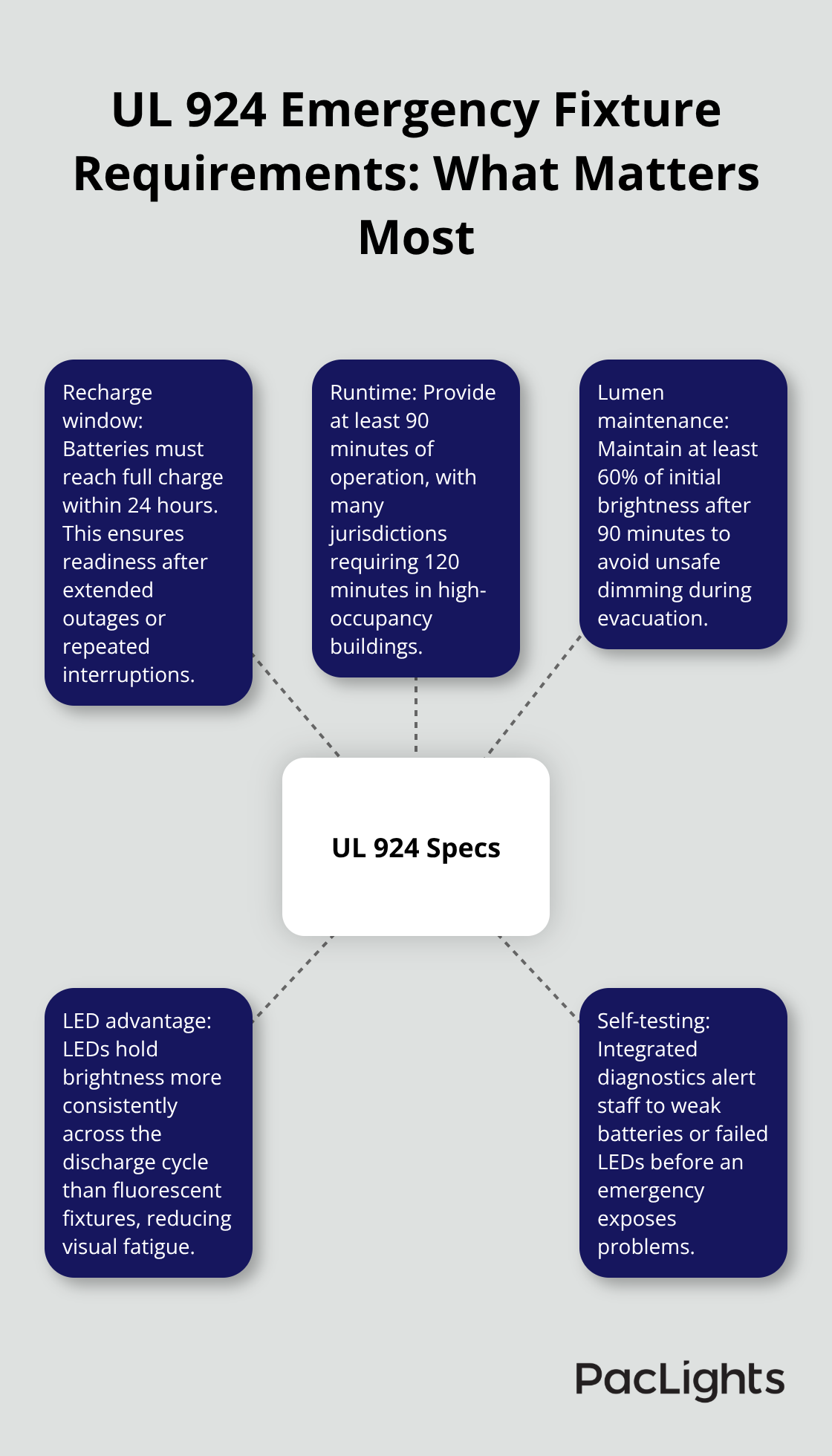
Facilities should specify fixtures with integrated self-testing capabilities that run diagnostics automatically, alerting maintenance staff to battery degradation or burned-out LEDs before an actual emergency occurs. This prevents the common scenario where emergency lighting fails during a real power outage because the system was never truly tested since installation.
Selecting the Right Fixture Technology Matters
The choice between LED and older technologies directly impacts long-term performance and maintenance costs. LED fixtures provide superior reliability, longer battery life, and faster recharge cycles compared to fluorescent or incandescent options. When evaluating fixtures, verify that manufacturers provide detailed lumen maintenance curves and battery discharge data-this information separates quality products from those that merely meet minimum code thresholds. Fixtures with modular battery components allow you to replace aging batteries without replacing the entire luminaire, reducing replacement costs over the system’s lifetime.
Now that you understand what codes require and how to select fixtures that actually perform, the next step involves positioning these luminaires strategically throughout your facility to maximize coverage and eliminate dark zones.
How to Position Emergency Luminaires for Complete Coverage
Spacing Standards and Real-World Adjustments
Placement strategy separates functional emergency lighting from systems that leave dark zones during actual evacuations. The Illuminating Engineering Society recommends placing wall-mounted emergency luminaires no more than 40 feet apart in corridors and 20 feet apart in high-traffic areas like stairwells. However, this baseline assumes unobstructed sightlines-in reality, furniture, equipment, and architectural features create shadows that expand these distances. Many facilities using standard spacing still have dark spots because designers placed fixtures based on floor plans rather than actual room layouts. Walk your evacuation routes at night with the main lights off and a single flashlight to identify genuine problem areas. You’ll find that corners, alcoves, and areas behind equipment need additional fixtures even if spacing calculations suggest otherwise.

Stairwell Illumination Requires Strategic Placement
Stairwells demand particular attention because occupants descend quickly and need consistent illumination at each step. Place fixtures at the top, middle, and bottom of stairs rather than relying on corridor-level lighting to spill into stairwells. This approach eliminates the shadows that form when light enters stairwells at steep angles, creating the illusion of missing steps. Test your stairwell lighting by descending in darkness-if you hesitate or misstep, your fixture placement needs adjustment. The goal is to light each step edge clearly so occupants maintain their pace without fear of falling.
Color Temperature Affects Occupant Behavior
The color temperature of emergency luminaires matters more than most facility managers realize. Warm white light around 3000K helps occupants stay calm during emergencies because it mimics natural indoor lighting, while cooler 5000K light can feel clinical and disorienting when people are already stressed. LED emergency fixtures maintain consistent color temperature throughout their 90-minute discharge cycle, unlike older fluorescent models that shift color as battery voltage drops. This consistency prevents the psychological discomfort that occurs when lighting changes during an evacuation.
Architectural Integration and Fixture Selection
Integration with your building’s architecture means choosing fixture styles that don’t appear bolted-on or industrial in professional spaces. Modern LED emergency luminaires come in sleek profiles that mount flush against walls or integrate into exit sign assemblies, eliminating the clunky appearance of older emergency lighting. Coordinate fixture placement with your existing lighting design so emergency luminaires reinforce rather than contradict your architectural intent. This practical approach-spacing based on actual room conditions, selecting appropriate color temperature, and choosing fixtures that complement your space-creates emergency lighting that occupants trust.
Testing and Validation Before Emergencies Occur
Quarterly testing under actual darkness conditions reveals gaps that floor plans miss, since furniture rearrangement or new partitions often block light coverage since the system was commissioned. Walk the routes yourself rather than relying on maintenance staff reports alone. Document dark zones with photos taken in darkness, then adjust fixture placement accordingly. This validation process prevents the scenario where emergency lighting fails during a real power outage because the system was never truly tested since installation. Once your placement strategy is locked in, the next consideration involves selecting fixture technologies and battery systems that maintain reliable performance throughout the 90-minute discharge period.
Technologies That Keep Emergency Lighting Working
LED Fixtures Outperform Older Systems Dramatically
LED emergency fixtures represent a fundamental shift away from older fluorescent and incandescent systems that fail predictably during extended power outages. Modern LED emergency luminaires maintain 80 to 90 percent of their initial brightness throughout the entire 90-minute discharge cycle, while fluorescent fixtures drop to 50 percent brightness within 60 minutes according to UL 924 testing data. This consistency matters enormously during evacuations because occupants maintain confidence in the lighting path rather than experiencing the psychological stress of dimming light that suggests the system is failing. Battery backup systems integrated into LED fixtures recharge in 24 hours or less, and quality units maintain full charge capacity for three to five years before degradation becomes significant.
Self-Testing Systems Catch Problems Before Emergencies
Facilities that conduct quarterly self-tests catch battery failure before emergencies occur, preventing the scenario where backup systems fail silently until a real power outage exposes the problem. Smart controls built into modern emergency luminaires run automated diagnostics that flag failed LEDs, weak batteries, or charging circuit problems within hours of occurrence rather than waiting for manual inspection cycles. This proactive approach means your maintenance team responds to issues on their schedule rather than discovering failures during actual emergencies. The investment in LED fixtures with integrated battery systems and self-testing capabilities costs 15 to 25 percent more upfront than basic fluorescent alternatives, but the elimination of battery replacement labor, reduced maintenance visits, and extended fixture lifespan recover that cost within five years for most facilities.
Maintenance Practices Determine Real-World Performance
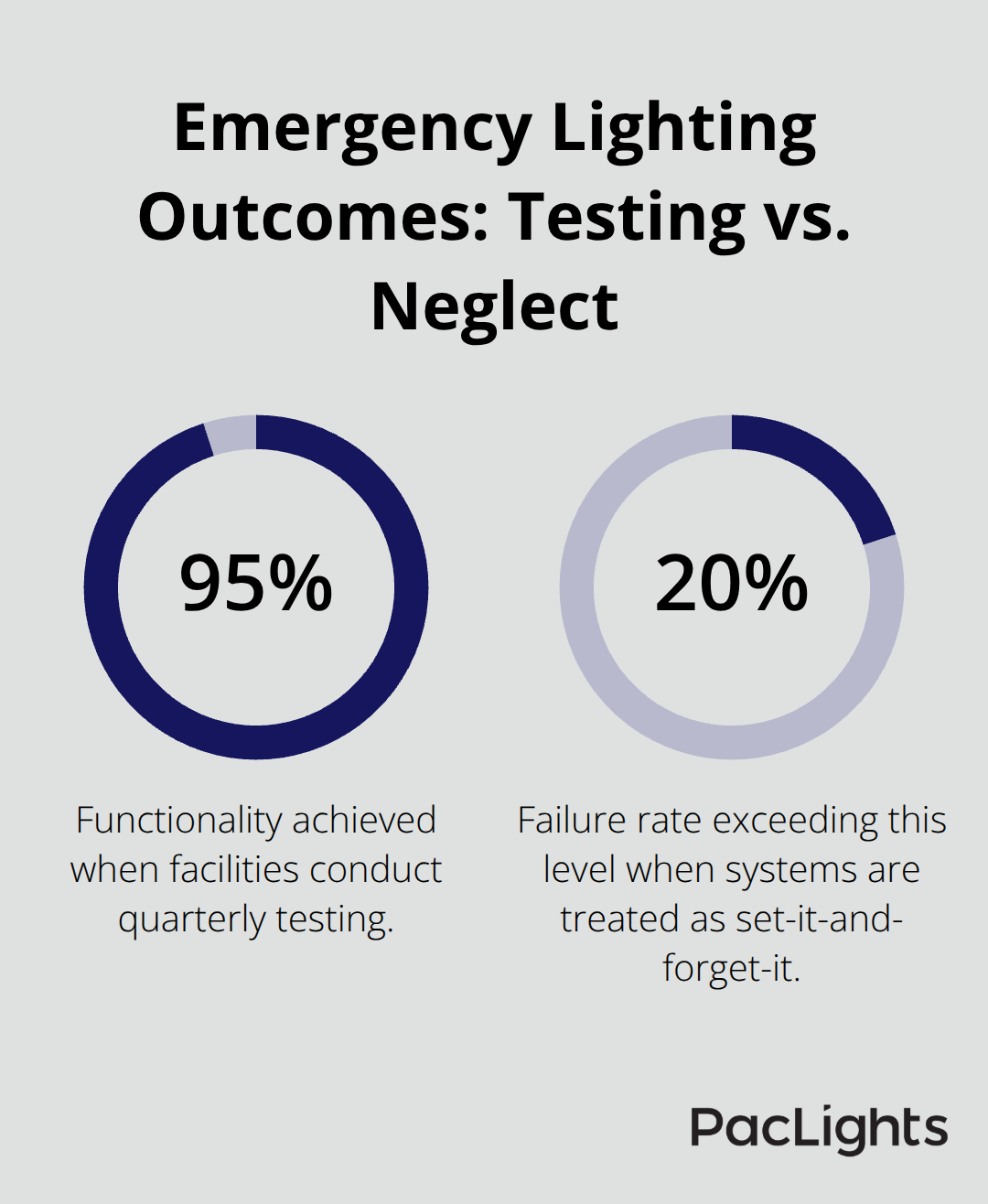
Facilities that treat emergency lighting as a set-it-and-forget-it system experience failure rates exceeding 20 percent according to inspection data from the National Fire Protection Association, while facilities conducting quarterly testing maintain 95 percent functionality. Dust and debris accumulation on LED lenses reduces brightness by 10 to 15 percent annually in typical indoor environments, so cleaning fixtures twice yearly restores full output without requiring replacement. Battery terminals corrode in humid environments, reducing charging efficiency and forcing premature battery replacement, which monthly visual inspections catch before performance degrades. Document every test result, every battery replacement, and every maintenance action in writing so inspectors see a clear history of system stewardship rather than speculation about whether the system actually works.
Networked Controls Transform Emergency Lighting Management
Facilities upgrading to networked lighting controls gain real-time visibility into emergency luminaire status across multiple buildings, receiving alerts when fixtures malfunction rather than discovering problems during code inspections or actual power events. This shift from reactive maintenance to predictive monitoring transforms emergency lighting from a compliance burden into a managed system that facility managers control rather than manage through crisis response. Advanced lighting controls provide the visibility and responsiveness that modern facilities require to maintain reliable emergency lighting across complex building portfolios.
Final Thoughts
Emergency wall luminaires design succeeds when you treat it as an ongoing system rather than a one-time compliance checkbox. Facilities that maintain reliable emergency lighting select LED fixtures with integrated battery backup and self-testing capabilities, position luminaires based on actual room conditions rather than generic spacing formulas, and conduct quarterly testing under darkness to catch problems before emergencies occur. Modern LED emergency systems maintain 80 to 90 percent brightness throughout the entire 90-minute discharge cycle, eliminating the dimming anxiety that occupants experience with older fluorescent fixtures.
Facilities investing in LED systems recover their upfront costs within five years through reduced maintenance labor, extended fixture lifespan, and elimination of premature battery replacement. The real payoff comes from knowing your emergency lighting actually works when power fails, protecting occupants and eliminating liability exposure. Your next step depends on your current situation-if your facility still uses fluorescent or incandescent emergency lighting, upgrading to LED fixtures with networked controls transforms your emergency lighting from a maintenance burden into a managed system that alerts you to problems before they become critical.
We at PacLights understand that emergency lighting is non-negotiable for facility safety and code compliance. We offer LED retrofit solutions and advanced lighting controls that optimize your emergency lighting systems while reducing energy costs across your entire facility. Contact our team to evaluate your current system and explore how modern emergency lighting technology can protect your occupants while improving your facility’s overall performance.
Disclaimer: PacLights is not responsible for any actions taken based on the suggestions and information provided in this article, and readers should consult local building and electrical codes for proper guidance.