

Data center lighting design standards shape how efficiently your facility operates. Poor lighting choices waste energy, inflate costs, and compromise safety-while smart design does the opposite.
At PacLights, we’ve seen firsthand how the right lighting framework transforms data halls. This guide walks you through the standards, layouts, and control systems that matter.
Understanding Data Center Lighting Requirements
Industry Standards and Compliance Regulations
Data center lighting isn’t regulated the same way as office buildings. There’s no single federal standard that dictates exactly how bright your server room must be. Instead, the industry relies on guidance from ANSI/IES RP-7, which sets illumination targets for different zones: 50 foot-candles for equipment areas where technicians read labels and perform maintenance, 30 foot-candles for aisles and common spaces, and 10 foot-candles for corridors. These aren’t arbitrary numbers.
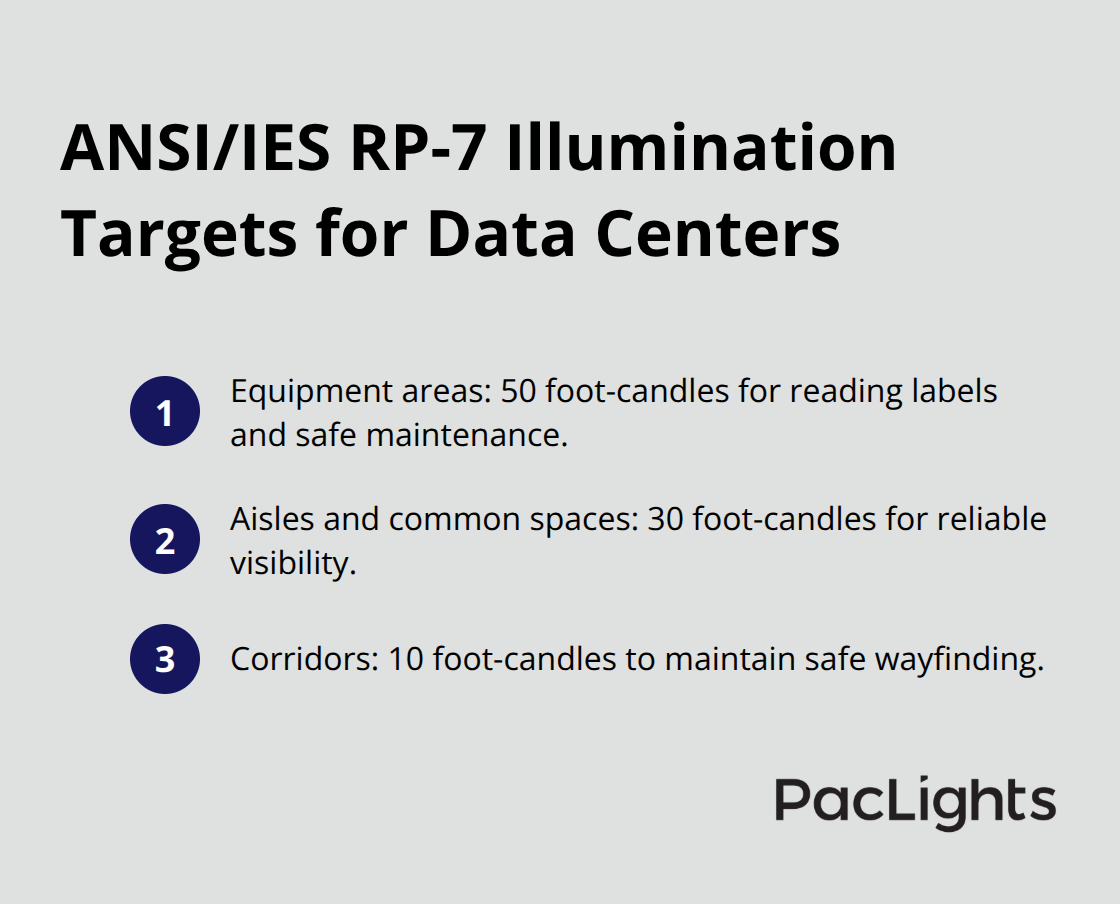
ANSI/IES research shows that technicians working below 50 foot-candles in dense server environments make more errors, miss critical warning lights on equipment, and experience higher fatigue. Going above these levels wastes energy without improving safety or performance. The real challenge is that most data centers either under-light their critical zones to save money or over-light everything uniformly because they lack a targeted design.
Energy Efficiency and Cost Reduction Goals
Energy efficiency directly determines your operating costs, and lighting accounts for roughly 15-20% of total data center energy consumption according to industry benchmarks. A poorly designed lighting system with inefficient fixtures and no controls can cost you $50,000 to $150,000 annually in wasted energy across a mid-sized facility.
The fix isn’t complicated: switch to LED fixtures with motion sensors and occupancy controls. LED technology delivers the same illumination as older fluorescent or incandescent systems while consuming 50-75% less energy. Add occupancy sensors to common areas and aisles, and you eliminate lighting in spaces where no one is working. Many data center operators see payback on LED retrofits within 3-5 years through energy savings alone, then enjoy another 10-15 years of lower operating costs.
Matching Lighting Levels to Work Zones
The key is matching lighting levels to actual work zones rather than lighting the entire facility at maximum brightness. This targeted approach (combined with modern controls) prevents both under-lighting critical areas and wasting energy in spaces that don’t require full illumination. PacLights offers LED retrofit solutions with optional motion control and advanced lighting controls that help you achieve these efficiency gains while maintaining the illumination levels your team needs to work safely.
With the right standards in place and energy-efficient fixtures selected, the next step involves translating these principles into actual physical layouts that support your specific data hall configuration.
How to Layout Lighting Across Different Data Center Zones
A multi-layered lighting approach-combining task lighting at equipment, ambient lighting in common areas, and dedicated emergency systems-prevents both dark spots that create safety risks and over-lit spaces that waste energy. The layout you choose depends on your rack density, aisle width, and maintenance workflow, not on generic industry templates. Most data centers fail because they treat lighting as a single problem rather than three distinct problems that require different solutions.
Task Lighting at Server Racks
Position task lighting directly above and around server racks where technicians need 50 foot-candles at eye level to read equipment labels, spot LED warning indicators, and perform cable management safely. This means placing fixtures to illuminate the front and rear of racks without creating harsh shadows on display screens. Many facilities mount high-bay fixtures 12-15 feet above the floor, but this approach often leaves the critical 4-8 foot zone (where technicians actually work) under-lit. Instead, add supplementary task lighting-such as linear strip lights or troffer lights-at 8-10 feet height or use adjustable fixtures that direct light precisely where needed. This targeted strategy cuts energy waste compared to flooding the entire data hall at maximum brightness. Space fixtures 10-12 feet apart in rows to minimize shadows while keeping energy consumption reasonable. Denser rack layouts require closer spacing or brighter individual fixtures to maintain consistent 50 foot-candle coverage.
Ambient Lighting in Aisles and Common Spaces
Ambient lighting in aisles and common spaces should hit 30 foot-candles according to ANSI/IES RP-7, but this does not mean constant illumination everywhere. Install occupancy sensors in low-traffic corridors, break rooms, and adjacent office spaces-areas where technicians spend only a fraction of their time. Motion-activated controls reduce energy use by 40-60% in these zones without compromising safety or response time. For main aisles between hot and cold rows, use continuous ambient lighting because technicians move through these areas regularly, but pair it with daylight harvesting controls if your facility has windows or skylights.
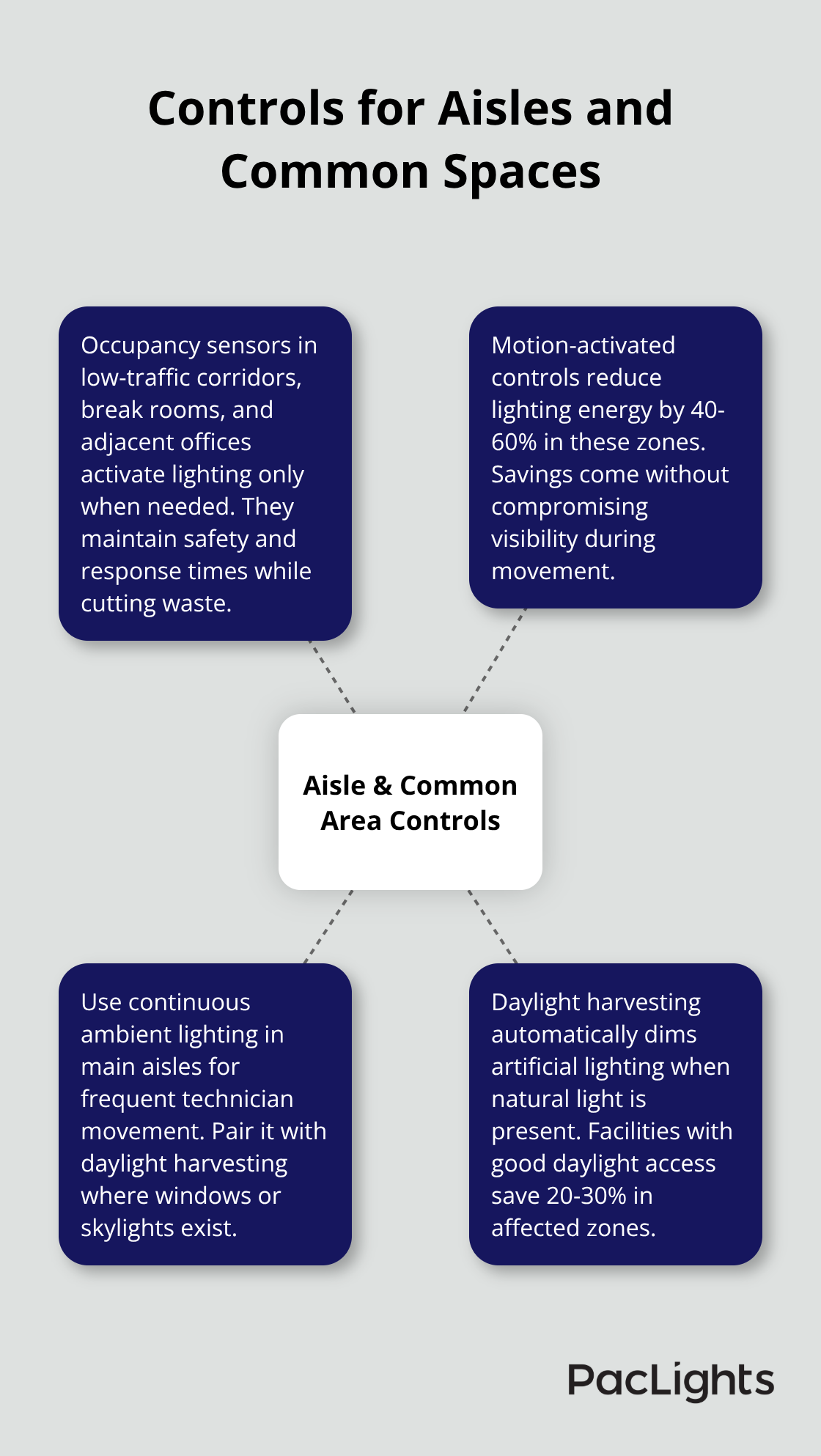
This approach automatically dims artificial lights when natural light is available, saving 20-30% on lighting energy in spaces with good daylight access.
Emergency and Safety Lighting Systems
Emergency and safety lighting requires a separate system entirely: exit signs, evacuation route markers, and backup lighting powered by battery or generator must function independently of your main controls and motion sensors. These systems consume minimal energy but are non-negotiable for compliance and life safety. Test battery-backed emergency fixtures quarterly to verify they operate reliably during power loss.
Implementing Zone-Based Control Strategies
Treat each zone as a distinct problem with its own illumination target, control strategy, and maintenance schedule rather than applying one-size-fits-all fixtures throughout the facility. This zone-based approach lets you optimize energy consumption in low-traffic areas while maintaining full illumination where technicians perform critical work. PacLights offers LED retrofit solutions with optional motion control and advanced lighting controls that help you implement these zone-specific strategies across your data hall. With your layout strategy defined and zones properly illuminated, the next step involves selecting and configuring the control systems that automate these lighting decisions and adapt to your facility’s actual usage patterns.
Advanced Lighting Control Systems for Data Centers
Motion Sensors Activate Lights on Demand
Occupancy sensors and motion controls transform lighting from a static, always-on system into one that responds to actual technician movement and presence. Most data centers operate at partial capacity during off-peak hours, yet lighting consumes the same energy as if the facility ran at full load. Motion-activated controls in aisles, corridors, and maintenance areas cut lighting energy by 40-60% in these zones without sacrificing safety or response time. The sensor detects movement within 15-30 seconds and activates lights automatically, then holds them on for a programmable duration (typically 5-15 minutes) before dimming or switching off. In practice, technicians moving through a corridor trigger lighting instantly while unoccupied spaces remain dark. A mid-sized data center with 15,000 square feet of aisles and common areas saves $8,000-$12,000 annually through occupancy controls alone, assuming average electricity rates of $0.12 per kilowatt-hour. The payback period on sensor installation typically runs 2-3 years, after which the savings compound.
Daylight Harvesting Reduces Artificial Light Demand
Daylight harvesting adds another efficiency layer when photosensors measure ambient light levels and automatically dim artificial fixtures proportionally. If your data center has windows, skylights, or transparent sections in the roof, this approach works effectively. Data centers with significant daylight access report 20-30% reductions in lighting energy in affected zones. The system requires minimal configuration once installed and operates continuously without manual intervention. Facilities in regions with consistent natural light see the strongest returns, though even partial daylight access delivers measurable savings.
Smart Scheduling Aligns Lighting with Facility Activity
Smart scheduling integrates with your building management system to dim or switch off lighting in scheduled maintenance windows, after-hours periods, or during planned shutdowns. Rather than relying on manual switches or timers, networked lighting controls let you program lighting schedules based on facility activity, equipment maintenance calendars, and seasonal changes. This approach eliminates the inconsistency that comes from human operators forgetting to adjust lighting manually.
Building Management System Integration Creates Unified Control
Integration with your building management system creates a unified command center where lighting, HVAC, security, and power monitoring operate together. This integration enables fault alerts (such as notifying you when a fixture fails or sensor malfunctions), real-time energy dashboards showing lighting consumption by zone, and automated responses to emergency events. Systems that track lighting energy use intensity (measured in watts per square foot) help you benchmark performance against your baseline and identify zones that consume more energy than expected. Most data centers that implement networked controls see monthly energy reports that reveal consumption patterns, peak usage times, and opportunities for further optimization.
Calculating Total Energy and Cost Savings
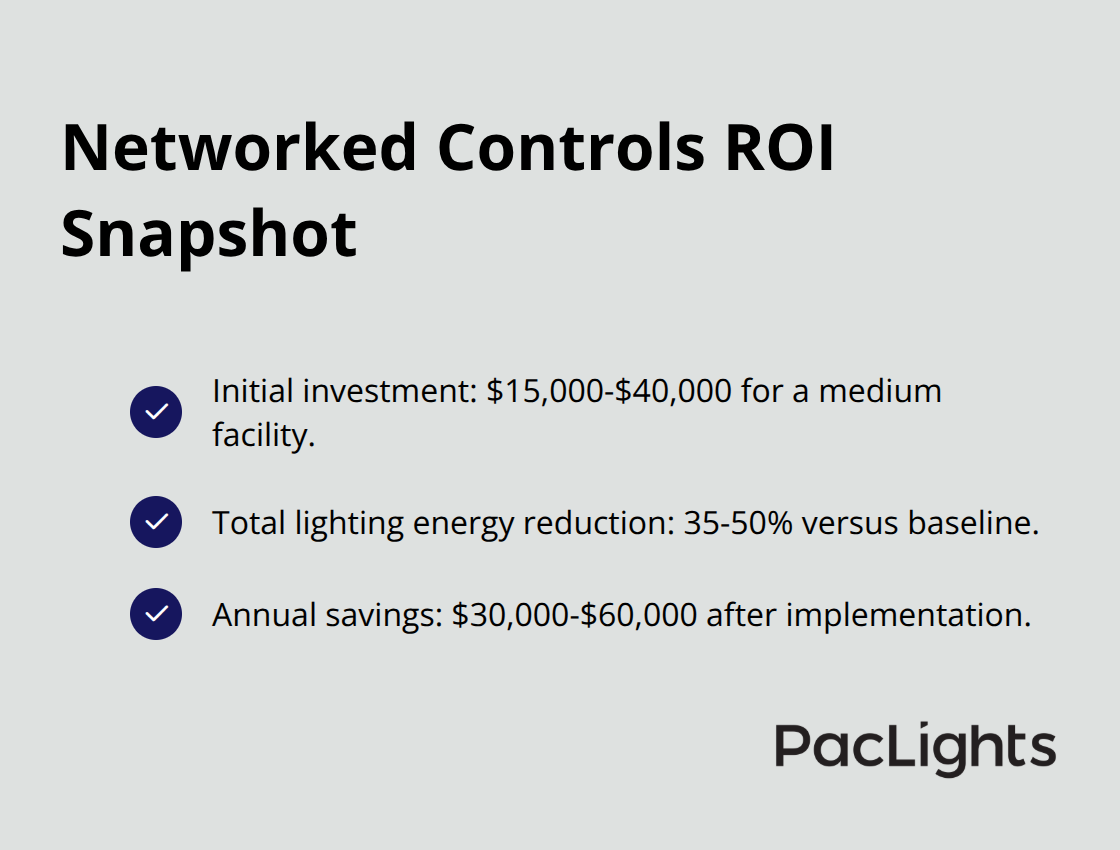
The initial investment in control infrastructure ranges from $15,000-$40,000 for a medium facility, but the combination of occupancy sensors, daylight harvesting, and smart scheduling typically delivers 35-50% total lighting energy reduction over the baseline, translating to $30,000-$60,000 in annual savings. PacLights offers LED retrofit solutions with optional motion control and advanced lighting controls that help you implement these automation strategies across your data hall.
Final Thoughts
Datacenter lighting design standards translate operational safety, energy efficiency, and cost control into measurable targets that work across different facility sizes and configurations. Data centers that implement these standards report 35-50% reductions in lighting energy consumption, payback periods of 2-5 years on LED retrofits and controls, and measurable improvements in technician safety and error rates. Proper lighting design reduces maintenance burden by using durable LED fixtures that last 50,000+ hours and minimizes equipment failures caused by technician errors in poorly lit environments.
Starting your lighting improvement project requires three concrete steps: audit your current system to identify zones that are under-lit, over-lit, or consuming excessive energy; develop a phased implementation plan that prioritizes high-traffic areas and zones with the greatest energy waste; and select fixtures and controls that align with your facility’s specific layout, rack density, and maintenance workflow. Facilities that adopt zone-based lighting strategies and networked controls gain visibility into energy consumption patterns, enabling continuous optimization rather than one-time fixes. Your lighting system becomes a data source that informs facility management decisions and supports benchmarking against industry performance metrics.
PacLights provides LED retrofit solutions with optional motion control and advanced lighting controls designed for data center environments. We offer free lighting layout designs and ROI assessments to help you understand the financial impact of upgrading your system. Our fixtures integrate with building management systems, giving you the automation and visibility required to maintain datacenter lighting design standards across your operation.
Disclaimer: PacLights is not responsible for any actions taken based on the suggestions and information provided in this article, and readers should consult local building and electrical codes for proper guidance.