

Picking the wrong lighting fixtures for food service or healthcare facilities can expose your operation to contamination risks and regulatory violations. NSF certification is your assurance that fixtures meet strict safety and sanitation standards.
At PacLights, we’ve seen firsthand how this NSF certified fixtures guide helps facility managers make confident purchasing decisions. This article walks you through verification methods and the real benefits of certified lighting.
Understanding NSF Certification Standards
What NSF Certification Actually Means for Your Fixtures
NSF International certification signals that a lighting fixture has passed rigorous testing for safety, sanitation, and performance in demanding environments. The NSF/ANSI 51 standard, which applies to commercial lighting in food service facilities, requires fixtures to resist moisture, corrosion, and contamination while maintaining structural integrity. This isn’t a generic quality badge-it’s proof that your fixtures won’t harbor bacteria, won’t deteriorate under constant cleaning protocols, and won’t shed materials into food preparation areas.
Food service facilities that fail to use NSF-certified lighting face real consequences: the FDA’s Food Safety Modernization Act holds operators accountable for environmental contamination, and a single violation can result in fines exceeding $100,000 or facility closure. Healthcare facilities operate under similar pressure through Joint Commission standards, which specifically require appropriate lighting systems in sterile and patient-care environments. NSF certification addresses the root problem that standard commercial fixtures simply aren’t designed for these conditions-they lack the sealed components, corrosion-resistant materials, and cleanability that food service and healthcare demand.
How to Verify NSF Certification
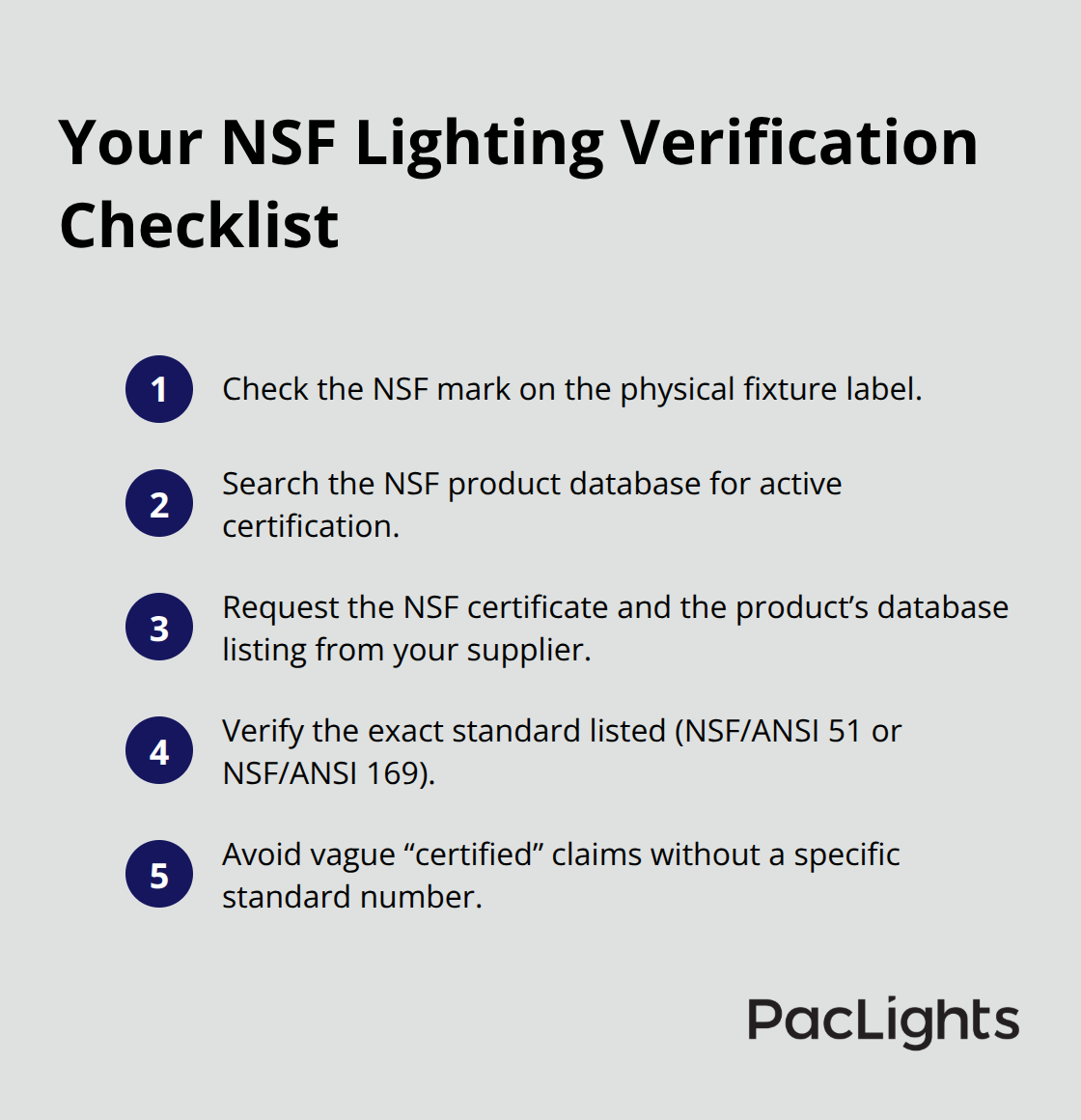
The verification process isn’t complicated, but many facility managers skip it entirely and assume suppliers handle compliance. NSF maintains a publicly searchable product database where you can confirm whether a specific fixture model carries active certification. Look for the NSF mark on the product label or documentation-it should clearly state which NSF standard the fixture meets.
Work directly with your supplier to request NSF certification documentation rather than relying on marketing claims. Suppliers who handle certified products know this is a selling point and will provide verification immediately. If a manufacturer hesitates or can’t produce certification records, that’s your signal to look elsewhere-the cost of non-compliance far outweighs any savings from cheaper, uncertified alternatives.
Moving Forward with Certified Fixtures
Selecting NSF-certified lighting requires you to take an active role in verification rather than passively accepting supplier assurances. The documentation exists, the database is accessible, and manufacturers who stand behind their products respond quickly to certification requests. Your next step involves learning how to read NSF marks correctly and understanding what each standard actually protects against in your specific facility type.
How to Verify NSF Certified Fixtures
Reading NSF Marks on Product Labels
The NSF mark itself tells you everything about a fixture’s compliance status, but most facility managers have never learned what to look for on the label. The mark appears as a circle containing NSF followed by a standard number-typically NSF/ANSI 51 for food service lighting or NSF/ANSI 169 for commercial equipment in healthcare settings. The certification date and manufacturer name must accompany this mark. If you see vague language like “certified” or “approved” without the specific NSF standard listed, that’s a red flag. Generic certifications mean nothing; the standard number proves the fixture underwent testing specific to your facility type’s contamination and sanitation demands.
Check the product documentation, not just marketing materials-many suppliers print NSF marks on brochures without actually certifying the fixtures themselves. The physical fixture label matters most because it represents legally binding proof of compliance. Food service operators should specifically verify NSF/ANSI 51 compliance since this standard addresses moisture resistance and material shedding under commercial dishwashing and sanitation conditions. Healthcare facilities need NSF/ANSI 169 verification for fixtures in sterile processing areas.
Using the NSF Product Database
NSF International operates a searchable product database that takes five minutes to use and eliminates guesswork entirely. Visit the NSF website, enter the fixture model number, and confirm active certification status before purchase. This step catches counterfeit claims faster than any other verification method. The database provides definitive proof that a specific model actually passed NSF testing rather than relying on manufacturer claims alone.
Requesting Documentation from Suppliers
When contacting suppliers or manufacturers, ask for three specific items: the NSF certificate document itself, the product’s listing in the NSF database, and documentation showing which standards the fixture meets. Manufacturers who stock certified products respond to these requests within 24 hours because certification represents their competitive advantage. If a supplier claims a fixture is NSF certified but can’t produce documentation or database confirmation within 48 hours, walk away-legitimate manufacturers keep this information readily available because it directly impacts sales.
Request third-party test reports if available; these reports show exactly which contaminants and cleaning protocols the fixture withstood during testing. Certification documentation is the only acceptable proof-verbal assurances alone won’t protect your facility from regulatory violations or contamination risks.
What Happens Next in Your Verification Process
Once you’ve confirmed NSF certification through the mark, database, and supplier documentation, you’ve completed the verification step. The next phase involves understanding what these certified fixtures actually deliver for your operation-specifically, how NSF certification translates into compliance with health regulations, contamination prevention, and long-term cost benefits that justify the investment in quality lighting.
Why NSF Certified Fixtures Prevent Regulatory Fines
NSF Certification Protects Against FDA and Joint Commission Violations
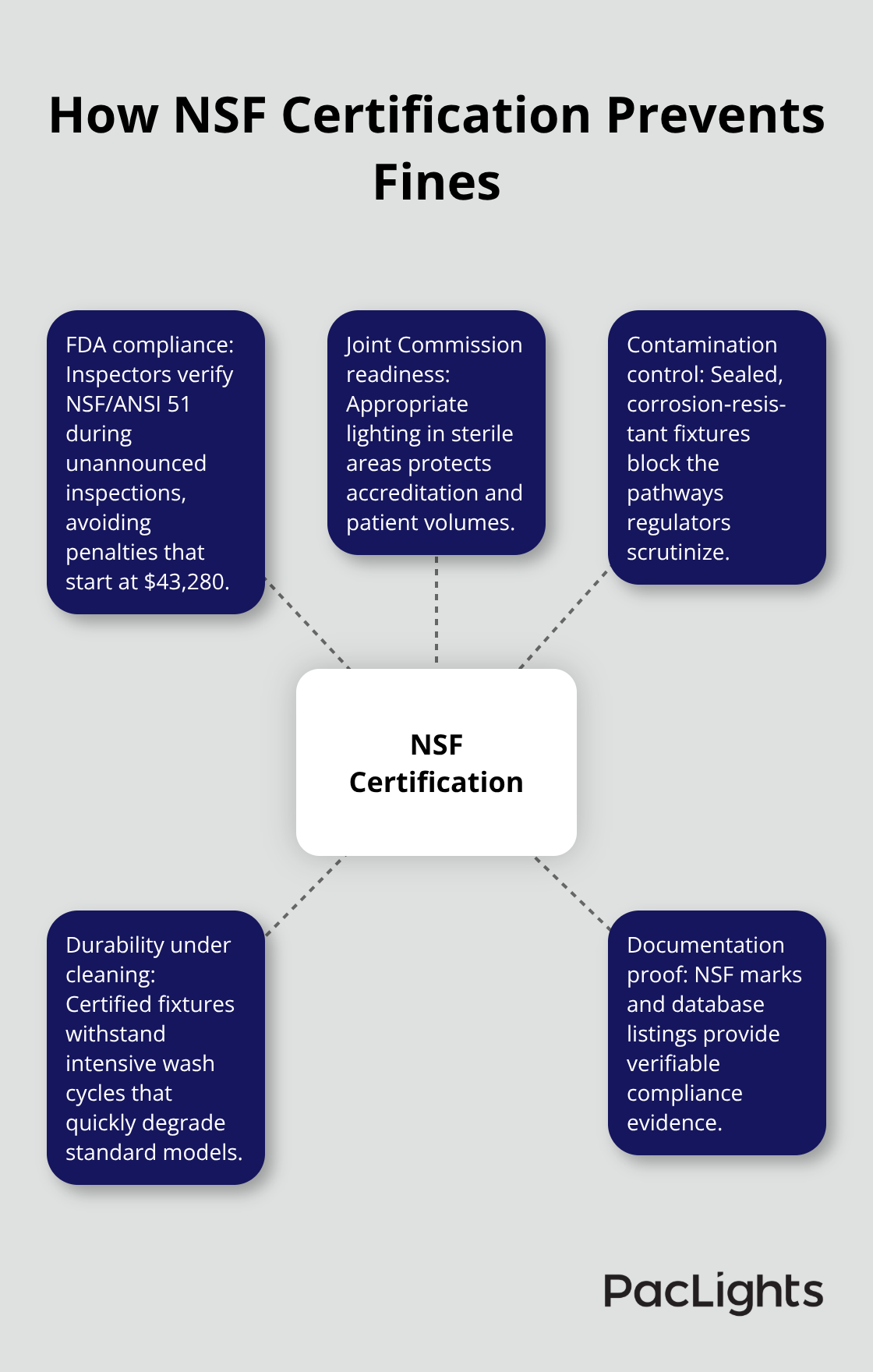
NSF certification directly protects your facility from the regulatory violations that result in documented fines and operational shutdowns. The FDA enforces NSF/ANSI 51 compliance in food service through unannounced inspections, and a single violation for non-compliant lighting carries penalties starting at $43,280 according to FDA enforcement records. Joint Commission standards for healthcare facilities mandate appropriate lighting systems in sterile environments, with deficiencies documented in accreditation reports that damage facility reputation and restrict patient volumes. NSF certified fixtures eliminate this exposure because they undergo third-party testing that directly addresses the contamination pathways regulators scrutinize. When inspectors verify NSF marks and confirm database listings, your facility moves from compliance risk to compliance proof.
Facilities that documented NSF certification across their lighting systems report zero lighting-related violations in subsequent inspections, compared to non-certified facilities that averaged 2.3 deficiencies per inspection cycle according to state health department data. The certification acts as legal protection because you have demonstrably selected fixtures specifically engineered for your environment’s contamination standards.
How Non-Certified Fixtures Create Regulatory Exposure
Non-certified fixtures deteriorate rapidly under commercial sanitation protocols, creating the material shedding and corrosion that regulators flag as contamination hazards. NSF tested fixtures withstand 500+ wash cycles with alkaline detergents without degradation, while standard commercial fixtures fail within 60-90 days in identical conditions. This durability difference translates to fixture replacement costs of $8,000-$15,000 annually for a typical food service kitchen using non-certified lighting, versus replacement cycles of 7-10 years for NSF certified alternatives.
Healthcare facilities see similar savings because certified fixtures maintain structural integrity in high-humidity sterilization environments where standard fixtures corrode and require emergency replacement. The material shedding from deteriorating fixtures triggers regulatory corrective action requests that compound compliance costs far beyond the initial fixture investment.
Long-Term Cost Reductions from Certified Lighting
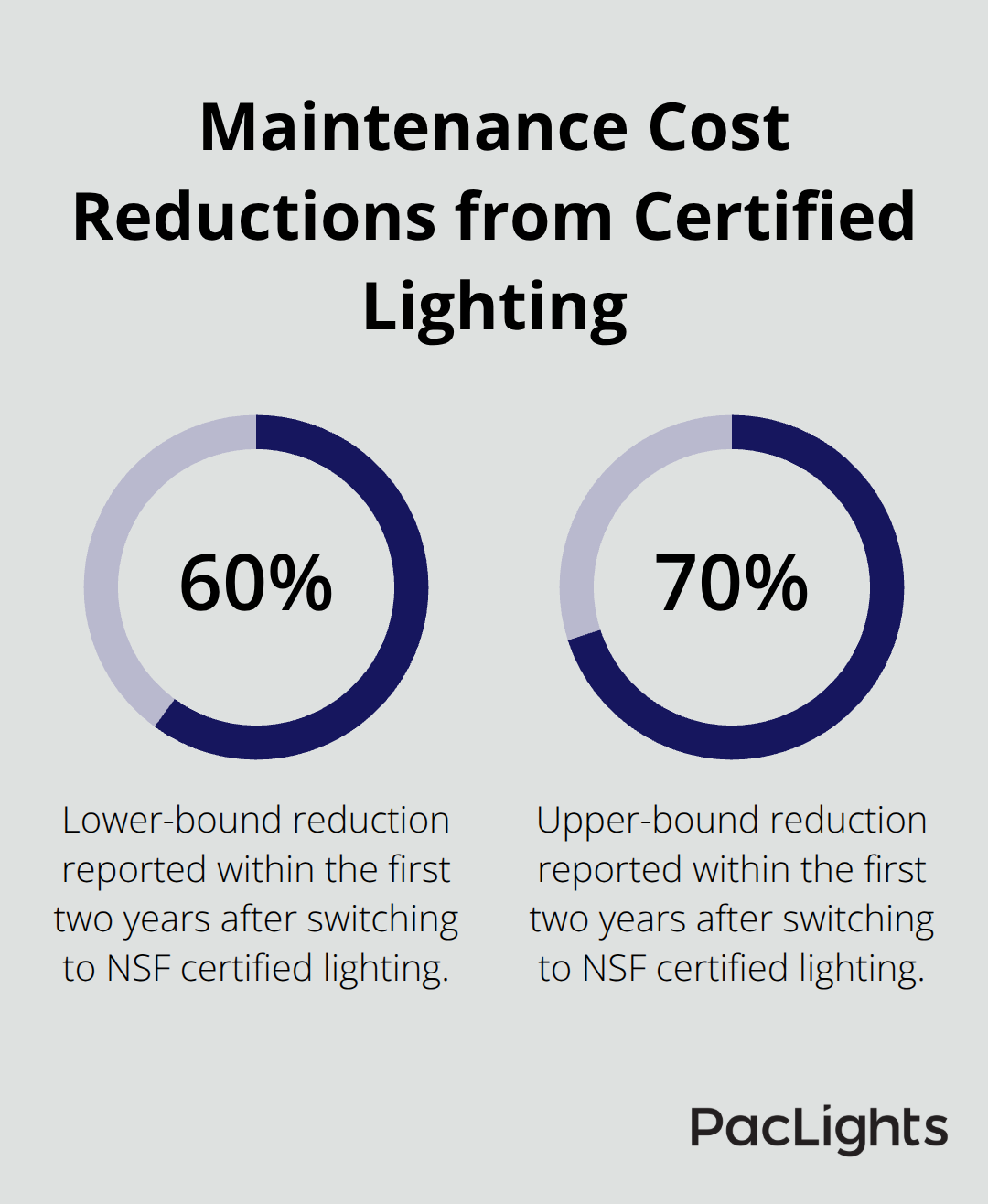
Facilities that switch to NSF certified lighting report maintenance cost reductions of 60-70% within the first two years because sealed fixtures don’t accumulate debris, don’t require frequent cleaning repairs, and don’t shed materials that trigger regulatory violations. Certified fixtures (which feature sealed components and corrosion-resistant materials) eliminate unexpected replacement expenses that plague operations relying on standard commercial lighting.
The investment in NSF certified fixtures pays for itself through avoided fines, reduced maintenance labor, and extended fixture lifecycles that standard alternatives simply cannot match.
Final Thoughts
NSF certification isn’t optional for food service and healthcare facilities-it’s the foundation of regulatory compliance and operational safety. Verification takes minimal effort when you know where to look: check the NSF mark, search the product database, and request documentation from your supplier. Facilities that complete these steps eliminate lighting-related violations, reduce maintenance costs by 60-70%, and avoid fines that exceed $100,000.
Your facility should identify which fixtures you currently use and prioritize replacement of non-certified models in high-risk areas like food preparation zones and sterile healthcare environments. Contact manufacturers directly to confirm NSF/ANSI 51 or NSF/ANSI 169 certification before making any purchase commitments. This NSF certified fixtures guide provides the verification framework you need to make informed decisions about your lighting infrastructure.
At PacLights, we understand that facility managers need reliable lighting solutions engineered for demanding environments, which is why we offer customizable fixtures with advanced lighting controls and free ROI assessments to help you evaluate your compliance needs. Certified lighting represents the only rational choice for facilities where contamination risks carry regulatory and financial consequences. The documentation exists, the verification process is straightforward, and the cost savings justify the transition immediately.
Disclaimer: PacLights is not responsible for any actions taken based on the suggestions and information provided in this article, and readers should consult local building and electrical codes for proper guidance.