

Warehouse high bay selection isn’t something to rush through. The right lighting system can cut your energy costs by 40–60% compared to traditional fixtures while dramatically improving worker safety and productivity.
At PacLights, we’ve helped countless facilities make this decision. This guide walks you through the key features to evaluate, how to assess your specific space, and why LED high bays deliver measurable returns on investment.
Why High Bays Transform Large Warehouse Operations
Large warehouse spaces demand lighting that works harder than standard fixtures. High bays address the specific challenge of covering expansive floor areas with consistent brightness while keeping your operational costs in check. The difference between adequate and optimal lighting directly impacts three measurable outcomes: energy consumption, worker productivity, and safety incidents.
Energy costs drop dramatically with the right system
Warehouse lighting typically accounts for 20–30% of total facility energy consumption according to the U.S. Department of Energy. When you switch from traditional metal halide or high-pressure sodium fixtures to LED high bays, the math becomes compelling. LED high bays consume 40–60% less energy than their traditional counterparts, which translates to real savings on your monthly utility bills. A 50,000-square-foot warehouse running high bays 16 hours daily saves between $8,000 and $15,000 annually just on electricity. These savings compound year after year, making the fixture upgrade pay for itself within 3–5 years in most cases. LED fixtures also generate less heat, which reduces cooling demands during warmer months and further lowers operational expenses.
Worker safety and productivity improve with proper illumination
Warehouse operations depend on visibility. Poor lighting causes picking errors, safety hazards, and slower throughput. Studies from the Illuminating Engineering Society show that inadequate lighting increases workplace accident rates by up to 20%. When workers can clearly see inventory, equipment, and floor hazards, injury rates drop and productivity increases. High bays deliver uniform light distribution across expansive areas without dark pockets or excessive shadows that create hazards. Motion sensor controls, available on many modern high bay systems (including advanced lighting controls that optimize energy use), add another layer of efficiency by reducing lighting in unoccupied zones while maintaining full brightness during active operations. Workers also report reduced eye strain and fatigue when facilities provide proper lumen levels and color temperature consistency throughout the space.
What comes next in your selection process
The financial case and safety benefits make high bays a smart investment, but selecting the right fixture requires understanding specific technical features that match your warehouse’s unique demands.
What Specs Actually Matter When Comparing High Bay Fixtures
Lumen output and light distribution work together
Lumen output determines whether your warehouse receives adequate brightness, but the number alone tells an incomplete story. A 150-watt LED high bay might deliver 20,000 lumens, while a 200-watt fixture produces 28,000 lumens-the difference matters only if your space actually needs that extra output. You must match lumens to your specific warehouse activities. Picking and packing operations require 300–500 lux (a measure of light intensity on a surface), according to standards from the Illuminating Engineering Society, while storage areas function adequately at 150–200 lux. Calculate your facility’s total square footage, divide by the coverage area per fixture, then verify the lumen output delivers the required lux levels.
Light distribution patterns matter equally because uneven light creates dark zones where accidents happen and productivity drops. Fixtures with a 120-degree beam angle spread light across wider areas compared to narrower 90-degree patterns, making them better for aisles but potentially wasteful in tall, narrow spaces. Request photometric data sheets from manufacturers-these show exactly how light spreads at different mounting heights.
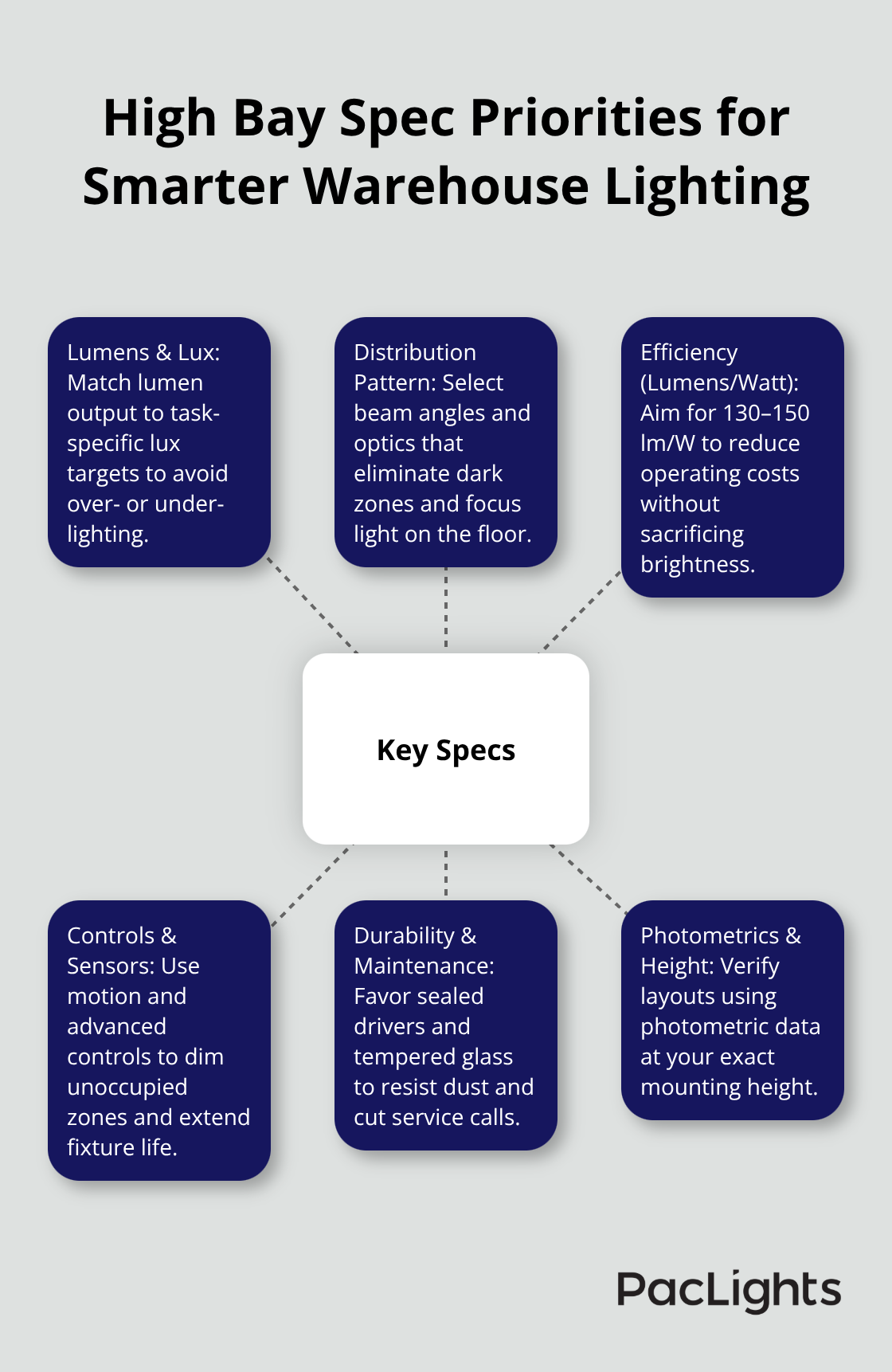
A 40-foot ceiling demands different distribution than a 20-foot space, and the wrong pattern wastes energy on walls instead of floor coverage where workers operate.
Energy efficiency ratings predict your operating costs
LED high bays typically range from 100 to 240 watts depending on output requirements, and this wattage directly predicts your electricity consumption. A 50,000-square-foot facility needing 100 fixtures at 150 watts each consumes 15 kilowatts when fully lit. At an average commercial electricity rate of $0.12 per kilowatt-hour and 16 daily operating hours, annual energy costs reach roughly $10,500. Switching to more efficient 120-watt fixtures in the same space cuts that to $8,400 annually-meaningful savings that compound over 10-year fixture lifespans.
Try for fixtures rated at 130–150 lumens per watt as a practical efficiency benchmark; anything below 120 lumens per watt indicates outdated technology. This metric reveals how much light output you receive per unit of power consumed, making it the single best way to compare fixtures across different manufacturers and wattage levels.
Durability and maintenance requirements separate true value from false economy
LED fixtures rated for 50,000-hour lifespans (approximately 8–10 years at 16 daily hours) cost less to maintain than metal halide bulbs requiring replacement every 2–3 years. Sealed driver compartments and tempered glass lenses resist dust accumulation in warehouses, reducing cleaning frequency and labor costs. Motion sensor controls, available on advanced fixtures, extend lamp life by reducing runtime in unoccupied zones-a real advantage in facilities with variable occupancy patterns throughout operating hours.
These technical specifications form the foundation of your selection process, but they only become actionable when you assess them against your warehouse’s unique physical characteristics and operational demands.
Matching Fixtures to Your Warehouse’s Physical Reality
Ceiling height and floor area determine your fixture requirements
Your ceiling height and floor area are the two non-negotiable starting points for fixture selection, and they determine whether you waste money or achieve optimal coverage. A 50,000-square-foot warehouse with 25-foot ceilings demands completely different fixtures than the same square footage with 40-foot ceilings. Start by measuring your actual ceiling height from floor to the structural obstruction where you’ll mount fixtures, then calculate your total illuminated area by multiplying length by width. Divide this total by the coverage area each fixture provides at your specific mounting height.
A 150-watt LED high bay mounted at 25 feet typically covers 1,500–2,000 square feet depending on beam angle and lumen output, while the same fixture at 40 feet covers only 800–1,200 square feet because light spreads wider but delivers lower intensity at ground level. Request photometric reports from manufacturers showing illuminance (measured in lux or foot-candles) at your exact ceiling height rather than relying on generic charts. This prevents ordering too many fixtures for a low-ceiling space or too few for a high-ceiling facility.
Calculate your energy costs before purchase
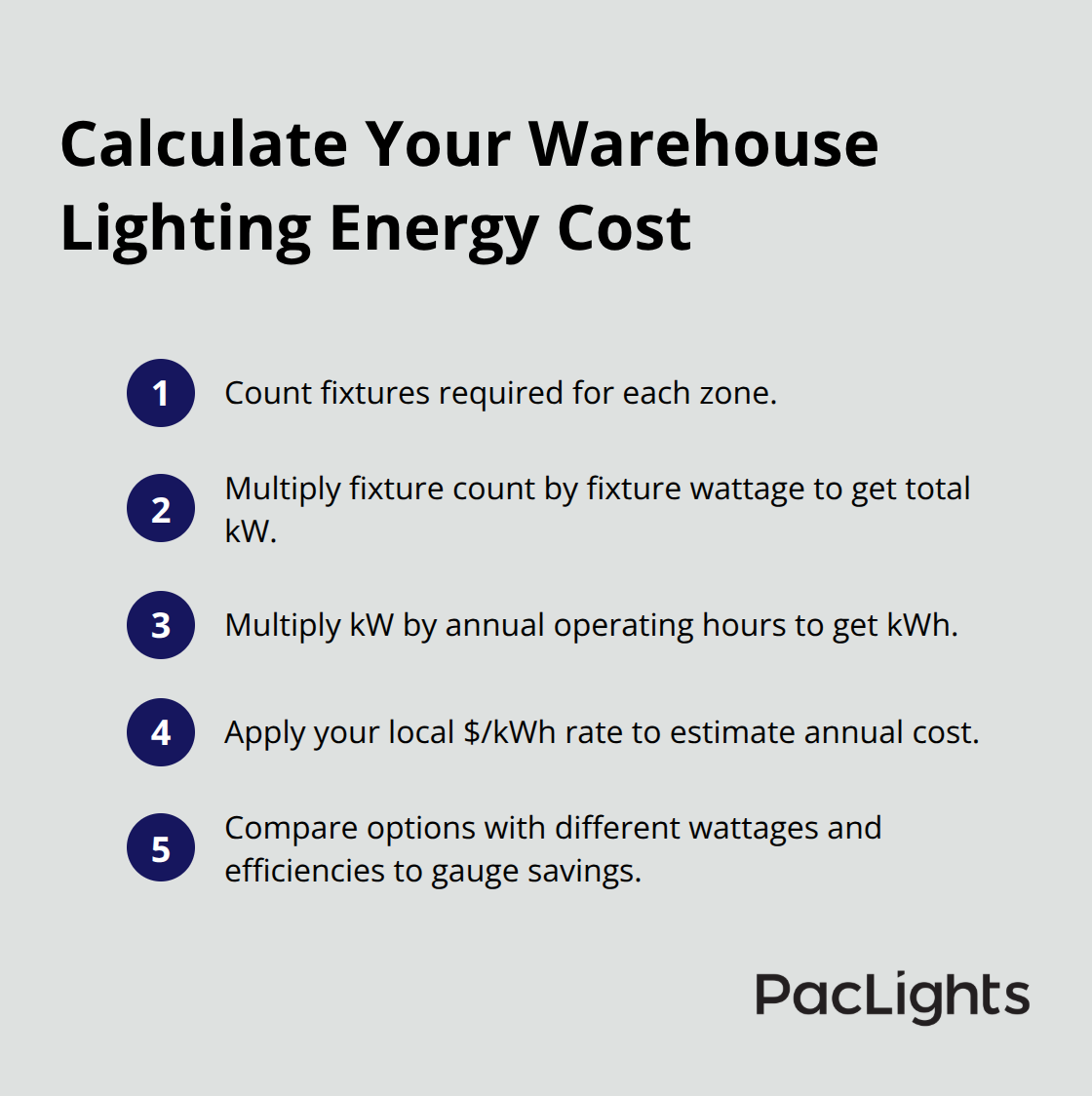
Once you know your fixture count, multiply by wattage and annual operating hours to calculate total electricity consumption, then multiply by your local rate per kilowatt-hour to project annual energy costs before purchase. This calculation reveals whether a slightly more expensive, higher-efficiency fixture actually saves money over its lifespan compared to a cheaper alternative.
Match light levels to specific warehouse activities
Your specific warehouse activities determine the minimum light levels you must deliver, and here’s where most facilities either overspend or compromise safety. Picking and packing operations require 300–500 lux according to the Illuminating Engineering Society, but bulk storage of uniform inventory needs only 150–200 lux. Receiving and shipping dock areas benefit from 500 lux to catch damage and verify contents, while aisles used exclusively for equipment movement function adequately at 200 lux.
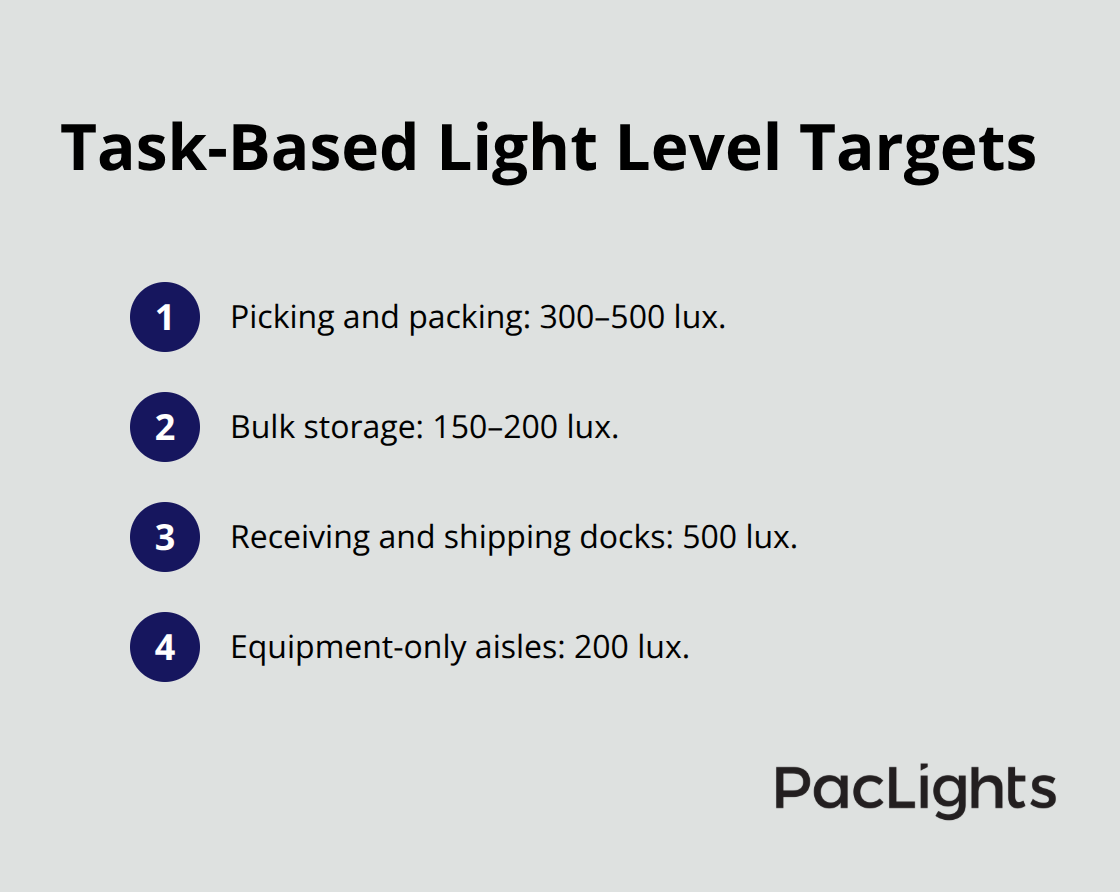
Map your facility by zone and assign appropriate lux targets to each area rather than lighting everything uniformly. This targeted approach cuts fixture counts by 15–25% compared to one-size-fits-all designs while maintaining safety where it matters.
LED outperforms traditional fixture technology across all metrics
LED high bays outperform traditional metal halide and high-pressure sodium fixtures on every practical measure: they reach full brightness instantly instead of requiring 10–15 minutes warmup time, they maintain consistent color temperature and lumen output throughout their lifespan while traditional bulbs dim progressively, and they cost 40–60% less to operate annually. The only scenario where traditional fixtures make sense is in facilities closing within two years, and even then the operational savings often justify LED conversion.
PacLights provides free lighting layout designs and ROI assessments that show exactly how many fixtures your space needs and what your energy costs will be under different scenarios, removing guesswork from the selection process entirely.
Final Thoughts
Warehouse high bay selection requires you to match fixture specifications to your physical space, calculate financial impact over the fixture lifespan, and commit to technology that delivers measurable returns. A 50,000-square-foot facility switching to LED high bays saves $8,000 to $15,000 annually on electricity alone, and these savings persist for 8–10 years as LED fixtures maintain consistent performance. Worker productivity gains from improved visibility add another layer of value through faster picking rates, fewer errors, and reduced safety incidents.
Your upgrade process starts with assessing your current facility conditions and operational demands. Measure your ceiling heights, calculate your total square footage, identify which zones demand higher light levels based on specific activities, and establish your baseline energy costs under your current lighting system. This information forms the foundation for comparing fixture options and projecting realistic savings.
We at PacLights provide free lighting layout designs and ROI assessments that remove uncertainty from warehouse high bay selection entirely. Our team analyzes your specific space, recommends fixture counts and configurations tailored to your ceiling height and activities, and shows exactly what your energy costs will be under different scenarios. Contact us to schedule your facility assessment.
Disclaimer: PacLights is not responsible for any actions taken based on the suggestions and information provided in this article, and readers should consult local building and electrical codes for proper guidance.