

Datacenter safety lighting standards aren’t optional-they’re the backbone of operational reliability and regulatory compliance. Poor lighting creates safety hazards, complicates maintenance work, and increases downtime risk.
At PacLights, we’ve seen firsthand how the right lighting strategy transforms datacenter operations. This guide covers the standards you need to follow, the real challenges you’ll face, and the practical solutions that work.
Datacenter Lighting Requirements and Standards
Standards That Govern Datacenter Safety
The National Fire Protection Association (NFPA) 110 standard sets the minimum requirements for emergency and standby power systems in datacenters, demanding that backup lighting activates within 10 seconds of main power loss. The International Electrotechnical Commission (IEC) 62061 standard applies to functional safety of electrical systems and reinforces the need for redundancy in critical areas. Most datacenters operate under NFPA 101 Life Safety Code compliance, which mandates illumination levels of at least 10 foot-candles in equipment rooms and 5 foot-candles in corridors and storage areas.
Server rooms typically require higher precision than general industrial spaces because technicians perform detailed work on sensitive equipment, making inadequate lighting a direct threat to both safety and operational accuracy. The American National Standards Institute (ANSI) RP-7 standard specifically addresses emergency lighting design, stating that exit routes must maintain visibility even during complete darkness. Meeting these standards isn’t about minimum compliance-it’s about building systems resilient enough to handle real-world failures.
Many operators assume that general commercial lighting fixtures meet datacenter requirements, but they don’t account for the thermal stress of always-on operation in enclosed spaces or the need for rapid recovery during power events.
Illumination Levels Match Task Complexity
Different datacenter zones demand different lighting levels based on the work performed there. Hot aisle containment areas need 50 foot-candles minimum because technicians identify cable connections, detect temperature anomalies, and spot equipment failures in these spaces. Standard racks in cooled aisles require 30 foot-candles for routine monitoring and cable management tasks.
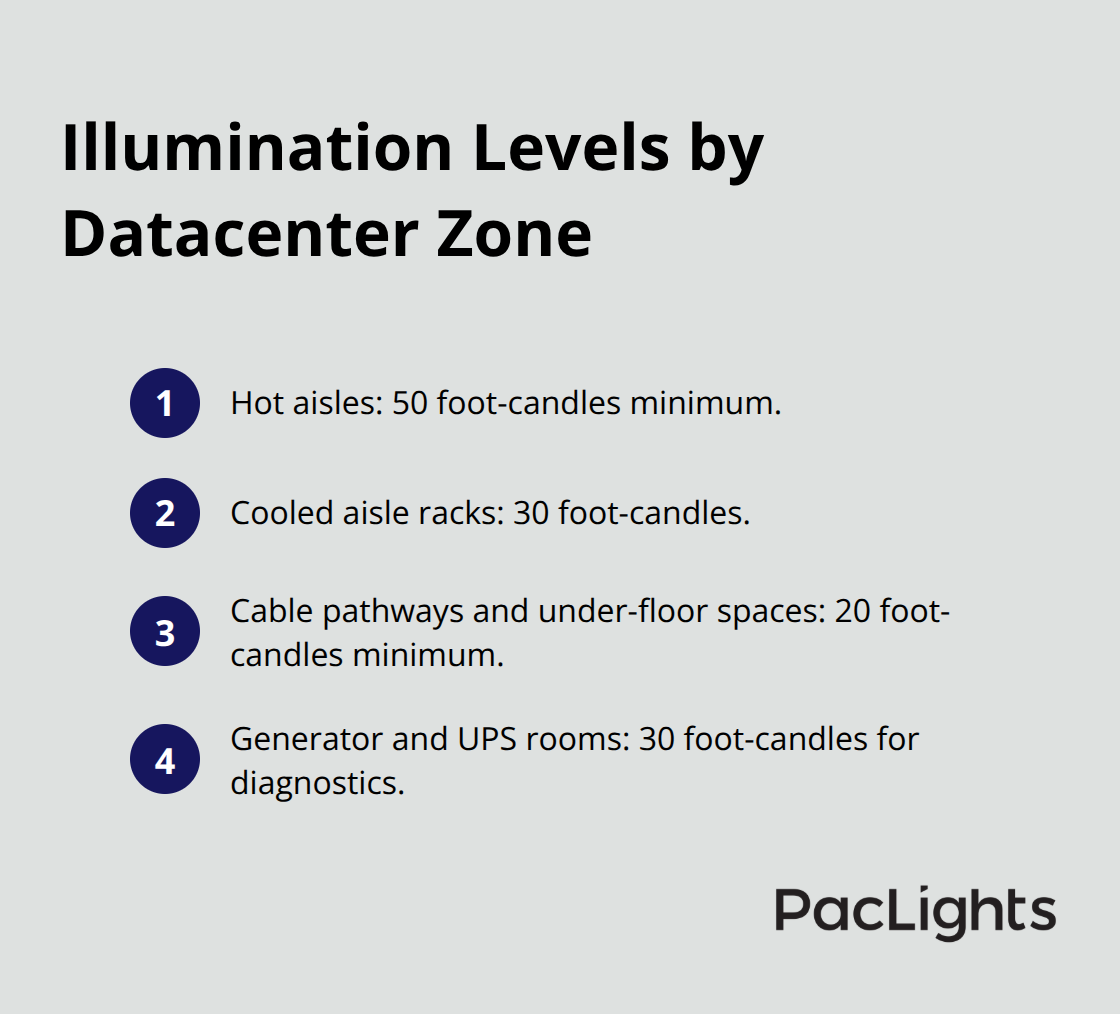
Cable pathways and under-floor spaces need 20 foot-candles at minimum to prevent tripping hazards and allow safe navigation during emergencies. Backup generator rooms and UPS installations demand 30 foot-candles because maintenance teams must perform critical diagnostics in these areas, often under time pressure. The mistake most operators make is installing uniform lighting throughout, treating the datacenter as one zone rather than recognizing that different tasks require different light levels.
Emergency Lighting Requires True Redundancy
Emergency lighting in datacenters must operate independently of the main power system with battery backup rated for at least 90 minutes of full illumination, according to NFPA 110 requirements. Exit routes need continuous illumination within 10 seconds, but equipment work areas require sustained lighting for up to 4 hours if technicians need to perform emergency maintenance or manual failover procedures.
The backup power system must be tested monthly, not annually-monthly testing catches degradation before it becomes a problem during an actual outage. Many datacenters install emergency lighting and forget about it, only to discover during a real power event that batteries have degraded or fixtures have burned out. Thermal management in fixtures prevents premature failure in the high-heat datacenter environment, which extends the life of both primary and backup lighting systems.
These standards form the foundation for reliable datacenter operations, but standards alone don’t address the practical challenges operators face when implementing compliant lighting systems.
Common Lighting Challenges in Datacenters
Heat Stress Shortens Fixture Lifespan
Datacenter operators face three interconnected problems that standards don’t fully address: heat stress on equipment, operational continuity during maintenance, and the tension between power consumption and safety requirements. These challenges demand practical solutions, not theoretical compliance.
Heat generation inside equipment rooms creates an environment that standard commercial lighting simply cannot tolerate. LED fixtures rated for general office use operate at 25-35°C ambient temperatures, but datacenter hot aisles regularly exceed 40-45°C. At these temperatures, LED driver components degrade faster, reducing fixture lifespan from the rated 50,000 hours to 30,000-35,000 hours according to testing from the Illuminating Engineering Society. This means fixtures fail sooner, forcing unplanned maintenance windows that interrupt operations.
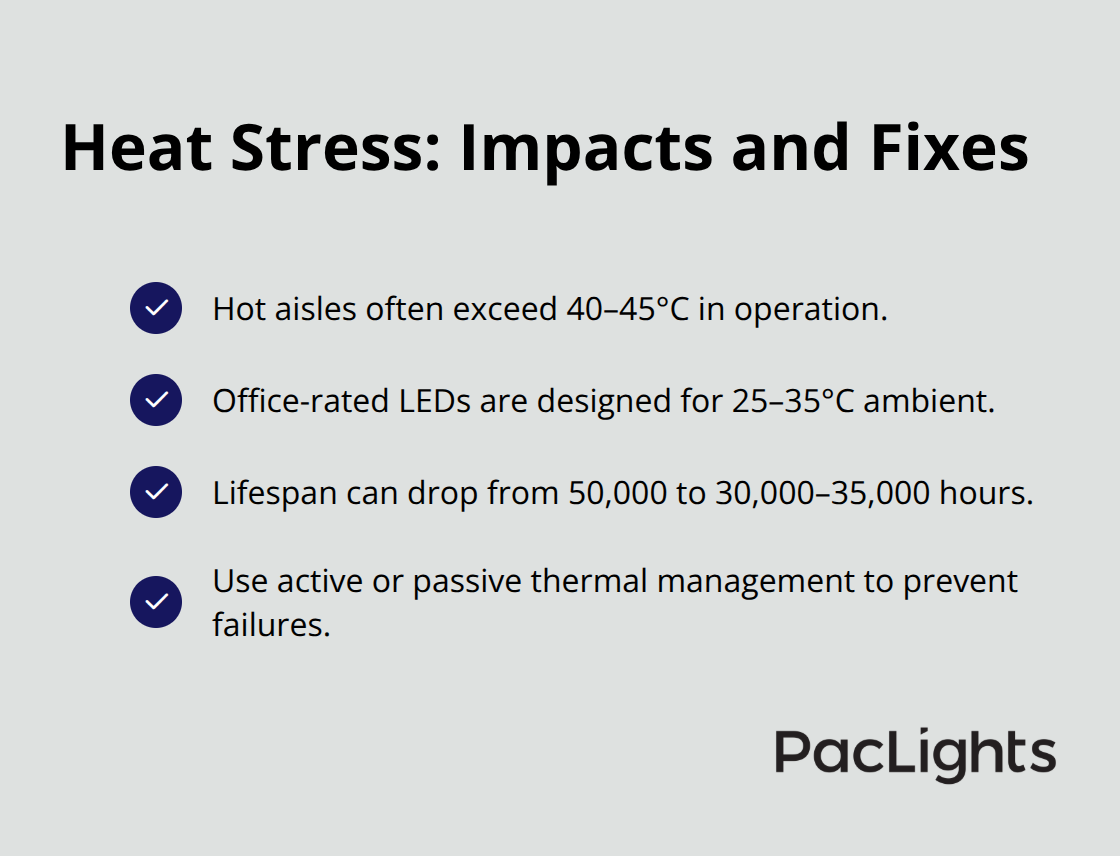
Thermal management becomes non-negotiable-fixtures must dissipate heat actively or use passive cooling designs that prevent component failure. Many operators install fixtures without thermal considerations, then face unexpected failures during peak usage periods when they cannot afford downtime.
Maintenance Work Demands Stable Illumination
Maintenance and repairs happen while systems operate, creating the second major challenge. When technicians work in server rooms, they need consistent, reliable lighting that won’t flicker or fail mid-task. A single power fluctuation that dims lights for even 2-3 seconds can force technicians to stop work, restart diagnostics, or worse, risk damaging sensitive equipment through improper connections.
Fixtures with stable power delivery and rapid recovery characteristics maintain illumination through minor grid disturbances. This stability prevents work interruptions and protects both personnel and equipment during critical maintenance windows.
Energy Efficiency Conflicts with Safety Standards
The third challenge pits energy efficiency against safety requirements. Running lights at full brightness 24/7 consumes substantial power, but dimming lights below required foot-candle levels creates liability and safety risks. Motion sensors help during low-activity periods, but they create blind spots when multiple technicians work in different zones simultaneously.
The realistic approach combines zone-based lighting with occupancy sensing that adjusts brightness within compliant ranges rather than switching lights off entirely. This strategy reduces energy consumption by 20-30% while maintaining the illumination levels NFPA 101 demands. Operators who attempt to cut energy costs by reducing lighting below standard levels face regulatory violations and increased accident risk-a false economy that costs far more when incidents occur.
These obstacles shape how operators select and deploy lighting systems. The next section covers the specific fixture types and placement strategies that overcome these real-world challenges.
Best Practices for Datacenter Lighting Implementation
Select Fixtures Built for Thermal Stress
Fixture selection determines whether your datacenter lighting survives the environment or fails prematurely. Standard commercial LED fixtures cannot handle continuous operation in 45°C hot aisles, so you need fixtures specifically rated for industrial thermal stress. Look for fixtures with thermal management ratings above 50,000 hours at datacenter operating temperatures, not office temperatures. Many manufacturers list ratings at 25°C ambient, which is meaningless for your application.
Fixtures with active cooling through aluminum heat sinks or passive designs that separate LED drivers from the fixture body perform significantly better in high-heat zones. These thermal management approaches prevent component degradation that cuts fixture lifespan from 50,000 hours to 30,000–35,000 hours in unmanaged environments. PacLights offers industrial-grade fixtures with thermal management designed specifically for high-temperature applications, providing the durability datacenter environments demand.
Position Fixtures for Uniform Coverage
Placement matters equally to fixture selection. Mount fixtures on cable trays above hot aisles to prevent direct heat from rising equipment, while recessed fixtures in cooled aisles reduce thermal loading on components. The Illuminating Engineering Society recommends spacing fixtures 1.5 times the mounting height apart to achieve uniform illumination without dead zones where technicians cannot see clearly.
Avoid clustering all fixtures in one area; distributed placement maintains consistent 30–50 foot-candles across work zones without creating shadows that force technicians to move to different positions to see equipment properly. This approach eliminates the frustration of inadequate lighting in critical work areas while preventing over-illumination in low-activity zones.
Integrate Smart Controls and Monitoring
Smart controls transform fixtures from passive light sources into active operational tools. Networked lighting control systems let you adjust brightness by zone based on occupancy and activity patterns, reducing energy consumption by 25–35% while maintaining required illumination levels. Integration with building management systems provides real-time alerts when fixtures fail or when illumination drops below compliance thresholds, catching problems before they become safety issues.
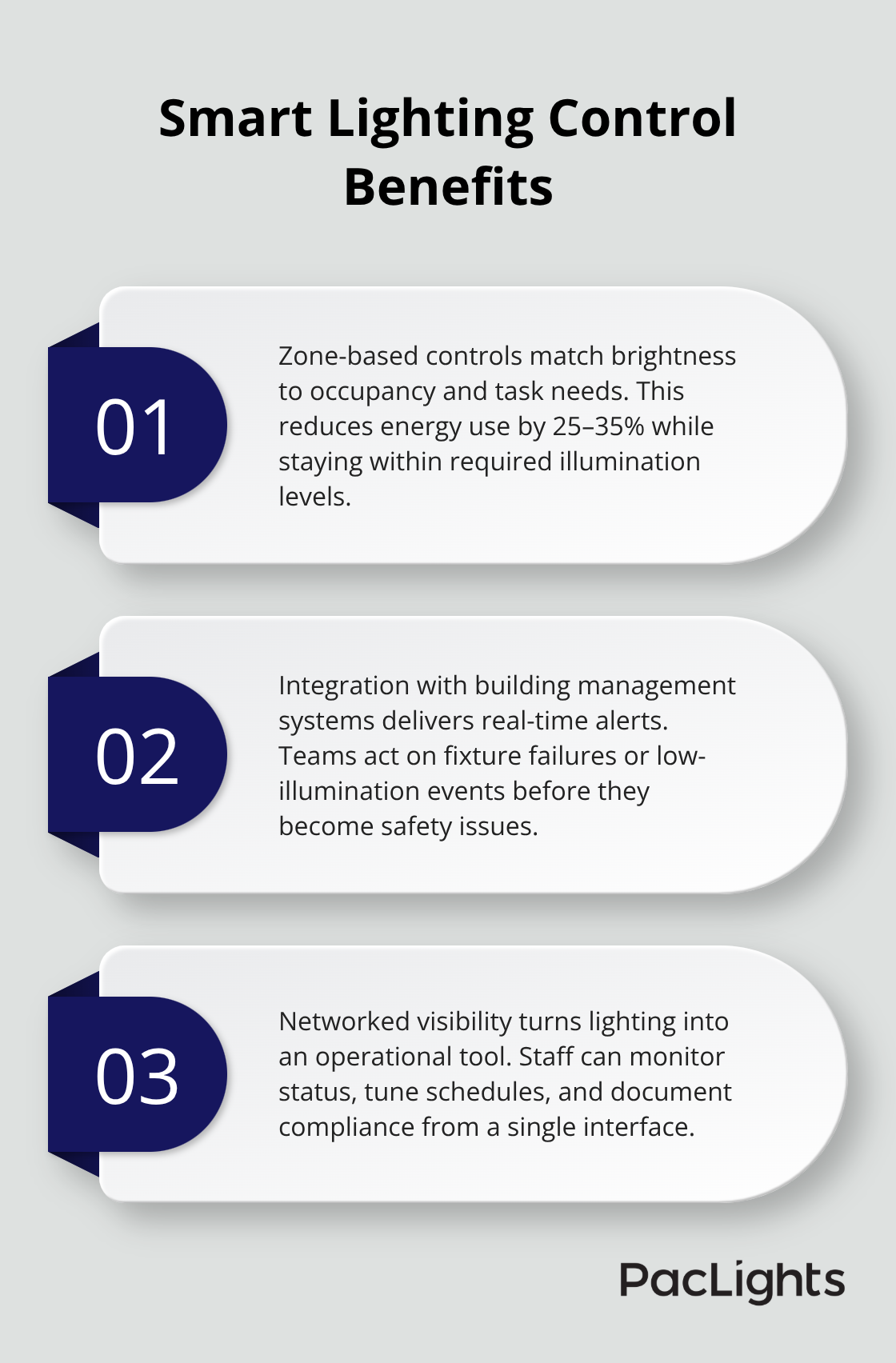
PacLights offers networked lighting controls and advanced control options that optimize energy use while maintaining compliance. These systems provide the visibility you need to manage datacenter lighting as a critical operational component rather than a static installation.
Test and Maintain on a Rigorous Schedule
Monthly testing of emergency lighting circuits must include actual load testing with all backup fixtures running simultaneously for at least 30 minutes, not just visual inspection. Document every test with timestamps and illumination readings to prove compliance during audits. Thermal imaging during testing reveals whether fixtures dissipate heat properly or build up internal temperatures that degrade components.
Maintenance protocols should include quarterly cleaning of fixtures because dust accumulation reduces light output by 15–20% and increases heat retention inside the fixture. Replace batteries in emergency lighting systems every 3–5 years regardless of test results, since battery degradation does not always show up during monthly checks until the moment you need them during an actual outage. This proactive approach prevents failures when your datacenter depends on backup systems most.
Final Thoughts
Datacenter safety lighting standards exist because operational failures cost money, and safety failures cost lives. The standards we covered-NFPA 110, IEC 62061, NFPA 101, and ANSI RP-7-represent decades of datacenter incidents that taught the industry what actually works. When a power event forces your team into emergency response mode, adequate illumination in backup generator rooms means technicians diagnose problems quickly instead of working blind.
Compliance with datacenter safety lighting standards directly translates to operational resilience. Facilities that invest in thermally rated fixtures, proper placement, smart controls, and rigorous testing experience fewer lighting-related incidents and shorter mean time to repair when problems occur. The energy savings from zone-based controls and occupancy sensing offset the higher upfront cost of industrial-grade fixtures within 2-3 years for most operations.
Audit your current lighting against the illumination levels we outlined for each zone type and identify fixtures operating in thermal stress without proper heat management. Schedule monthly emergency lighting tests if you haven’t already, then work with a lighting partner who understands datacenter environments specifically (not general commercial applications). We at PacLights specialize in industrial-grade fixtures and controls designed for exactly these conditions, and our team provides free lighting layout designs and ROI assessments to show you the real financial impact of upgrading to compliant systems-visit PacLights to explore fixtures built for thermal stress and networked controls that optimize energy use.
Disclaimer: PacLights is not responsible for any actions taken based on the suggestions and information provided in this article, and readers should consult local building and electrical codes for proper guidance.