

Datacenter lighting controls have become a competitive advantage, not a luxury. Most facilities still rely on outdated manual systems that waste energy and inflate operational costs.
At PacLights, we’ve seen firsthand how modern lighting control systems transform datacenter efficiency. This guide walks you through sensor technology, networked management, and the financial returns that make upgrading worthwhile.
How Datacenter Lighting Controls Actually Work
Manual Switching Wastes Energy and Money
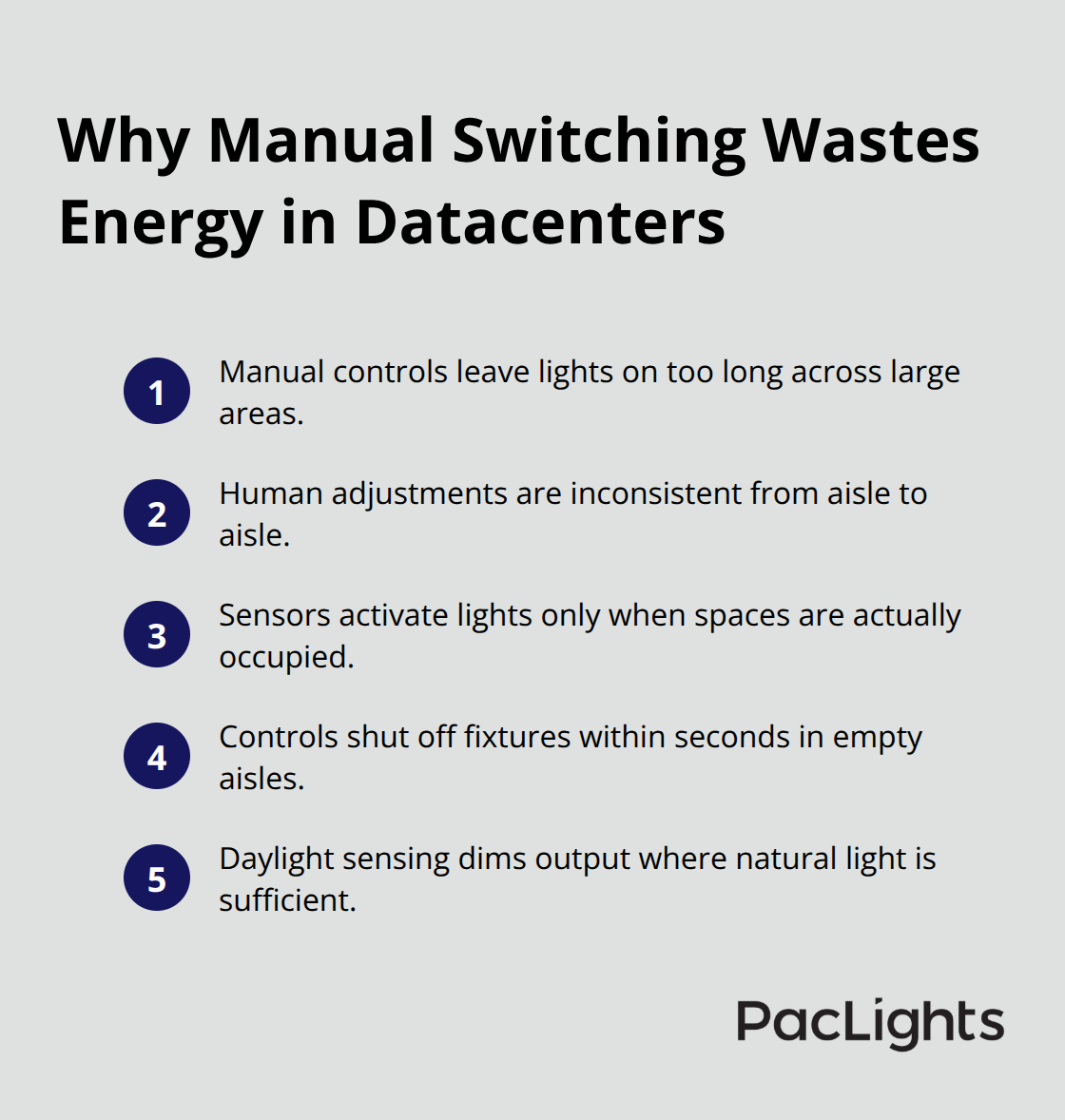
Manual switching belongs in the past. Datacenters that still rely on staff flipping switches waste between 20-30% of lighting energy according to industry benchmarks, while automated systems cut that waste dramatically. The difference comes down to responsiveness and precision. When a technician manually controls lights across thousands of square feet, they either leave them on too long or adjust them inconsistently. Automated systems respond instantly to actual occupancy and ambient light levels, turning off fixtures in empty aisles within seconds and dimming in areas with sufficient natural light.
Facilities switching to networked controls report immediate reductions in their lighting energy consumption, sometimes dropping usage by 40-50% in the first month alone. This speed of improvement reflects how much energy manual systems squander.
Sensor Technology Powers Automation
Motion sensors and daylight sensors form the backbone of modern automation. Motion sensors detect presence in specific zones, so lights activate only when someone actually occupies that space. Daylight sensors measure incoming natural light and adjust artificial lighting accordingly, which matters significantly in datacenters with windows or skylights.
A quality motion sensor triggers lighting within 1-2 seconds of detecting movement, and modern sensors distinguish between sustained occupancy and brief passes through a space. This prevents the annoying on-off cycling that frustrated users in older automated systems. The real advantage appears in this real-time responsiveness-technicians get the light they need exactly when they need it.
Reliability and System Integration
Reliability matters equally in datacenter environments. Datacenters cannot tolerate lighting failures that leave technicians working in darkness or create security gaps. Networked lighting controls use redundant communication protocols and battery backup systems to maintain functionality even during network interruptions. Some systems include local fallback modes where individual fixtures continue operating at preset levels if the central control system goes offline.
Integration with existing datacenter infrastructure determines practical success. Your lighting controls should communicate with your building management system, HVAC controls, and security systems through standard protocols like BACnet or Modbus. This prevents isolated silos where lighting operates independently from other facility systems. Technicians gain visibility into lighting performance through a single dashboard rather than managing separate interfaces, reducing training time and operational complexity.
Financial Returns Justify the Investment
The financial case builds quickly once you measure actual performance. A typical 50,000 square foot datacenter spending $8,000-12,000 annually on lighting can reduce that by $3,200-6,000 per year with automated controls, creating payback periods of 18-36 months depending on local energy rates and existing fixture efficiency.
These numbers explain why networked lighting control systems have become standard in modern facilities. Understanding how these systems work sets the stage for examining the management and monitoring capabilities that make them truly powerful across multiple locations and complex environments.
Networked Lighting Control Systems for Datacenters
Centralized Control Transforms Facility Management
Centralized control fundamentally changes how facility managers oversee lighting across sprawling datacenter environments. Instead of managing individual zones or buildings separately, networked systems allow you to monitor and adjust lighting from a single dashboard, regardless of whether your facilities span one building or multiple locations across different regions. This centralization eliminates the coordination problems that plague disconnected systems. A facility manager can view real-time energy consumption for each zone, identify underperforming sensors, and push updates to thousands of fixtures simultaneously without visiting each location. The operational efficiency gains compound quickly-facilities report reducing their lighting management overhead by 30-40% simply by consolidating control into one interface.
Integration with Building Management Systems Amplifies Results
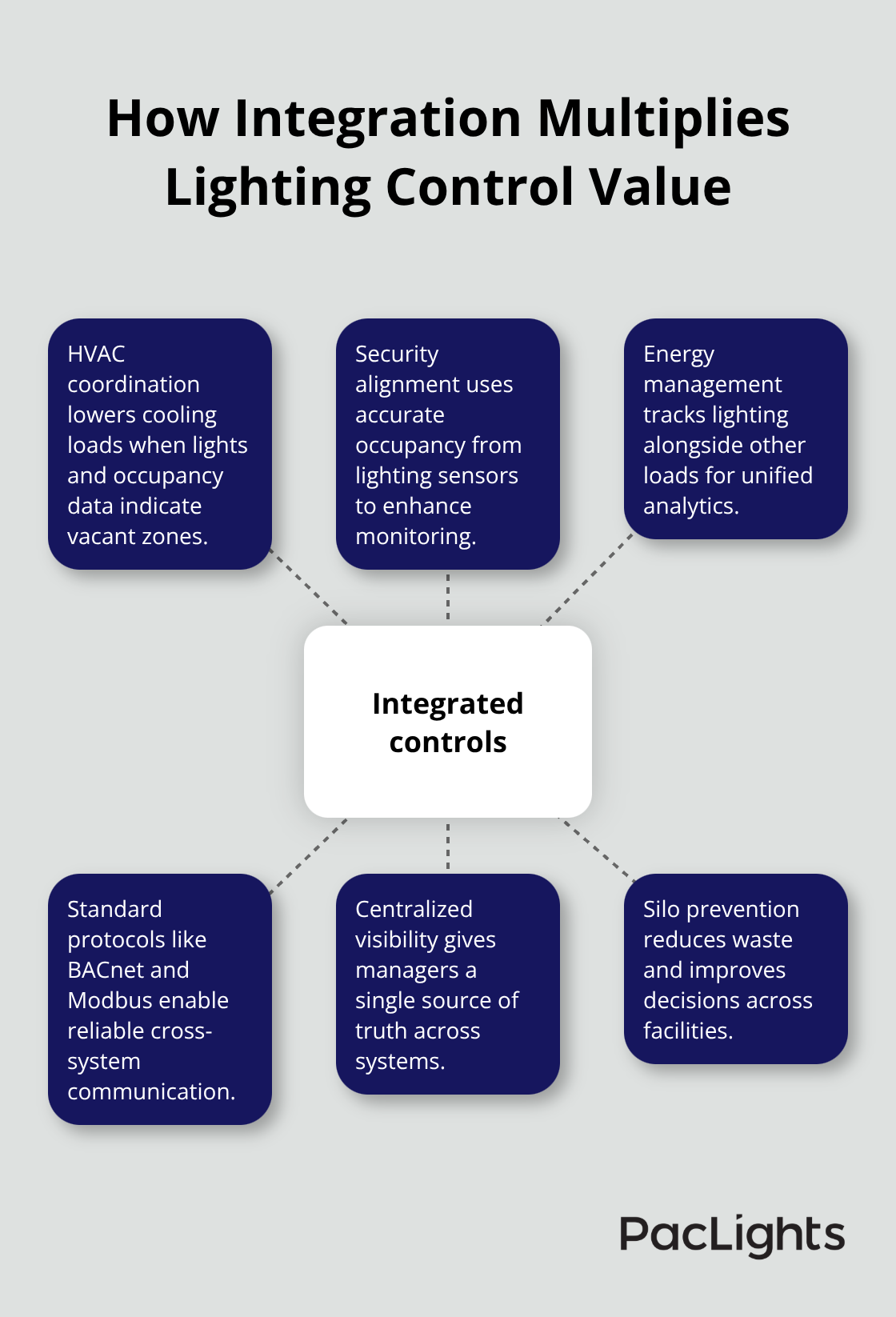
Integration with your building management system amplifies these benefits substantially. When lighting controls communicate directly with your HVAC, security, and power monitoring systems through protocols like BACnet or Modbus, you gain unprecedented visibility into facility performance. Your HVAC system can reduce cooling loads in unoccupied zones where lights have automatically shut off, your security system receives accurate occupancy data from lighting sensors, and your energy management platform tracks lighting consumption alongside other major load centers. This interconnection prevents the information silos that waste thousands annually in most datacenters.
Scalability Across Multiple Facilities Removes Complexity
Scalability across multiple facilities removes the complexity barrier that once made networked controls impractical for distributed operations. Modern systems handle hundreds of buildings with different layouts, occupancy patterns, and local regulations through cloud-based management platforms that scale effortlessly. A company operating datacenters in five different states can enforce consistent energy policies while respecting regional compliance requirements-California’s Title 24 standards, for example, require specific lighting control features that the system applies automatically to those facilities while maintaining different settings elsewhere. Technicians receive instant alerts when fixtures malfunction, sensors drift out of calibration, or energy consumption deviates from expected baselines, allowing preventive maintenance before problems affect operations.
Reduced Staffing Needs and Faster Response Times
The financial advantage appears in reduced staffing needs and faster response times. Instead of sending technicians to investigate lighting complaints or conduct routine inspections, facility managers address issues remotely and prioritize in-person visits for genuine problems, cutting maintenance labor costs by 20-35% depending on your current staffing model. These operational improvements set the stage for understanding the specific financial returns that justify the investment in networked lighting systems.
How Much Energy Do Networked Controls Actually Save
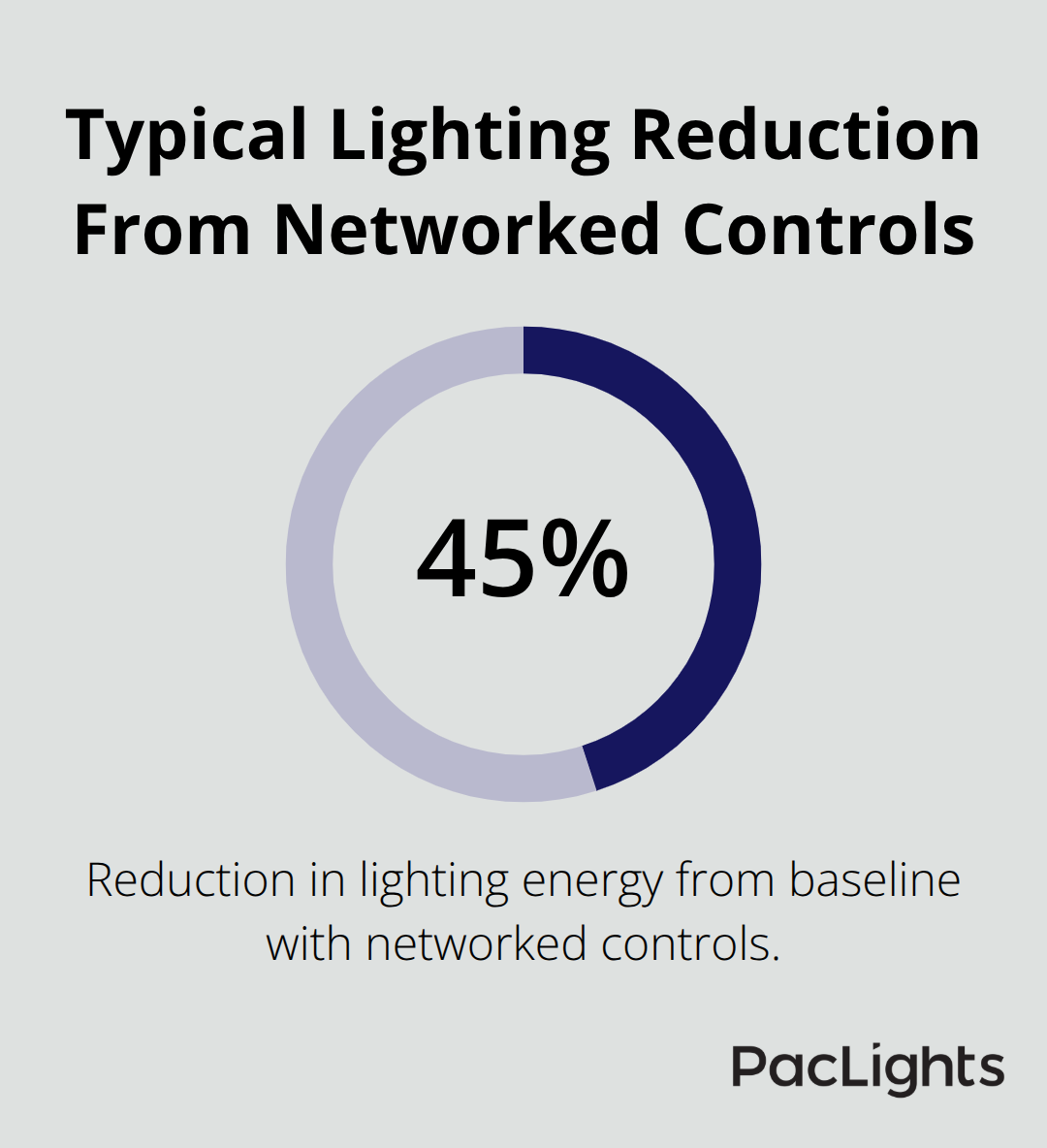
Networked lighting controls deliver measurable energy reductions that directly impact your bottom line. The 40-50% first-month improvements mentioned earlier reflect what happens when you eliminate the waste built into manual systems, but the real gains compound over time as facility managers optimize sensor placement and fine-tune occupancy thresholds. A 50,000 square foot datacenter typically consumes 15-20 kWh annually for lighting alone. Reducing that by 45% through networked controls saves 6,750-9,000 kWh per year, translating to $810-1,350 in annual energy costs at the U.S. average commercial rate of $0.12 per kWh.
These numbers assume baseline fixture efficiency. When you combine networked controls with LED retrofits that include motion and daylight sensors built into the fixtures themselves, savings often reach 60-70% because you eliminate waste at multiple stages simultaneously. The key metric facility managers should track is kWh consumed per square foot per year. Most datacenters operating without controls average 0.8-1.2 kWh per square foot annually for lighting. After you implement networked controls, that figure drops to 0.4-0.6 kWh per square foot, and this improvement holds year after year without additional capital investment beyond the initial system installation.
Payback Timelines That Make Financial Sense
Your payback period depends directly on three variables: current energy consumption, local electricity rates, and installation costs for networked controls. A typical networked lighting control system for a 50,000 square foot datacenter costs $45,000-65,000 installed, including sensors, controllers, wiring, and labor. With annual savings of $3,600-6,000, you recover that investment in 9-18 months depending on your starting consumption and regional rates. Facilities in high-cost energy markets like California or the Northeast see faster payback because their baseline electricity rates exceed $0.14 per kWh. After payback, every dollar saved flows directly to your operating margin. Over a ten-year period, a single 50,000 square foot datacenter generates $36,000-60,000 in cumulative lighting energy savings. Scale this across multiple facilities and the financial case becomes impossible to ignore.
Compliance Certifications Amplify Financial Returns
Compliance certifications amplify these returns further. California’s Title 24 standards require specific lighting control features in commercial buildings. Meeting these requirements with networked systems costs less than retrofitting manual systems to comply later, and you gain the energy savings simultaneously. LEED certification, which increasingly influences tenant attraction and property valuations, requires documented lighting control compliance that networked systems satisfy automatically through their monitoring capabilities. These certifications (when combined with measurable energy reductions) strengthen your facility’s market position and justify premium pricing or faster lease renewals in competitive markets.
Final Thoughts
Modern datacenter lighting controls deliver three concrete advantages that justify immediate investment. They reduce energy consumption by 40-70% depending on your current system and fixture efficiency, generating $3,600-6,000 annually in a typical 50,000 square foot facility. They cut operational overhead by 30-40% through centralized management and remote troubleshooting, reducing the staff time spent on lighting maintenance.
Implementation requires honest assessment of your current infrastructure. Evaluate your existing fixtures first-older lighting wastes energy regardless of controls, so combining networked systems with LED retrofits produces the fastest payback. Assess your sensor placement carefully because poorly positioned motion and daylight sensors underperform and frustrate technicians, and plan your integration with building management systems before installation to avoid costly rewiring later.
We at PacLights understand these requirements because we build lighting solutions specifically for industrial and commercial facilities. Our fixtures include optional motion and daylight sensors, and we offer advanced networked lighting controls to optimize energy use across your operations. Start by requesting an assessment of your current facility to see exactly where your savings opportunity lies.
Disclaimer: PacLights is not responsible for any actions taken based on the suggestions and information provided in this article, and readers should consult local building and electrical codes for proper guidance.