

Poor lighting in warehouses costs businesses millions annually through accidents and lost productivity. At PacLights, we’ve seen firsthand how warehouse safety lighting guidelines make the difference between a safe operation and a dangerous one.
This guide covers everything you need to know about proper illumination standards, the hazards it prevents, and how to implement effective solutions in your facility.
Warehouse Lighting Standards and Compliance Requirements
OSHA Illumination Mandates
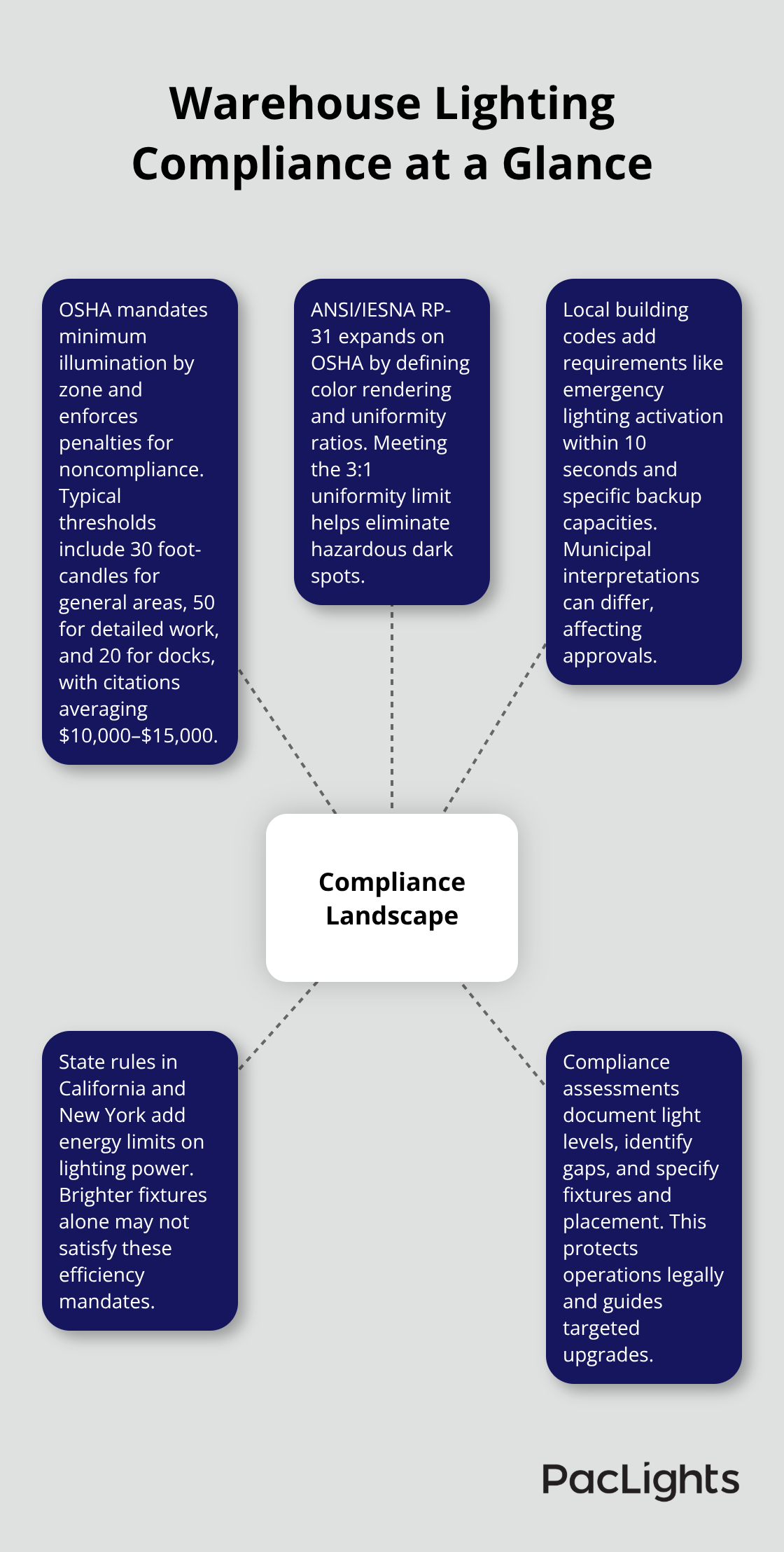
OSHA mandates minimum illumination levels that vary by warehouse zone, and these requirements are far stricter than most facility managers realize. General warehouse areas require 30 foot-candles of light, while detailed work areas demand 50 foot-candles, and loading docks need 20 foot-candles according to OSHA standards. These aren’t suggestions-they’re legal obligations, and warehouses operating below these thresholds face citations that average $10,000 to $15,000 per violation. Many facilities we work with discover their existing lighting falls 40% short of compliance, which explains why accident rates often exceed industry averages.
Industry Standards Beyond OSHA
The American National Standards Institute publishes the ANSI/IESNA RP-31 guidelines, which go deeper than OSHA by specifying color rendering index values and uniformity ratios that prevent dark zones where workers become vulnerable to accidents. Most warehouses ignore the uniformity requirement, which states that light distribution shouldn’t vary by more than 3:1 between the brightest and darkest areas. Many facilities have ratios exceeding 5:1, which creates dangerous pockets where visibility drops dramatically and worker safety suffers.
Local Building Codes and Regional Variations
Local building codes add another layer of complexity that warehouse operators frequently overlook. Some jurisdictions require emergency lighting systems that must activate within 10 seconds of power loss, while others mandate specific backup battery capacities based on facility square footage. State-level regulations in California and New York impose additional energy efficiency standards that restrict how much power lighting systems can consume, which means simply installing brighter fixtures won’t solve compliance issues in those regions.
Your facility’s location matters enormously-a warehouse in Massachusetts faces different requirements than an identical operation in Texas. The practical solution involves hiring a lighting assessment specialist who understands both OSHA requirements and your local building department’s specific interpretations, because code officials in different municipalities often disagree on implementation details.
Conducting a Compliance Assessment
A proper assessment documents existing illumination levels using a calibrated light meter, identifies non-compliant zones with photographic evidence, and specifies the exact fixture types and placements needed to achieve compliance without overshooting energy consumption limits. This documentation protects your operation legally and reveals which warehouse zones require immediate attention. With compliance mapped out, you can now evaluate which lighting solutions actually work for your specific facility layout and operational needs.
How Proper Lighting Prevents Warehouse Accidents
Slip, Trip, and Fall Incidents
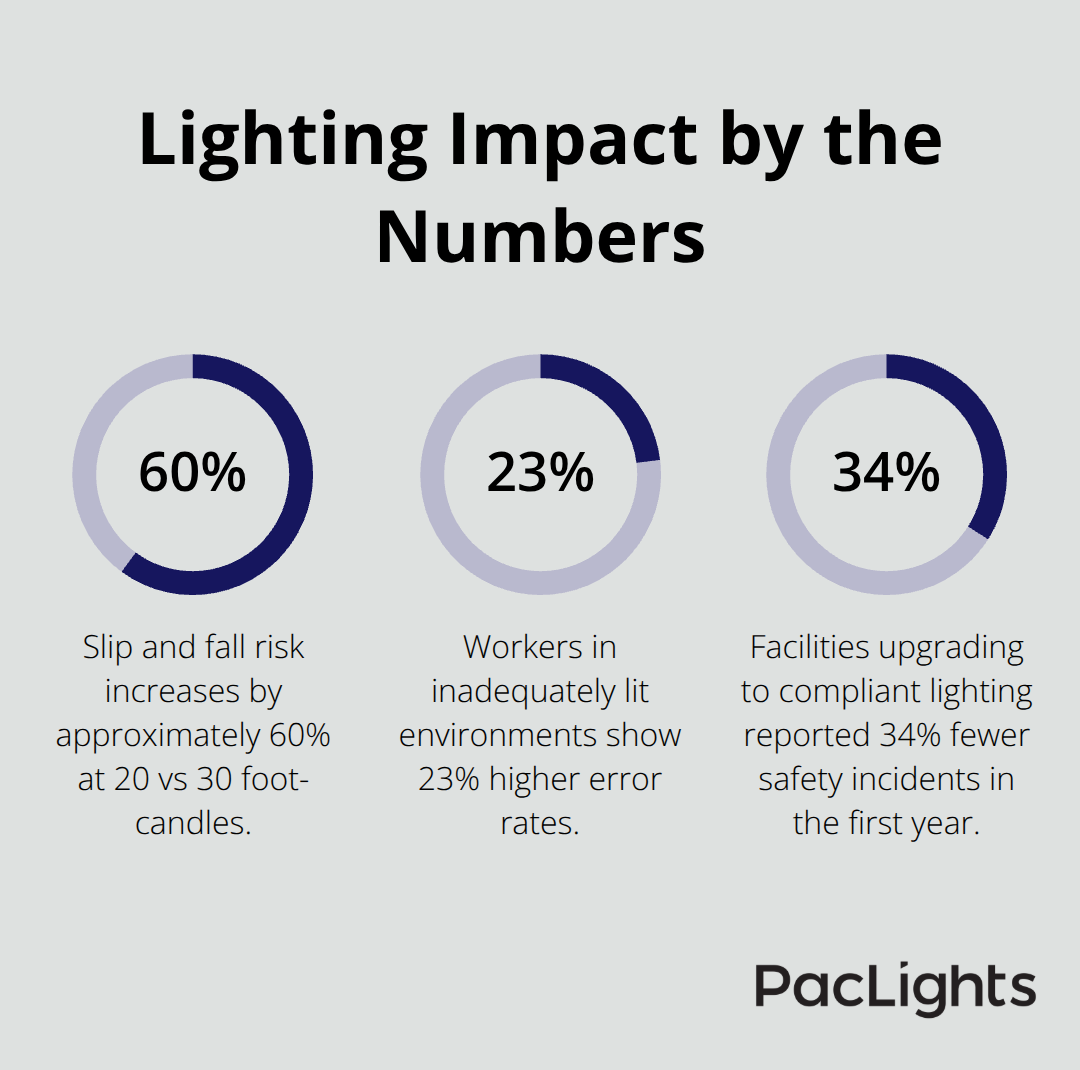
Inadequate lighting directly causes accidents that injure workers and drain operational budgets. The Bureau of Labor Statistics reports that slip, trip, and fall incidents account for over 800,000 hospitalizations annually across all industries, with warehouses experiencing disproportionately high rates due to cluttered floors and poor visibility. A warehouse operating at 20 foot-candles instead of the required 30 foot-candles increases slip and fall risk by approximately 60%, according to research from the American Industrial Hygiene Conference.
Workers cannot identify hazards they cannot see, which means dark aisles, shadowed corners, and unlit loading zones become accident hotspots. Proper illumination eliminates these blind spots entirely.
Forklift and Equipment Collisions
Equipment operators depend on visibility to identify pedestrians, stacked inventory, and structural obstacles, yet many warehouses create dangerous shadows where operators cannot see workers standing nearby. The National Safety Council found that visibility-related forklift accidents result in an average of $63,000 in direct costs per incident when accounting for medical expenses, lost productivity, and equipment damage. Installing fixtures with uniform light distribution across high-traffic zones and loading areas prevents these collisions from happening in the first place. Operators need clear sightlines at the speeds equipment operates within warehouses, and inadequate lighting removes that critical advantage.
Worker Fatigue and Error Reduction
Worker fatigue and mental errors multiply dramatically in poorly lit facilities, affecting both safety and productivity. Research from the Journal of Applied Psychology demonstrates that workers in inadequately lit environments experience 23% higher error rates and report significantly greater fatigue levels after 8-hour shifts compared to colleagues in properly illuminated spaces. Dim lighting forces workers to concentrate harder on visual tasks, depleting cognitive resources and increases the likelihood of mistakes that lead to accidents or product damage. Eye strain from inadequate illumination causes headaches, reduces alertness, and impairs decision-making during time-sensitive operations like order fulfillment or equipment operation.
The color rendering index of your fixtures matters significantly-lighting with CRI values below 80 creates visual distortion that amplifies fatigue, while fixtures rated 90 CRI or higher provide accurate color perception that keeps workers alert and engaged throughout their shifts. Facilities that upgraded to compliant lighting levels reported 34% fewer safety incidents within the first year, demonstrating that illumination improvements deliver measurable protection. Warehouses cannot simply install more fixtures and expect results; fixture quality, placement uniformity, and appropriate brightness levels for specific work zones all contribute to hazard reduction.
Selecting the Right Fixtures for Your Warehouse
This is why compliance assessments reveal not just inadequate foot-candles, but also whether your existing fixtures are the right type for the work performed in each zone. Different warehouse areas demand different lighting solutions-high-bay fixtures work for storage areas, while troffer lights suit administrative zones, and specialized fixtures handle loading docks and outdoor perimeters. The assessment process identifies which zones need immediate attention and which fixtures will actually solve your specific visibility problems rather than creating new ones.
Turning Assessment Data Into a Working Lighting Plan
A compliance assessment reveals your facility’s current state, but the real work starts when you translate those findings into actual fixture installations and controls that work within your budget and operational constraints. Most warehouses fail at this stage because they either install fixtures without considering workflow patterns or they chase the cheapest option regardless of whether it solves their specific visibility problems.
Prioritize Zones Based on Risk and Activity
The assessment should identify not just deficient foot-candles, but also which zones experience the heaviest worker traffic, where equipment operates at highest speeds, and which areas present the greatest slip and fall risks. Once you have this data, you can prioritize installations strategically-addressing the most dangerous zones first rather than attempting a facility-wide retrofit that strains budgets and disrupts operations. Loading docks and high-traffic aisles where forklifts operate should receive attention before storage areas with minimal worker presence, since accident probability directly correlates to activity levels in each zone.
Match Fixtures to Warehouse Zones
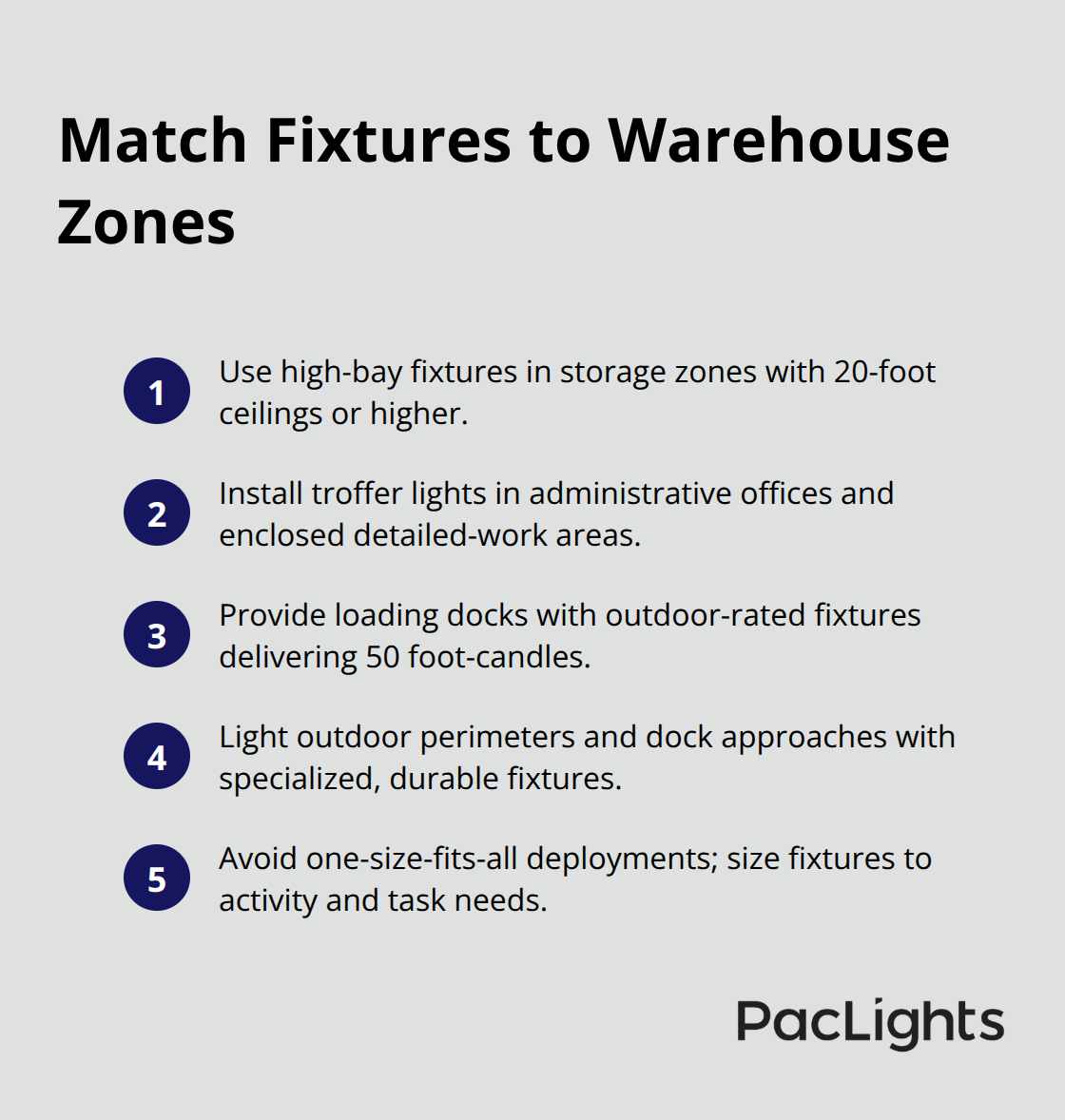
Fixture selection depends entirely on your warehouse layout and the specific work performed in different areas. High-bay fixtures work for storage zones with 20-foot ceilings or higher, where wide beam angles illuminate large floor areas efficiently, while troffer lights belong in administrative offices and enclosed work areas where workers perform detailed tasks requiring higher color rendering. Loading docks need fixtures rated for outdoor exposure and capable of 50 foot-candles across receiving and shipping zones, regardless of weather conditions.
The mistake most facility managers make involves treating their entire warehouse as one lighting problem and installing identical fixtures everywhere, which wastes money on oversized fixtures in low-activity zones while undersizing in critical areas.
Deploy Controls Strategically
Motion sensors make sense in storage areas accessed sporadically by workers, reducing energy consumption when zones sit empty for hours, but they create dangerous situations in high-traffic areas where workers need consistent illumination. Daylight controls work effectively in warehouses with significant skylights or windows facing south or west, automatically reducing fixture output when natural light provides adequate illumination.
PacLights offers fixtures with optional daylight and motion control features, along with advanced lighting controls to optimize energy use across your facility. The installation phase requires precision-poor placement negates fixture quality, and warehouses often discover that moving fixtures just six feet can transform dark zones into compliant areas without adding fixtures.
Verify Compliance Through Documentation
Document your installation results with light meter readings in the same spots where your initial assessment identified deficiencies, confirming that compliance is genuinely achieved rather than assumed. This verification step protects your operation and demonstrates that your lighting investments actually solved the visibility problems your assessment revealed.
Final Thoughts
Warehouse safety lighting guidelines exist because accidents cost money, injure workers, and disrupt operations. The standards we’ve covered-OSHA requirements, industry uniformity ratios, and local compliance mandates-aren’t bureaucratic obstacles but proven frameworks that prevent slip and fall incidents, equipment collisions, and worker fatigue. Warehouses that upgraded to compliant lighting levels reported 34% fewer safety incidents within the first year, demonstrating that illumination improvements deliver measurable protection.
The path forward starts with a compliance assessment that documents your current illumination levels and identifies problem zones. This assessment reveals exactly which fixtures you need, where to place them, and how to prioritize installations within your budget. Strategic fixture selection and control deployment-motion sensors in low-traffic areas, daylight controls where natural light is available-optimize both safety and energy consumption while reducing medical costs and workers’ compensation claims.
We at PacLights provide the fixtures and controls needed to transform your warehouse into a safe, efficient operation. Request your free lighting assessment today to document your current conditions and begin prioritizing installations in your highest-risk zones. The investment pays for itself through reduced accidents and lower energy bills.
Disclaimer: PacLights is not responsible for any actions taken based on the suggestions and information provided in this article, and readers should consult local building and electrical codes for proper guidance.