

Datacenters consume massive amounts of energy, with lighting accounting for 20-30% of total facility power usage. We at PacLights know that traditional fixed lighting systems waste resources by running at full capacity regardless of actual need.
Networked datacenter lighting controls change this equation by automating light levels based on real occupancy and natural light availability. The result is immediate energy savings, reduced operational costs, and faster ROI than most facility upgrades.
How Networked Controls Adapt Light to Real Datacenter Needs
Networked lighting controls work because they respond to what’s actually happening inside your datacenter right now, not what happened last month or what some preset schedule dictates. Real-time sensors measure occupancy levels, natural light coming through windows or skylights, and equipment heat patterns, then adjust lighting output instantly. This continuous feedback loop eliminates the waste of traditional systems that run at full brightness 24/7 regardless of whether anyone is working in a section or whether daylight is already providing sufficient illumination.
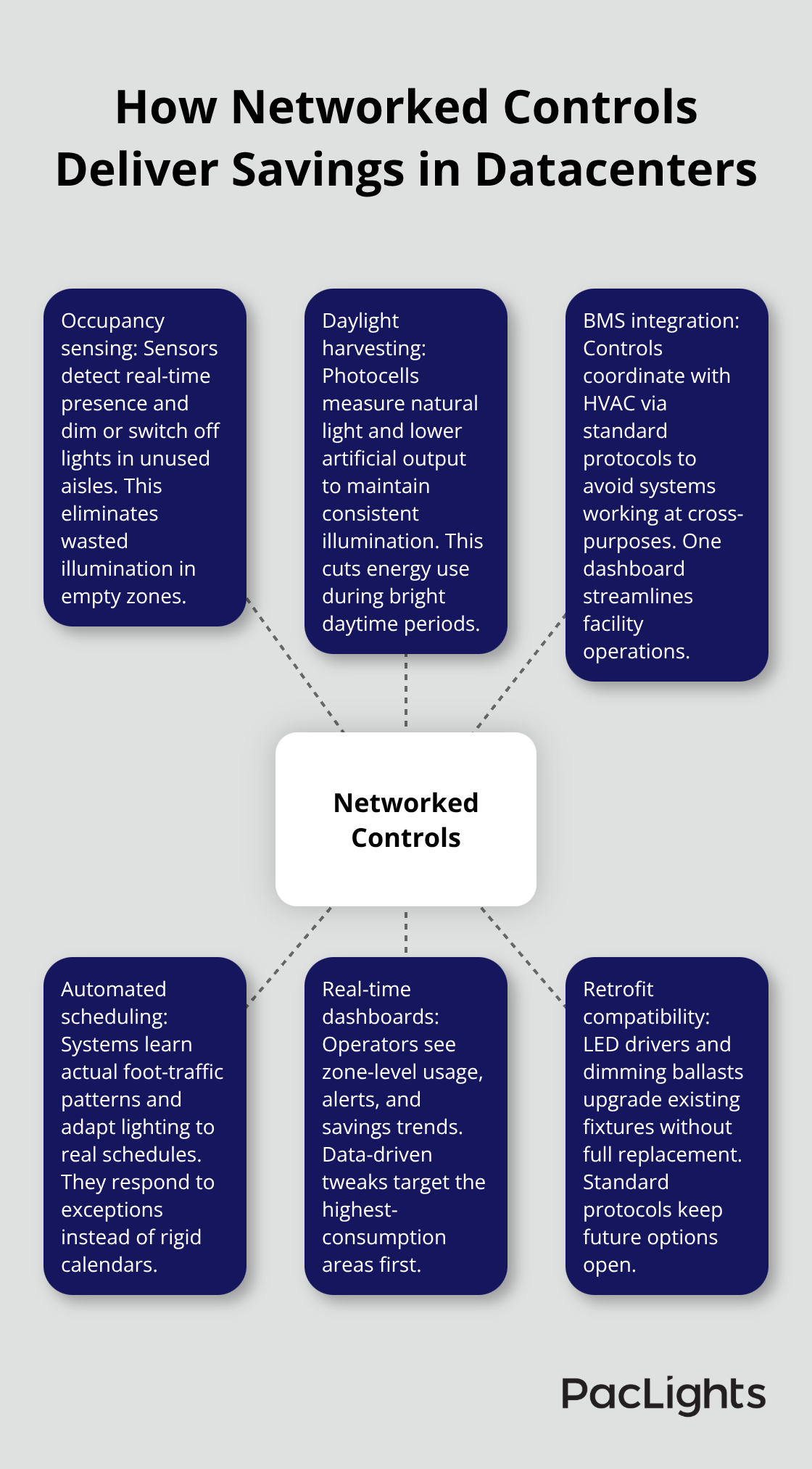
According to the U.S. Department of Energy, datacenters that implement occupancy-based lighting controls see energy reductions of 30-50% in lighting-related consumption. The practical benefit is straightforward: if a server room has no personnel for eight hours, networked controls dim or turn off lights completely rather than burning energy for an empty space. Many datacenters report achieving payback on their networked lighting investment within 18-24 months purely through reduced electricity bills.
Integration with Your Building Management Systems
Building Management Systems already monitor temperature, humidity, power distribution, and security across your facility. Networked lighting controls integrate directly into this ecosystem, allowing one dashboard to manage lighting alongside HVAC and other systems. This integration prevents conflicts where cooling systems work to remove heat while lighting systems unnecessarily generate more.
A datacenter operator can set priorities so that when occupancy drops below a threshold, lighting dims automatically while the BMS simultaneously adjusts cooling loads. Most modern networked lighting systems communicate via standard protocols like BACnet or MQTT that BMS platforms already support. This means your existing infrastructure team can manage lighting without learning entirely new software or hiring additional staff.
Automated Scheduling Based on Actual Occupancy
Automated scheduling based on real occupancy data beats calendar-based scheduling every time. Instead of assuming your datacenter runs the same hours every day, networked systems learn actual foot traffic patterns and adjust accordingly. If your facility typically has staff from 7 AM to 6 PM on weekdays but minimal presence on Saturdays, the system adapts lighting output to match those patterns precisely.
Motion sensors and door access logs provide the occupancy data, eliminating guesswork. Networked systems learn exceptions and adjust when your actual operations differ from typical patterns, making them responsive rather than robotic.
Natural Light Reduces Artificial Lighting Demand
Natural light integration works similarly to occupancy control: sensors detect when skylights or windows provide adequate illumination and reduce artificial lighting proportionally. Datacenters in climates with significant daylight hours can reduce lighting energy consumption by 15-25% through this feature alone. The system continuously monitors incoming daylight and compensates by lowering artificial output, so your facility maintains consistent illumination without wasting energy.
These adaptive capabilities set the stage for understanding what specific features modern systems bring to the table and how they deliver measurable results across different datacenter environments.
Key Features of Modern Datacenter Lighting Control Systems
Modern datacenter lighting systems succeed because they combine three practical capabilities that older systems lack. First, sensor networks measure what actually happens in real spaces rather than relying on assumptions. Second, these systems feed data into dashboards that operators use to make decisions and spot problems.
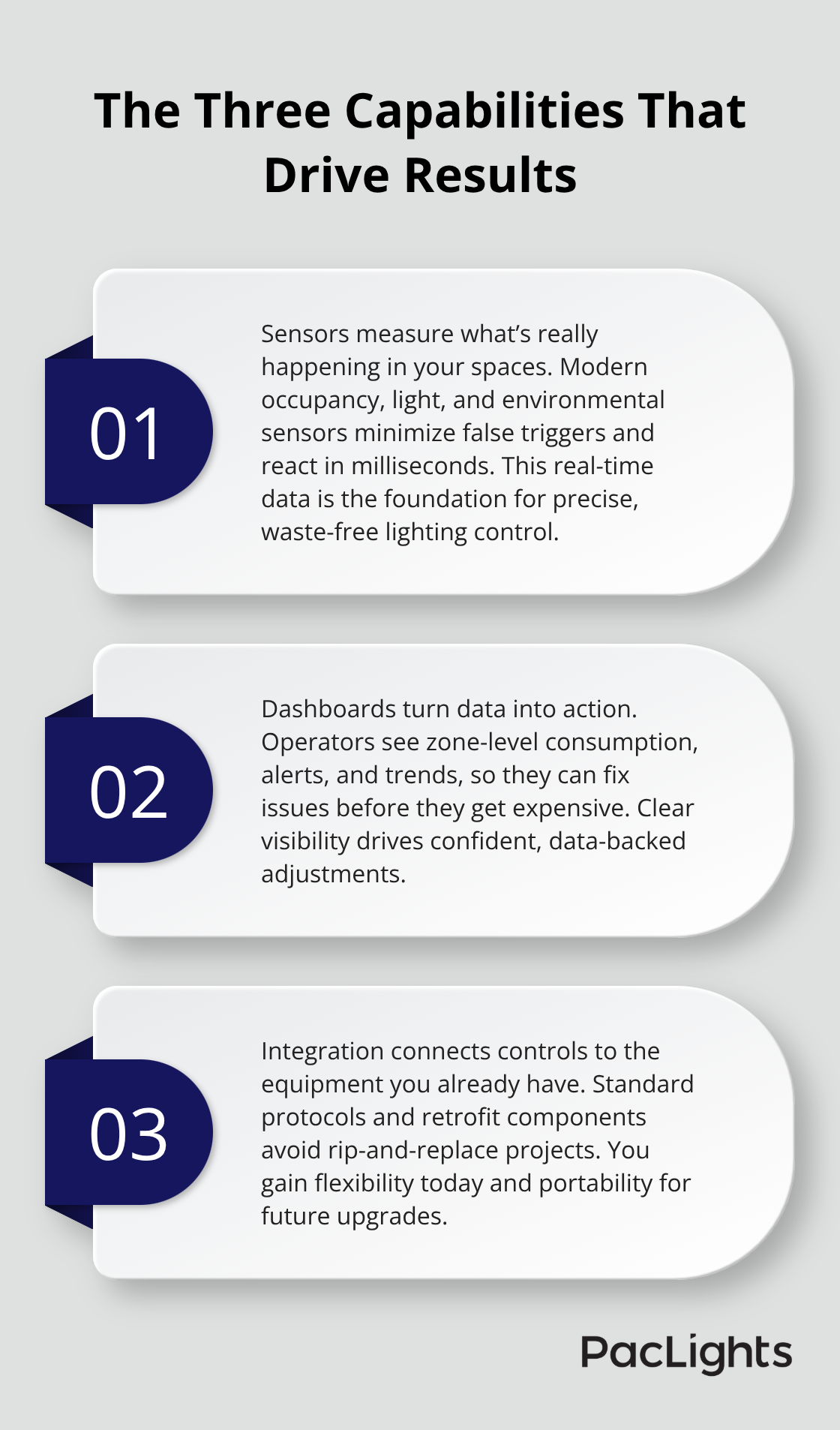
Third, they connect to existing equipment without requiring a complete infrastructure overhaul. The combination of these three elements determines whether a networked lighting system delivers promised savings or becomes expensive hardware collecting dust.
Sensors That Measure Real Conditions, Not Predictions
Smart sensors form the backbone of effective networked lighting. Occupancy sensors detect movement and presence, but modern systems go further by measuring light levels, temperature, and humidity simultaneously. This multi-sensor approach prevents the common problem where basic motion detectors trigger false positives from HVAC equipment or vibrations, causing unnecessary lighting adjustments. Datacenters typically deploy sensors every 100-150 square meters to maintain adequate coverage without redundant overlapping readings. The data from these sensors feeds into edge computing devices that make decisions locally rather than transmitting every signal to a cloud server, reducing latency and eliminating dependency on internet connectivity for basic functionality. This local processing means lighting adjusts within milliseconds of occupancy changes, not seconds or minutes. IoT protocols like Zigbee or Z-Wave allow sensors to communicate wirelessly, eliminating costly rewiring of existing facilities. Most modern systems support at least 50-100 sensors per control node, making large datacenters manageable without proportionally increasing equipment costs.
Dashboards That Reveal Problems Before They Become Expensive
Remote management dashboards separate systems that operators actually use from those that sit ignored. A poorly designed dashboard creates work rather than reducing it, so operators abandon it and fall back on manual controls. Effective dashboards at datacenters show energy consumption by zone, alert operators to sensor failures before they cause problems, and display cost savings in real time. Many operators report that visibility into lighting patterns reveals unexpected inefficiencies, such as certain zones running at full brightness despite zero occupancy for extended periods. Analytics expose these patterns and allow operators to adjust settings without guesswork. The best systems show historical trends over weeks and months, helping facility managers understand seasonal variations and plan maintenance accordingly. Some systems integrate with existing monitoring tools through APIs rather than requiring staff to learn entirely new software. Real-time alerts notify operators when sensors malfunction, preventing situations where broken occupancy sensors leave lights running continuously in supposedly automated zones. Dashboard data also supports budget planning by projecting annual savings based on actual usage patterns rather than theoretical estimates.
Integration Without Replacing What Already Works
Compatibility with existing lighting infrastructure means you keep functioning equipment and add control capabilities rather than replacing everything. Retrofit dimming ballasts and LED drivers work with existing fixtures, transforming standard luminaires into controllable units. Most datacenters already have wiring infrastructure, conduit runs, and electrical systems in place, so networked controls leverage these assets rather than requiring new construction. Standard communication protocols mean control systems from different manufacturers can coexist and share data. A datacenter might have networked controls in recently renovated sections while traditional fixtures remain in older areas, with both managed from a single dashboard (this gradual upgrade path reduces capital expenditure and operational disruption compared to full replacement). Compatibility also protects your investment if you later decide to upgrade to different control hardware, since the sensor network and data remain portable across systems that support standard protocols. This flexibility means your facility adapts to changing needs without abandoning previous investments.
These capabilities set the foundation for understanding how networked systems translate into measurable financial returns and operational advantages across different datacenter environments.
ROI and Cost Savings from Implementing Networked Lighting Controls
Networked lighting controls deliver measurable financial returns that most datacenter operators underestimate when making the initial investment decision. Energy consumption accounts for 20-30% of datacenter operational costs according to the U.S. Environmental Protection Agency, and lighting represents a significant portion of that energy spend. A typical datacenter running 24/7 with 10,000 square meters of space consumes approximately 150-200 kilowatts just for lighting at full brightness. Implementing networked controls reduces this consumption by 30-50% in lighting-related usage, translating to annual electricity savings of $45,000-$120,000 depending on local utility rates and baseline efficiency.
Energy Cost Reduction Metrics
A datacenter in California paying $0.15 per kilowatt-hour saves substantially more than one in Louisiana paying $0.08 per kilowatt-hour for identical operational improvements. The difference in regional electricity rates means your actual savings depend on your location and current utility costs. Most facilities track energy consumption monthly, allowing operators to measure savings against baseline consumption from before the networked system installation. Real-time dashboards show consumption by zone, revealing which areas contribute most to overall energy spend. Operators can then prioritize optimization efforts in high-consumption zones first, maximizing returns on control investments. Many datacenters report that visibility into lighting patterns exposes unexpected inefficiencies, such as certain zones running at full brightness despite zero occupancy for extended periods.
Maintenance and Operational Savings
Networked systems lower maintenance costs because dimmed LEDs last significantly longer than those running at full capacity continuously. LED lifespan extends from the standard 50,000 hours to 70,000-80,000 hours or more when operating at reduced brightness levels, meaning fewer replacement cycles and lower labor costs for maintenance teams. Most datacenters report maintenance savings of 20-30% after implementing networked controls, primarily from reduced lamp and ballast replacements.

Operational staff also spend less time manually adjusting lighting or responding to complaints about inadequate illumination in specific zones, freeing personnel for higher-value facility management tasks. This reduction in routine maintenance work translates directly to lower operational budgets and more efficient staffing allocation.
Quick Payback Period for Investment
The combination of energy savings, extended equipment lifespan, and reduced maintenance labor typically produces payback periods of 18-24 months, making networked lighting controls one of the fastest-returning facility upgrades available. Some datacenters achieve payback within 12-15 months if they operate multiple shifts or have particularly high baseline energy costs. After the initial investment is recovered, the facility captures pure operational savings for the remaining 15-20 year lifespan of the control system, generating cumulative returns that justify the upfront capital expenditure decisively. PacLights offers LED retrofit solutions and advanced networked lighting controls that help datacenters optimize energy use and accelerate these financial returns. Free ROI assessments from lighting providers help facility managers project actual savings based on their specific operational patterns and utility rates rather than relying on theoretical estimates.
Final Thoughts
Networked datacenter lighting controls transform lighting from a fixed operational expense into a dynamic system that responds to actual facility conditions. Real-time occupancy detection, daylight harvesting, and integration with building management systems coordinate lighting with HVAC and other facility operations, preventing conflicts where different systems work against each other. This coordination multiplies efficiency gains across your entire facility while delivering 30-50% reductions in lighting energy consumption, extended equipment lifespan through dimmed operation, and lower maintenance labor costs that produce financial returns within 18-24 months for most facilities.
The strategic advantage of upgrading to networked solutions lies in eliminating waste that traditional fixed lighting systems create by running at full capacity regardless of occupancy or available natural light. Datacenter operators who implement these systems capture immediate operational benefits while building a foundation for sustained cost reduction over the 15-20 year lifespan of the control infrastructure. The financial case remains straightforward: lower operating costs, reduced maintenance expenses, and faster payback than most facility improvements make datacenter lighting controls a practical investment that delivers returns immediately and continues generating savings for decades.
Assessing your current lighting infrastructure and understanding your baseline energy consumption represents the first step toward upgrading. Many lighting providers offer free ROI assessments and lighting layout designs that project actual savings based on your specific operational patterns and utility rates. PacLights provides energy-efficient lighting fixtures for datacenters alongside LED retrofit solutions and advanced networked lighting controls that optimize energy use without requiring complete infrastructure replacement.
Disclaimer: PacLights is not responsible for any actions taken based on the suggestions and information provided in this article, and readers should consult local building and electrical codes for proper guidance.