

Warehouse LED high bay lighting is one of the most overlooked upgrades in facility management. Most warehouse managers still operate with outdated fixtures that waste energy and create dark spots on the floor.
At PacLights, we’ve seen firsthand how the right high bay system transforms operations. This guide walks you through everything you need to know to make the switch.
Why LED High Bays Transform Warehouse Economics
Energy Consumption and Cost Reduction
Traditional metal halide or high-pressure sodium fixtures consume 400 to 1000 watts per unit, while modern LED high bays operate at 150 to 240 watts for equivalent or superior light output. A warehouse with 100 fixtures running 16 hours daily achieves an annual energy reduction of approximately 46,000 to 136,000 kilowatt-hours through an LED conversion. At the U.S. average industrial electricity rate of around $0.07 per kilowatt-hour, that translates to $3,220 to $9,520 in annual savings per 100 fixtures. Payback periods typically fall between 2 to 4 years, after which the operational cost advantage compounds year after year.
Maintenance costs drop significantly as well. LED fixtures last 50,000 to 100,000 hours compared to 10,000 to 20,000 hours for traditional bulbs, meaning fewer replacement cycles, lower maintenance labor costs, and reduced inventory management for spare parts.
Visibility and Safety Eliminate Operational Friction
Poor warehouse lighting creates genuine operational problems. Dark spots cause picking errors, increase accident rates, and slow down forklift movements as operators compensate for reduced sight lines. LED high bays deliver 120 to 160 lumens per watt, compared to 80 to 100 lumens per watt for older technologies, eliminating shadows and providing uniform coverage across aisles and storage areas.
Color temperature matters significantly. A 4000K to 5000K LED fixture improves visual acuity and reduces eye strain during long shifts in warehouse environments. This range outperforms cooler or warmer alternatives for industrial spaces.
Smart Controls Amplify Efficiency Gains
Motion sensors paired with LED systems add another layer of efficiency. Warehouses with motion detection report 20 to 30 percent additional energy savings in zones with intermittent activity, like break rooms or storage areas accessed sporadically. Daylight harvesting controls automatically dim fixtures when natural light supplements overhead illumination, preventing overlit conditions that waste energy. Facilities using these controls see further reductions of 10 to 15 percent in lighting energy costs.
LED fixtures generate minimal heat compared to traditional high bays, reducing strain on HVAC systems in summer months and lowering cooling costs by 5 to 10 percent in temperature-controlled warehouses. This thermal advantage extends the financial benefits well beyond the lighting system itself.
The numbers make the case clear, but selecting the right system requires understanding your specific warehouse layout and lighting requirements.
What Specifications Actually Matter in LED High Bay Selection
Lumens and Color Temperature Set Your Foundation
Lumens output and color temperature form the foundation of effective warehouse lighting, yet most facility managers choose based on wattage alone-a critical mistake. A 200-watt LED high bay that delivers 30,000 lumens outperforms a 180-watt fixture producing only 24,000 lumens, though the cheaper option often wins the purchasing decision. Calculate lumens per square foot based on your specific warehouse activity. General storage areas need 10 to 20 foot-candles of illumination, while picking and packing zones require 30 to 50 foot-candles. Color temperature between 4000K and 5000K remains optimal for warehouse work because it sharpens visual contrast and reduces fatigue during extended shifts. Anything below 4000K creates a yellowish cast that obscures detail, while 6500K or higher produces excessive glare that actually slows worker productivity. The Illuminating Engineering Society publishes specific recommendations for different warehouse activities, and aligning your fixture selection to these standards prevents costly over-lighting or under-lighting scenarios.
Motion Sensors and Daylight Controls Require Proper Placement
Motion sensors and daylight harvesting controls transform LED efficiency from good to exceptional, but installation placement determines whether you gain the promised 20 to 30 percent savings or see minimal benefit. Motion sensors fail when positioned too high, too far from activity zones, or with obstructed views of traffic patterns-they miss movement and leave lights running unnecessarily. Daylight harvesting requires accurate photocell calibration and positioning on the building’s brightest side to prevent the system from activating when sufficient natural light already exists. Incorrect placement wastes the financial advantage these controls promise.
Thermal Management Protects Long-Term Performance
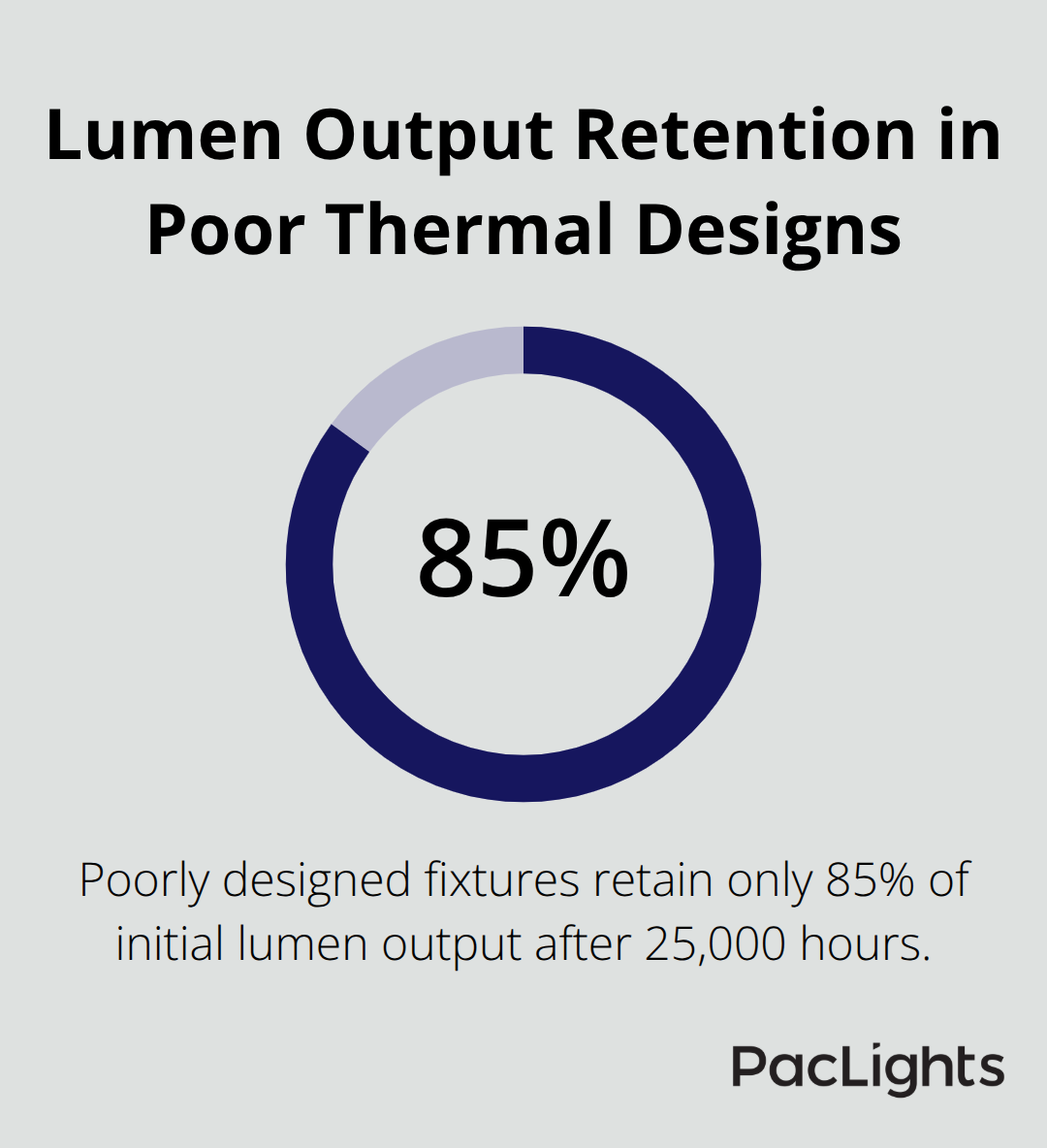
Heat dissipation performance separates mediocre LED fixtures from reliable ones in warehouse environments where temperatures fluctuate significantly. LED drivers and components degrade faster in poorly ventilated spaces, shortening lifespan from 50,000 hours to 30,000 hours or less. Fixtures with active thermal management (including aluminum heat sinks and optimized airflow design) maintain performance consistency across seasonal temperature variations. Testing data from independent lighting labs shows that fixtures with superior thermal design maintain consistent lumen output after 25,000 hours of operation, while poorly designed alternatives drop to 85 percent of initial output within the same timeframe. Request thermal performance specifications and lumen maintenance curves at 25 percent and 50 percent of rated lifespan rather than accepting manufacturer claims at face value.
Making the Right Selection Requires Specification Review
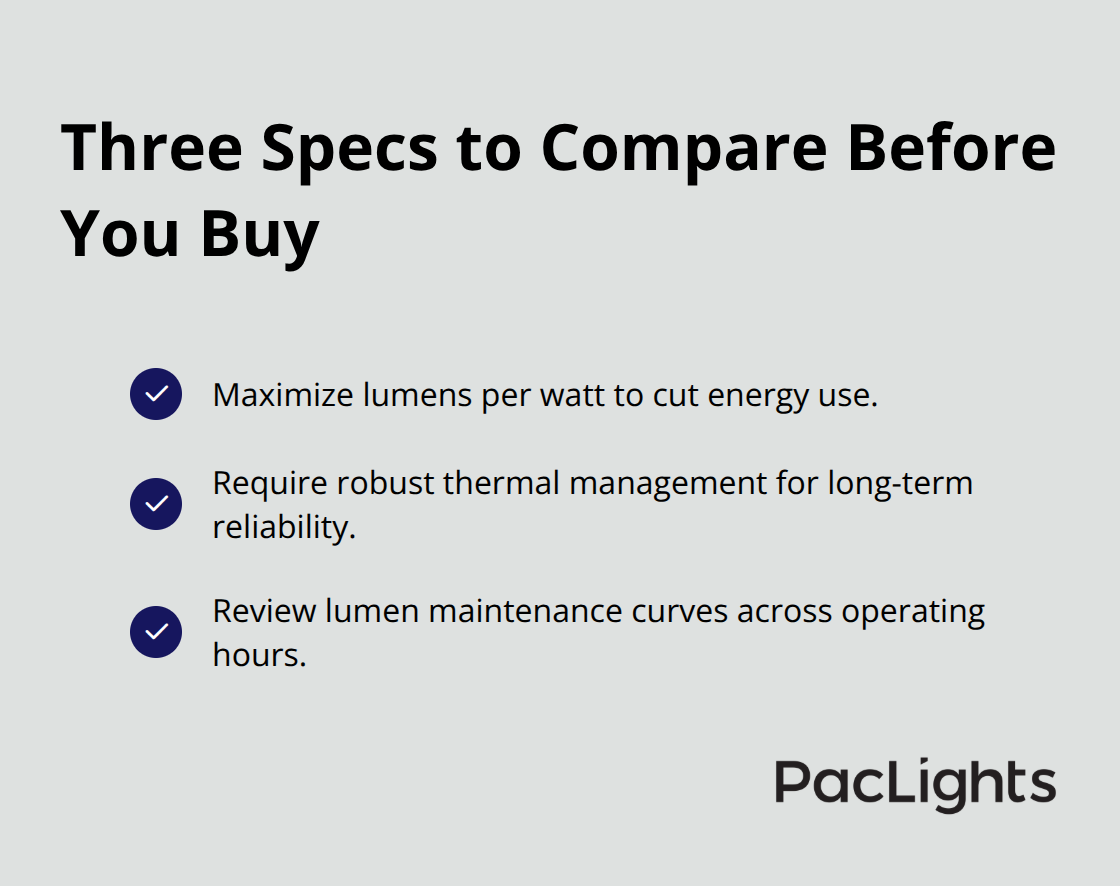
Evaluating LED high bay options demands attention to measurable performance data rather than marketing promises. Compare fixtures across three metrics: lumens per watt efficiency, thermal management design, and lumen maintenance curves over time. Facilities that prioritize these specifications avoid the false economy of selecting cheaper fixtures that underperform or fail prematurely.
With the right specifications identified, the next step involves assessing how these fixtures fit your warehouse layout and calculating the actual return on your investment.
How to Calculate ROI and Match Fixtures to Your Warehouse
Map Your Warehouse by Activity Zone
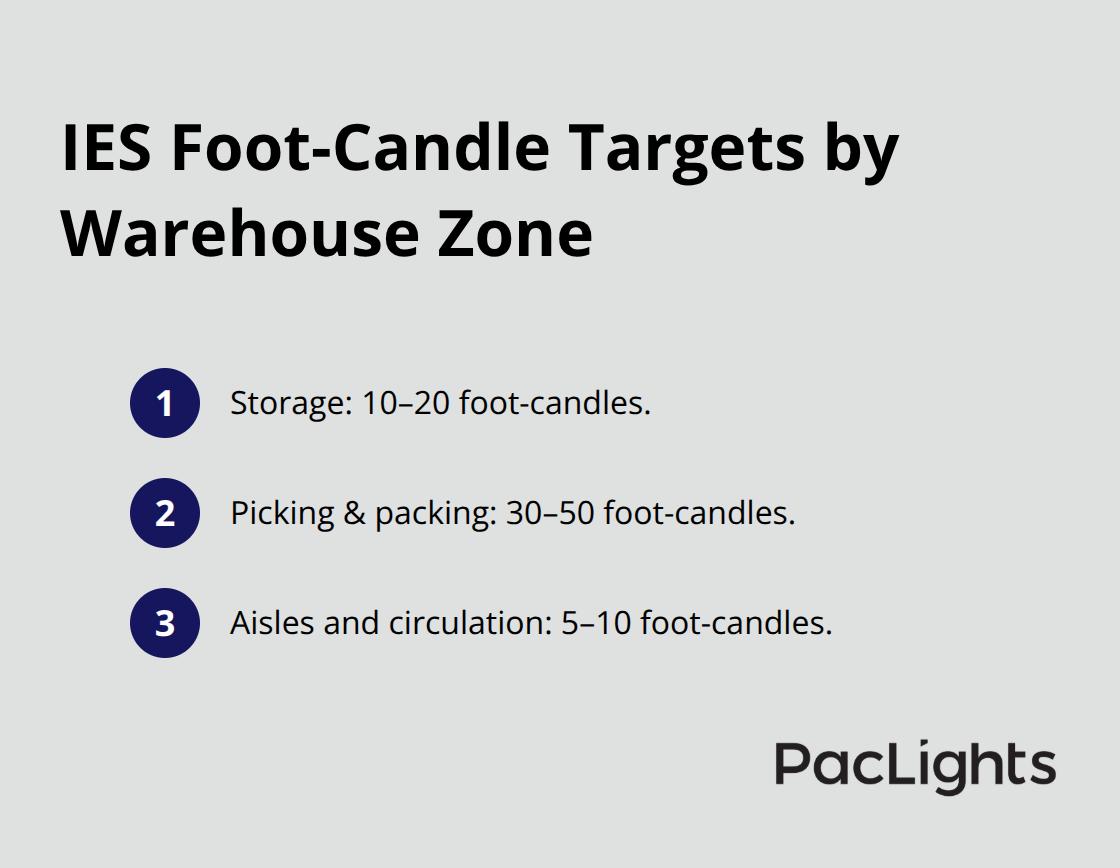
Warehouse layout determines everything about your LED high bay investment, yet most facilities skip this step and install uniform fixtures across spaces with vastly different lighting demands. Start by mapping your warehouse in sections based on activity type. General storage areas where inventory sits temporarily need far less light than picking zones where workers read labels and scan items constantly. Measure the height of your ceiling and the distance between support columns, then calculate square footage per fixture. A 40-foot ceiling with 30-foot column spacing requires different lumen output than a 20-foot ceiling with the same spacing. The Illuminating Engineering Society recommends 10 to 20 foot-candles for storage, 30 to 50 foot-candles for picking and packing, and 5 to 10 foot-candles for aisles and circulation areas. This variation means a 150-watt fixture might work perfectly in one zone and waste energy in another.
Create a Detailed Layout and Calculate Energy Reduction
Create a detailed layout showing fixture placement, quantity, and wattage for each section. This precision prevents the common mistake of over-lighting low-activity zones while under-lighting high-demand areas. Once you have this layout, calculate your actual energy consumption by multiplying fixture wattage by hours of operation by total fixture count, then compare it to your current system’s consumption. A warehouse running 100 fixtures at 600 watts each for 16 hours daily uses 960 kilowatt-hours daily. Switching to 180-watt LED fixtures cuts that to 288 kilowatt-hours daily, a reduction of 672 kilowatt-hours. At your local industrial electricity rate (check your utility bill, not national averages), multiply this daily savings by 365 days to find annual savings. If you pay $0.065 per kilowatt-hour, that warehouse saves $15,912 annually on energy alone.
Factor in Maintenance Savings and Payback Timelines
Add maintenance cost reductions of 40 to 50 percent based on LED lifespan advantages, typically adding another $2,000 to $4,000 annually depending on your current maintenance labor costs. Divide your total system cost by combined annual savings to find payback period. Most warehouses see payback between 2 to 3.5 years, but this varies significantly based on local electricity rates and existing system age. Facilities paying above $0.08 per kilowatt-hour see payback under 2 years. Those in lower-rate regions might need 3 to 4 years. This calculation matters because it determines whether you pursue a full conversion or phase the project across multiple years.
Leverage Professional Lighting Design for Precision
Professional lighting designers accelerate this process considerably. They use photometric software to simulate your exact warehouse conditions with candidate fixtures, showing you illumination levels at every point on your floor rather than relying on rule-of-thumb calculations. This prevents costly mistakes where you discover mid-installation that your chosen fixtures don’t deliver adequate light in critical zones. Designers also identify opportunities for daylight harvesting or motion control that your initial layout might miss, sometimes adding 10 to 15 percent additional savings beyond the baseline LED conversion. PacLights provides free lighting layout designs and ROI assessments that give you this precision without the expense of hiring an independent consultant, helping you make confident decisions before purchasing a single fixture.
Final Thoughts
LED high bay lighting delivers measurable financial returns that extend far beyond the initial purchase price. The energy savings alone-46,000 to 136,000 kilowatt-hours annually for a 100-fixture warehouse-create immediate budget relief, while maintenance cost reductions compound those gains year after year. Most facilities recover their investment within 2 to 3.5 years, then operate with significantly lower overhead for the remaining 25 to 50 years of building life.
The real advantage of warehouse LED high bay systems emerges over time as your payback period closes and pure savings accumulate. After you recover your initial investment, every year of operation generates $15,000 to $20,000 in annual savings that compound across decades into hundreds of thousands in cumulative benefit. Improved visibility also reduces picking errors and safety incidents while better working conditions improve employee retention and productivity.
Implementation starts with honest assessment of your current situation-pull your electricity bills to find your actual rate per kilowatt-hour, measure your warehouse ceiling heights and column spacing, and identify which zones demand the most light. PacLights provides free lighting layout designs and ROI assessments that take the guesswork out of this process, analyzing your specific warehouse conditions and showing you exactly what financial returns you can expect before you commit to any purchase.
Disclaimer: PacLights is not responsible for any actions taken based on the suggestions and information provided in this article, and readers should consult local building and electrical codes for proper guidance.