

Warehouse lighting controls are one of the easiest ways to slash energy costs, yet most facilities leave thousands of dollars on the table every year. We at PacLights have seen firsthand how poor lighting design drives up operating budgets while wasting energy that could be saved with smarter systems.
The good news is that upgrading to motion sensors, daylight harvesting, and networked controls doesn’t require a complete facility overhaul. This guide walks you through the real numbers, the technology that works, and exactly how fast you’ll recoup your investment.
How Much Energy Your Warehouse Actually Wastes
Warehouses waste staggering amounts of energy on lighting because most facilities operate the same way they did twenty years ago. Lights stay on across entire sections whether anyone works there or not. A typical warehouse runs lighting 24/7, but actual occupancy peaks during day shift hours and drops dramatically after hours. This mismatch between lighting operation and actual facility use is where thousands of dollars leak out annually.
The Scale of Wasted Energy
A major distribution center running 100,000 square feet of high-bay lighting at full brightness around the clock can spend $30,000 to $50,000 per year on lighting alone. If that facility operates inefficiently-using older HID or fluorescent fixtures without controls-energy costs climb even higher. The real problem isn’t the fixtures themselves; it’s that most warehouses treat lighting as an all-or-nothing system rather than a dynamic tool that should respond to actual space usage.
Hidden Costs Beyond Energy Bills
Inefficient lighting systems create secondary costs that facility managers often overlook. Burned-out bulbs require more frequent replacements, maintenance crews spend extra time on repairs, and poor visibility in certain aisles leads to picking errors and safety incidents that compound operational expenses.
Where the Money Actually Goes
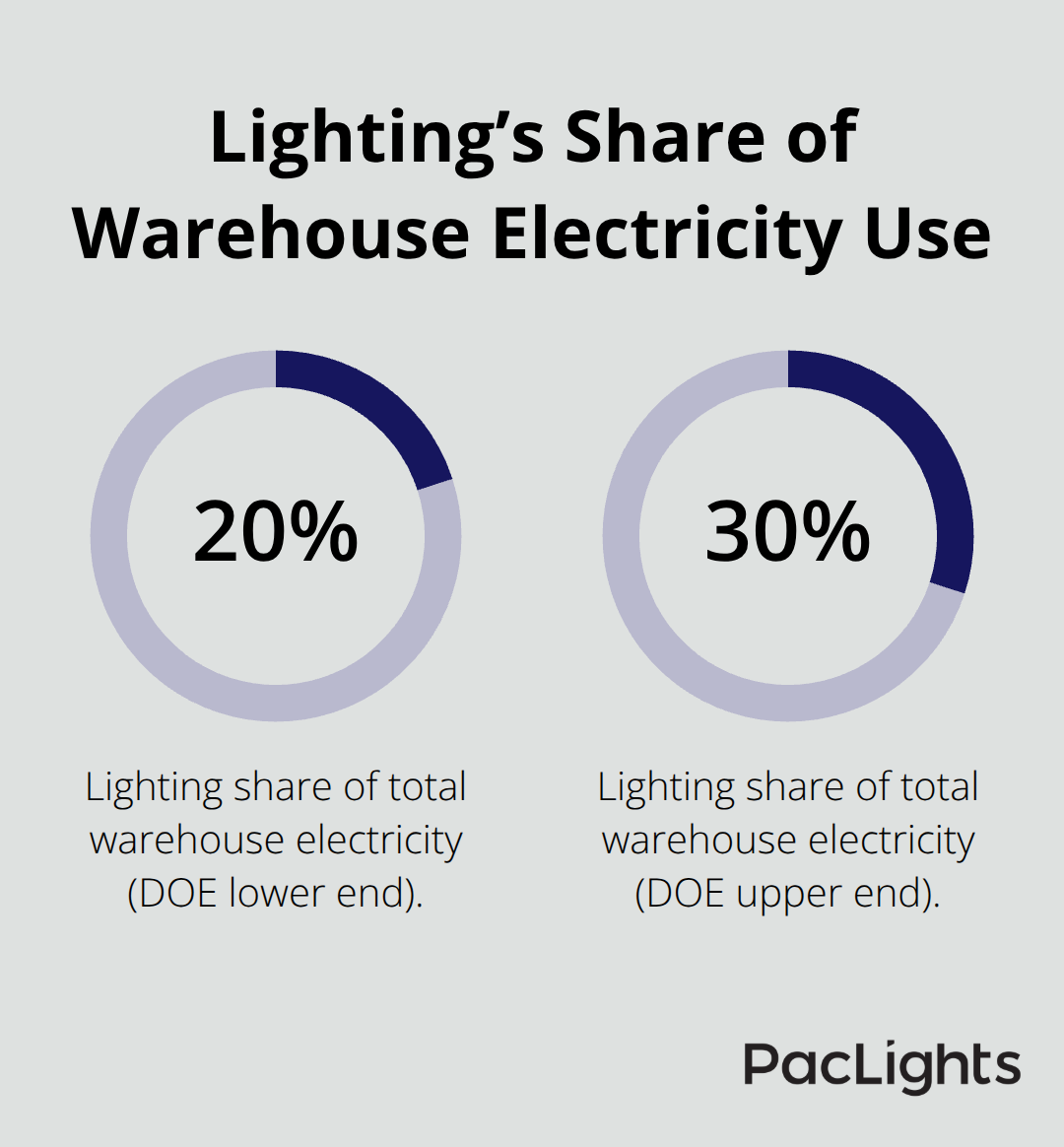
The financial drain from poor warehouse lighting shows up in multiple places on your operating statement. Energy consumption benchmarks from the U.S. Department of Energy indicate that lighting typically accounts for 20 to 30 percent of total warehouse electricity use, making it one of the largest controllable expenses in the facility. For a warehouse spending $200,000 annually on electricity, lighting alone represents $40,000 to $60,000-and that’s before factoring in maintenance costs.
Warehouses using older technologies like high-intensity discharge bulbs or uncontrolled fluorescent systems operate at the high end of this range. These older systems also degrade over time; a 10-year-old HID fixture loses output efficiency and consumes more power to maintain the same light levels.
Maintenance Costs That Add Up Fast
Beyond direct energy costs, inefficient lighting drives up maintenance budgets significantly. HID and fluorescent bulbs require replacement every 10,000 to 15,000 hours of operation, while LED fixtures last 50,000 to 100,000 hours. In a warehouse running 24/7, that difference means replacing HID bulbs roughly every 14 months but replacing LED bulbs only every 5 to 8 years. Labor costs for those replacements, plus the cost of the bulbs themselves, add another 10 to 15 percent to total lighting expenses in older facilities.
The financial case for upgrading becomes clear when you add these numbers together. What looks like a simple lighting problem actually represents a cascade of expenses that drain your bottom line month after month. The next section reveals which control technologies actually cut these costs and how fast they pay for themselves.
Which Control Technologies Actually Deliver Energy Savings
Motion Sensors and Occupancy-Based Controls
Motion sensors and occupancy-based controls form the backbone of warehouse energy reduction because they eliminate the single biggest source of waste: lighting empty spaces. When you install high-bay occupancy sensors covering large volumes, individual aisles turn on only when workers enter and dim or shut off completely in unoccupied zones. A distribution center with 50 aisles running 24/7 might have only 10 to 15 actively staffed during off-peak hours, yet all 50 stay fully lit. Independent aisle controls solve this problem directly.
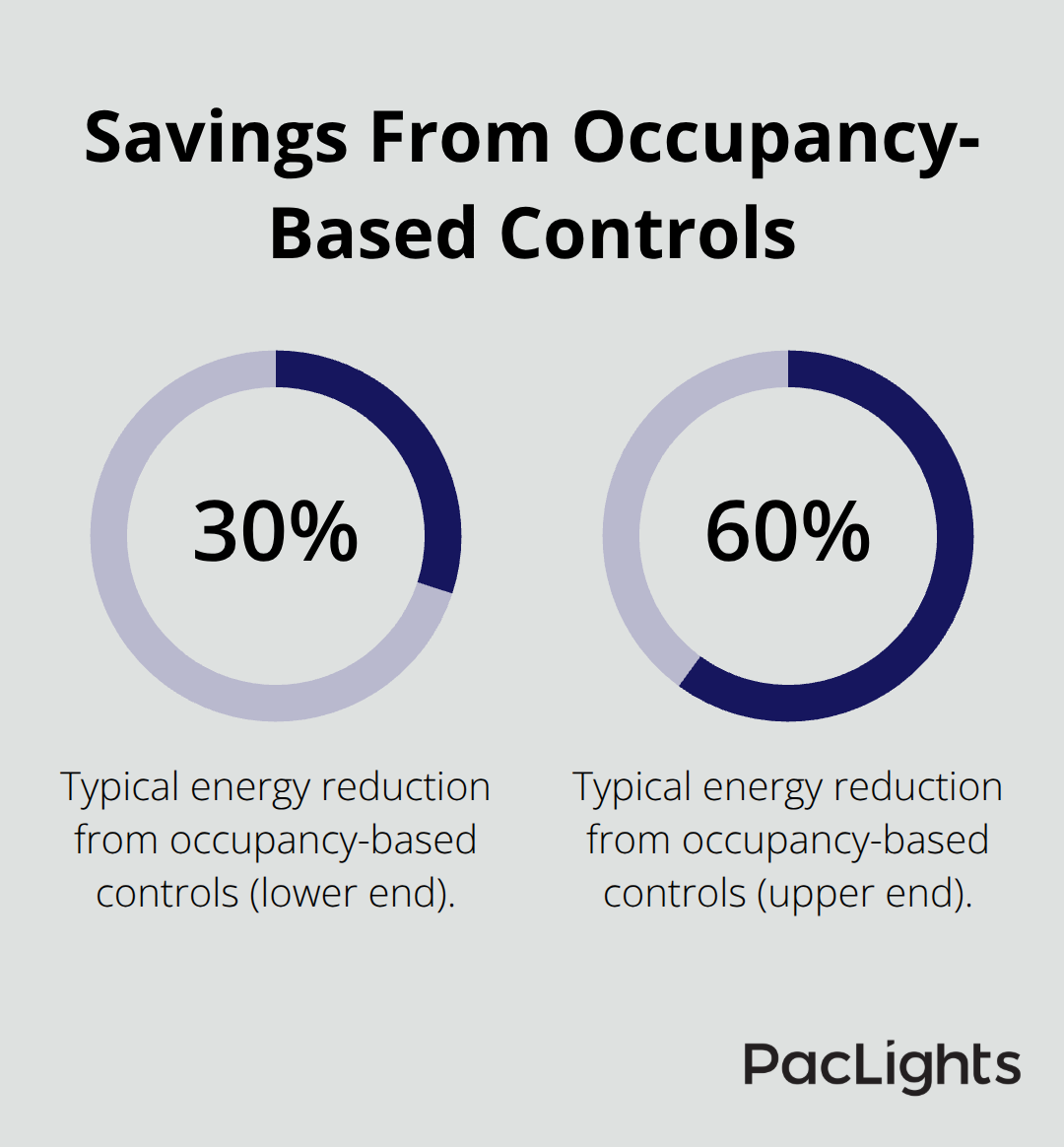
The U.S. Department of Energy reports that occupancy-based systems typically reduce energy consumption by 30 to 60 percent in warehouses, with larger savings in facilities that operate across multiple shifts with variable occupancy patterns. The key is proper sensor placement: mount occupancy sensors 8 to 10 feet high with overlapping coverage to avoid dark zones and false triggers from nearby movement. Cheap sensors with poor calibration waste money on unnecessary on-cycles and frustrate workers when lights flicker or fail to activate. Test sensor coverage in your highest-traffic aisles first before rolling out facility-wide to confirm the setup matches your actual workflow.
Daylight Harvesting for Maximum Efficiency
Daylight harvesting works alongside occupancy sensing and delivers outsized returns in warehouses with skylights, clerestory windows, or large dock doors that flood spaces with natural light throughout the day. Photosensors measure ambient light levels and automatically reduce artificial lighting intensity when daylight is sufficient, then boost it again as clouds roll in or sunset approaches. This approach cuts energy use far more aggressively than occupancy sensing alone because it responds continuously to external conditions rather than waiting for someone to enter a zone.
Networked Controls and Real-Time Monitoring
Networked lighting controls and dimming solutions tie everything together into a cohesive system that learns your facility’s rhythms and adjusts automatically. A wireless distributed control system eliminates the cost and disruption of running new wiring through existing structures, which makes retrofits feasible even in older warehouses. These systems integrate with your building management system to coordinate lighting adjustments with HVAC schedules and security protocols, creating facility-wide efficiency rather than isolated improvements.
Real-time monitoring shows energy consumption by zone, revealing which areas perform well and where additional controls can squeeze out more savings. Install submetering on lighting circuits to track usage by branch or department, which helps meet energy codes and uncovers patterns that manual observation misses entirely. A phased rollout starting in high-traffic zones like main aisles and receiving areas lets you validate the approach, measure actual payback, and refine settings before expanding to storage areas and back-of-house corridors where occupancy is sporadic. These control technologies work best when paired with modern LED fixtures that respond quickly to dimming commands and maintain consistent light output across their lifespan, which sets the stage for calculating exactly how fast your investment pays back.
How Fast Your Lighting Investment Pays Back
Upgrading warehouse lighting to LED fixtures paired with controls requires upfront capital, but the payback timeline is shorter than most facility managers expect. A 100,000-square-foot warehouse retrofitting from older HID or fluorescent systems to LED with occupancy sensing and daylight harvesting typically invests $80,000 to $150,000 depending on fixture counts, sensor placement, and control system complexity. That sounds substantial until you calculate actual energy reductions. The U.S. Department of Energy data shows occupancy-based systems cut warehouse energy consumption by 30 to 60 percent, with the higher end achieved when daylight harvesting and networked dimming work together. For a facility spending $50,000 annually on lighting, a 40 percent reduction saves $20,000 per year in electricity alone. Add in maintenance savings from LED longevity-avoiding HID bulb replacements every 14 months-and total annual savings climb to $24,000 to $28,000. A $120,000 retrofit investment divided by $26,000 in annual savings yields a payback period of roughly 4.6 years, after which the system generates pure cost reduction for another 15 to 20 years of LED fixture life.
Tax Deductions and Rebates Compress Your Timeline
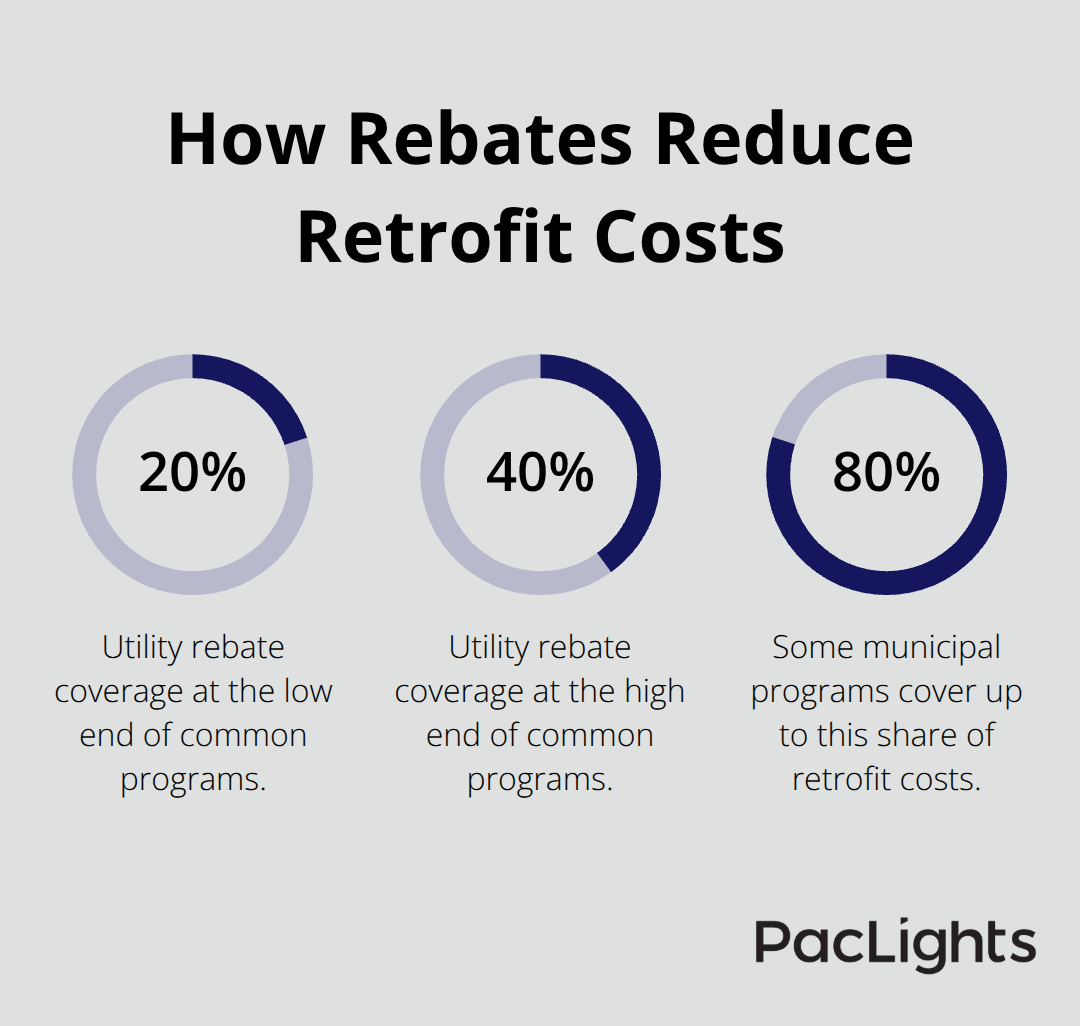
Tax deductions and rebates slash your actual out-of-pocket cost significantly. The IRS Section 179D tax deduction allows commercial building owners to deduct up to $1.88 per square foot for energy-efficient lighting systems, which translates to $188,000 in deductions on a 100,000-square-foot warehouse. At a 25 percent tax rate, that deduction reduces your federal tax liability to roughly $47,000. Many utilities offer rebate programs covering 20 to 40 percent of retrofit costs, and some municipal programs cover up to 80 percent depending on your location and utility provider.
Contact your local utility directly to confirm available incentives before you budget your project; a warehouse in California or New York may access substantially different rebates than one in Texas. When you combine the 179D deduction with utility rebates, your actual out-of-pocket retrofit cost often drops to $30,000 to $60,000, compressing your payback timeline to 18 to 30 months instead of four to five years. That acceleration makes the financial case nearly bulletproof, especially for facilities with high occupancy variability where occupancy sensors deliver outsized savings.
Start With a Free Lighting Audit
A free lighting audit quantifies your specific savings potential and removes guesswork from the investment decision. A proper audit measures your existing energy consumption by zone, identifies which areas benefit most from controls versus LED upgrades alone, and calculates payback based on your actual utility rates rather than industry averages. This data-driven approach prevents overspending on controls in low-occupancy zones where simple LED upgrades deliver better returns, and ensures you prioritize high-traffic areas where occupancy sensors and dimming generate immediate measurable savings. PacLights offers free lighting layout designs and ROI assessments tailored to your facility’s dimensions, occupancy patterns, and current fixture types.
Prioritize High-Traffic Zones First
Start with your highest-energy-consumption zones-typically main aisles and receiving areas-where retrofits demonstrate fast payback and build internal momentum for broader facility upgrades. Most facilities complete phased rollouts within 18 to 36 months, spreading capital expenditure across multiple budget cycles while capturing energy savings from completed sections immediately. This staged approach lets you validate results in one section before you commit resources to the entire facility, which reduces risk and allows you to refine control settings based on real occupancy data rather than assumptions.
Final Thoughts
Smart warehouse lighting controls deliver measurable financial returns while transforming how your facility operates. Motion sensors eliminate waste in unoccupied aisles, daylight harvesting cuts energy during daylight hours, and networked controls coordinate everything into a system that responds to actual occupancy patterns. These technologies reduce energy consumption by 30 to 60 percent and compress payback timelines to 18 to 30 months when combined with tax incentives and utility rebates.
Start with a free lighting audit that measures your current energy consumption by zone and calculates payback based on your actual utility rates. Prioritize your highest-traffic zones first-main aisles and receiving areas typically show the fastest payback-then expand systematically across your facility as budget allows. This approach removes guesswork and prevents overspending on controls in areas where simple LED upgrades deliver better returns.
We at PacLights provide energy-efficient lighting fixtures with optional motion and daylight controls, plus advanced networked lighting control systems designed for industrial facilities. Our team offers free lighting layout designs and ROI assessments tailored to your specific warehouse dimensions and occupancy patterns. Contact PacLights today to evaluate your facility’s warehouse lighting controls and start capturing savings immediately.
Disclaimer: PacLights is not responsible for any actions taken based on the suggestions and information provided in this article, and readers should consult local building and electrical codes for proper guidance.