

Warehouse LED lighting transforms how your facility operates. Poor illumination drains productivity, increases errors, and puts workers at risk-but the right lighting solution changes everything.
At PacLights, we’ve seen firsthand how LED upgrades deliver immediate gains in safety and efficiency while cutting energy costs dramatically. This guide shows you exactly how to make it happen.
How Poor Lighting Tanks Warehouse Productivity
Picking Errors and Lost Efficiency
Warehouse lighting directly impacts how fast workers move and how many mistakes they make. When illumination falls short, picking errors spike dramatically. Warehouses handling small items need around 30 lumens per square foot to keep labels readable and accuracy high, according to industry standards. Drop below that threshold and mispicks increase, forcing workers to waste time correcting orders instead of moving inventory. Poor lighting also strains eyes, triggering headaches and fatigue that slow down the entire operation.
Workers in dim spaces make careless decisions faster because their brains work harder to process visual information. The result is compounded inefficiency-slower picking speeds combined with higher error rates that damage customer satisfaction and repeat business. Many warehouses still operate with old fluorescent or metal halide systems that deliver uneven illumination, creating dark pockets where mistakes happen most often. These older systems flicker constantly, which research shows increases eye strain and reduces worker concentration. The cost of these errors compounds monthly, yet warehouse managers often treat lighting as a secondary concern rather than a core operational asset.
Safety Hazards in Low-Light Environments
Safety hazards multiply when visibility drops below acceptable levels. Forklift accidents, equipment collisions, and trip-and-fall incidents spike in poorly lit spaces because operators and workers simply cannot see obstacles or other people clearly enough. Metal halide lamps create additional safety gaps-they can take minutes to reach full brightness, leaving your warehouse operating at reduced visibility during warm-up periods. This startup delay exposes workers to preventable accidents that LED fixtures eliminate entirely through instant-on capability.
Worker Morale and Retention
Worker morale suffers under poor lighting conditions too. Employees feel uncomfortable and fatigued, leading to higher turnover rates and increased retraining costs. Quality LED lighting with color temperatures between 4000K and 5000K creates bright, crisp illumination that mimics daylight, keeping workers alert and engaged throughout their shifts. Workers in well-lit warehouses report fewer headaches and less neck strain, translating directly into better attendance and retention.
The psychological impact matters more than many managers realize-bright, consistent lighting signals a professional environment where safety and efficiency matter, boosting worker confidence and morale. LED fixtures deliver the instant-on performance your operation needs, eliminating the visibility gaps that compromise both safety and productivity. This combination of physical comfort and psychological reassurance transforms how your team performs, setting the stage for the operational improvements that proper lighting solutions provide.
LED Fixtures and Controls That Transform Warehouse Operations
Match Fixture Type to Your Ceiling Height
High bay fixtures work best for ceilings between 15 and 50 feet, delivering the concentrated brightness that tall warehouse spaces require. These fixtures typically produce 15,000 to 50,000 lumens depending on wattage, concentrating light downward rather than wasting illumination on ceiling areas where no work happens. For warehouses with lower ceilings under 20 feet, low bay fixtures provide more appropriate beam spreads that prevent over-lighting and reduce glare. The key decision comes down to matching fixture type to your actual ceiling height and work area.
Many warehouse managers install oversized high bays in moderately tall spaces, creating excessive brightness that strains eyes and wastes energy. Instead, calculate your specific requirements based on ceiling height and work type. Warehouses handling small items with detailed picking work need tighter beam angles that concentrate light on inventory. Warehouses with wide-open floor plans and general storage benefit from broader beam spreads that distribute light more evenly across larger areas.
Beam Angles Direct Light Where Work Happens
The beam angle you select determines whether light reaches your workers or gets wasted on empty floor space. Narrow beam angles concentrate illumination on specific zones, making them ideal for tall shelving and narrow aisles where workers pick from high locations. Wide beam angles spread light across larger areas, suiting open warehouse floors where forklifts move freely and inventory sits at ground level. Modern LED fixtures offer adjustable mounting kits and multiple beam spread options, allowing you to fine-tune coverage without replacing entire systems.
Motion Sensors and Daylight Harvesting Multiply Your Savings
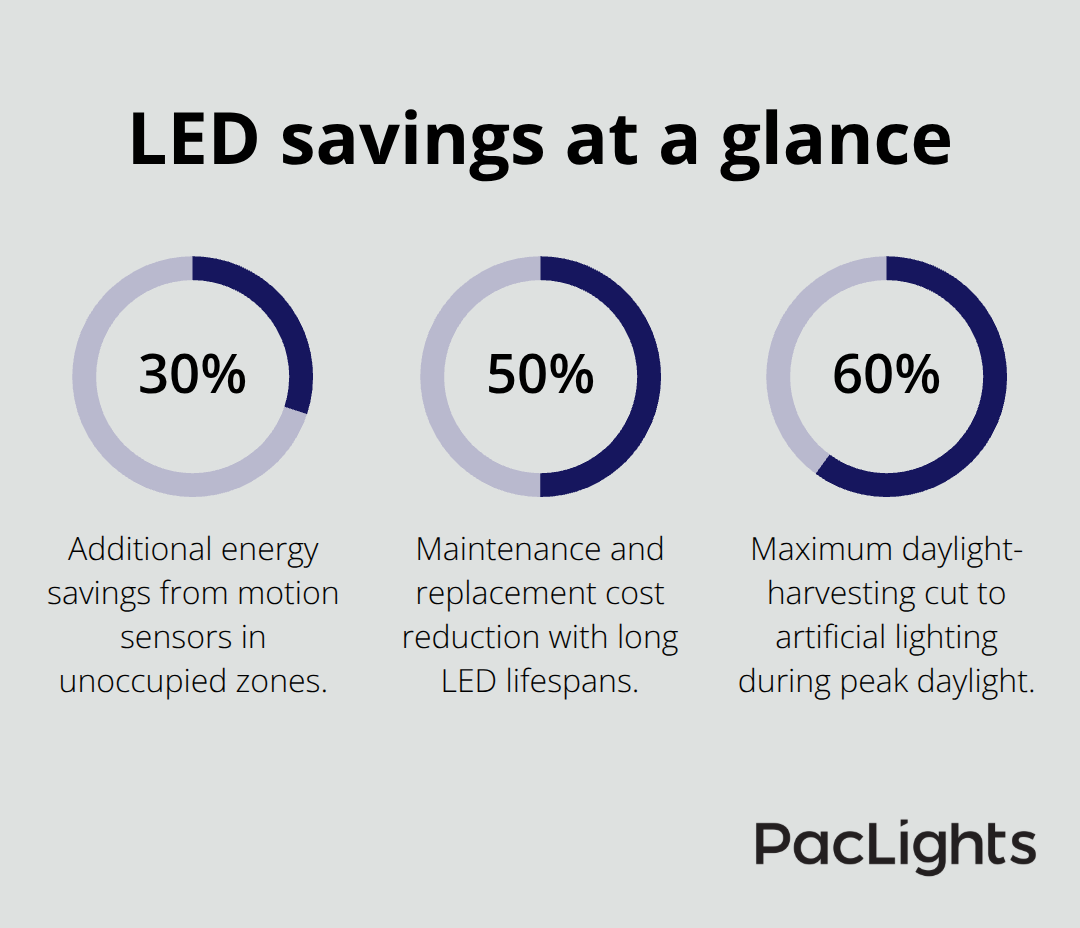
Motion-activated controls and daylight harvesting represent the operational upgrades that transform LED installations from cost-effective to genuinely profitable. Motion sensors reduce energy consumption by turning lights off in unoccupied zones, delivering approximately 30 percent additional energy savings beyond the base LED efficiency gains. Daylight harvesting systems automatically dim artificial lighting when natural light enters through windows or skylights, capturing the strongest energy savings available in warehouse operations.
Warehouses with significant natural light exposure can reduce artificial lighting needs by 40 to 60 percent during daylight hours using harvesting technology. Smart controls also enable centralized management across multiple zones, allowing facility managers to adjust lighting schedules based on actual operational patterns rather than fixed timers. A warehouse with high ceilings and motion sensors in low-traffic zones but full brightness in active picking areas operates at peak efficiency without compromising safety or productivity.
Advanced Controls Optimize Performance Across Your Facility
Networked lighting control systems integrate seamlessly with your LED fixtures, giving you real-time visibility into energy consumption and performance across every zone. These systems allow you to create custom schedules that match your actual operational patterns-dimming lights during slow periods, ramping up brightness during peak picking times, and eliminating illumination in completely unoccupied areas. The real value emerges when you combine these controls with proper fixture selection and beam angles tailored to your layout.
Your lighting strategy should account for how your warehouse actually operates, not how you think it operates. Many facilities discover that their peak activity concentrates in specific zones during certain hours, allowing controls to reduce energy use in other areas without affecting worker safety or productivity. This zone-based approach (combining high bay lighting for main aisles with appropriate low bay fixtures in secondary areas) creates uniform illumination while maintaining cost efficiency. The next step involves calculating the actual financial impact of these upgrades on your bottom line.
What’s the Real Financial Impact of Going LED
LED warehouse conversions deliver measurable energy reductions that translate directly to bottom-line savings. Switching from fluorescent or metal halide systems cuts energy consumption by 50 to 75 percent, according to industry data on commercial lighting efficiency. A warehouse consuming 100,000 kilowatt-hours annually under old fluorescent systems drops to roughly 25,000 to 50,000 kilowatt-hours with LED fixtures, assuming comparable illumination levels and operational hours. At average U.S. commercial electricity rates around 11 cents per kilowatt-hour, that translates to $5,500 to $8,250 in annual energy savings on a mid-sized facility.
Maintenance Costs Plummet With LED Lifespan
The real advantage emerges when you factor in maintenance expenses. Fluorescent fixtures typically last 7,000 to 15,000 hours before requiring replacement, forcing warehouses to schedule frequent maintenance cycles that disrupt operations. LED fixtures operate for 50,000 hours or longer, reducing maintenance disruptions and replacement costs by 50 percent or more compared to traditional systems. This longer lifespan eliminates the constant cycle of bulb failures that plague older installations.
Payback Timelines Compress Faster Than Expected
Most warehouse managers assume LED upgrades require years to break even, but actual payback periods typically range from two to four years when combining energy and maintenance savings. A facility spending $15,000 annually on electricity and $3,000 on maintenance replacements saves $18,000 yearly through LED conversion. An LED retrofit project costing $35,000 to $45,000 pays for itself in roughly two to three years, after which every dollar saved becomes pure operational profit.
Motion Sensors and Daylight Harvesting Accelerate Returns
Motion sensors and daylight harvesting represent the operational upgrades that transform LED installations from cost-effective to genuinely profitable. Motion-activated controls reduce energy consumption in unoccupied zones, delivering approximately 30 percent additional energy savings beyond base LED efficiency gains. Warehouses with substantial natural light exposure benefit even more dramatically from daylight harvesting, potentially reducing artificial lighting needs by 40 to 60 percent during peak daylight hours.
These controls also extend LED lifespan by reducing operating hours, creating a secondary financial benefit that most facilities overlook when calculating ROI. Adding motion controls compresses payback to 18 to 24 months in many cases. Smart controls enable centralized management across multiple zones, allowing facility managers to adjust lighting schedules based on actual operational patterns rather than fixed timers. A warehouse with high ceilings and motion sensors in low-traffic zones but full brightness in active picking areas operates at peak efficiency without compromising safety or productivity.
Final Thoughts
Warehouse LED lighting transforms your facility into a high-performance operation where workers move faster, errors drop, and energy costs plummet. The financial returns arrive quickly-most warehouses recover their investment within two to three years, then generate pure profit for decades. Motion sensors and daylight harvesting amplify these gains further, compressing payback to 18 to 24 months while reducing operating hours that extend fixture lifespan.
Treat your lighting system as a strategic asset that drives both productivity and profitability simultaneously. Smart controls let you adjust illumination based on actual operational patterns rather than fixed schedules, capturing efficiency gains that basic LED fixtures alone cannot achieve. Your facility’s unique layout and work patterns determine which fixture types, beam angles, and control strategies deliver maximum impact.
We at PacLights customize LED solutions for your specific warehouse needs and provide free lighting assessments and ROI calculations to guide your upgrade decision. Contact our team to transform your facility’s performance and bottom line.
Disclaimer: PacLights is not responsible for any actions taken based on the suggestions and information provided in this article, and readers should consult local building and electrical codes for proper guidance.