

Most facilities waste 20-30% of their lighting energy because schedules don’t match actual usage patterns. At PacLights, we’ve seen how cylinder fixtures scheduling transforms this problem into real savings.
The right automation cuts energy costs while keeping spaces properly lit when people need them. This guide shows you exactly how to set up schedules that work for your facility.
How Scheduling Actually Works
Cylinder pendant lights respond to three core mechanisms that drive scheduling: time-based rules, occupancy detection, and daylight awareness. Time-based scheduling tells lights to turn on or off at specific hours regardless of activity.
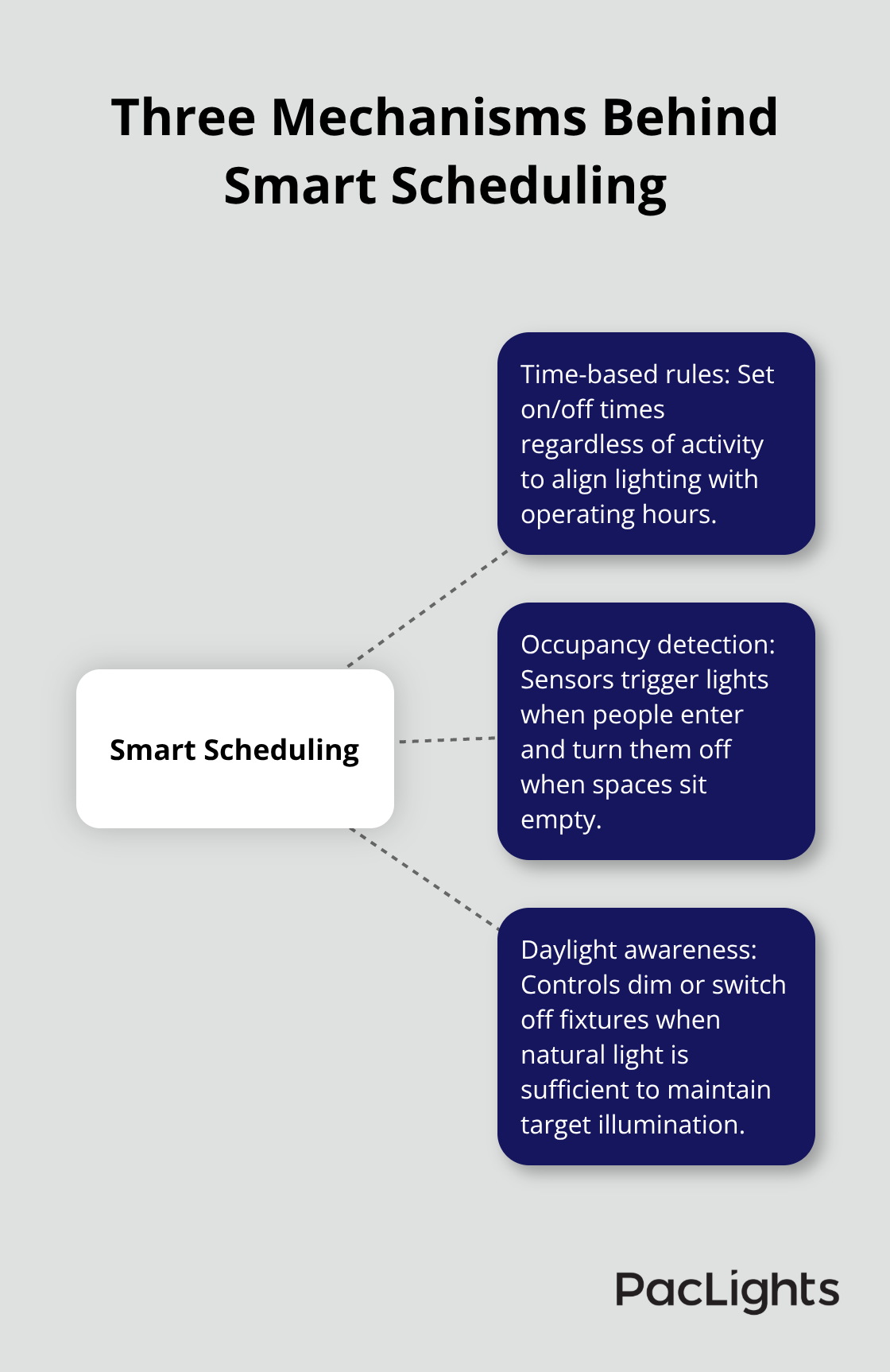
Occupancy sensors detect movement and can override schedules to turn lights on when someone enters a dark space or off when a room sits empty. Daylight controls measure natural light levels and dim or turn off fixtures when sufficient sunlight enters the space, which according to the U.S. Department of Energy can reduce artificial lighting needs by 20-40% depending on window orientation and season.
The real power emerges when these three mechanisms work together. A conference room pendant might stay off until 7 AM on weekdays, turn on at that time, then dim by 30% if daylight sensors detect morning sun, and switch to full brightness during cloudy periods. If no motion registers for 15 minutes after 5 PM, the lights turn off completely. This layered approach prevents the common failure where a single rule wastes energy because it ignores actual conditions. Facilities that implement this multi-sensor strategy report 30-50% energy reductions in controlled spaces, according to real-world retrofit data from commercial lighting deployments. The scheduling system learns nothing on its own-you must configure each rule based on how your space actually functions. A warehouse with 12-hour daily operations sees massive savings from aggressive scheduling, while a reception area with unpredictable foot traffic needs occupancy sensors as the primary control, with time-based rules as backup only.
Why Seasonal Adjustments Matter More Than Most Realize
Ignoring daylight shifts between seasons sabotages scheduling efficiency faster than almost any other mistake. Winter days in northern climates deliver usable daylight for only 8-9 hours, while summer extends to 15-16 hours. If your pendant schedule doesn’t adjust, you’ll run lights during midday summer hours when they’re completely unnecessary, wasting 10-15% of your annual lighting budget in just three months. Smart controls that use sunrise and sunset times-which update automatically based on your location-eliminate this mistake automatically. Manual schedules require you to reprogram twice yearly, which most facilities forget to do. Facilities that switch to location-aware scheduling typically recover 8-12% in annual energy costs from seasonal optimization alone, without any other changes.
Real Savings Require Matching Schedules to Actual Usage
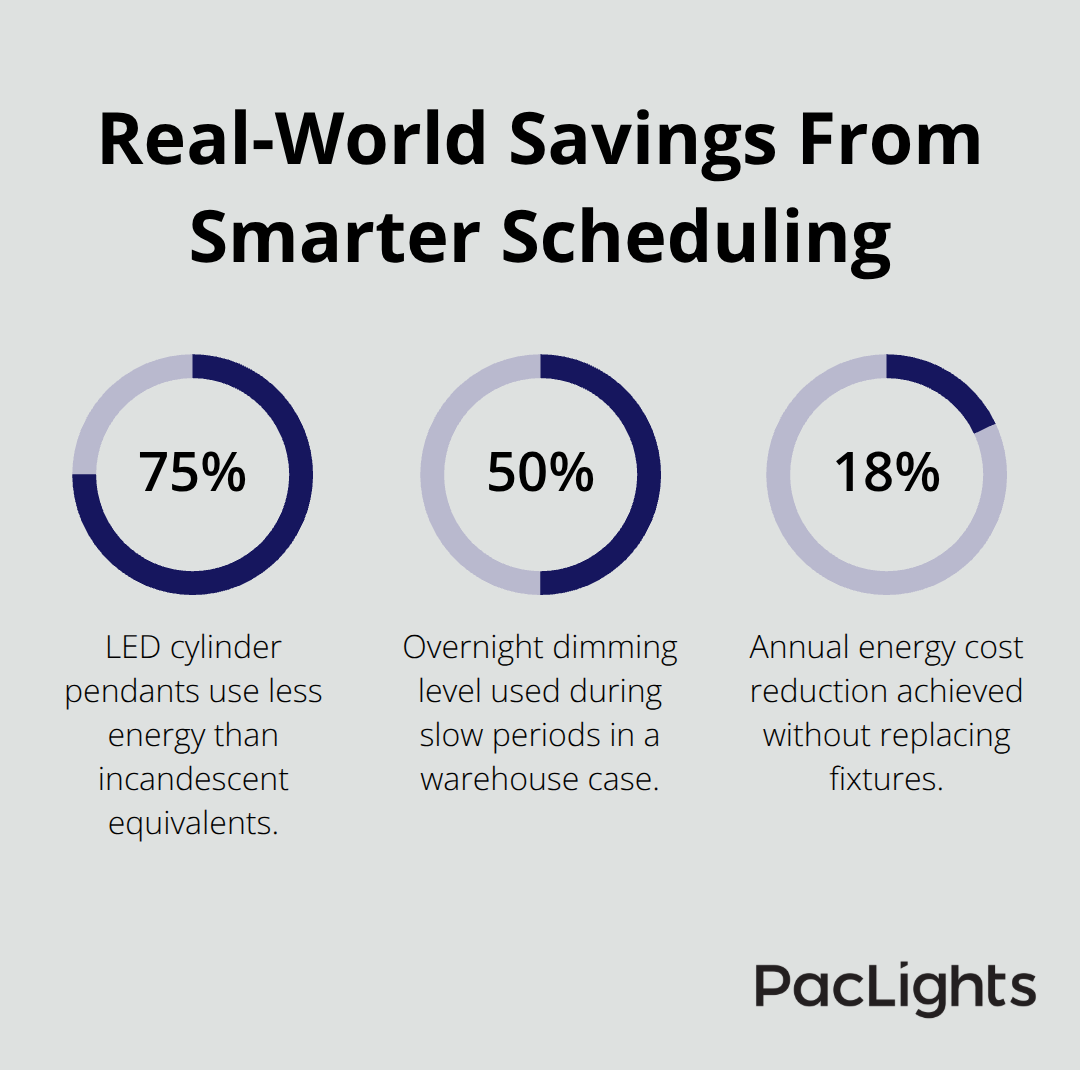
A pendant fixture running 12 hours daily uses roughly 50-60% more energy annually than one running 8 hours, assuming identical wattage. The U.S. Department of Energy data shows LED cylinder pendants consume 75% less energy than incandescent equivalents, but scheduling determines whether you realize those savings or squander them. If your facility operates pendant lights during off-hours-a common scenario in spaces with flexible occupancy-you lose 20-30% of potential savings immediately. Dimming pendant brightness during lower-activity periods (early morning, late afternoon, after-hours security) cuts energy further without affecting visibility when it matters. A warehouse that dimmed outdoor area pendants to 50% brightness during slow overnight periods while maintaining full brightness during peak shipping hours saw annual energy costs drop by 18% without any fixture replacement.
The scheduling strategy must match your facility’s actual rhythm, not an assumed standard pattern.
How to Identify Your Facility’s True Operating Pattern
Most facilities operate under assumptions about when spaces actually need light, and those assumptions often prove wrong. Walk through your facility during different times of day and note when people actually occupy each zone. A storage area might sit empty for hours despite lights running on a fixed schedule. A loading dock might have unpredictable activity that fixed time-based rules cannot accommodate. Occupancy sensors reveal the truth about your space’s actual usage, showing which areas waste the most energy due to poor scheduling. Once you understand your facility’s real operating pattern, you can configure schedules that match actual conditions rather than guesses. This analysis takes time upfront but prevents months of wasted energy from misaligned schedules.
Taking the Next Step with Professional Assessment
Your facility’s lighting efficiency depends on schedules that reflect how your space actually functions. PacLights offers free lighting layout designs and ROI assessments to identify which spaces waste the most energy and how scheduling adjustments can recover those losses. A professional assessment reveals opportunities that visual inspection alone cannot uncover, showing exactly where your facility loses money to poor scheduling decisions.
Setting Up Schedules That Match How Your Facility Actually Works
Measure Occupancy Before You Configure Anything
Measure occupancy in each zone over a full week, not just a single day. Observe when people actually move through spaces-many facilities discover that conference rooms sit empty 60-70% of their operating hours, yet lights run on fixed schedules regardless. Install temporary motion sensors in problem areas and log when activity occurs. After one week of data, you’ll see the real pattern: some spaces need lights only during specific shifts, while others require flexible control because occupancy varies wildly.
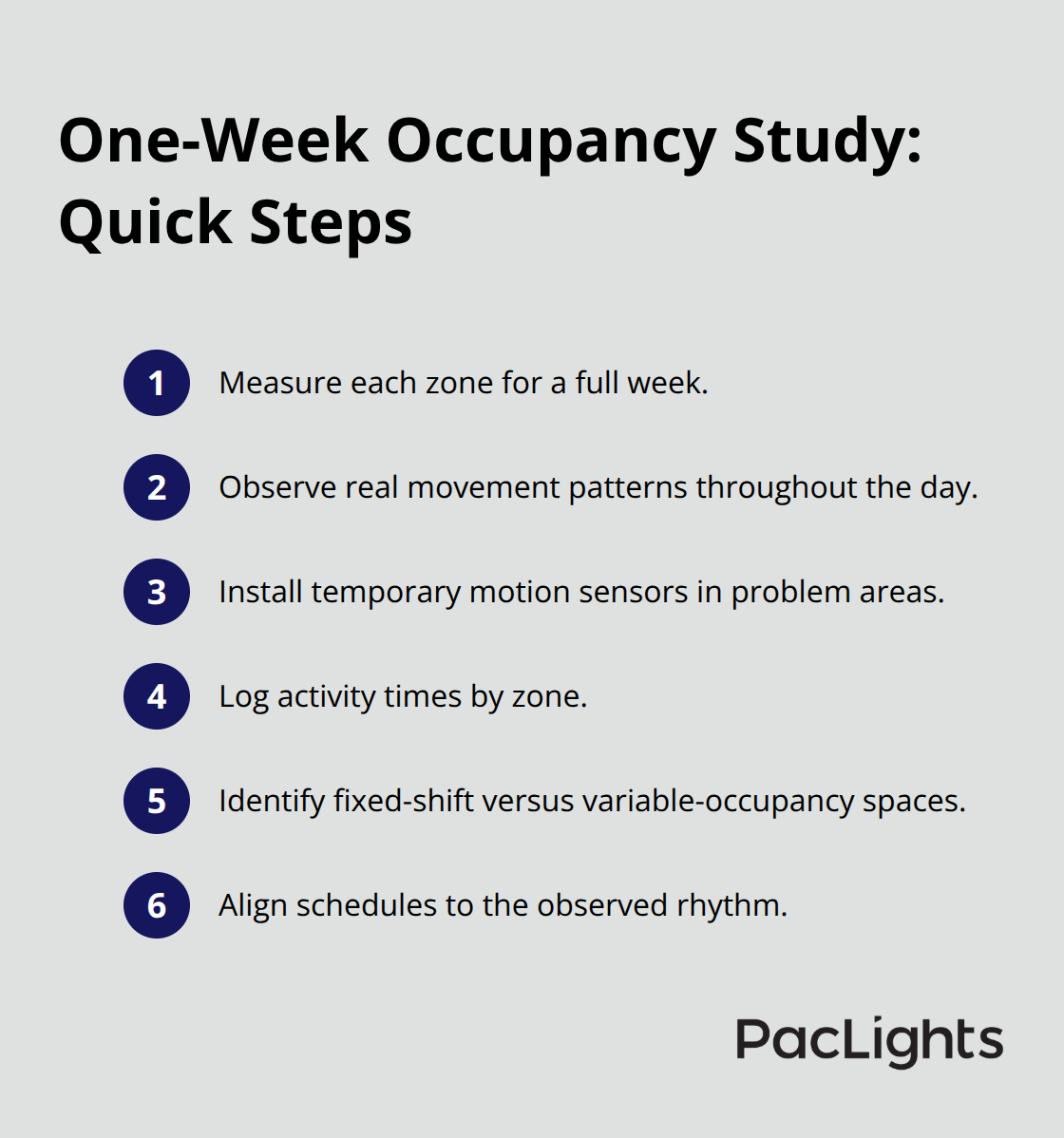
A manufacturing floor with three shifts needs different schedules for each period, but a break room might run lights only 2-3 hours daily despite being available 12 hours. Once you know actual occupancy, set your pendant schedules to match that rhythm exactly. If a space sits empty from 2 PM to 4 PM, lights should turn off during those hours, period. This single adjustment typically cuts energy waste by 15-25% in spaces where occupancy doesn’t match the assumed schedule.
Let Daylight Sensors and Location Data Drive Your Settings
Natural daylight changes everything, which is why location-aware controls outperform manual schedules every time. Sunrise and sunset vary by 2-3 hours between winter and summer in most climates, so a fixed dimming schedule that works in June fails completely in December. Configure your pendant controls to adjust automatically based on sunset times in your location rather than using a static time like 6 PM year-round.
Pair this with daylight sensors that measure actual light entering the space. If your facility has significant south-facing windows, pendant brightness can drop 40-50% on clear days simply because natural light compensates. However, don’t trust daylight sensors alone; they work best combined with occupancy detection so lights stay off in unoccupied spaces regardless of outdoor conditions.
Layer Occupancy Detection with Time-Based Rules
In spaces with unpredictable foot traffic, occupancy sensors should trigger lights immediately when someone enters, while time-based rules serve as a safety net to ensure lights turn off after closing time even if sensors malfunction. This layered approach prevents both the scenario where someone sits in darkness waiting for motion sensors to react and the scenario where a malfunctioning sensor leaves lights running all night.
The combination of sensors and schedules creates redundancy that protects both energy efficiency and user experience. A sensor failure won’t leave your facility dark or wastefully lit because the time-based backup activates. Similarly, a broken time-based rule won’t drain energy because occupancy detection still controls the lights during active hours.
Test Your Complete Schedule Before Full Deployment
Test your complete schedule for one full week before declaring it final. Walk through your facility at different times and confirm that lights behave as intended when you expect them to turn on and off. This validation phase catches configuration errors that would otherwise waste energy for months. Pay attention to transition moments-early morning arrivals, lunch breaks, shift changes, and closing time-because these periods reveal whether your schedules actually match how people use your spaces.
Once your schedules perform correctly across a full week of real operations, you’re ready to move forward with fine-tuning. The next step involves adjusting dimming levels and brightness thresholds to maximize efficiency without sacrificing visibility or comfort in the spaces where your team works most intensely.
Mistakes That Sabotage Your Scheduling Results
Assumption-Based Scheduling Wastes More Energy Than Poor Equipment
The most expensive scheduling mistake happens before you touch a single control: assuming your facility operates the way you think it does. Facilities that skip occupancy analysis and jump straight to configuring schedules based on theoretical usage patterns waste 15–25% of their expected savings because the schedules don’t match reality. A conference room scheduled to turn lights off at 6 PM might sit empty every afternoon at 3 PM, yet those lights burn for three hours unnecessarily. A warehouse might have two active shifts but lights run on a three-shift schedule because someone guessed at the operating pattern years ago.
The only way to avoid this trap is to measure actual occupancy for at least one full week before configuring anything permanent. Install motion sensors temporarily, track when people actually occupy each space, and let the data guide your schedule design. Facilities that invest two days in this analysis recover 20–30% more energy savings than those that skip it because their schedules match actual conditions instead of assumptions.
Seasonal Daylight Changes Destroy Fixed Schedules
Seasonal daylight shifts destroy scheduling efficiency when you ignore them, and manual schedules make this worse because most facilities forget to reprogram twice yearly. Winter daylight in northern climates drops to 8–9 hours while summer extends to 15–16 hours, yet a fixed schedule set for June will run lights during bright midday hours in winter and turn them off too early in summer. This seasonal misalignment costs 10–15% of annual lighting budget in just three months according to real-world facility data.
Location-aware controls that automatically adjust based on sunset times in your region eliminate this problem entirely, but you must configure them correctly at installation. These systems update your schedules without manual intervention, preventing the common scenario where facilities operate on outdated seasonal settings for months.
Aggressive Dimming Backfires When Users Override It
Overly aggressive dimming creates visibility problems that force occupants to override your schedules manually, which defeats the entire purpose of automation. If you dim pendant lights to 40% brightness during low-activity periods, workers in dimly-lit spaces will either manually turn brightness to full (wasting all your energy gains) or complain about poor working conditions. The right approach dims to 60–70% during slower periods while maintaining full brightness during peak activity times, preserving both energy savings and usability.
Test dimming levels with actual occupants before finalizing schedules because what feels acceptable in an empty space often frustrates people trying to work. Facilities that involve their teams in dimming adjustments see 25–30% higher compliance with automated schedules compared to those that impose aggressive settings without feedback. User resistance to poorly configured dimming can eliminate half your potential savings within weeks.
Final Thoughts
Smart scheduling for cylinder fixtures transforms energy waste into measurable savings, but only when your schedules match how your facility actually operates. The three core principles work together: measure occupancy before configuring anything, let location-aware controls handle seasonal daylight shifts automatically, and layer occupancy detection with time-based rules to create redundancy that protects both efficiency and reliability. Facilities that follow this approach recover 20–30% in energy costs compared to those using assumption-based schedules, according to real-world retrofit data.
LED cylinder pendant lights already consume 75% less energy than incandescent equivalents, but scheduling determines whether you realize those savings or squander them through poor automation. A warehouse that dimmed outdoor pendants to 50% brightness during slow overnight periods while maintaining full brightness during peak hours saw annual energy costs drop by 18% without fixture replacement. These results compound over time, creating payback periods of 18–24 months in many facilities, and sustainability benefits follow directly from cost reduction since every kilowatt-hour your facility stops wasting reduces your carbon footprint while lowering operational expenses.
We at PacLights provide free lighting layout designs and ROI assessments that identify which spaces waste the most energy and show exactly how scheduling adjustments recover those losses. A professional assessment reveals opportunities that visual inspection alone cannot uncover, giving you the data needed to prioritize upgrades and quantify payback timelines. Contact us to get started with a customized assessment for your facility.
Disclaimer: PacLights is not responsible for any actions taken based on the suggestions and information provided in this article, and readers should consult local building and electrical codes for proper guidance.