

Warehouse LED fixture selection directly impacts your bottom line. Poor lighting choices drain energy budgets, create safety hazards, and force constant maintenance cycles.
At PacLights, we’ve seen warehouses cut energy costs by 40–60% simply by switching to the right LED solutions. This guide walks you through the specific fixtures and selection criteria that deliver real results.
What Matters Most When Choosing Warehouse LED Fixtures
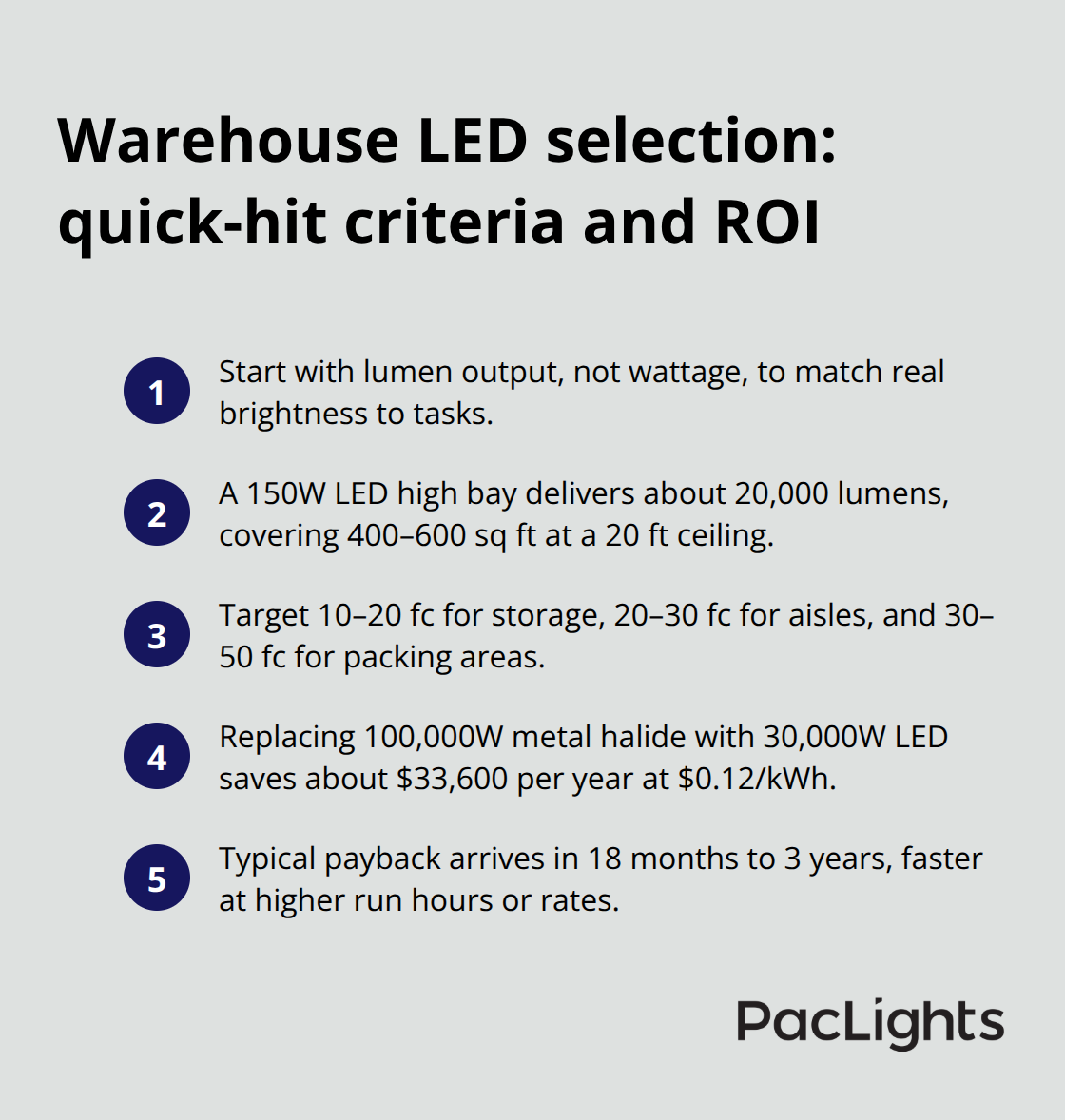
Start with lumen output, not wattage. Most warehouse managers still think in watts, but lumens determine actual brightness on your floor. A 150W LED high bay produces roughly 20,000 lumens, which covers 400–600 square feet at a 20-foot ceiling depending on task type. General storage needs 10–20 foot-candles, aisles require 20–30 foot-candles, and packing areas demand 30–50 foot-candles according to industry standards. Older metal halide systems required 400W to 1500W to achieve similar results, so the efficiency gap is massive. At $0.12 per kilowatt-hour, replacing 100,000W of metal halide with 30,000W of LED saves roughly $33,600 annually. Payback typically hits 18 months to 3 years, faster in facilities running 24/7 or paying higher electricity rates.
Color Temperature and Visibility
Color temperature matters more than most realize. We recommend 5000K for warehouses because it maximizes task visibility and works well with security cameras. Warmer 3000K tones belong only in spaces where you intentionally want softer lighting; anything above 5700K creates unnecessary glare without better visibility. This choice directly affects worker accuracy and safety on your warehouse floor.
Energy Efficiency Certifications
Energy efficiency ratings separate fixtures that truly perform from marketing hype. Look for DLC Listed or DLC Premium Listed certifications from the DesignLights Consortium, which verify actual performance before you buy. Try for fixtures that deliver 140 lumens per watt or higher to minimize both energy draw and long-term maintenance costs. These certifications also unlock rebate eligibility that improves your ROI timeline.
Durability in Harsh Warehouse Conditions
Durability determines whether your investment survives your warehouse environment. Cold storage, washdown areas, and chemical exposure demand different protection levels than standard dry warehouses. IP69K-rated enclosures withstand high-pressure cleaning in food, beverage, and pharmaceutical facilities, while IP67 ratings handle dust and occasional water spray in typical warehouses. LEDs outperform older technologies in vibration and impact resistance because they lack fragile glass components, reducing breakage from forklifts and equipment vibration.
Temperature Management and Lifespan
Temperature management protects your fixtures and extends their operational life. LED fixtures rated for -40°C perform reliably in freezers without efficiency loss. Some fixtures include automatic temperature protection that dims output above 50°C to extend lifetime in hot environments. A 50,000–100,000 hour lifespan translates to 5–11 years of operation, compared to metal halide lamps needing replacement every 1–2 years. That lifespan advantage cuts maintenance labor costs substantially and reduces operational disruptions from frequent relamping.
Environmental Protection and Corrosion Resistance
Water and oil resistance protects against corrosion in refineries, manufacturing plants, and food processing facilities where traditional housings deteriorate quickly. Corrosion-resistant materials and fully sealed enclosures prevent premature fixture failure and maintain consistent brightness over time. Selecting the right fixture for your specific environment prevents expensive failures and compounds your energy savings through uninterrupted, reliable operation. The next section explores which fixture types work best for different warehouse spaces and how to match them to your layout.
Why Your Current Warehouse Lighting Costs Too Much and Fails Workers
Poor Illumination Undermines Safety and Accuracy
Outdated warehouse lighting systems fail workers in three distinct ways that compound over time. Poor illumination directly undermines worker safety and accuracy. When foot-candle levels fall below 20 foot-candles in aisles or drop below 30 foot-candles in packing areas, workers struggle to read labels, spot hazards, and operate equipment safely. Metal halide and fluorescent systems often create uneven coverage with dark patches between fixtures, forcing workers to squint or move under brighter spots to complete tasks.
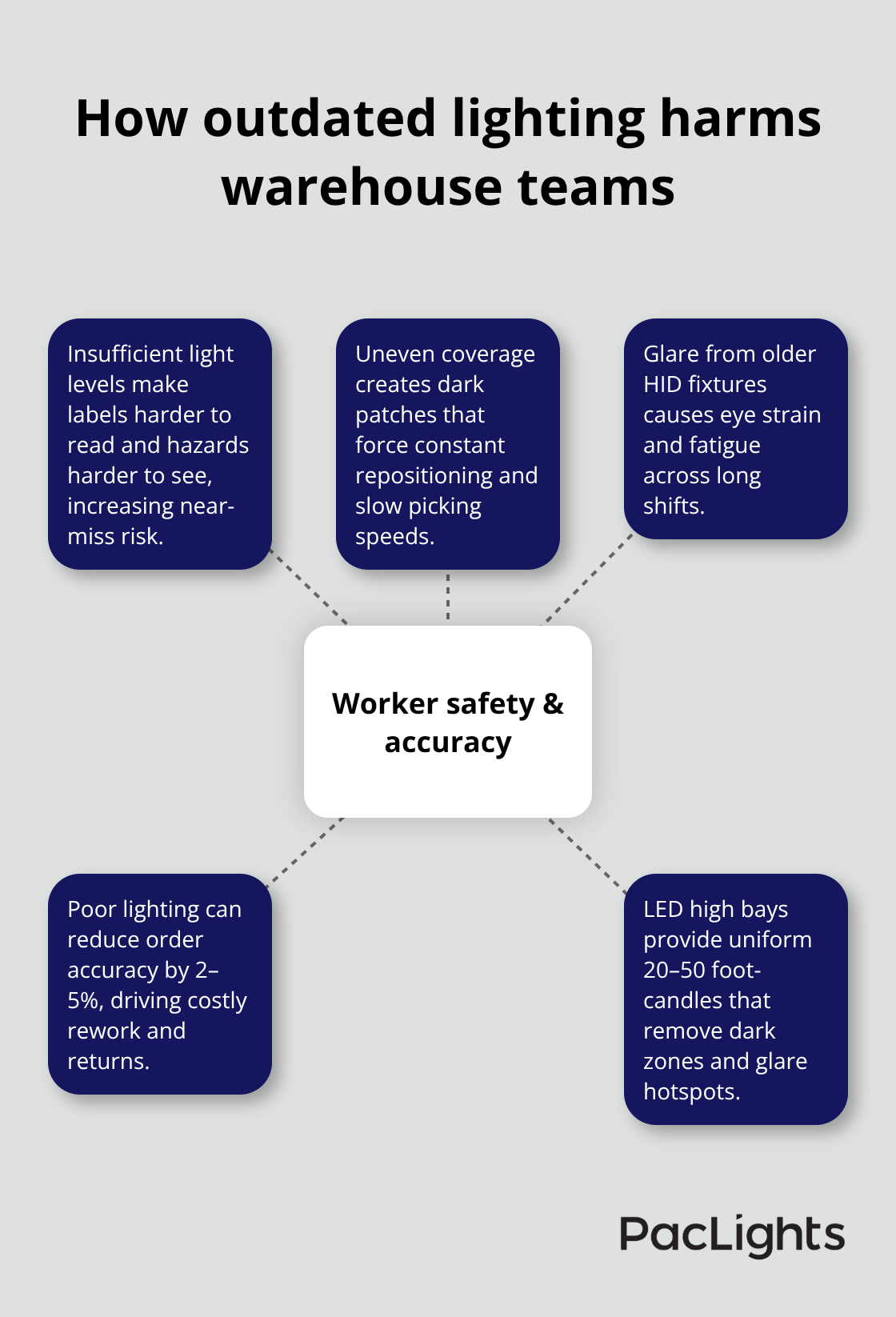
This uneven lighting increases picking errors significantly. Studies on warehouse operations show that poor lighting can cost 2–5% of order accuracy, translating to thousands in lost revenue monthly for mid-sized facilities. Older HID fixtures also produce significant glare at eye level when workers operate forklifts or stand near racking, causing eye strain and fatigue that compounds over an 8–12 hour shift. LED high bays eliminate these problems through superior beam control and consistent lumen distribution, delivering uniform 20–50 foot-candles across your entire floor without dark zones or glare hotspots.
Energy Consumption Crushes Your Operating Budget
Energy consumption from outdated systems destroys your operating budget. A typical 50,000 square foot warehouse running 4000W of metal halide lighting at 16 hours daily consumes 32,000 kilowatt-hours annually. At the U.S. average industrial rate of $0.10 per kilowatt-hour, that costs $3,200 yearly just for lighting-and many regions pay $0.12–$0.15 per kilowatt-hour, pushing costs to $4,800 or higher.
Switching to LED reduces that same space to roughly 10,000W, cutting annual consumption to 8,000 kilowatt-hours and dropping costs to $800–$1,200. That $2,000–$3,000 annual saving accumulates fast, and facilities running 24/7 see double or triple these savings. The math favors LED conversion decisively, especially when you factor in rebates and tax incentives available in most states.
Maintenance Expenses From Frequent Relamping Destroy Labor Budgets
Maintenance expenses from frequent relamping destroy your labor budget. Metal halide lamps last 6,000–15,000 hours, requiring replacement every 1–2 years in busy warehouses. Each relamping cycle demands electricians, lift equipment, and downtime-costs that add up to $5,000–$15,000 annually depending on fixture count and labor rates.
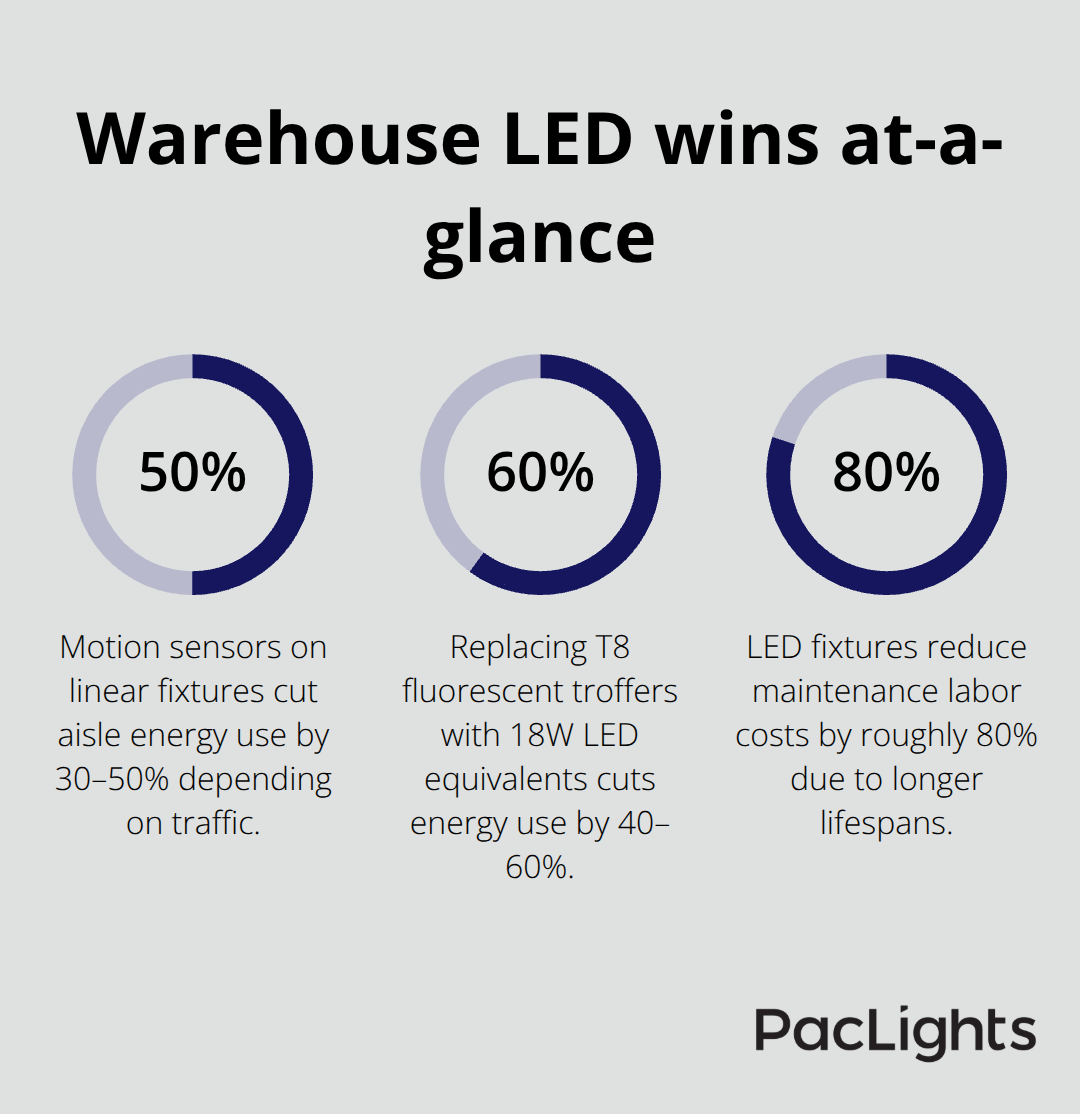
LED fixtures rated for 50,000–100,000 hours eliminate relamping for 5–11 years, cutting maintenance labor costs by roughly 80% and reducing operational disruptions that slow warehouse throughput. These three cost drivers-poor safety outcomes, high energy bills, and constant maintenance-make your current system a financial liability. The next section examines which LED fixture types address these problems most effectively for different warehouse spaces.
LED Fixture Types for Different Warehouse Spaces
UFO High Bays for Open Floor Areas
UFO high bay lights dominate open warehouse floors for solid reasons: they deliver concentrated brightness in a compact footprint, typically producing 20,000–30,000 lumens from a single 150W–240W fixture. At a 20-foot ceiling with standard 14-foot spacing, one UFO high bay covers 400–600 square feet effectively, making them the workhorse for main storage areas and receiving zones. The tight beam pattern concentrates light where you need it without wasting lumens on walls or rafters, which cuts wattage requirements significantly compared to linear fixtures spreading light across wider areas.
For a 50,000 square foot warehouse with 20-foot ceilings, you’d typically deploy 80–100 UFO high bays spaced in a grid pattern, consuming roughly 15,000W total and costing $1,800–$2,400 annually to operate at $0.12 per kilowatt-hour. Metal halide equivalents running 400W per fixture would consume 40,000W and cost $4,800–$6,400 annually, making the LED conversion deliver $3,000–$4,000 in yearly savings before accounting for maintenance labor reductions.
Linear Fixtures for Aisles and Racking
Linear high bay fixtures excel in long aisles between racking because their elongated beam pattern distributes light uniformly along the aisle width, eliminating the dark zones that plague UFO spacing in narrow corridors. A 40W linear strip light running 8 feet long maintains consistent 20–30 foot-candles across a 6-foot-wide aisle without glare hotspots, whereas UFO fixtures create bright spots and shadows that force workers to shift position constantly.
Linear fixtures also pair naturally with motion sensors that cut energy consumption 30–50% in aisles with intermittent traffic, since they activate only when workers approach rather than burning continuously. This combination reduces both energy bills and maintenance cycles in areas where constant illumination wastes resources.
Recessed Downlights for Administrative Spaces
Administrative offices, break rooms, and quality inspection areas demand different solutions entirely-recessed downlights or troffer fixtures rated 40–80W deliver task-appropriate brightness of 50–75 foot-candles for detailed inspection work without the industrial appearance of high bays. These fixtures mount flush with drop ceilings or recessed into standard commercial ceilings, providing clean aesthetics while maintaining energy efficiency through LED technology.
Older T8 fluorescent troffers consuming 32W per fixture can be replaced with 18W LED equivalents delivering identical or superior light output, cutting energy use by 40–60% while eliminating the flickering and color degradation that accumulates in fluorescent systems over time.
Matching Fixtures to Your Specific Layout
The fixture selection decision ultimately hinges on ceiling height, aisle dimensions, task brightness requirements, and occupancy patterns-not on generic warehouse categories. A 15-foot ceiling in a narrow aisle demands linear fixtures, while a 30-foot open receiving area needs higher-wattage UFO high bays (200W+) to achieve required brightness from that height. Photometric layouts validate spacing and fixture counts before purchase, preventing undersizing that forces supplemental lighting later or oversizing that wastes energy and capital.
We at PacLights provide free photometric studies tailored to your specific space dimensions and task requirements, ensuring fixture selection matches your actual operational needs rather than industry averages that often miss the mark for specialized layouts.
Final Thoughts
Warehouse LED fixture selection hinges on three core decisions that eliminate the cost drains plaguing older systems. Match lumen output to your specific tasks, prioritize energy efficiency certifications that deliver measurable savings, and select durability ratings appropriate for your environment. A typical 50,000 square foot warehouse switching from metal halide to LED cuts annual energy costs by $2,000–$4,000 while reducing maintenance labor by roughly 80% through longer fixture lifespans, with payback arriving in 18 months to 3 years for most facilities.
Better lighting transforms your warehouse operations beyond the financial metrics. Workers experience fewer picking errors, reduced eye strain, and improved safety when they operate under uniform, glare-free illumination that eliminates the dark zones and glare hotspots plaguing older systems. Equipment runs more reliably when fixtures survive vibration and temperature swings without frequent replacement, and your facility becomes more efficient simply because the environment supports better work.
Start your warehouse LED fixture selection process by measuring ceiling heights, aisle widths, and task areas, then document your existing lighting system and energy bills. We at PacLights provide free photometric studies and ROI assessments that translate these measurements into specific fixture recommendations tailored to your layout and operational requirements. Contact us to schedule your free lighting layout design and begin your path toward lower costs and safer operations.
Disclaimer: PacLights is not responsible for any actions taken based on the suggestions and information provided in this article, and readers should consult local building and electrical codes for proper guidance.