

Industrial LED lighting is one of the biggest decisions you’ll make for your facility. The wrong choice wastes money and creates operational headaches.
At PacLights, we help facilities cut through the confusion and find lighting solutions that actually work. This guide walks you through the exact factors that matter when selecting industrial LED lighting for your space.
Understanding Your Facility’s Lighting Needs
Start With Your Energy Baseline
Pull your last 12 months of utility statements and isolate the lighting costs. Most facilities have no idea how much they spend on lighting alone, but industrial lighting typically accounts for 20 to 40 percent of total electricity consumption. This baseline matters because it shows you exactly what you’re working with. If your facility runs 24/7 with high bays illuminating 50,000 square feet, the math changes dramatically compared to a warehouse with lower ceilings and shorter operating hours. Calculate your current cost per square foot per year, then use this number to measure improvements later. Understanding your current lighting costs sets the foundation for evaluating LED solutions and control systems that can transform your facility’s energy profile.
Map Your Space and Ceiling Heights
Ceiling height determines everything about fixture selection. Facilities with ceilings between 15 to 40 feet suit round high bay lights that can illuminate up to 25,000 square feet efficiently. Spaces between 12 to 40 feet work well with linear high bays, which provide even light across long aisles and replace outdated HID or fluorescent systems effectively. Lower ceiling areas, particularly under shelving or in tight clearance zones, need LED strip lights instead. Measure your actual space dimensions and note ceiling height variations across different zones.
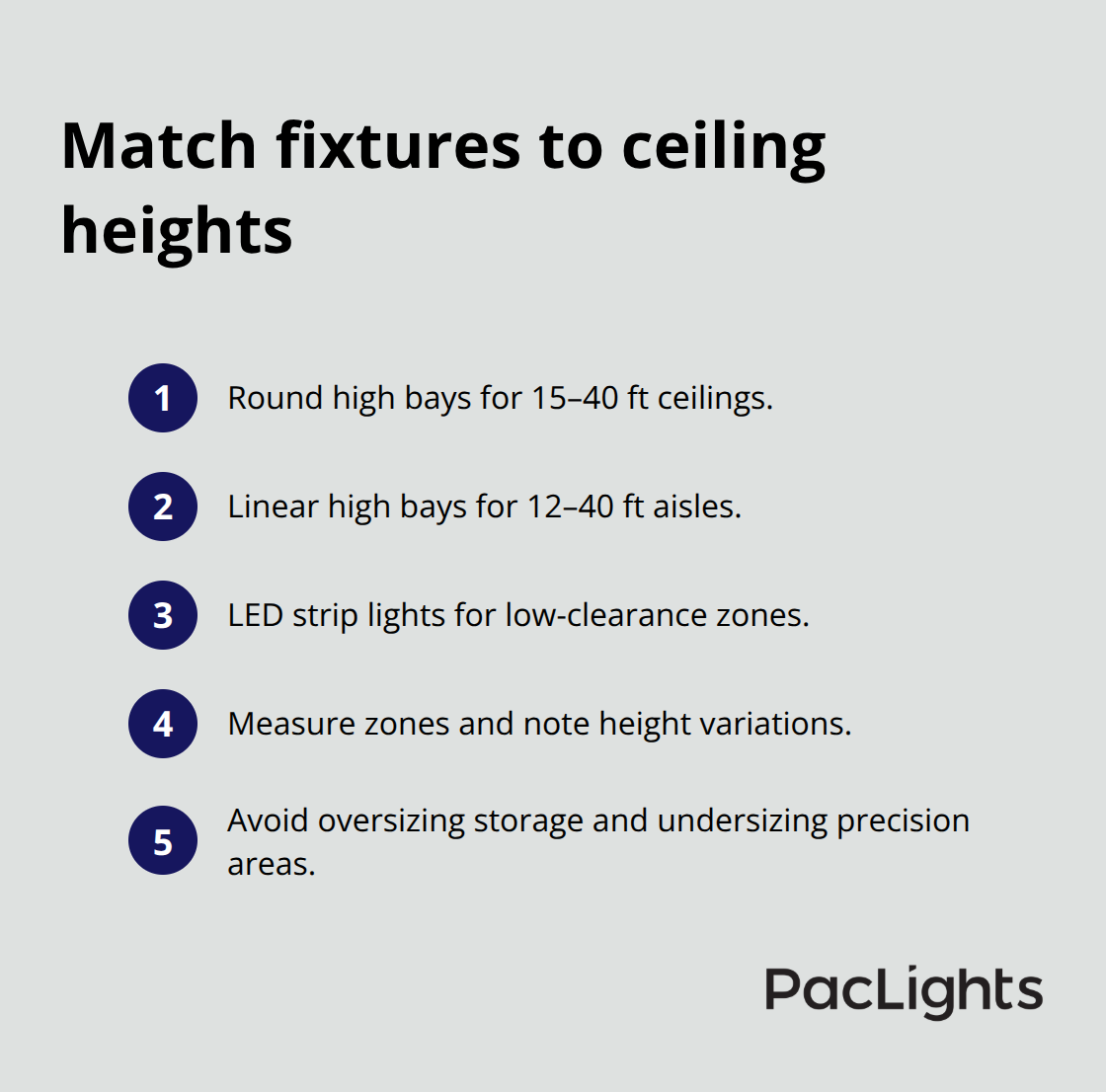
This prevents oversizing fixtures in storage areas or undersizing them where workers need precision.
Different zones require different brightness levels too. High-activity areas like packing stations need crisp, bright illumination for accuracy and safety, while storage zones can operate at lower intensity. Detail work stations need cooler color temperatures above 4000K for clarity, whereas office or break areas perform better with warmer color temperatures around 3000K (which improves comfort). Motion sensors make sense for storage rooms and bathrooms where occupancy is intermittent, but not for production floors where workers need consistent, immediate lighting. Dimming controls work well in areas with variable tasks but waste money in spaces requiring constant brightness.
Match Lighting to Specific Tasks
A loading dock has completely different lighting requirements than a manufacturing floor. Loading docks benefit from wall packs and exterior lighting that improve visibility for safety and navigation. Manufacturing areas with repetitive tasks need consistent, flicker-free illumination. List each functional area separately and note the specific tasks happening there. This prevents you from selecting one-size-fits-all solutions that waste energy in some zones and underperform in others.
Plan for Facility Evolution
Facilities rarely stay static. Warehouse layouts shift, product lines expand, and operational hours change. Modular LED systems with adjustable or upgradeable components protect your investment better than rigid installations. Linear high bays and strip lights adapt to layout changes without complete replacement. A proper assessment considers whether your facility might expand by 20 percent or shift operations to different zones. With these specifics in hand, you’re ready to evaluate the actual features that separate effective industrial LED solutions from mediocre ones.
What Actually Matters When Comparing Industrial LED Fixtures
Energy Efficiency Beyond Lab Numbers
Energy efficiency ratings mean nothing without context. A fixture claiming 150 lumens per watt sounds impressive until you realize that number applies only under ideal lab conditions. What matters is how that fixture performs in your actual environment at full brightness and after 10,000 hours of operation. The Department of Energy reports that LED lighting could save up to 569 TWh annually by 2035 if facilities choose the right products, but this assumes you select fixtures rated for your specific application and ceiling height.
Check for DLC 5.1 Premium certification on any fixture you’re considering. This standard validates energy performance under real-world conditions rather than theoretical ones. A 50,000 square foot facility running high bays 16 hours daily will see dramatic cost differences between certified and uncertified products.
Calculate Your Actual Savings
Pull your current fixture wattage and compare it against LED alternatives. Multiply the difference by your facility’s operating hours and local electricity rates. If you currently spend $25,000 annually on lighting for a 40,000 square foot warehouse, switching to certified LED high bays might reduce that to $7,500, but only if you select fixtures appropriate for your ceiling height and layout. This calculation transforms abstract efficiency claims into dollars you’ll actually save.
Durability That Withstands Real Conditions
Durability in industrial settings means fixtures that withstand temperature swings, moisture, dust, and vibration without performance degradation. Standard LED high bays fail faster in damp environments like food processing facilities or outdoor loading areas. Vapor tight fixtures designed for these conditions last significantly longer and protect your investment.
Lifespan claims mean little without warranty backing them up. Strong warranties reflect genuine confidence in durability rather than marketing hype. When evaluating products, ask suppliers about their warranty terms and what they actually cover.
Control Systems That Match Your Operations
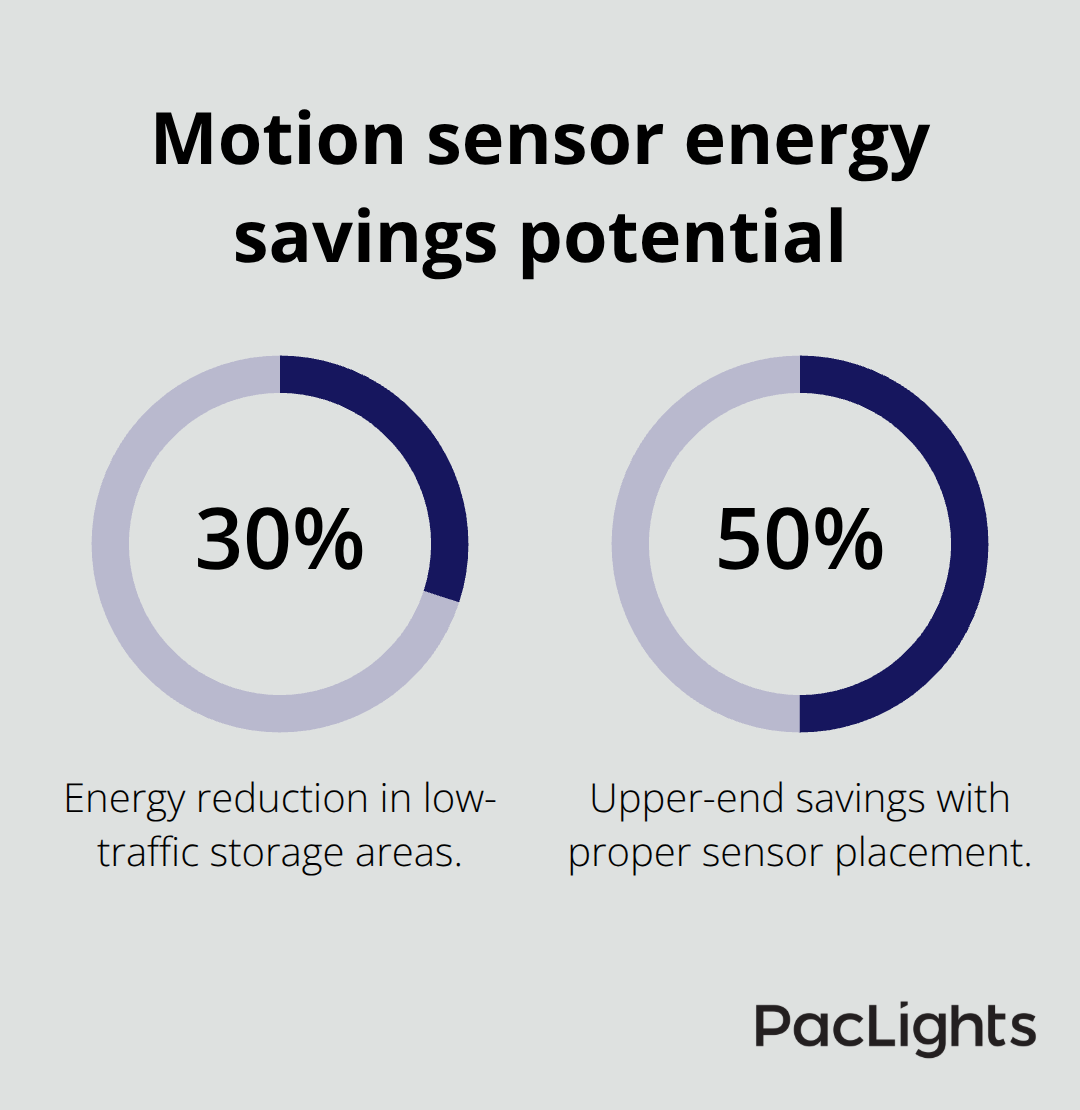
Control systems separate average LED installations from exceptional ones. Motion sensors in storage areas reduce energy consumption by 30 to 50 percent since those spaces don’t need constant illumination. Installing sensors in active production zones wastes money on unnecessary complexity.
Dimming controls work only in spaces with variable task requirements, not in areas needing consistent brightness for safety or accuracy. The best control strategy combines zone-specific dimming with occupancy sensors and optional daylight harvesting in areas with natural light exposure. A warehouse with skylights in one section might reduce those fixture brightness by 40 percent during daylight hours while maintaining full output in interior zones without windows.
These controls require upfront investment but generate measurable energy savings within two to three years for most industrial facilities. With durability and controls locked in, the next step involves calculating whether your investment actually pays off and what support you’ll receive after installation.
Comparing LED Lighting Solutions and ROI
Calculate Payback Period and Return on Investment
ROI calculations separate facilities that make smart lighting decisions from those that overspend on unnecessary features. Start with your baseline annual lighting cost from the previous section. If your 40,000 square foot warehouse currently costs $25,000 yearly for lighting, and LED high bays reduce that to $7,500, you’re looking at $17,500 in annual savings. Subtract your total project cost, including fixtures, installation labor, and controls. A comprehensive retrofit for that facility typically runs $40,000 to $60,000 depending on complexity and fixture selection. At $17,500 annual savings, you hit payback in roughly 2.5 to 3.5 years. After that point, every dollar saved flows directly to your bottom line for the next 15 to 20 years since quality LED fixtures last that long.
Most facilities make the mistake of comparing LED fixture prices alone without factoring in energy savings over the fixture’s lifetime. A $300 LED high bay that lasts 50,000 hours costs far less per year than a $150 HID fixture that lasts 10,000 hours, especially when energy consumption drops by 40 to 60 percent. This isn’t theoretical-it’s the math that determines whether your facility actually benefits from upgrading.
Review Warranty and Maintenance Support
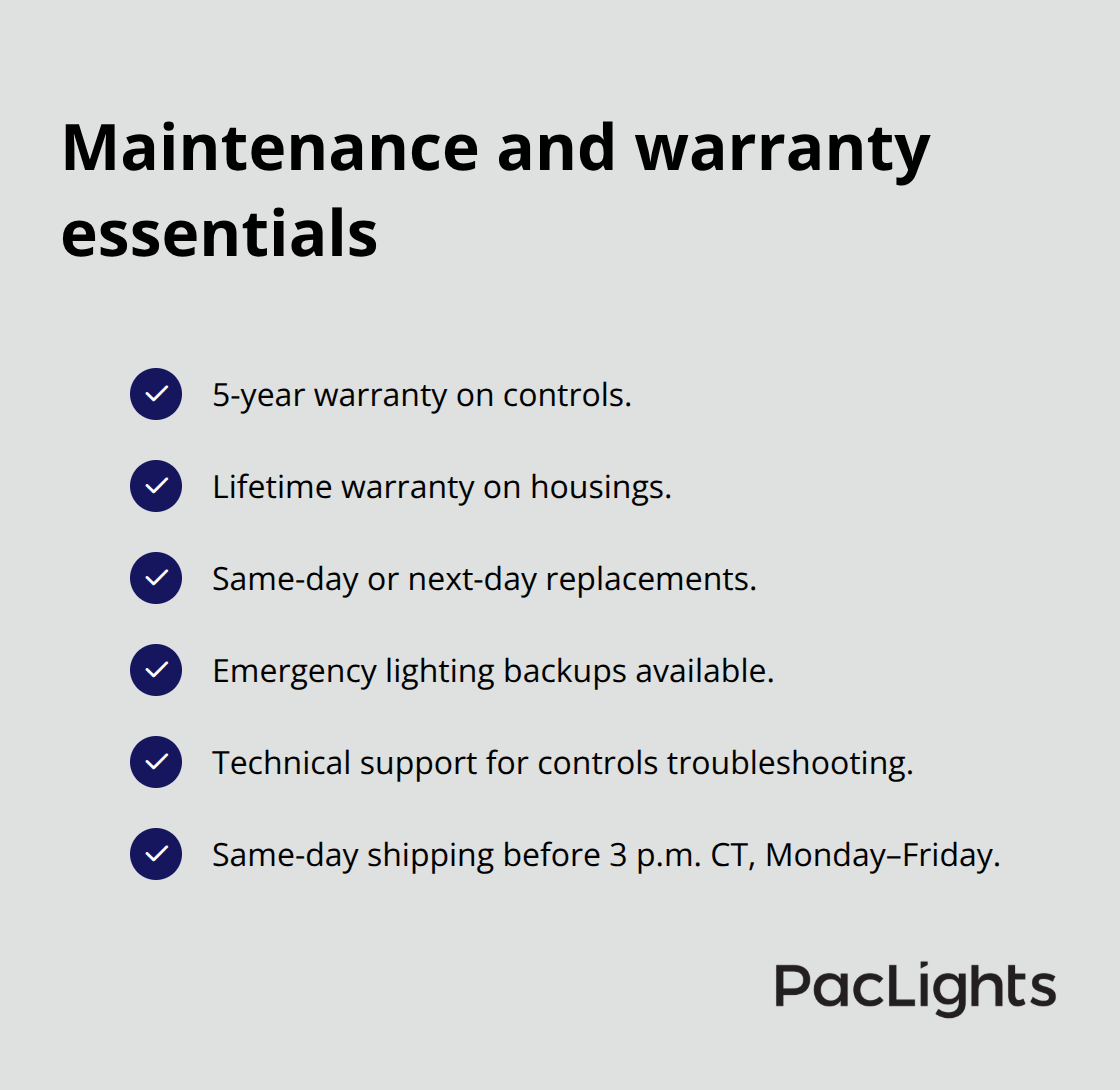
Warranty terms reveal whether a manufacturer stands behind durability claims or cuts corners. A 5-year warranty on controls and a lifetime warranty on fixture housings tells you the company expects those products to perform for decades. Conversely, 1 or 2-year warranties suggest the manufacturer knows failures will occur early. Read warranty terms carefully because many exclude labor costs for replacement, meaning you pay for technician time even though the fixture failed under warranty.
Maintenance support matters equally for industrial facilities. Ask suppliers whether they provide same-day or next-day replacement for critical fixtures, emergency lighting backups during outages, and technical support for troubleshooting control systems. Same-day shipping for orders placed before 3 p.m. CT Monday through Friday minimizes downtime when fixtures fail. Strong maintenance partnerships keep your facility running smoothly rather than waiting days for replacements.
Evaluate Customization and Scalability Options
Scalability determines whether your lighting system adapts as your facility changes. Modular fixtures and networked lighting controls let you expand coverage, adjust brightness zones, and reconfigure layouts without replacing your entire system. A facility planning to add 15,000 square feet of warehouse space needs fixtures that integrate seamlessly with existing installations rather than forcing a complete overhaul. Linear high bays and strip lights offer this flexibility better than rigid installations.
Ask suppliers about upgrade paths for their control systems because technology evolves, and you want systems that accept newer sensors and dimming capabilities without replacing the core fixtures. Customization options matter too-your facility’s unique layout and task requirements demand solutions tailored to your specific needs rather than off-the-shelf products that force compromises. PacLights offers free lighting layout designs and ROI assessments to calculate your specific payback period and scalability options before you commit to anything.
Final Thoughts
Your facility’s lighting performance depends on matching the right fixtures to your actual operational needs, not on selecting the most expensive or feature-rich option available. The analysis you’ve completed through this guide-measuring your energy baseline, mapping your space, identifying task requirements, and calculating ROI-gives you the foundation to make decisions that stick. Industrial LED lighting succeeds when it aligns with how your facility actually operates, not how manufacturers imagine it should operate.
Energy savings compound over years and create real financial impact for your bottom line. A 40,000 square foot warehouse saving $17,500 annually recovers its investment in three years and generates $262,500 in additional savings over the next 15 years as LED fixtures continue performing. Operational performance matters equally because downtime costs far more than any lighting system, and fixtures that fail or controls that malfunction disrupt production and create safety risks.
Contact PacLights to schedule your free lighting assessment and see exactly how much your facility can save with the right industrial LED lighting solution. Our team reviews your space dimensions, current energy costs, and operational requirements to recommend fixtures and controls tailored to your specific needs. You’ll receive exact numbers for your facility rather than relying on industry averages.
Disclaimer: PacLights is not responsible for any actions taken based on the suggestions and information provided in this article, and readers should consult local building and electrical codes for proper guidance.