

A power failure in your data center doesn’t just kill the lights-it puts people at risk. Without proper server room safety lighting, staff navigating dark aisles face trip hazards, equipment damage, and delayed emergency response.
At PacLights, we’ve seen firsthand how the right emergency lighting system transforms a crisis into a manageable situation. This guide covers the solutions and strategies that keep your facility safe when the power goes out.
Why Visibility Matters When Power Fails
Darkness in a server room during a power outage creates immediate danger. NFPA 101 Life Safety Code mandates a minimum of 0.6 foot-candles under emergency power along all egress paths, yet many facilities fall short of this standard. Without adequate illumination, staff cannot safely navigate aisles, identify equipment locations, or reach exits quickly. Trip hazards multiply when visibility drops, and equipment damage risk increases as technicians work without proper sight lines. OSHA data shows that documentation failures account for roughly 60% of emergency lighting violations, suggesting many data centers lack the systems they think they have in place. Delayed response times during outages mean longer downtime, increased financial losses, and potential liability if incidents occur.

Compliance Demands Active Systems
Regulatory requirements demand more than basic lighting. NFPA 101 requires emergency systems to activate within 10 seconds of power loss and sustain illumination for a minimum of 90 minutes. The International Building Code sets 1 foot-candle as the minimum during normal operations, though this can reduce to 0.06 foot-candles after 90 minutes under emergency backup. Monthly functional tests and annual 90-minute duration tests are mandatory, with detailed logs required for audits. OSHA standards 1910.37 and 1910.38 override local codes and apply to all occupied data center areas. Non-compliance carries real costs-regulatory fines average about 15,000 dollars per violation according to OSHA enforcement data. Exit signs must deliver 54 lux on sign faces and remain visible even through smoke. Self-contained LED emergency fixtures with UL 924 compliance reduce testing complexity by roughly 40% compared to centralized inverter systems, making compliance more manageable.
Strategic Placement Prevents Dark Zones
Target 500 lux in active server-room work zones to support cable tracing and maintenance without causing eye strain. The maximum-to-minimum illumination ratio must not exceed 40:1 to prevent shadows that could cause falls during evacuations. Grid-aligned lighting directly above aisles eliminates dark spots between racks-improper mounting above cable trays creates roughly 20% dark zones. In six-foot-wide aisles, space fixtures 8–10 feet apart along the centerline with mounting heights of 8–12 feet to achieve consistent brightness. Quarterly lux measurements verify that 500 lux or more exists in data halls and at least 54 lux on exit signs.
Battery Systems and Redundancy Ensure Reliability
Battery systems should use NiMH technology for 90-minute runtimes, as NiMH tolerates temperature swings and lasts 7–10 years versus 3–5 years for lead-acid alternatives. Redundancy matters-build independent circuits covering different zones so a single circuit failure does not leave the space completely dark. Preventive maintenance reduces emergency failures by roughly 60% and maintains compliance, starting with code research and fixture selection aligned to your specific space and environment. The next section covers how battery-backed LED fixtures and motion-activated systems work together to maintain continuous illumination while reducing unnecessary energy consumption.
Building Reliable Emergency Lighting Systems
LED Fixtures and Battery Systems That Perform
LED-based emergency fixtures deliver the brightness your team needs when power fails, outperforming older technologies by a significant margin. NiMH battery systems sustain 90-minute illumination during outages and last 7–10 years, compared to lead-acid alternatives that fail after 3–5 years. Self-contained LED emergency units integrate battery backup directly into each fixture, reducing testing complexity by roughly 40% compared to centralized inverter systems. This matters because simpler systems encourage your facilities team to maintain them consistently. UL 924 compliance activates automatic self-diagnostics that log test results and battery status without manual intervention. Battery systems notify you roughly 60 days before replacement becomes necessary, preventing surprise failures during critical moments.
Placement and Spacing for Optimal Coverage
Mounting fixtures at 8–12 feet high in six-foot-wide aisles and spacing them 8–10 feet apart along the centerline achieves the 500 lux target needed for cable tracing and maintenance work. Wall-mounted fixtures work best in narrow corridors at 80–84 inches high to avoid obstruction from racks, while ceiling-mounted units provide coverage in cold aisles. IP65-rated fixtures resist condensation and dust buildup common in server environments. Quarterly lux measurements verify that 500 or more lux exists in data halls and at least 54 lux on exit signs, confirming the 40:1 maximum-to-minimum illumination ratio remains intact.

Motion Activation and Energy Efficiency
Motion-activated lighting cuts energy waste dramatically in server rooms that sit vacant most hours. Occupancy sensors reduce lighting runtime from 8,760 hours annually to roughly 2,000 hours in rarely visited zones, delivering substantial efficiency gains. LED emergency fixtures consume about 440 kWh per year compared to 4,380 kWh for fluorescent systems, saving approximately 527 dollars annually at standard utility rates of 12 cents per kilowatt-hour. A three-level lighting strategy aligns with NFPA 101 requirements: Level 1 minimal illumination in vacant areas, Level 2 moderate brightness when staff are present for safe navigation, and Level 3 full brightness during maintenance tasks. Networked lighting controls enable real-time energy monitoring and occupancy-based adjustments across zones.
Testing and System Redundancy
Install test switches in UPS rooms and generator areas for monthly 30-second functional tests and annual 90-minute duration tests without disrupting operations. Redundancy remains non-negotiable-build independent circuits covering different zones so a single circuit failure does not leave the space completely dark. Fire alarm integration prevents conflicts between systems and requires continuous monitoring with alerts when fixtures fail or battery capacity drops below 80 percent. These interconnected safeguards work together to maintain both compliance and operational reliability, setting the stage for understanding how to integrate these systems into your broader facility management strategy.
How to Design Emergency Lighting That Actually Works
Positioning Exit Signs for Maximum Visibility
Exit signs demand precision placement because staff under stress move toward the most visible indication of safety. Position illuminated exit signs at every door leading out of the server room and along all egress paths, mounting them at heights between 80 and 84 inches to remain visible above equipment racks without obstruction. Each sign must deliver 54 lux on its face according to NFPA 101, which means quarterly lux measurements are non-negotiable to verify compliance. Photoluminescent backup on exit signs provides additional visibility when power fails completely, though battery-backed LED signs remain superior because they deliver consistent brightness regardless of ambient light conditions.
Testing Without Disrupting Operations
Install test switches directly in your UPS room and generator areas so your facilities team can run monthly 30-second functional tests and annual 90-minute duration tests without disrupting normal operations. Documentation matters more than most people realize-OSHA data shows that roughly 60 percent of emergency lighting violations stem from documentation failures rather than actual system problems.
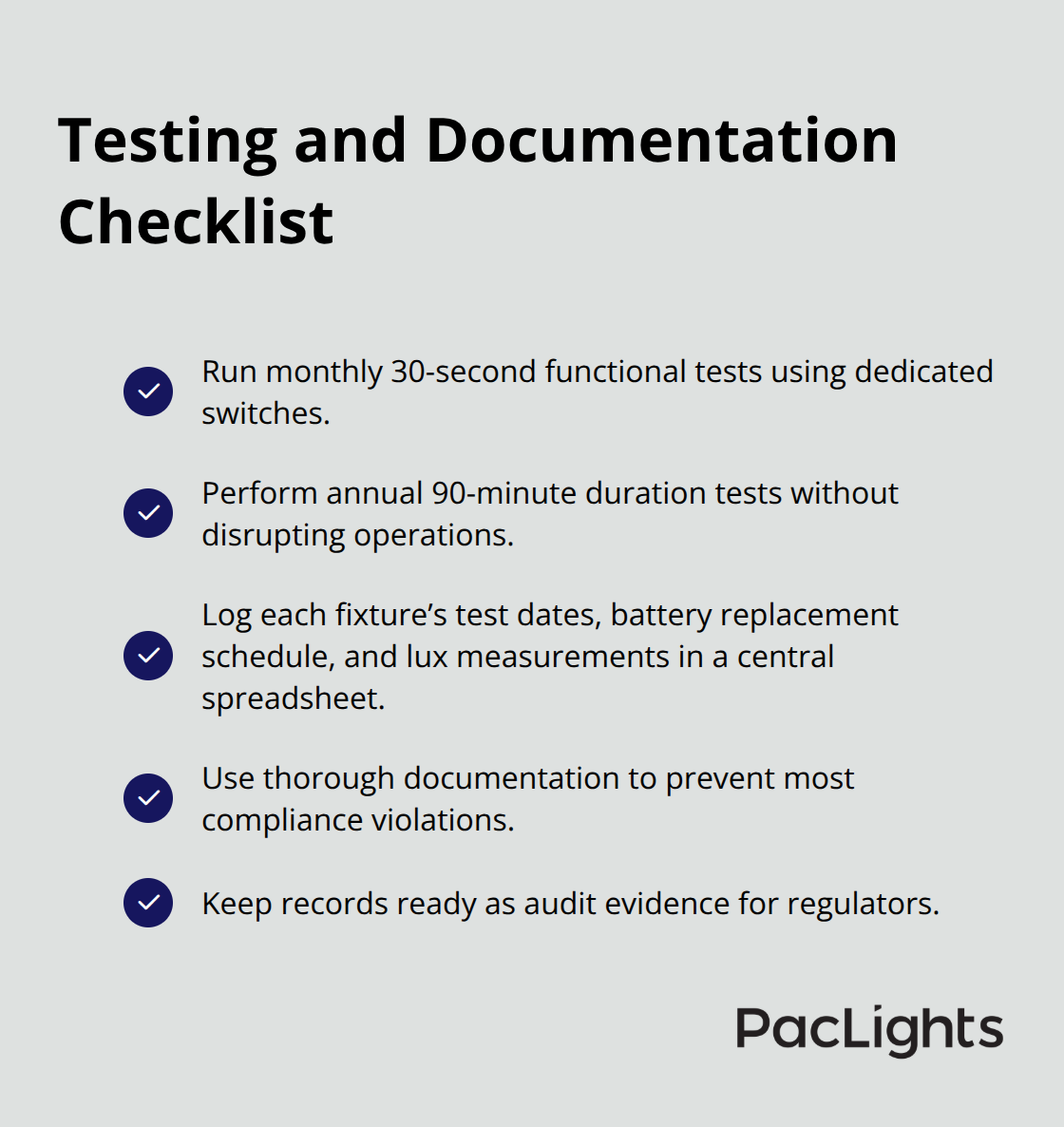
Create a spreadsheet tracking each fixture, its last test date, battery replacement schedule, and lux measurements. This single practice prevents the majority of compliance violations and gives you concrete evidence during regulatory audits.
Building Circuit Redundancy Into Your Design
Redundancy in your lighting circuits separates adequate systems from genuinely reliable ones. Build at least two independent circuits that cover different zones so a single circuit failure never leaves your server room completely dark-this approach is not optional if you value safety and uptime. Fire alarm integration prevents conflicts between your emergency lighting and other safety systems, requiring continuous monitoring with automatic alerts when any fixture fails or battery capacity drops below 80 percent. Test your redundant circuits quarterly by cutting power to one circuit at a time and confirming that the other circuit maintains full illumination across all critical zones.
Selecting Fixtures for Long-Term Reliability
Preventive maintenance reduces emergency failures by roughly 60 percent, starting with selecting fixtures designed for your specific environment. IP65-rated fixtures resist the condensation and dust buildup common in server rooms, extending service life and reducing unexpected downtime. NiMH battery systems last 7 to 10 years compared to 3 to 5 years for lead-acid alternatives, and they tolerate temperature swings that fluctuate in data centers. Schedule battery replacement roughly 60 days before capacity becomes critical-most modern UL 924 compliant systems alert you automatically when this window approaches.
Final Thoughts
Server room safety lighting directly determines whether your facility responds to power failures with confidence or chaos. Battery-backed LED fixtures sustain 90 minutes of illumination during outages, redundant circuits prevent total darkness from a single failure, and quarterly lux measurements catch problems before they become emergencies. The financial case strengthens this argument-LED fixtures consume roughly 440 kWh annually compared to 4,380 kWh for fluorescent systems, saving approximately 527 dollars per year, with payback periods of 2 to 4 years before energy savings accumulate as ongoing profit.
Start by conducting a risk assessment of your server room layout to identify high-traffic areas, critical pathways, and equipment zones that must remain illuminated during outages. Position fixtures to eliminate dark spots between racks while maintaining the 40:1 maximum-to-minimum illumination ratio that prevents falls, install exit signs at every egress point to verify they deliver 54 lux on their faces, and build redundancy into your circuits to integrate fire alarm systems and prevent conflicts. Motion-activated controls reduce runtime in rarely visited zones from 8,760 hours to roughly 2,000 hours annually, multiplying your energy savings and strengthening your operational resilience.
We at PacLights understand that server room safety lighting demands precision and reliability in data center environments. Our energy-efficient LED fixtures and advanced lighting controls are tailored to your specific needs, and we offer free lighting layout designs and ROI assessments to help you plan your strategy and identify opportunities for improvement.
Disclaimer: PacLights is not responsible for any actions taken based on the suggestions and information provided in this article, and readers should consult local building and electrical codes for proper guidance.