

Datacenters face real security threats. Unauthorized access, theft, and equipment damage cost organizations millions annually. Security lighting is often overlooked, yet it’s one of the most effective deterrents available.
At PacLights, we’ve seen firsthand how proper lighting design transforms datacenter security. The right illumination strategy protects assets, supports surveillance systems, and keeps your team safe.
Why Lighting Matters More Than You Think for Datacenter Security
Criminals target datacenters because the payoff is enormous. A single breach exposes millions of customer records or halts critical operations entirely. Yet many facilities treat lighting as an afterthought, installing whatever fixtures cost the least rather than what actually stops threats. This is a fundamental mistake. High-performance lighting doesn’t just improve visibility-it fundamentally changes how attackers perceive risk. When a datacenter’s perimeter shines brightly, potential intruders move to easier targets. Well-lit facilities experience significantly fewer intrusion attempts than poorly lit ones, making lighting one of your most cost-effective security investments.
Lighting Transforms Camera Performance
Your surveillance cameras perform only as well as the light they receive. Standard visible-light cameras struggle dramatically in low-light conditions, producing grainy footage that makes threat identification nearly impossible. High-performance LED lighting changes this equation entirely. With proper illumination, cameras capture clear facial features, license plates, and equipment details at distances that would otherwise yield nothing useful. Hybrid lighting systems combine white-light and infrared capabilities to give you flexibility-infrared for discreet monitoring when you need covert surveillance, and instant high-intensity white-light when motion sensors detect a potential threat. This adaptive approach means you gain both security and discretion. The lighting switches automatically based on real-time triggers from your video management system, eliminating manual intervention and supporting rapid response during incidents.
Personnel Safety and Operational Clarity
Datacenter staff navigating racks, cables, and equipment in poorly lit spaces face genuine safety risks. Falls, equipment damage, and security vulnerabilities multiply when visibility is inadequate. Proper aisle lighting positioned at 8–10 foot intervals along centerlines, mounted at heights of 8–12 feet, delivers approximately 500 lux of illumination across equipment faces. This brightness level isn’t arbitrary-it reflects decades of industrial safety standards that recognize what human eyes need to work safely and accurately. LED technology delivers this brightness while generating significantly less heat than older lighting, which directly reduces your cooling costs. A 10% reduction in lighting heat cuts cooling energy use by roughly 2–3%, turning your security lighting into an efficiency multiplier. Quality, flicker-free LED fixtures with professional drivers minimize eye strain for operators monitoring systems over extended shifts, improving their alertness and reducing errors during critical security assessments.
Energy Efficiency as a Security Advantage
LED technology reduces energy consumption by up to 90% compared with incandescent lighting, according to Energy.gov. This efficiency matters beyond your utility bill. Lower heat output from LED fixtures means your cooling systems work less hard, which improves overall facility reliability. When lighting consumes less power, you reduce strain on electrical infrastructure and lower the risk of outages that could compromise security monitoring. Energy-efficient lighting also supports compliance with sustainability standards that many organizations now require. The combination of robust security performance and operational efficiency makes modern LED lighting a strategic investment rather than a cost center.
Designing for Real-World Performance
Effective datacenter lighting requires more than selecting bright fixtures. Placement, beam control, and integration with your existing systems determine whether lighting actually protects your assets or simply wastes energy. Grid-aligned fixture placement above aisles eliminates shadows and ensures uniform visibility across equipment faces.

Spacing fixtures at consistent intervals prevents dark zones where threats could hide. Your lighting layout should also account for cable trays and maintenance access-fixtures that obstruct sight lines or impede operations create security blind spots rather than eliminating them. PacLights offers free lighting layout designs and ROI assessments that help you understand exactly how different configurations would perform in your specific facility, turning lighting design from guesswork into data-driven planning.
The foundation of effective datacenter security lighting is now clear. What remains is understanding how to implement these principles within industry standards and compliance frameworks that govern modern facilities.
Lighting Design Standards for Datacenter Security
Industry Standards Shape Your Security Foundation
Datacenter lighting operates within established compliance frameworks that directly impact your security posture and operational reliability. NFPA 101 mandates emergency lighting with illuminated exit paths, requiring battery-backed LED fixtures to function during power outages when security monitoring matters most. This isn’t optional compliance theater-it’s a foundation for keeping your facility operational during the exact moments when threats exploit disruptions. ISO/IEC 27001, the international standard for information security management systems, encompasses physical security controls that lighting directly supports. When auditors evaluate your security framework, they assess whether your lighting design prevents unauthorized access and supports surveillance capabilities. Meeting these standards requires intentional fixture placement, not afterthought installations. Your lighting layout must eliminate shadows where intruders could hide, maintain consistent illumination across all perimeter zones, and integrate seamlessly with access control systems so security staff verify identities and monitor movements in real time.
Three-Level Lighting Strategy for Operational Efficiency
Datacenter interiors demand three distinct lighting levels depending on operational needs. Level 1 provides minimal visible light in vacant areas, relying on infrared cameras for monitoring without wasting energy on spaces without personnel. Level 2 activates moderate illumination when staff are present to support safe navigation and security awareness.
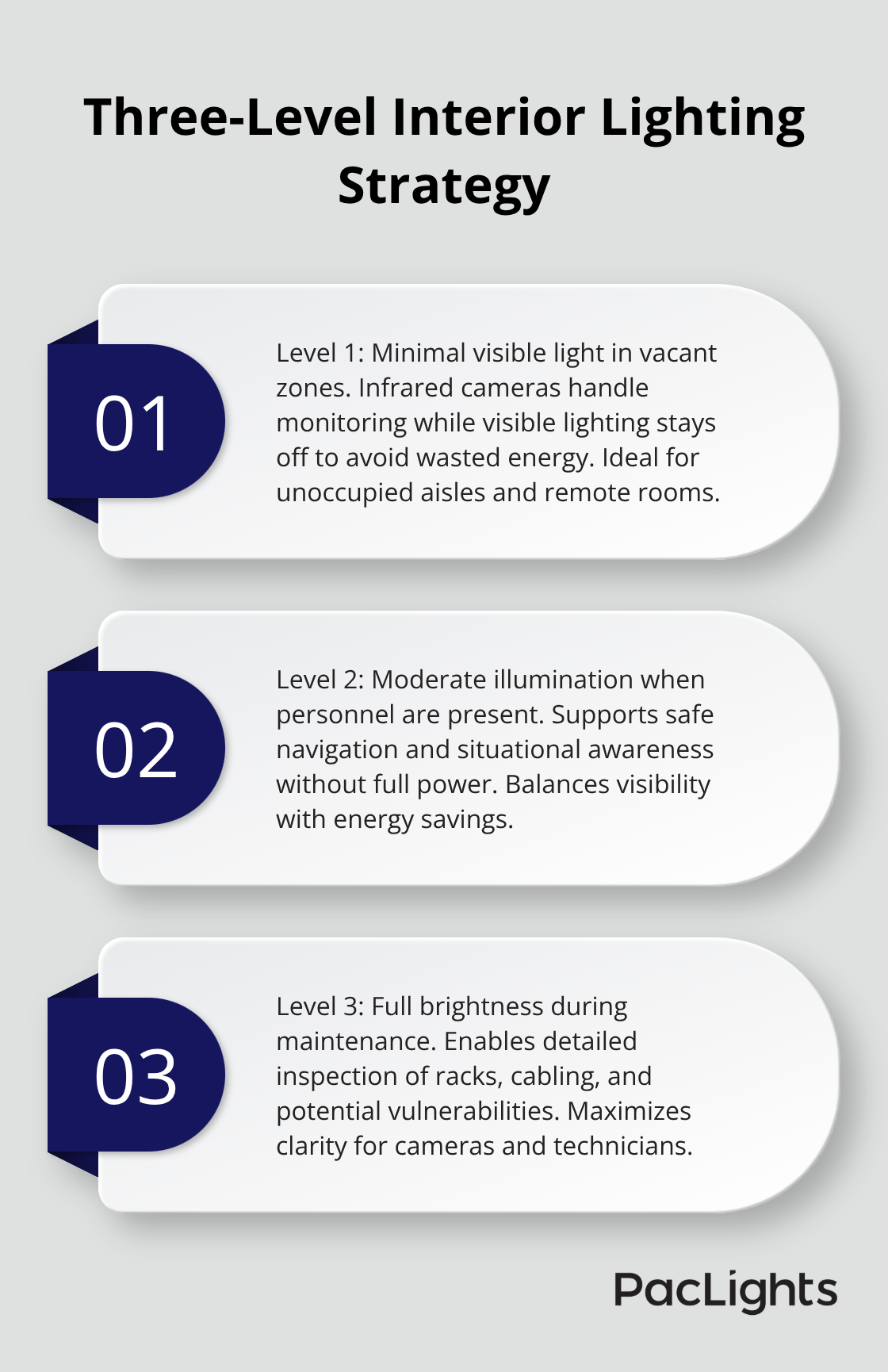
Level 3 delivers full brightness during maintenance procedures to enable detailed inspection of racks, cables, and potential vulnerabilities. This tiered approach, combined with motion sensing and scheduling, yields substantial energy savings-occupancy sensors reduce lighting runtime in rarely visited zones from 8,760 hours annually to approximately 2,000 hours. Cooler color temperatures in the 4000K–5000K range improve operator focus and reduce errors during critical security assessments. Flicker-free LED fixtures with quality drivers minimize eye strain and prevent interference with camera monitoring systems that might otherwise misinterpret electrical noise as motion events.
Precision Placement and Integration
Grid-aligned fixture placement above aisles at 8–10 foot intervals, mounted 8–12 feet high, delivers roughly 500 lux uniformly across equipment faces-a brightness level grounded in decades of industrial safety data, not guesswork. Integration with your video management system transforms lighting from static infrastructure into an active security layer. Hybrid systems automatically switch between infrared for covert surveillance and high-intensity white-light when motion sensors detect threats, supporting rapid response without manual intervention. This adaptive capability means your lighting responds to real-time security events rather than operating on fixed schedules. Redundant electrical circuits with at least two independent power paths keep critical areas illuminated during outages or maintenance work, ensuring no security gaps when infrastructure shifts.
Moving From Standards to Implementation
Standards establish what your datacenter lighting must accomplish, but translating those requirements into actual hardware and control systems presents real challenges. The gap between compliance documentation and on-site performance determines whether your investment truly protects assets or simply satisfies auditors. Understanding how to select fixtures, position them correctly, and connect them to your existing security infrastructure requires technical expertise that most facilities lack internally. The next section examines the advanced lighting technologies that actually close this gap-the specific tools and systems that transform standards into measurable security outcomes.
Advanced Lighting Technologies for Datacenter Protection
Motion Sensors and Occupancy Detection Transform Static Infrastructure
Motion sensors and occupancy detection shift lighting from static infrastructure to responsive security systems. Rather than illuminating spaces continuously, intelligent controls activate illumination only when personnel or movement triggers detection, reducing annual lighting runtime in rarely visited zones from 8,760 hours to roughly 2,000 hours.

This 77% reduction directly translates to measurable energy savings and lower operational costs. Industrial deployments show lighting energy consumption reductions of approximately 25-40% after intelligent lighting controls are implemented, with the most dramatic gains occurring in spaces with unpredictable occupancy patterns. Networked lighting systems provide real-time visibility into when and where lights operate, enabling data-driven optimization rather than guesswork about facility usage.
Your controls should integrate directly with your video management system so that motion detection triggers not just illumination but also camera recording and alert protocols. This integration eliminates the delay between threat detection and response, which matters critically during security incidents. Occupancy sensors positioned strategically throughout your datacenter identify genuine personnel movement versus equipment vibration or airflow, preventing false activations that waste energy or desensitize security staff to alerts.
LED Efficiency Multiplies When Combined With Smart Controls
LED fixtures paired with intelligent controls deliver the reliability that datacenters demand without the heat generation that strains cooling systems. LED technology reduces energy consumption by up to 90% compared with incandescent lighting according to Energy.gov, and this efficiency multiplies when combined with motion sensing and scheduling. A 10% reduction in lighting heat cuts cooling energy use by approximately 2-3%, meaning your security investment directly improves facility efficiency metrics. Networked LED systems support remote diagnostics and performance monitoring, allowing your team to identify failing fixtures before they create security blind spots.
The VARIO2 modular platform exemplifies this approach, offering customizable lens optics and power outputs with IP/PoE capability for remote access and integration with your existing management infrastructure. Advanced controls help track energy use and identify high-usage zones, guiding security-focused optimization of fixture placement and operation.
Phased Deployment Reduces Risk and Enables Refinement
Rather than replacing your entire lighting system at once, phased deployments reduce risk and allow iterative refinement as you learn which configurations perform best in your specific facility. This approach lets you test control strategies in lower-risk zones before expanding to critical perimeter areas. Your team gains practical experience with the new systems, identifies integration challenges early, and adjusts placement or sensor sensitivity based on real operational data. Phased implementation also spreads capital expenditure across multiple budget cycles, making security lighting upgrades more financially manageable for most organizations.
Data-Driven Planning Replaces Guesswork
Free lighting layout designs and ROI assessments quantify potential energy and security savings before you commit to hardware, transforming lighting upgrades from capital guesses into informed investments backed on facility-specific data. These assessments identify which zones consume the most energy, where occupancy patterns create opportunities for sensor-based controls, and how fixture placement affects both security coverage and operational efficiency. Understanding your baseline performance establishes realistic expectations for what intelligent controls can accomplish in your environment, preventing disappointment from unrealistic projections.
Final Thoughts
Security lighting integration transforms datacenter protection from reactive response to proactive deterrence. Well-lit facilities experience significantly fewer intrusion attempts than poorly lit ones, and this advantage compounds when lighting systems integrate with surveillance, access control, and occupancy management. Your security lighting strategy should prioritize three outcomes: eliminating shadows where threats hide, supporting camera performance in all conditions, and reducing operational costs through intelligent controls that illuminate only when needed.
The trajectory of datacenter lighting points toward deeper integration with facility management systems. Organizations increasingly connect lighting with HVAC, security monitoring, and energy management platforms to achieve holistic optimization rather than treating each system independently. This convergence enables predictive maintenance through continuous monitoring, identifies energy waste patterns that manual inspection misses, and supports compliance with evolving security standards like NFPA 101 or ISO/IEC 27001.
Starting your security lighting upgrade requires honest assessment of your current situation. Identify which zones create security blind spots, measure how much energy your existing fixtures consume, and understand where your facility fails to meet industry standards. We at PacLights help organizations move from assessment to implementation through free lighting layout designs and ROI assessments that quantify potential security and energy savings before you commit capital, so contact us to discuss how security lighting can strengthen your facility’s protection while reducing costs.
Disclaimer: PacLights is not responsible for any actions taken based on the suggestions and information provided in this article, and readers should consult local building and electrical codes for proper guidance.